Introduction
You are probably not searching for wholesale EV charging stations because you need another explanation of what an EV charger is. You need to avoid buying the wrong product mix: 22 kW wallboxes that local vehicles or buildings cannot fully use, DC chargers that customer sites cannot power, or public chargers that reach the destination market without the required connector, payment workflow or documentation.
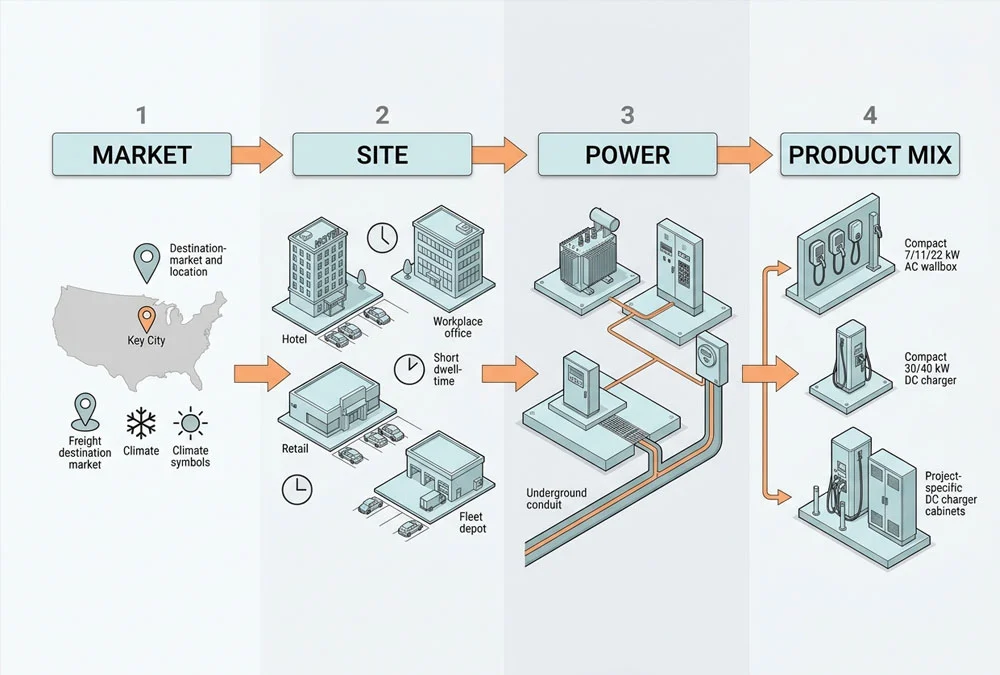
A useful wholesale recommendation should begin with five inputs: destination country, city or region, end-customer site, vehicle dwell time and available electrical capacity. It should then confirm who can access the charger, how drivers pay or authenticate, and whether a charging management backend is required. This guide turns those inputs into a practical AC/DC shortlist for distributors, EPCs and commercial charging buyers serving Europe first, followed by the United States and other markets.
Short answer: start with the customer’s charging task, not the highest charger rating. Long parking normally points to managed AC charging; short turnaround may justify DC charging. The final power, connector and quantity must still be checked against the vehicles, site supply and local requirements.
For an initial product match, you do not need to disclose a private street address. Country, city/region, site type, parking duration and basic electrical information are enough. The exact address becomes important before the final quotation, installation plan and freight calculation.
Find a Starting EV Charger Configuration in 60 Seconds
The table below is a screening tool, not a final electrical design. It helps a wholesaler or EPC avoid two common mistakes: recommending DC simply because it is faster, or recommending the same AC rating to every market.
| Customer site | Useful starting point | Why it often fits | Do not recommend it blindly when… | Confirm before quoting |
|---|---|---|---|---|
| Home and apartment installer channel | 7 kW single-phase or 11 kW three-phase AC; 22 kW as a verified option | Vehicles usually remain parked overnight. | The building, vehicle or local installation does not support the advertised power. | Country supply, connector, cable/socket, load management and vehicle acceptance. |
| Hotel and workplace | Managed 7, 11 or 22 kW AC; optional 30/40 kW DC for short-stay or priority service | Several hours of dwell time allow power to be shared. | Guest turnover is short, connector occupancy is unmanaged or the site lacks spare capacity. | Parking duration, bay count, guest/staff rules, simultaneous demand and payment method. |
| Retail, mall or dealership | 11/22 kW AC for longer stays plus 30/40 kW DC where faster turnover creates value | A mixed portfolio serves both parked vehicles and time-sensitive users. | The visit is too short for AC to deliver useful energy, or DC utilization will not justify its site cost. | Typical visit time, vehicle mix, access/payment, power tariff and business objective. |
| Fleet or depot | Managed AC for overnight vehicles; project-specific DC when turnaround is short | The choice follows route energy and departure deadlines, not vehicle count alone. | Duty cycles, missed-charge risk and simultaneous departures have not been modelled. | Daily kWh per vehicle, return/departure windows, redundancy and site power. |
| Public charging or highway site | Project-specific DC portfolio after a vehicle and grid study | Drivers expect useful energy during a short stop. | The grid connection, current/voltage envelope, payment or service plan is unknown. | Traffic and vehicle mix, target session, utility capacity, connectors, payment and uptime plan. |
What this table prevents: a 22 kW AC charger does not force a car to accept 22 kW, and a high-power DC cabinet does not guarantee that every vehicle receives the cabinet rating. Vehicle acceptance, output current, voltage, power sharing, temperature and site limits all affect real delivery.
Why Country, City and Project Address Change the Recommendation
Country defines the market configuration
The destination country affects electrical supply, connector format, required documentation, labels and manuals, language, communications, payment expectations and the commercial role of the importer. A European distributor may need Type 2 AC and CCS2 DC configurations, while a US project can require a different connector and conformity route. “Europe version” or “US version” is not a complete order code; the exact hardware, software and document set must be named.
City or region reveals climate, grid and logistics conditions
City or regional information can flag coastal corrosion exposure, temperature range, altitude, local network conditions, installation practices and delivery access. It also helps separate a mild urban hotel project from a high-altitude fleet depot or an exposed coastal car park. These factors do not automatically select a charger, but they tell the supplier which limits and options must be checked.
The exact address matters before final design and delivery
An exact street address is normally unnecessary for an early wholesale shortlist. Before an EPC or end customer commits, however, the actual site should be checked for incoming supply, transformer and switchboard capacity, cable route, parking layout, accessibility, drainage, impact protection, cellular coverage, civil works, utility rules and freight unloading. A catalogue recommendation cannot replace this site review.
Send these details for a useful first recommendation:
- Country and city/region; exact address can follow later.
- Customer type: home installer, apartment, hotel, workplace, retail, dealership, fleet or public site.
- Number of parking bays and expected active charging vehicles.
- Typical arrival, departure and parking duration.
- Known vehicle models or at least passenger car, van, bus or truck.
- Available supply, phase, voltage and provisional EV charging capacity.
- Private, RFID, app, card, QR or other payment/access requirement.
- Initial quantity, future rollout and required delivery destination.
Which Wholesale EV Charger Fits Each Customer Type?
European home, apartment and workplace channels
For a distributor serving overnight and workday parking, a compact AC portfolio is often easier to sell and support than stocking every possible variant. AnengJi’s published AC wallbox family includes 7 kW single-phase, 11 kW three-phase and 22 kW three-phase configurations. Use the 7/11/22 kW range as a shortlist, then confirm whether the local customer actually has the matching supply and whether the vehicle can use it. Review the published AC wallbox options rather than treating the highest rating as the default.
The sale is often lost after installation rather than during product selection: an apartment has too little spare capacity, a workplace has eight connectors but no fair sharing rule, or a 22 kW wallbox repeatedly delivers less because the car accepts less AC power. A better wholesale offer combines the hardware with load-management compatibility, a commissioning checklist and a simple explanation of vehicle-side limits.
Hotels, retail sites and dealerships
These sites rarely need one universal power level. A hotel may use managed AC for overnight guests and a compact DC unit for a guest who needs a meaningful top-up before departure. A dealership may keep inventory on AC while using DC for service turnaround or test-drive preparation. A retail property may combine AC for employees and longer visits with DC for time-sensitive customers.
AnengJi publishes a 30/40 kW DC charger option that can be considered where medium-power DC matches the dwell time and available supply. Its suitability still depends on connector configuration, vehicle voltage/current needs, installation, access/payment and the destination-market evidence for the exact ordered model.
Fleet, depot and public charging projects
A fleet buyer should specify energy and deadlines: how many kWh each vehicle needs before its next departure, how long it is available and what happens if one charger is unavailable. A public charging project should specify the target vehicle mix, session duration, output current/voltage needs, connector allocation and payment flow. Only then should the EPC shortlist a higher-power DC configuration from the commercial DC charger range.
A detail experienced operators learn quickly: connector occupation and energy delivery are not the same thing. Adding more cabinet power will not solve a bay that remains blocked after charging, and adding more connectors will not solve insufficient site capacity. The design must separately check energy, power and parking access.
Use Site Data to Recommend Charger Power and Quantity
A practical first calculation is:
Required effective charging power ≈ required energy ÷ usable charging time
This is a screening calculation, not a circuit or grid design. “Usable charging time” is the realistic active window before departure, not simply the time a cable remains connected. The result must be adjusted for conversion losses, vehicle acceptance, power sharing, load management, temperature and an operational margin.
Illustrative hotel and workplace example
Assume a site expects six vehicles to need 18 kWh each during an eight-hour stay. The idealized energy requirement is 108 kWh, or 13.5 kW averaged across the full window. That does not mean one 13.5 kW charger solves the project. The buyer must still check how many cars arrive together, how long each connector is occupied, whether vehicles can be moved, losses, the available EV charging allocation and the minimum energy needed by each departure time.
For a long-dwell site, several managed AC connectors may provide better access than one fast charger. For a site with short, unpredictable visits, an AC-only design may leave drivers with too little energy. The correct recommendation comes from the operating pattern, not from the arithmetic alone.
Build a Sellable Wholesale Portfolio, Not a Catalogue of Everything
| Portfolio layer | Role | Possible starting range | Keep under control |
|---|---|---|---|
| Core volume | Repeat installer and distributor sales | A limited group of 7/11/22 kW AC variants selected for the destination market | Connector, cable/socket, language, access, communications and packaging. |
| Commercial upgrade | Hotels, workplaces, retail and dealerships | Managed AC plus selected 30/40 kW DC where the charging task supports it | Load management, access/payment, backend, pedestal and support scope. |
| Project-only | Fleet, depot and public infrastructure tenders | DC configuration selected after vehicle, current/voltage, grid and duty-cycle review | Power allocation, thermal limits, redundancy, payment, OCPP and acceptance tests. |
Create a country-specific SKU card for every sellable variant. It should identify connector, input, rated output, cable/socket, meter, RFID/payment hardware, modem, firmware branch, language, backend settings, labels, manuals, documents and packaging. This prevents a familiar wholesale problem: the sample works, but the repeat order arrives with a different internal or software configuration under the same marketing name.
Three Example Wholesale Recommendation Briefs
1. European distributor serving homes and small workplaces
Starting mix: a small 7/11 kW AC range, with 22 kW offered only where the site and vehicle case supports it. Key questions: single- or three-phase supply, cable versus socket, access method, dynamic load management, local language and importer documentation. Avoid: stocking many cosmetic variants before the main electrical and connector combinations have proven demand.
2. EPC quoting a hotel, mall or dealership
Starting mix: managed AC for long-stay bays, with a 30/40 kW DC option assessed for short-stay or priority users. Key questions: visit duration, number of simultaneous vehicles, available charging capacity, guest versus staff access, payment, parking enforcement and who handles first-line support. Avoid: selecting DC before checking whether the operating value justifies the extra grid, civil and service scope.
3. Fleet or public-charging project buyer
Starting mix: no fixed rating until route/session energy, available time, vehicle acceptance and site capacity are known. Key questions: output voltage/current, connector power allocation, redundancy, backend transactions, payment, remote recovery, spares and acceptance criteria. Avoid: comparing DC offers only by cabinet kW or buying one configuration for every site in a rollout.
How to Compare Wholesale EV Charging Station Quotes
Ask every supplier to complete the same schedule. Record the exact order code, input and output limits, connector and cable, simultaneous power allocation, meter, access/payment, communications, CSMS, mounting accessories, documents, commissioning, warranty and spare parts. A blank field is unresolved; it should not be assumed to be included.
Landed deployable cost = charger + configuration + testing + packaging + freight/import + local works + software + commissioning + support reserve
The ICC’s Incoterms® 2020 overview explains how the rules allocate delivery obligations, costs and risk between seller and buyer. They do not define firmware access, backend fees, acceptance, warranty labor or spare-part responsibility. Put those technical and service boundaries in the purchase contract separately.
Verify Compliance, OCPP and Support for the Exact Ordered Model
For Europe, the European Commission states that CE marking requires the manufacturer to complete the applicable conformity assessment, technical documentation and EU Declaration of Conformity. It also describes responsibilities for manufacturers, importers and distributors. Check the exact model and legal entity—not only a logo in a brochure—using the Commission’s CE marking guidance and product compliance responsibilities.
For US projects, confirm the finished product, applicable standard and listing record rather than relying on statements about certified components. OSHA explains the role and scope of Nationally Recognized Testing Laboratories in its NRTL FAQ. Local code, utility and programme requirements still need project-specific review.
“OCPP supported” is also incomplete. Confirm the version and product/software scope, verify any claimed certificate through the Open Charge Alliance certificate process, and test the production configuration on the intended CSMS. Boot, authorization, session start/stop, meter values, remote commands, offline behavior, diagnostics and recovery are more useful than a checkbox. The commercial OCPP guide provides a deeper procurement checklist.
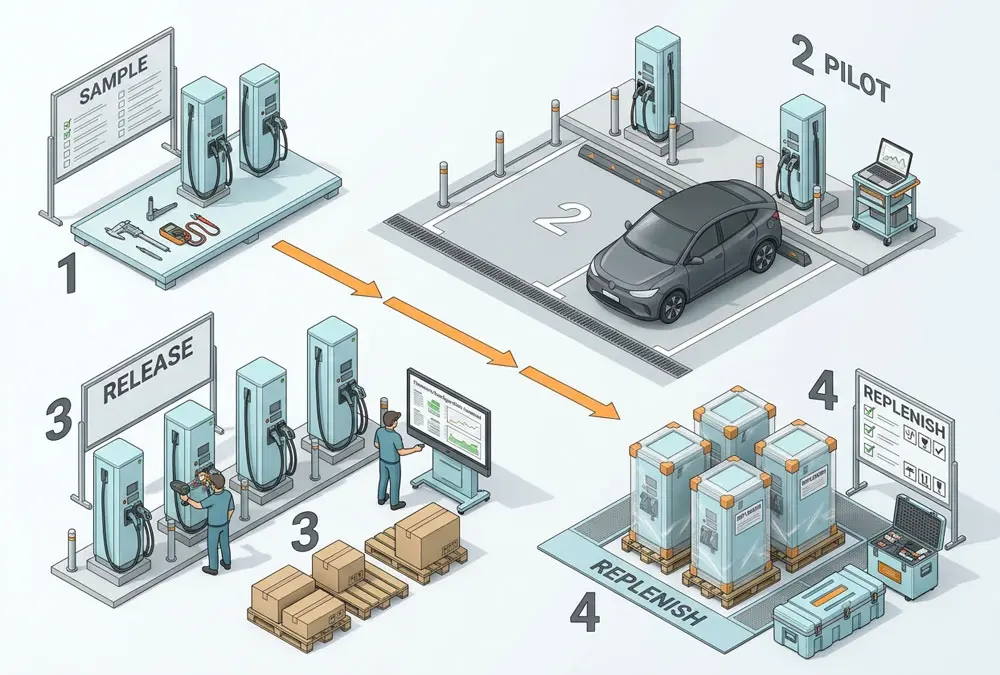
Approve the Sample, Pilot, Bulk Release and Repeat Order
1. Sample
Confirm model, connector, labels, access, interface, documents and basic operation.
2. Pilot
Test target vehicles, CSMS, network, language, payment/access and actual site workflow.
3. Bulk release
Freeze order code, controlled components, firmware, settings, labels, manuals and acceptance tests.
4. Replenishment
Record serials and versions; require notice and revalidation for relevant changes.
Do not approve only a visually correct “golden sample.” A later batch can keep the same enclosure and model name while changing a meter, modem, control board, connector supplier or firmware branch. Define which changes need notice and which tests must be repeated. Also assign first-line support, engineering escalation, log access, firmware recovery, field-replaceable parts, warranty freight and out-of-warranty support before the order ships.
How AnengJi Can Shortlist Wholesale EV Charging Stations
AnengJi publishes AC and DC charging options for different commercial applications. A buyer can begin with the AC charger range, the DC charger range or the complete product directory. The correct next step is not to request the cheapest unit. It is to send the market and site brief above so the product, configuration and evidence can be matched to the intended sale or project.
Need help choosing the product mix?
Send your country, city/region, customer site, parking time, vehicle type, available power and estimated quantity. AnengJi can use that information to prepare an initial AC/DC shortlist for further technical verification.
Wholesale EV Charging Stations FAQ
Do I need the exact project address to get an EV charger recommendation?
Not for the first shortlist. Country, city/region, site type, parking duration, vehicles and basic electrical data are normally enough. The exact address is needed later to verify the actual supply, cable route, environment, permitting, communications, civil works and delivery.
Should a distributor stock 7 kW, 11 kW or 22 kW AC chargers?
Choose the smallest group that matches local supply, vehicle acceptance and customer demand. In European channels, 7 kW single-phase and 11 kW three-phase can cover many use cases, while 22 kW should be stocked where suitable buildings and vehicles create real demand. Validate this with local sales and installer feedback rather than treating it as a universal rule.
When should a commercial customer choose AC instead of DC charging?
AC is usually a stronger starting point when vehicles remain for several hours and power can be shared. DC becomes more relevant when the user must receive meaningful energy during a short stop. The final decision also depends on vehicle acceptance, site power, utilization and total installed cost.
Can one wholesale EV charger model be sold in every country?
Do not assume so. Connector, electrical supply, labels, documents, modem, language, payment, metering, firmware and compliance responsibilities may differ. Build and approve country-specific order codes.
What should be included in a wholesale EV charger quotation?
The exact order code, electrical and connector configuration, power-sharing behavior, communications, access/payment, backend scope, mounting accessories, documents, packaging, acceptance tests, Incoterm, lead time, warranty, spare parts and support responsibilities should all be visible.
Does OCPP support guarantee backend compatibility?
No. Confirm the version, profile and certificate scope, then test the exact charger and firmware with the intended CSMS and network. Configuration, TLS, credentials and backend workflows can still prevent successful operation.