Introduction
A guest arrives at 10:30 p.m. with little range left. The hotel charger is lit and the dashboard shows green, yet payment fails and no energy reaches the car. The front desk calls the charging operator; the operator says the unit is online; the maintenance contractor is not due until morning. This is the failure that a useful ev charging station maintenance hotel plan must prevent—not merely a dusty enclosure or a damaged cable.
For a hotel, the maintenance target is a guest-ready charging service: an accessible bay, a safe charger, a working authorization or payment path, actual energy transfer, accurate public information and a clear support route. This guide helps facilities managers and hotel owners define that result, allocate responsibility, compare service-level agreements (SLAs) and verify that a repaired charger genuinely works.
The short answer
Maintain the entire charging transaction, not only the cabinet. Track technical condition, transaction success and guest access separately; assign one incident owner; set response and restoration milestones; and require an end-to-end charging test after material repairs, resets or software changes.
What Does Hotel EV Charging Station Maintenance Include?
Hotel EV charging station maintenance has three connected layers. A contract that covers only annual electrical inspection can leave the hotel exposed when a SIM, payment terminal, RFID account or charging-management platform fails. A software-only monitoring contract can miss a blocked bay, water ingress or a damaged connector.
The U.S. Department of Energy’s Alternative Fuels Data Center explains that operation and maintenance should be considered during procurement and installation, and that ownership of maintenance costs must be established. Its guidance also identifies cable storage, periodic component checks, cleaning, repair and troubleshooting as practical maintenance concerns. The exact procedure still has to follow the charger manufacturer’s manual, warranty conditions and local electrical rules. See the AFDC operation and maintenance guidance.
Physical and electrical maintenance
The physical scope may include connectors, socket shutters, tethered cables, cable-management hardware, holsters, mounting points, protective barriers, seals, drainage, lighting and signs. Qualified personnel may also need to inspect protective devices, terminations, earthing arrangements and evidence of overheating or water ingress. The applicable tests and intervals are model- and jurisdiction-specific.
Hotel staff can report visible damage, contamination, standing water, impact marks or a cable left across a pedestrian route. They should not open the charger, enter an electrical cabinet or repeatedly reset a circuit breaker unless an approved procedure expressly authorizes trained personnel to do so.
Digital, payment and communication maintenance
The service scope should name responsibility for the charge station management system (CSMS), cellular or wired connectivity, certificates, firmware, configuration, RFID access, QR or app flow, payment terminal, tariffs, receipts and remote commands. “Software included” is too vague. The hotel needs to know which party owns each account, who can see connector-level logs, and who can change settings without invalidating the warranty.
Operational maintenance around the charging bay
A technically healthy charger is useless when the bay is occupied by a combustion vehicle, the sign is hidden, valet staff repeatedly allocate guests to a known-faulted connector, or the hotel website still advertises a unit that is out of service. Bay access, wayfinding, lighting, cable storage, occupancy rules and public information therefore belong in the operating plan, even when they sit outside the hardware warranty.
| Maintenance layer | Typical failure | Best detection route | Evidence to retain | Why it matters to the hotel |
|---|---|---|---|---|
| Physical/electrical | Damaged connector, impact, overheating or protective trip | Staff observation plus qualified inspection/testing | Photos, test record, component and technician details | Controls safety risk and repeated hardware failures |
| Digital/transaction | App, RFID, payment, tariff or receipt failure | CSMS alarms, payment logs and test transaction | Timestamped event, error code, transaction ID and outcome | Prevents a green dashboard from masking a failed guest journey |
| Bay/guest operations | Blocked bay, unclear instructions or stale listing | Front-desk rounds, complaints and listing review | Occupancy note, incident log and corrected listing | Protects the amenity promised during booking |
Why an “Online” Hotel EV Charger Can Still Fail the Guest
One of the most expensive misunderstandings in hotel EV charger maintenance is treating a communications signal as proof of service. The Open Charge Alliance’s white paper Improving Uptime Monitoring with OCPP explains that a WebSocket ping/pong can show that the connection is open without proving that the charging-station application is fully functional. Heartbeat messages provide more application-level confidence, while status notifications and error data provide additional diagnostic context.
None of those signals alone proves that a guest can authenticate, complete payment, establish a vehicle handshake, receive energy and close the session correctly. This is why a front desk can be told “the charger is online” while the guest remains stranded.
Measure three levels of hotel charging availability
- Technical availability: the equipment and connector have no known blocking fault.
- Transaction-ready availability: an eligible guest can authorize or pay, start charging, receive metered energy and stop the session.
- Guest-ready availability: the transaction-ready connector also has an accessible bay, accurate instructions and an effective support path.
Report these separately rather than multiplying them into a precise-looking composite score. A single weak layer can prevent use, and separate reporting tells the facilities manager whether the remedy belongs to engineering, the CPO, the payment provider or hotel operations.
Require an end-to-end recovery test
After a material reset, firmware update, payment repair or recurring fault, use a real vehicle or an approved simulator/test tool according to the manufacturer’s instructions and site safety procedure. Verify the complete path: authorization or payment, handshake, energy transfer, meter values, normal stop, receipt or session record, and the final status shown in the CSMS. Attach the result to the work order. A remote command that changes red to green is not a complete acceptance test.
| Dashboard signal | What it can prove | What it does not prove | Required verification |
|---|---|---|---|
| WebSocket connected | A communications path is open | The charger application or transaction path works | Heartbeat/status review plus session test |
| Available status | The charger reports no known blocking state | Payment, vehicle compatibility or usable bay | Approved authorization and energy-transfer test |
| Remote reset accepted | The command reached the unit and was acknowledged | The root cause is removed or service is stable | End-to-end test and recurrence monitoring |
Use the CHECK-OUT Hotel EV Charger Maintenance Framework
A hotel team can turn a vague maintenance checklist into a procurement and operating brief with the following CHECK-OUT framework.
| Check | Maintenance decision | Buyer benefit |
|---|---|---|
| C — Connector and cable | Inspect condition, locking, storage and the market-specific tethered or socketed arrangement. | Reduces direct guest failures and safety exposure. |
| H — Hotel bay and access | Check occupancy, signage, lighting, drainage, route and local access policy. | Converts technical availability into actual access. |
| E — Electrical and environment | Review protective events, supply conditions, enclosure exposure, impact and water risk. | Finds site conditions behind repeat faults. |
| C — Communications and CSMS | Confirm connectivity, status, logs, certificate and configuration ownership. | Gives remote support actionable evidence. |
| K — Key guest journey | Test authorization, payment, start, metering, stop, receipt and support. | Proves the advertised service works. |
| O — Ownership | Assign hotel, CPO, CSMS, payment, OEM and field-service roles. | Prevents a responsibility vacuum. |
| U — Uptime and service metrics | Measure each connector, fault stage, recurrence and bay availability. | Makes the SLA auditable. |
| T — Test after recovery | Record an approved end-to-end transaction after repair or change. | Stops false closure of unresolved faults. |
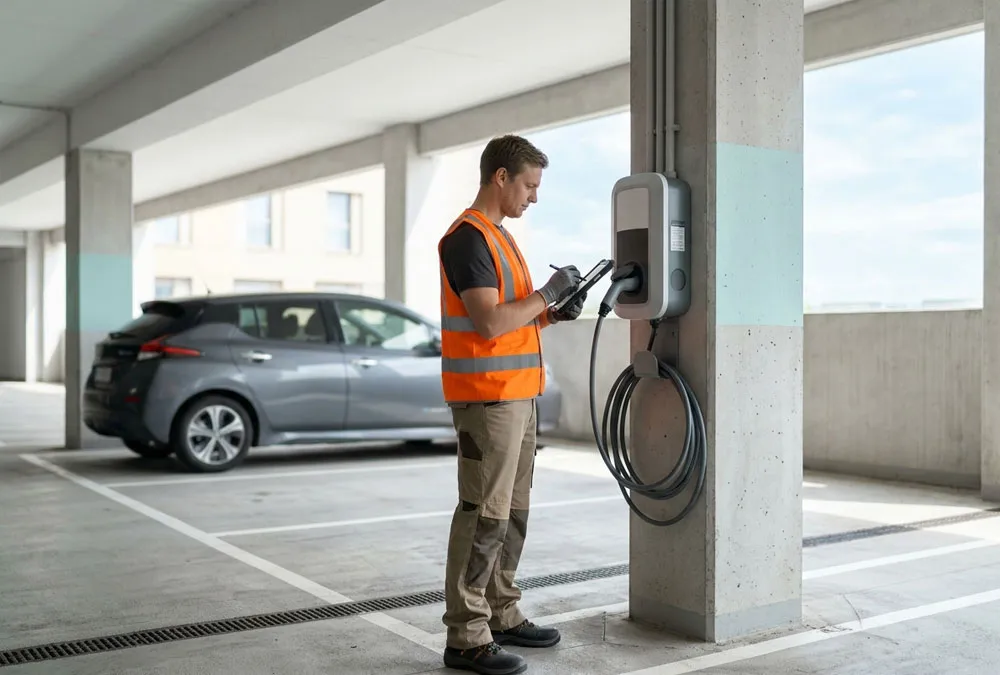
How Often Should Hotel EV Chargers Be Inspected or Serviced?
There is no safe universal schedule for every hotel EV charger. Set the programme from the exact manufacturer’s maintenance manual and warranty, local inspection requirements, usage intensity, site risk and fault history. A sheltered wallbox used a few times each week does not have the same maintenance exposure as a high-turnover unit beside a coastal car park or a DC charger with active cooling.
Create both planned and triggered tasks. Triggers can include vehicle impact, water ingress, repeated protective trips, abnormal heat, damaged connectors, a firmware or CSMS change, payment-terminal replacement, communications migration or a recurring fault. For DC equipment, the model documentation may add filters, fans, liquid-cooling components and power-module procedures. Do not transfer one vendor’s intervals to another product.
| Hotel staff may observe and report | Remote operator may diagnose | Qualified/authorized technician must handle |
|---|---|---|
| Equipment ID, visible damage, screen message, indicator state, blocked bay, standing water, time and guest steps | Connectivity, OCPP status, error codes, configuration, authorization and payment logs, approved remote commands | Opening equipment, electrical testing, protective devices, internal terminations, damaged power components and work requiring local licensing |
Who Is Responsible When a Hotel EV Charger Fails?
A single incident may involve the hotel host, charge point operator (CPO), CSMS provider, payment provider, network operator, charger manufacturer, electrical maintainer and local field contractor. The guest should not have to navigate this supply chain. Assign one incident owner with authority to coordinate all parties until service is restored or a safe fallback is active.
In the United Kingdom, official guidance identifies the CPO as the entity responsible for operating the charge point, although the landowner or charger owner may be different. That definition is useful when mapping roles for charge points within scope of the UK Public Charge Point Regulations; it is not a universal definition for every private hotel installation. Review the UK Public Charge Point Regulations guidance against the hotel’s actual access model.
Give the front desk a one-page escalation card
The night team needs a short, property-specific procedure—not an engineering manual. It should show the equipment and connector IDs, symptoms to record, support route, service ticket format, safe guest fallback and who may authorize compensation.
- Staff may: check for visible hazards from a safe distance, confirm the bay and connector number, record the screen or light state, note the guest’s authorization method and contact the designated support desk.
- Staff must not: open equipment, touch damaged conductors, bypass payment, use a damaged cable, enter electrical cabinets or perform unauthorized breaker resets.
- The fallback should state: whether another on-site connector is available, whether a nearby public option has been verified, and how the hotel communicates that the amenity is temporarily unavailable.
Use a safe five-minute triage before raising the ticket
A guest does not need to hear that “engineering will look tomorrow.” They need a safe next step now. The front desk can use the table below to separate a simple access problem from a fault requiring technical support. These actions are intentionally limited: the exact charger and vehicle manuals, hotel policy and operator instructions always take priority.
| What the guest sees | Safe immediate action | What staff should record | When to stop and escalate |
|---|---|---|---|
| QR, app or RFID will not authorize | Confirm the guest is using the access method stated on the charger and that the connector number selected in the app matches the bay. If hotel policy permits, try one other approved method or connector—never bypass payment or access control. | Time, connector ID, access method, screen/app message and transaction reference | A second authorized attempt fails, several guests are affected, or the price/tariff shown is wrong |
| Plug does not latch or the session will not start | Ask the guest to stop the attempt and visually check for obvious damage or debris without touching contacts. Do not force the connector. Offer another compatible connector if it appears safe. | Vehicle model, cable ownership, connector ID and indicator/error message | Bent, wet, cracked, hot or contaminated components; repeated latch failure |
| Cable will not release | Confirm that the session shows stopped and the vehicle is unlocked, following the vehicle and charger instructions. Do not pull, twist or use tools. Contact the operator or vehicle assistance if it remains locked. | Whether the session ended normally, vehicle lock state and any app/charger error | Cable remains locked, emergency release is unfamiliar, or any part appears damaged |
| Session starts but no energy is delivered | Check whether the vehicle reports a full battery or a scheduled/delayed charge. If not, offer another connector and send the operator the session ID. Staff should not change load-management or charger settings. | Session ID, displayed power, start time, vehicle message and whether another connector works | Multiple vehicles or connectors show the same symptom, or the connector repeatedly drops to zero |
| Charger is blank or offline, with no visible hazard | Mark the connector unavailable, offer a verified alternative and call the designated operator. Only the authorized operator or technician may perform the approved reset or electrical checks. | Asset ID, last known successful session, indicators, nearby chargers and outage start time | The unit does not recover remotely or the whole site is affected |
| Bay is blocked but the charger is healthy | Apply the hotel’s parking or valet escalation policy and guide the guest to another bay. Record this as an access incident, not a hardware failure. | Bay, occupancy type, duration and outcome | Blocking is repeated or no alternative accessible bay exists |
| Burning smell, sparks, abnormal heat, standing water, damaged cable or repeated protective trip | Stop use, keep people away and follow the property’s electrical-emergency plan. Supply isolation is for authorized personnel under the approved procedure. | Location, visible condition and time—only if this can be recorded safely | Immediately. This is not a minor guest-service fault. |
A manufacturer’s user guide may allow a specific owner to perform a defined restart, but that permission should not be copied across products or handed to untrained hotel staff. For example, E.ON’s eCharge guide tells users not to use visibly damaged equipment and to contact support when a fault persists; its steps are product-specific. See the E.ON eCharge user guide, aftercare section. A hotel should write its card from the manual for the exact installed model.
Keep public information accurate during an outage
Synchronize the site sign, front-desk message, hotel website, booking-channel description and operator map where those channels can be updated. For publicly accessible points in the European Union, Article 20 of Regulation (EU) 2023/1804 includes operational status and availability among dynamic data fields. That requirement applies within AFIR’s scope; it should not be presented as a rule for every private guest-only charger. See Regulation (EU) 2023/1804.
What Should a Hotel EV Charger Maintenance SLA Include?
“24/7 support” is a contact promise, not a restoration commitment. The AFDC guidance recommends that maintenance contracts address response time, repair time and an overall uptime requirement. A hotel procurement team should go further and define what starts and stops each clock.
Split response into five measurable milestones
- Alarm or incident acknowledged.
- Remote diagnosis completed and the next action assigned.
- Site attendance completed when physical intervention is required.
- Service restored or a safe, communicated workaround activated.
- Permanent repair, recovery test and root-cause closure completed.
Define severity by consequence. A damaged connector or electrical hazard needs isolation and safety escalation. One failed connector at a multi-port site differs from total overnight loss. A payment failure affecting every guest can deserve higher priority than a non-blocking cosmetic issue.
Measure the connector and the transaction—not only the site
Useful service reports can include connector technical availability, transaction-start success under a clearly documented method, time to acknowledge, time to restore, time to permanent repair, open-fault age, repeated faults, payment or authorization failures and parts status. Record blocked bays separately so operational failure is visible without corrupting technical fault data.
The Joint Office of Energy and Transportation’s ChargeX work highlights the need for useful diagnostic and error information to improve charging reliability. Its material is a U.S. diagnostic reference, not a European legal standard, but the procurement lesson travels well: a fault code must help a service team identify an action rather than merely report “error.” See the Joint Office technical publications.
Important UK boundary
The UK requirement for 99% reliability is calculated across a CPO’s rapid public charging network of 50 kW and above over a calendar year. It is not a legal uptime target for every hotel AC wallbox. A hotel may still set its own connector-level SLA, but it should not mislabel that contractual target as the statutory rule.
Define spares, remote access and warranty boundaries
The SLA should identify replaceable parts, stocking location, lead-time treatment, RMA process, replacement-unit policy, site-access windows, remote permissions, firmware rollback, configuration backup and whether third-party work affects the warranty. Do not copy a generic spare-parts list into a contract. Match every item to the exact charger model, hardware revision, firmware and service region.
How Much Does Hotel EV Charger Maintenance Cost?
There is no reliable universal hotel EV charger maintenance price. A low annual fee may exclude the CSMS subscription, payment support, travel, emergency attendance, parts or after-hours labour. Comparing headline fees before comparing scope is likely to produce the wrong decision.
Ask each bidder to itemise:
- remote monitoring, CSMS and connectivity;
- planned inspections and electrical testing;
- reactive call-outs, labour, travel and after-hours cover;
- parts, consumables, RMA freight and temporary replacement;
- firmware, payment, certificate and configuration support;
- reports, staff training and recovery testing.
Use published prices as budget anchors, not market averages
The following figures were visible online when checked on 22 October 2026. They are examples from different providers and countries, not an AnengJi quotation and not like-for-like packages. VAT, travel, parts, software, payment services, response hours and charger types can change the total substantially.
| Published example | Price shown online | What the page says is included | How a hotel should use it |
|---|---|---|---|
| UK commercial socket service — Solarus | £200 + VAT per socket annually, or £20 + VAT per socket monthly | Annual inspection, visual/performance checks, safety certificate, water-ingress check, firmware check, business-hours support and stated priority diagnosis | A per-socket baseline; verify whether corrective labour, travel, parts, CSMS and night response are excluded. View the published service page. |
| UK commercial site plan — Proper Solar | From £425 per site per year | Annual inspection; monitoring and faster response vary by tier | Shows why a site-level starting price cannot be compared with a per-socket package until scope and SLA are normalized. View the published plan summary. |
| UK one-off services — Polarity Electrics London | From £95 for fault diagnosis/call-out, £65 for firmware/OCPP connectivity service and £85 per unit for an annual EVSE safety inspection | Separate one-off testing and maintenance items; enterprise sites are custom quoted | A useful reserve-building example, not a nationwide or hotel-specific rate. Confirm VAT, travel, parts, opening hours and supported brands. View the published price list. |
| United States planning reference — DOE AFDC | Up to US$400 annually per charger as an average maintenance planning allowance; DC fast-charger extended warranties can exceed US$800 per charger per year | General U.S. planning guidance, not a hotel quotation | Use only as a U.S. early-budget check; obtain local quotes and separate software, network fees, repairs and warranty coverage. Review the AFDC cost guidance. |
Illustrative eight-socket hotel budget
If a UK hotel used the £200 + VAT per-socket annual example above, the planned-service baseline would be 8 × £200 = £1,600 + VAT per year. That arithmetic does not prove that the package fits the hotel.
The budget should then add the hotel’s actual CSMS/network fee, payment support, any excluded travel and parts, an agreed reactive-repair reserve, and the cost of the required SLA. For example, a £95 published diagnostic call-out can be used as a provisional planning input only after confirming that the same rate, geography and charger type apply. Replace every provisional input with written supplier quotes before approval.
For planning—not as a guaranteed financial model—use: annual service exposure = fixed support fees + planned visits + software/connectivity + expected call-outs and parts + hotel handling and guest recovery costs. Populate the last term with hotel records: failed sessions, complaints, refunds or goodwill actions, alternative charging arrangements, staff coordination time and lost charging revenue. This makes the business case property-specific instead of importing an unverified return-on-investment percentage.
Hotel EV Charger Maintenance Supplier Checklist
Before signing a maintenance contract—or taking over a legacy site—give the supplier an asset list with charger make and model, serial number, hardware revision, firmware, connector type, power rating, CSMS/CPO, authorization and payment methods, warranty status, network arrangement, fault history and site access conditions.
Ask the supplier to answer these questions in writing:
- Which exact charger, firmware, protocol and CSMS combinations can you support?
- Which connector-level status, fault codes, logs and transaction records can you access?
- Who may reset, unlock, update firmware or restore configuration, and how is each action audited?
- Which faults require a site visit, and where is field coverage actually available?
- How are spares, compatibility, lead times, RMA and temporary replacements managed?
- How will you prove that authorization, payment and energy transfer work after repair?
- Will the monthly report show recurring faults, root causes, work-order timestamps and unresolved risks?
- At contract exit, how will the hotel receive accounts, configurations, credentials, documentation and service history?
For an AnengJi-based project, the public Q6 product page lists 7 kW, 11 kW and 22 kW AC wallbox options. That family-level information is not enough to write a maintenance SLA. Procurement should request the exact model manual, market-specific connector arrangement, parts list, warranty/RMA terms, firmware and CSMS compatibility matrix, available diagnostics and approved recovery procedure.
Hotels still deciding how AC and DC equipment should serve overnight guests and short-stay visitors can review the separate guide to AC and DC charging roles at hotels. Keep that equipment-selection decision separate from the maintenance and SLA decision addressed here.
Hotel EV Charging Station Maintenance FAQ
Do hotel EV chargers require maintenance?
Yes. The scope normally combines physical condition, electrical safety, communications, firmware and configuration, authorization or payment, transaction testing and hotel bay operations. The exact work must follow the specific equipment, warranty and local requirements.
How often should a hotel EV charger be serviced?
Use the manufacturer’s model-specific manual, warranty, local inspection rules, environment, utilisation and fault history. Add trigger-based checks after impact, water ingress, repeated trips, software changes or recurring failures. A universal annual interval is not enough evidence for every site.
Why does a charger show online but fail to charge?
An online signal can confirm communications without proving the full transaction. Authorization, payment, configuration, vehicle communication, contactor operation or energy transfer may still fail. Review logs and complete an approved end-to-end test.
Can hotel staff reset an EV charger?
Only when trained and expressly authorized under the manufacturer- and site-approved procedure. Staff should never open equipment, touch electrical cabinets or repeatedly cycle breakers as an improvised repair. A reset also needs a work record and recovery test.
What should an EV charger maintenance contract include?
Define covered assets and software, monitoring, preventive and reactive work, five response/restoration milestones, exclusions, parts and travel, warranty/RMA, remote permissions, field coverage, reporting, recovery testing and exit handover.
Does the UK 99% reliability rule apply to hotel chargers?
Not automatically. The statutory metric applies to CPO rapid public charging networks of 50 kW and above and is averaged across the network over a calendar year. Check whether the hotel’s equipment and access model fall within the regulations; set separate contractual targets where appropriate.
Who pays for parts outside the charger warranty?
The commercial agreement should state this before failure. Clarify parts, labour, travel, freight, access equipment, temporary replacement and faults caused by impact, network changes, third-party work or environmental conditions.
What records should a hotel keep after each repair?
Keep asset and connector ID, detection and response timestamps, symptoms, error codes, logs, photos, remote actions, technician work, parts and versions, test results, restored-service time, root cause, warranty impact and recurrence status.
Maintain the Guest Journey, Not Just the Charger Cabinet
The strongest hotel EV charging maintenance programme does not close a ticket when a dashboard changes colour. It closes the incident when the safety issue is controlled, responsibility is clear, the transaction has been tested, the bay and information are usable, and the evidence is stored for trend analysis.
To obtain a credible service scope, provide the charger make and model, connector count, AC/DC rating, hardware and firmware versions, CSMS/CPO, access and payment route, fault history, site environment, current SLA and target market. Those inputs determine which diagnostics, parts, technicians and recovery tests are actually required.