Introduction
The lowest hotel EV charger installation quote can become the most expensive one after work starts. A short cable route turns into a long trench, the distribution board has no verified spare capacity, mobile reception disappears in the car park, or “software setup” does not include payment activation. The equipment may be fixed to the ground and powered on, yet a guest still cannot start a reliable charging session.
A successful hotel EV charger installation is therefore not a charger purchase followed by electrical work. It is a coordinated project covering guest demand, parking layout, electrical capacity, civil works, connectivity, access and payment, hotel operations, commissioning and support. Before comparing prices, the hotel should produce three things: an installation-ready site data pack, a scope-and-responsibility matrix, and a testable acceptance schedule.
The short answer
Do not ask suppliers only, “How much is a hotel charger?” Ask them to price the same surveyed design basis. Record who needs to charge, when vehicles arrive and leave, what electrical headroom is genuinely available, where cables and communications will run, who operates the service, and what must work before the hotel accepts it. This turns a vague equipment quote into a comparable project proposal.
| A familiar hotel problem | What was probably missed | What should have been specified |
|---|---|---|
| The charger is listed online but is unavailable when a guest arrives. | No end-to-end commissioning, monitoring owner or fault-response path. | Guest-journey tests, remote alarms, support responsibility and recovery targets. |
| A quote increases after trenching begins. | “Standard installation” did not define route length, surfaces, utilities or reinstatement. | Drawn cable routes, measured quantities, exclusions, allowances and variation triggers. |
| The front desk becomes the charger help desk. | The operator, hotel, software provider and maintenance roles were never separated. | A named operator of record, escalation tree, staff script and service-level agreement. |
| An electrical upgrade is proposed without showing why. | Charger nameplate total was treated as site maximum demand. | Interval-load evidence, controlled charging limit, design margin and upgrade trigger. |
Jump to the decision you need
What Must Be Decided Before Requesting a Hotel EV Charger Installation Quote?
A supplier cannot design a dependable service from the number of bedrooms alone. A 100-room airport hotel with late arrivals, rental cars and short stays has a different charging profile from a 100-room resort where vehicles remain parked for two nights. Start with the service the hotel intends to provide, then convert it into power, ports and operating rules.
Who Will Use the Chargers—and When?
Separate overnight guests, restaurant and conference visitors, employees, hotel vehicles and the general public. For each group, record typical arrival and departure windows, the energy required before departure, whether the vehicle can be moved, and what happens when every connector is occupied. Track denied charging requests as well as completed sessions: an apparently quiet charger may be hard to find, hard to start or blocked by another vehicle.
This is why “install one charger per X rooms” is a weak design rule. The project needs overlapping demand and parking windows, not a room count shortcut. A short demand survey can also expose a problem that hardware cannot solve—for example, fully charged vehicles remaining in dedicated bays all night.
Will the Charging Area Be Guest-Only or Publicly Accessible?
Access changes the project. A charger reserved for validated hotel guests may use a different authentication, pricing and support model from a site promoted to any driver. In the EU, publicly accessible charging may bring obligations concerning ad hoc access and price transparency under Article 5 of the Alternative Fuels Infrastructure Regulation. In the UK, the official Public Charge Point Regulations guidance explains that a charge point in a hotel car park may be in scope when the public has access.
Do not decide this from the equipment brochure. Ask qualified local advisers to classify the actual access model, then specify payment, pricing display, receipts, customer support, data and maintenance accordingly. EU rules, UK rules and national implementation must not be treated as interchangeable.
Who Will Own, Operate and Support the Charging Service?
Name the asset owner, charge point operator, charging management platform, payment provider, maintenance contractor and hotel contact before the RFQ is issued. Decide who sets prices, receives revenue, owns session data, holds administrator accounts, approves software updates and answers a driver at midnight. The front desk should have a short, tested escalation procedure—not responsibility for diagnosing a network or charger fault.
Use the CHECK-IN Framework Before Selecting Equipment
CHECK-IN is a pre-procurement framework for keeping the charger, building and hotel operation in one design. If one line cannot be answered, it becomes an explicit survey item or tender assumption rather than a surprise after award.
| CHECK-IN item | Questions to resolve | Buyer benefit |
|---|---|---|
| C — Charging demand | Users, dwell time, required energy, simultaneous arrivals and rotation | Prevents buying speed when the real shortage is connector access |
| H — Hotel electrical load | Interval demand, switchgear, available capacity and future building loads | Avoids unsupported upgrade claims and undersized designs |
| E — Equipment and ecosystem | Power, connector, CSMS, payment, communications and interoperability | Makes hardware and software responsibilities testable |
| C — Civil works and car park | Cable routes, surfaces, drainage, lighting, collision protection and accessibility | Reduces hidden trenching, reinstatement and layout changes |
| K — Known approvals | Owner, planning, electrical, fire, utility, metering and public-access requirements | Makes approval dependencies visible before scheduling |
| I — Installation and integration | Outages, work windows, configuration, software setup and test sequence | Limits disruption and closes the gap between power-on and go-live |
| N — Network operation and handover | Monitoring, maintenance, spares, SLA, training, credentials and records | Gives the hotel a maintainable service after contractors leave |
What Should a Hotel EV Charging Site Survey Record?
Map the Car Park Around Guest Movement, Not Just Cable Distance
Mark entrances, exits, reception routes, valet handover, service traffic, fire access, accessible routes, kerbs, columns and spaces that are closed during events. Confirm whether the charging cable can reach vehicles with inlets in different positions without crossing a pedestrian route or creating a trip hazard. Check the equipment’s operating space, protective bollards, wheel stops and door opening clearance as one layout—not as separate objects added later.
The U.S. Access Board design recommendations are a useful reference for accessible mobility features, routes, operable parts and cable reach. They are not a substitute for binding local accessibility, building or electrical requirements. European, UK and U.S. projects must be checked against the law and standards applicable at the site.
Survey Civil Works and Communications Together
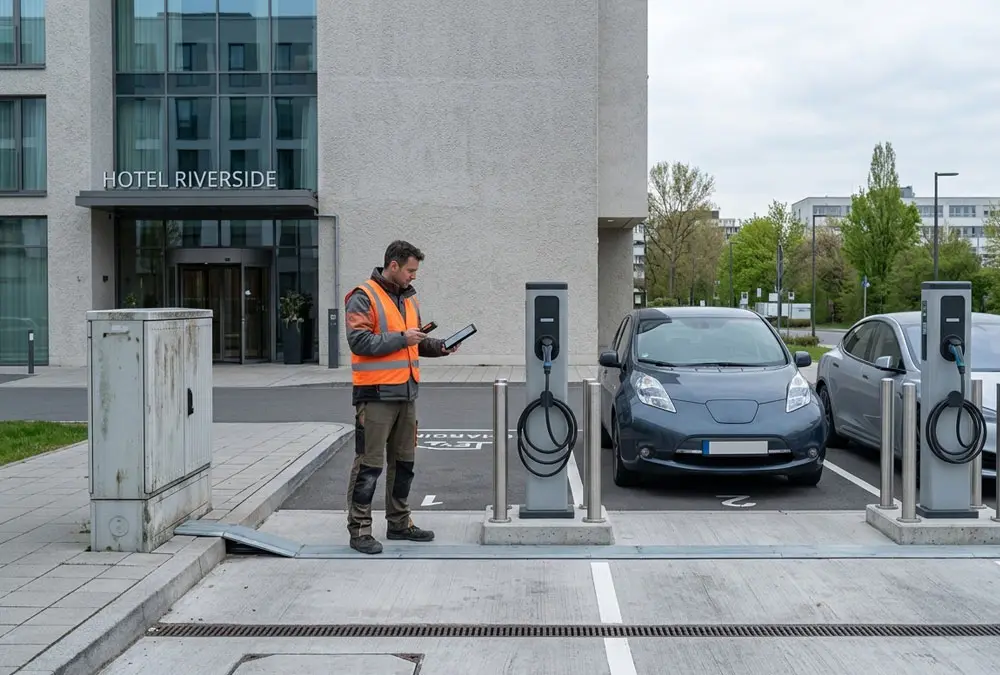
Record surface construction, measured trench length, underground-service information, duct capacity, proposed bases, drainage and areas prone to standing water. Photograph both ends of the cable route and every surface that must be reinstated. Test the intended network connection at the actual charger locations; good reception at reception does not prove reliable service inside a basement or behind a concrete retaining wall.
The U.S. Joint Office EV charging site selection checklist similarly brings together safety, accessibility, lighting, utility power, connectivity, expansion and cost. Use it as a planning reference, not as a European compliance certificate.
Give Every Bidder the Same Installation-Ready Data Pack
- Dimensioned parking layout, photographs and charger/cable route options
- Electrical single-line diagram, board schedules and protective-device information
- Available interval-load data and agreed measurement period
- Known utility connection terms and future HVAC, kitchen, heat-pump or other major loads
- Network or cellular survey at each proposed equipment position
- Guest, staff, fleet and public-access scenarios
- Hotel blackout periods, events and permitted construction hours
- Local approval, accessibility and parking requirements to be confirmed
The U.S. Department of Energy publishes an EVSE installation planning form that demonstrates the value of gathering facility information before purchase. A hotel-specific data pack should go further by including operating hours, guest flow, revenue/access policy and handover expectations.
How Much Electrical Capacity Does a Hotel EV Charger Installation Need?
Separate Connected Load From Controlled Maximum Demand
Three values are often confused: the sum of charger nameplate ratings, the maximum power that the site control system permits, and the power vehicles actually accept. They are not the same.
Illustrative calculation—not an electrical design
Eight 11 kW ports have an 88 kW nameplate total. A designed load-management system might limit the EV charging system to a 30 kW site allocation, subject to verified building headroom and the approved electrical design. At one moment, four connected cars might receive 7.5 kW each; at another, fewer vehicles or vehicle limits could reduce actual demand.
This example does not prove that 30 kW is sufficient. The engineer must still test arrival overlap, departure deadlines, required energy, losses, minimum usable power, control behaviour and design margin.
Measure Hotel Peaks Before Choosing a Grid Upgrade
Hotel demand can change with check-in, dinner service, laundry, hot water, kitchens, HVAC and events. A nameplate-only calculation can either trigger an unnecessarily large upgrade or hide a real peak constraint. Ask a qualified electrical professional to use suitable demand data, confirm the measurement boundary and protection arrangement, apply the required design margin, and document the condition that would trigger switchboard, transformer or utility work.
Load management may allow more connectors to share a controlled allocation, but it does not manufacture energy. If many late-arriving vehicles need substantial energy before an early departure, the site still needs enough time and capacity to deliver it.
Specify What Dynamic Load Management Does When Data Disappears
A tender should define the site measurement point, update interval, charger priorities, any minimum-per-port rule and the approved charging ceiling. It should also ask what happens if the meter, controller, network or charging platform stops communicating. Does output reduce to a configured safe level, pause, or continue at the last value? How is the fault reported, who can reset it, and how is normal allocation restored? Accept only behaviour supported by the proposed system documentation and project design.
What Must a Hotel EV Charger Installation Scope and Price Include?
Hotel EV charger installation cost cannot be reduced to a universal price per unit. Cable distance, surface restoration, distribution capacity, networking, approvals, payment and support can matter more than the charger price. Compare tenders through a common scope matrix with five fields: included, excluded, allowance, variation trigger and responsible party.
| Cost group | Items that should be visible | Common ambiguity to remove |
|---|---|---|
| Electrical | Design, panels, protection, metering, cabling, isolation, utility or transformer work | Who pays if spare capacity or fault-level assumptions are wrong? |
| Civil | Survey, trenching, ducts, bases, bollards, drainage, markings and reinstatement | What length and surface type does “standard installation” include? |
| Digital | Router/SIM, data plan, CSMS, payment, configuration, integration and cybersecurity responsibilities | Does “connected” mean remotely visible, payable and ready for guests? |
| Lifecycle | Commissioning, training, warranty, preventive maintenance, call-out, spares and software fees | When does the SLA start, and which party owns each fault? |
Require bidders to state quantities and assumptions, not simply a lump sum. A low bid that excludes trench reinstatement, payment onboarding, test vehicles or operator setup is not comparable with a complete bid. The evaluation should consider whole-life service boundaries as well as initial capital cost.
Which Hotel EV Charger Hardware Should Be Procured?
Choose the Charger After the Survey, Not Before It
For many overnight spaces, managed AC charging can make better use of long parking windows and allow wider connector coverage. DC charging may serve shorter stays, rapid turnarounds or selected operational vehicles, but it changes the electrical and commercial scope. If the architecture is still undecided, compare the AC and DC charging roles at hotels against measured dwell time rather than assuming faster is always better.
Turn the Project Brief Into a Model-Specific Datasheet Check
The public AnengJi product page lists 7 kW, 11 kW and 22 kW AC wallbox options. Those ratings can support early configuration discussions, but the exact model still needs a project datasheet. Confirm voltage, phase, current, socket or tethered cable, connector type, simultaneous output, protective interfaces, communications, mounting, environmental conditions, certification and country suitability.
Procurement rule: do not infer OCPP support, payment capability, dynamic load management, IP rating or certification from a product category or a different model. Ask for evidence for the exact hardware, firmware, market and software combination being offered. The same rule applies when reviewing other commercial AC charger configurations.
Protect the Hotel From Software and Operator Lock-In
Ask which protocol version and functions are supported, how CSMS compatibility will be demonstrated, who holds certificates and administrator credentials, whether session and fault data can be exported, who owns the SIM or network contract, and what happens if the software service ends. Include a migration test or documented process where interoperability is a purchasing requirement. A physical charger that a replacement platform cannot control is not a flexible asset.
How Should Hotel EV Charger Installation Be Phased Around Operations?
Plan Construction Around Guests, Events and Hotel Systems
A practical sequence is survey, detailed design, approvals, enabling works, civil and electrical installation, configuration, commissioning and handover. The programme should identify parking spaces closed in each phase, construction access, noise restrictions, electrical outages, event blackouts and temporary accessible routes. Do not promise a universal installation duration: utilities, ground conditions, approvals and operating constraints vary by site.
Control Changes Before They Become Claims
Name one hotel technical owner and one commercial approver. Require requests for information, site instructions and proposed variations to record the reason, cost, programme effect and drawing change before work proceeds. Update the as-built record whenever a route, device, setting or network component changes. This is especially important where several parties divide hardware, electrical work, software and operation.
Hotel EV Charger Commissioning and Acceptance Checklist
Power-on is a milestone, not acceptance. The hotel should accept the installation only after physical, electrical, digital and guest-facing functions have been demonstrated under the agreed conditions.
| Test group | Witness before acceptance | Evidence to retain |
|---|---|---|
| Electrical and physical | Required local electrical tests; isolation and protection; foundations; labels; drainage; lighting; collision protection; cable reach and accessible route | Certificates, photographs, test results and defect list |
| Functional and concurrent charging | Every port; several ports at once; power allocation; configured ceiling; metering comparison; restart and session completion | Time-stamped session and controller records |
| Guest journey | Approved access methods; displayed price; start/stop; receipt; failed payment or cancellation path; support contact | Screenshots, receipts and signed scenario results |
| Failure and recovery | Loss of network, CSMS, site meter or controller as relevant; alarm delivery; remote support; reboot and safe restoration | Fault log, response record and restored-state confirmation |
| Handover | Administrator access, staff training, escalation procedure and maintenance route | As-builts, single-line diagram, settings backup, serial numbers, warranties, certificates, SLA, spares list and contacts |
The decisive test is not “Does the screen light up?” It is “Can a guest find the bay, understand the terms, start a session, receive energy, stop normally and obtain help when something fails?” Conduct that journey with the actual access and payment arrangement before promoting the service.
What Should the Hotel Monitor During the First 90 Days?
Use the first 30, 60 and 90 days to compare design assumptions with operation. Monitor connector availability, start-success rate, fault reason, refused or unmet charging requests, plug-in time versus active charging time, delivered energy, complaints and time to restore service. The contract should define project-specific targets; do not borrow unsupported benchmarks from another hotel.
The pattern tells the hotel what to change. Long connection time with little energy may indicate occupancy policy or fully charged vehicles left in bays. Repeated start failures point toward access, communications or backend setup. Vehicles leaving below the agreed energy target may require different power allocation, more capacity, longer access or more connectors. Empty chargers alongside guest complaints may indicate poor signage, unclear pricing or an unreliable user journey.
Hotel EV Charger Installation FAQ
How Much Does Hotel EV Charger Installation Cost?
There is no reliable universal price. Hardware, cable distance, switchgear, utility work, trenching and reinstatement, communications, payment setup, approvals, commissioning and ongoing software/support all affect cost. Request a surveyed, itemised scope and compare exclusions and variation triggers as well as the total.
Does a Hotel Always Need an Electrical Service Upgrade?
No. Some sites can use verified spare capacity and dynamic load management; others need distribution or utility upgrades. A qualified designer should assess interval demand, switchgear, protection, charging duty and future loads before deciding.
How Many Charging Points Should a Hotel Install First?
Base the first phase on overlapping demand, dwell time, required energy, denied requests and expansion cost—not room count alone. Design ducts, panels, network and layout so later ports can be added without repeating avoidable civil work.
Can Hotel Chargers Share Available Electrical Capacity?
They can when a compatible, correctly designed load-management system controls the allocation. Procurement must define the measurement boundary, power ceiling, priorities and failure behaviour, and commissioning must test several ports simultaneously.
Are Hotel Chargers Legally Considered Public Charge Points?
It depends on who can access the site and the applicable jurisdiction. A hotel car park may be publicly accessible even though it is privately owned. Confirm the specific access model against EU, national, UK or U.S. requirements with qualified local advisers.
What Documents Should the Hotel Receive at Handover?
At minimum, collect as-built drawings, the final single-line diagram, local test certificates, device and serial-number register, approved settings and backups, warranties, software and network account ownership, maintenance and SLA documents, spare-parts information, staff training records and escalation contacts.
A Successful Hotel EV Charger Installation Is Proven at Checkout, Not at Power-On
The best project is not the one with the most impressive charger rating or the shortest initial quote. It is the one that converts real parking demand into a controlled electrical design, defines every scope boundary, works through the complete guest journey and leaves the hotel with the records and support needed to operate it.
Begin with the parking plan, load evidence, access model and operating responsibility. Then compare equipment within the wider hotel charging solution architecture. AnengJi can review the charger-side brief and proposed configuration; final electrical design, installation and compliance must be completed and verified by appropriately qualified local parties.
Prepare a more useful project enquiry
Share the parking layout, proposed cable route, available electrical data, guest access model, desired charging window and expansion plan. These inputs allow a supplier to discuss a relevant configuration instead of guessing from the hotel’s room count.
Related Articles
- Plan the complete hotel charging solution
- Match AC and DC charging to hotel parking behaviour
- Explore commercial AC charging options
Technical and regulatory note: This article provides procurement and planning guidance, not a site-specific electrical design or legal opinion. Requirements vary by country, grid connection, building, access model and equipment. Confirm the final design, product documentation, installation and compliance with qualified local professionals and the relevant authorities.