
Introduction
Choosing AC vs DC EV charging for hotels is not simply a contest between slow and fast equipment. A hotel is buying a service outcome: enough guests must receive the energy they need before departure, without overloading the property, creating a parking dispute, or giving the front desk another system it cannot support.
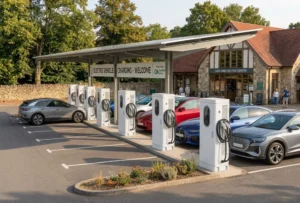
For most properties dominated by overnight stays, managed AC wallboxes are the practical coverage layer because vehicles remain parked for hours and the available electrical capacity can be shared across more connectors. A compact or lower-power DC charger becomes valuable when the hotel has a proven group of late-arriving guests, short-stay restaurant or conference visitors, airport traffic, valet operations, shuttle vehicles, or public users who cannot wait overnight.
The practical answer: use AC to provide broad overnight access. Add DC only when faster energy delivery solves a measurable departure, turnover, or revenue problem. Do not select a fixed AC/DC ratio until you know the parking window, required kilowatt-hours, simultaneous demand, usable site capacity, and operating rules.
AC vs DC EV Charging for Hotels: The Decision in 60 Seconds
| Decision factor | Managed AC wallboxes | Compact DC charger | Buyer benefit |
|---|---|---|---|
| Natural parking pattern | Several hours or overnight | Short stay, urgent recovery or scheduled turnover | Matches charging speed to the time the vehicle is already parked |
| Primary purchase | More plug-in coverage | Faster energy delivery and bay turnover | Prevents paying for speed that produces no operational value |
| Site-power effect | Power can be distributed across many ports | Higher instantaneous demand per active session | Clarifies transformer, switchgear and load-management consequences |
| Typical hotel role | Overnight guest service | Late-arrival recovery, day visitors, public traffic or hotel fleets | Separates the core amenity from an optional fast-charging business case |
With AC charging, the vehicle’s onboard charger converts grid AC into the DC stored by the battery. The car’s onboard limit can therefore cap the actual charging rate. A DC charger performs the conversion in the station and supplies controlled DC power to the vehicle, but the vehicle’s acceptance curve, state of charge, battery temperature and the site’s available power still limit delivery. Charger nameplate power is not a promise of constant power at the battery.
The U.S. Department of Energy’s Alternative Fuels Data Center places Level 2 charging at locations where vehicles remain parked for long periods, explicitly including hotels, while DC fast charging is associated with corridors and rapid-turnover use. Its Charging Electric Vehicles in Public guidance supports the planning principle, even though European projects use different electrical and connector terminology.
Why Guest Dwell Time Matters More Than Maximum Charger Power
A guest does not normally need the vehicle’s entire battery filled. The useful design question is how much energy must be added before the guest’s planned departure. A first-pass calculation is:
Minimum average power (kW) = required energy by departure (kWh) ÷ usable charging window (hours)
Suppose a guest needs 32 kWh and the vehicle can charge for eight usable hours. The first-pass average is 4 kW. That does not mean a 4 kW nameplate is automatically sufficient: the engineer still needs allowances for conversion losses, reduced load allocation, interruptions, colder conditions, schedule uncertainty and an operational reserve. It does show why a high-power DC unit may add little value to that routine overnight task.
Now change the condition. A late-arriving guest needs the same 32 kWh in 90 minutes. The first-pass average rises to about 21.3 kW before allowances and vehicle charging-curve effects. That situation may justify higher-power AC where the vehicle supports it, a compact DC recovery point, or a managed priority rule. The correct answer comes from the deadline, not from the room count.
An accommodation-site study commissioned by South Australia’s Department for Energy and Mining analysed site electricity, occupancy and weather data. It found that accommodation loads can have morning and evening peaks and that unmanaged EV charging can add demand around the same evening period. The study’s site-specific Australian results should not be copied into a European budget, but its load-profile method and discussion on pages 24–26 illustrate why check-in timing and building demand must be examined together.
When AC Wallbox Chargers Are the Better Hotel Choice
Overnight Guests Need Access More Than Extreme Speed
At an overnight hotel, the practical failure is often not that charging is too slow. It is that the only connector is occupied, blocked, incompatible, or out of service. A single fast unit can finish one vehicle early while other arriving guests still have nowhere to connect. Multiple managed AC wallboxes can use the same broad power budget to give more guests a charging opportunity.
This does not mean every AC outlet must run at its full rating simultaneously. Dynamic load management can establish a controlled EV charging limit and distribute power according to connection time, required energy or departure priority. The schedule must still prove that enough energy can be delivered; software cannot create missing kilowatt-hours.
Distributed AC Can Improve Parking Flexibility
Wall-mounted AC equipment is useful in structured car parks and along hotel parking rows where civil work and cable routes permit distribution. It can also reduce pressure to move a vehicle immediately after charging completes. That matters at 02:00, when an aggressive idle-fee or relocation policy creates more guest frustration than operational benefit.
The hotel still needs clear rules: charging bays are for actively participating guests, the front desk must know which room or vehicle is associated with a session, and staff need a fair process when demand exceeds supply. Hardware without this operating layer is only a partially delivered amenity.
When a Small DC Charger Adds Value at a Hotel
A “small DC charger” is not a universal technical category. Suppliers may use terms such as compact DC, destination DC or lower-power DC for different ranges. The project specification should state required output, input supply, connector, simultaneous operation, power-sharing behaviour and the target vehicles rather than relying on the label.
Late Arrival and Early Departure Recovery
A compact DC point can protect the guest promise when a meaningful share of customers arrive late, depart early and need more energy than managed AC can reliably provide in that shortened window. Before buying it, the hotel should review arrival timestamps, requested departure times, initial state-of-charge information where available, and how often an AC session would have missed the energy target.
Restaurants, Conferences, Spas and Day Visitors
These visitors may remain for one to three hours rather than overnight. If the hotel wants charging to support food, beverage, meeting or wellness revenue, faster energy delivery can be useful. The hotel should still test whether those visitors will use the service, whether parking turnover can be enforced, and whether the charging price remains competitive after electricity, payment, network and maintenance costs.
Highway, Airport, Valet and Hotel-Fleet Operations
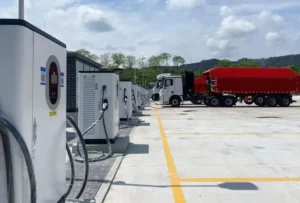
A route-adjacent hotel may operate two businesses on the same property: destination charging for overnight guests and rapid charging for passing traffic. Airport shuttles, hotel vehicles and valet-managed cars may also have defined departure deadlines. DC can serve those tasks, but public users and fleets should not displace the guests for whom the amenity was advertised. Separate zones, access rules, tariffs and service metrics make the operating model clearer.
AC-First, Hybrid or DC-Led: Three Hotel Charging Designs
The following configurations are screening concepts, not equipment schedules. Final quantities and power ratings require a site survey, load data, guest-demand evidence, utility conditions and local approvals.
| Architecture | Best-fit demand | Operational strength | Main risk | Buyer benefit |
|---|---|---|---|---|
| AC-first Multiple managed wallboxes | Overnight and multi-night stays | Broad access and staged expansion | Insufficient recovery option for very short windows | Prioritises usable connectors within a controlled power allocation |
| Hybrid AC coverage plus compact DC | Overnight guests plus a verified short-stay or priority group | Coverage with a recovery lane | DC underutilisation or competition for site power | Protects the guest amenity while serving exceptions |
| DC-led exception Public or fleet DC zone plus guest AC | Highway, airport, fleet or high-turnover destination | Higher throughput and defined departure assurance | Grid, capital, uptime and parking-management exposure | Creates a separate commercial charging service where demand supports it |
The International Energy Agency classifies public chargers at 22 kW or below as slow and those above 22 kW up to 150 kW as fast for its global reporting. That classification in the Global EV Outlook 2025 charging chapter is useful for market statistics, but it is not a hotel design rule. A project’s correct layer depends on the task, not the category name.
Which AnengJi Charger Models Fit Different Hotel Tasks?
The table below maps products currently listed on the AnengJi website to hotel charging tasks. It is a selection guide, not a final quotation or engineering schedule. Exact connector, cable, OCPP, payment, certificate and environmental requirements must be confirmed against the current model-specific datasheet and destination-country rules before ordering.
| AnengJi product currently listed | Published power options | Hotel role | Specify it when | Buyer benefit and caution |
|---|---|---|---|---|
| Q6 AC wallbox series Q6-EH07S4 / Q6-EH11S4 / Q6-EH22S4 | 7 kW at AC 230 V; 11 kW and 22 kW at AC 400 V, as currently listed | Core overnight guest coverage | Vehicles remain parked for several hours and the hotel wants one connector per participating bay | Scalable distributed access. Verify the guest vehicles’ onboard AC limits; a 22 kW wallbox does not make every car accept 22 kW. |
| 44 kW dual-port AC platform | 2 × 22 kW AC outputs, as listed on the current project page | Two adjacent overnight or event-parking bays | A floor-standing shared location is preferable to two separate wall positions | Consolidates user interface and equipment placement. Confirm simultaneous output, load-control topology and whether target vehicles can use the available AC power. |
| 30 kW / 40 kW compact DC charger | 30 kW or 40 kW DC; the listed 40 kW dual-port arrangement can allocate 40 kW to one vehicle or 20 kW + 20 kW to two | Late-arrival recovery, restaurant, meeting or valet priority charging | Observed short-window demand cannot be served reliably by the AC layer | Adds a recovery lane without defaulting to ultra-high power. Actual output still depends on the vehicle, battery condition and shared site limit. |
| Combined AC/DC platform | 22 kW AC + 60 kW DC, as currently listed | One mixed-use zone serving an overnight bay and a faster-turnover bay | The hotel has two distinct dwell-time groups and wants an integrated cabinet | Combines coverage and faster service in one platform. Confirm concurrent output, failure-domain risk and whether one cabinet creates an unacceptable single point of failure. |
| Commercial DC fast-charger platform | 60 kW, 80 kW, 120 kW or 160 kW DC options, as listed | Highway hotel, airport property or separately operated public charging hub | Traffic, utilisation, grid capacity, parking turnover and public-operation support justify a DC-led business case | Provides higher throughput. It should not replace broad overnight AC coverage unless the hotel is intentionally operating a rapid-charging site. |
For a typical European overnight property, the 11 kW Q6 variant is often a useful option to evaluate because it matches a three-phase AC architecture without assuming that every vehicle can accept 22 kW. That is an engineering screening observation, not a universal recommendation. A 7 kW unit may be adequate where the parking window is long and single-phase capacity is preferred; 22 kW AC is valuable only when vehicle acceptance, site supply and shorter dwell patterns support it.
What Could a Hotel AC/DC Configuration Look Like?
All examples below are engineering illustrations, not completed designs. They use transparent assumptions to show the selection method. Final quantities, diversity factors, protection, cable sizing and maximum demand require measured site data and a qualified local engineer.
Example 1: Boutique Hotel With Mainly Overnight Guests
Assumptions: 30 parking spaces, up to four EV guests on a busy night, eight usable charging hours and about 20 kWh required per vehicle before departure. The energy task is 80 kWh. Its ideal average is 10 kW across the full charging window before losses and reserve.
Screening configuration: four Q6-EH11S4 11 kW AC wallboxes under a controlled 16–24 kW site limit. Even the lower 16 kW allocation could theoretically deliver 128 kWh over eight hours before losses and interruptions, so the schedule appears feasible on an energy basis. Load management can reduce charging during the hotel’s kitchen, heating or cooling peak and restore it later.
Why no DC by default? Four AC connectors address the more common problem—access for four overnight vehicles. Add a 30 kW DC option only if operating records show repeated late-arrival or short-stay failures that cannot be solved through priority scheduling.
Example 2: Business and Conference Hotel With Mixed Dwell Times
Assumptions: 100 parking spaces, up to twelve overnight charging requests, a ten-hour window and an average requirement of 24 kWh per overnight vehicle. The overnight energy task is 288 kWh, or 28.8 kW ideal average before allowances. The hotel also records shorter meeting and restaurant visits.
Screening configuration: twelve 11 kW AC wallboxes managed within an initial 50–70 kW AC allocation, plus one 30 kW or 40 kW DC charger for verified short-stay and late-departure exceptions. If two adjacent premium bays need a shared floor-standing unit, the 44 kW dual-port AC platform can also be evaluated, but only after checking vehicle AC acceptance and simultaneous-output behaviour.
Operating rule: keep the DC bay for time-constrained sessions rather than allowing it to become another overnight parking space. If it is publicly accessible, treat payment, pricing and support as a distinct service workflow.
Example 3: Highway Hotel With Restaurant and Public Traffic
Assumptions: the hotel still has overnight guests, but a traffic study also demonstrates recurring short-stop demand from road travellers. The property has adequate utility capacity or a defined connection-upgrade plan, and staff or a CPO can support public charging.
Screening configuration: an overnight layer of eight or more 11 kW AC wallboxes under dynamic control, plus a separate 60 kW or 80 kW DC zone. The listed 22 kW AC + 60 kW DC combined platform may suit a compact mixed-use area; a separate commercial DC platform may provide better maintenance separation and expansion. Where charging availability is part of the public business promise, model redundancy instead of relying on one cabinet.
Why not jump directly to 120 kW or 160 kW? Higher nameplate power only creates value when target vehicles can accept it, the site can supply it, sessions turn over, and utilisation pays for the additional electrical and service scope. Collect traffic and session evidence first, then reserve space and electrical pathways for expansion.
Use DEPART to Calculate the Right Hotel Charger Mix
DEPART converts guest behaviour and site constraints into a design brief before equipment is selected.
| Input | Evidence to collect | Decision advanced |
|---|---|---|
| D — Dwell window | Arrival, connection and departure timestamps by guest type | Separates overnight coverage from short-stay charging |
| E — Energy by departure | Requested kWh or trip requirement, not full battery capacity | Estimates the average power task |
| P — Ports and occupancy | Peak arrivals, connector occupancy and blocked-bay events | Determines access, queue and parking rules |
| A — Available site power | Interval load data, transformer/switchgear condition and utility limits | Sets the controlled charging boundary |
| R — Rules and revenue | Guest-only/public access, tariff, parking and idle policy | Defines payment and operational responsibility |
| T — Technical recovery | Monitoring, fault ownership, support hours, spares and restoration test | Turns equipment availability into a dependable guest service |
Avoid using a universal rooms-to-chargers ratio. Two hotels with 150 rooms can have very different car-arrival rates, EV demand, parking duration, public access and electrical limits. Start with observed demand, test an initial phase, and reserve conduit, switchboard space, communications capacity and software licences for expansion.
Compare Hotel EV Charging Cost on the Same Boundary
Quotations are easy to misread when one supplier prices only the charger and another includes the complete energized system. Compare AC and DC options using the same scope:
- charger hardware, pedestals, cables and protection;
- transformer, switchgear, panels, metering and utility work;
- trenching, conduit, foundations, barriers, drainage and reinstatement;
- backend, communications, payment and transaction fees;
- design, permits, inspection, testing and commissioning;
- preventive maintenance, corrective service, spare parts and software support;
- electricity, capacity or demand charges, taxes and parking operations.
A compact DC unit may have a moderate equipment rating yet still trigger substantial upstream work. Conversely, a distributed AC project can become expensive when parking bays are remote from the switchroom or civil work is difficult. No credible article can provide a universal installed price or payback period without country, tariff, site design, tax, utilisation, financing and maintenance assumptions.
The business case should value more than charging revenue. For overnight guests, the relevant result may be a completed charge before departure and fewer complaints. For a roadside property, the relevant result may be charging contribution margin plus food-and-beverage spend. For a shuttle fleet, the relevant value may be avoiding a missed trip. Keep those value streams separate instead of claiming that every charger is a profit centre.
Recommended reading
For a broader cross-industry cost and architecture method, see AC vs DC EV charging for business.
Make Hotel Charging Usable, Not Merely Installed
Publish Information Guests Can Actually Plan Around
A listing that says only “EV charging available” leaves the critical questions unanswered. Publish the connector type, number of usable connectors, expected power range, cable arrangement, guest or public access, reservation process, complete price components, parking rules, opening hours and last verification date. Keep the hotel website, booking platforms, maps and charging directories consistent.
Give the Front Desk an Escalation Path
Guests lose confidence when the charger is offline and staff do not know who owns the problem. The operating package should include a one-page front-desk guide, remote status visibility, session-start troubleshooting, a named support route, fault priority, response target and a verified fallback location. After repair, test a real session; “device online” does not prove that authentication, payment and energy delivery work.
Use Parking Rules That Fit Overnight Guests
Link a charging session to a room, booking or vehicle registration where privacy and local rules permit. Define guest priority, what happens when a non-charging vehicle blocks a bay, and how staff handle a vehicle that has finished charging. Avoid an overnight policy that expects sleeping guests to move cars immediately. Where demand regularly exceeds supply, add ports or use a transparent queue rather than relying on conflict at the front desk.
Reduce Payment and Authentication Friction
A repeat commuter may tolerate a network app; a one-time international guest may not. Evaluate RFID, QR or browser-based initiation, payment terminals, room-bill integration and staff-assisted access against the legal status of the charger and the hotel’s operating model. Display electricity, parking, session and idle charges before the guest starts.
Europe vs the United States: What Changes in the Specification?
European Projects
European hotel specifications commonly consider Type 2 for AC and CCS2 for DC, but connector choice, cable arrangement, metering, accessibility, electrical installation and approval requirements must be confirmed for the destination country. Europe is not one permitting or tariff market, and EU rules do not automatically apply to the United Kingdom.
The revised Energy Performance of Buildings Directive introduces charging-point and pre-cabling requirements for certain non-residential buildings. The European Commission’s sustainable mobility and buildings guidance explains the EU-level direction, but hotel owners must verify scope, exemptions, dates and national transposition with the relevant authority.
If the hotel charger is publicly accessible, Article 5 of the EU Alternative Fuels Infrastructure Regulation addresses ad hoc charging, payment and price transparency. The consolidated AFIR text distinguishes requirements by factors including deployment date and power. A guest-only charger serving a limited group may not have the same legal status as a charger offered to the general public, so classify the access model before specifying payment hardware.
United States Projects
US projects commonly use Level 2 and DC fast-charging terminology and must evaluate J1772, J3400/NACS and CCS1 against the expected vehicle population. Electrical service, utility interconnection, demand charges and adopted codes vary by jurisdiction. Do not translate a European 11 kW or 22 kW assumption directly into a US panel schedule.
Accessibility also belongs in the first layout, not in a late compliance check. The U.S. Access Board’s EV charging design recommendations address charging-space access, accessible routes, operable parts, displays and cable management. The project team should distinguish technical assistance and recommendations from enforceable federal, state and local requirements applicable to the site.
Turn the AC/DC Decision Into a Hotel EV Charger RFQ
A useful request for quotation should give every supplier the same boundary. The hotel or EPC should provide:
- country, site address, hotel type, parking layout and indoor/outdoor environment;
- guest, restaurant, conference, public and fleet user groups;
- arrival, departure, required energy and simultaneous-demand evidence;
- available supply, interval load data, transformer and switchgear information;
- guest-only, public or hybrid access and the intended charging tariff;
- target opening date, future expansion, backend and reporting requirements.
Require suppliers to state the charger model, connector configuration, maximum controlled site demand, simultaneous output assumptions, vehicle limitations, power-sharing behaviour, OCPP and backend conditions, payment dependencies, certification evidence for the exact model, warranty, software fees, spare-parts plan and service response. Ask for AC-first, hybrid and DC-led alternatives on the same commercial boundary.
Define Acceptance Before Installation
Commissioning should test more than energisation. Verify connector reach, vehicle compatibility, authentication, payment where applicable, load control, communication-loss behaviour, remote monitoring, tariff display, transaction records, fault escalation and restoration. Once operational, track connector availability, session-start success, the share of charging tasks completed before departure, blocked-bay incidents, response time and guest complaints.
How AnengJi Can Support a Hotel AC/DC Charging Project
AnengJi supplies AC charging station and DC charging station product categories for commercial charging projects. The appropriate model, power, connector, communications, payment interface and certification scope must be confirmed for the destination market and project configuration.
A productive design discussion starts with the DEPART inputs rather than a requested charger count alone. AnengJi can then compare the equipment layer for an AC-first, hybrid or DC-led architecture against the site’s operating and electrical brief. Site design, installation, utility coordination and legal compliance remain subject to the appointed local professionals and authorities.
AC vs DC EV Charging for Hotels FAQ
Is AC or DC charging better for hotels?
Managed AC is usually the starting point for overnight guest coverage. DC is better when a proven user group needs more energy in a shorter window or when the hotel deliberately operates a rapid-turnover public or fleet service.
Is an AC wallbox fast enough for overnight hotel guests?
It can be, but calculate the required energy, usable hours and vehicle’s onboard AC limit. Also account for power sharing, losses, interruptions and a reserve. The answer depends on the charging task, not only the wallbox rating.
When should a hotel install a small DC charger?
Consider it when recurring late-arrival, early-departure, short-stay, valet, shuttle or public-charging demand cannot be served reliably by managed AC. Validate utilisation, upstream electrical work, parking turnover and service capability before purchase.
How many EV charging ports does a hotel need?
There is no universal ratio. Use peak EV arrivals, guest parking windows, required kWh, connector occupancy, blocked-bay events, available capacity and expected growth. A pilot with expansion-ready infrastructure is often more defensible than an unsupported fixed number.
Can AC and DC hotel chargers share a site-power limit?
They can be coordinated under a load-management architecture if the selected equipment and control system support the required behaviour. The design must define priorities, communication-loss response, minimum service levels and the energy schedule.
Should hotel guests pay for EV charging?
Free, room-inclusive and paid models can all work. The hotel should compare energy and operating cost, guest positioning, public access and local rules. Whatever the model, disclose the complete price and idle or parking policy before the session begins.
Choose the Charging Task Before the Charger
The best AC vs DC EV charging design for a hotel is the lowest-risk system that delivers the required energy before departure, provides enough usable connectors, stays within a controlled site-power boundary and can be operated by hotel staff. AC is the coverage layer. DC is the recovery or turnover layer. A hybrid system is justified only when the property can demonstrate both demand groups.
Use DEPART to define the charging task, compare alternatives on the same cost boundary, and make uptime, access and recovery part of the procurement specification. That approach produces a more dependable guest amenity than buying the highest available power and solving operations later.