Introduction
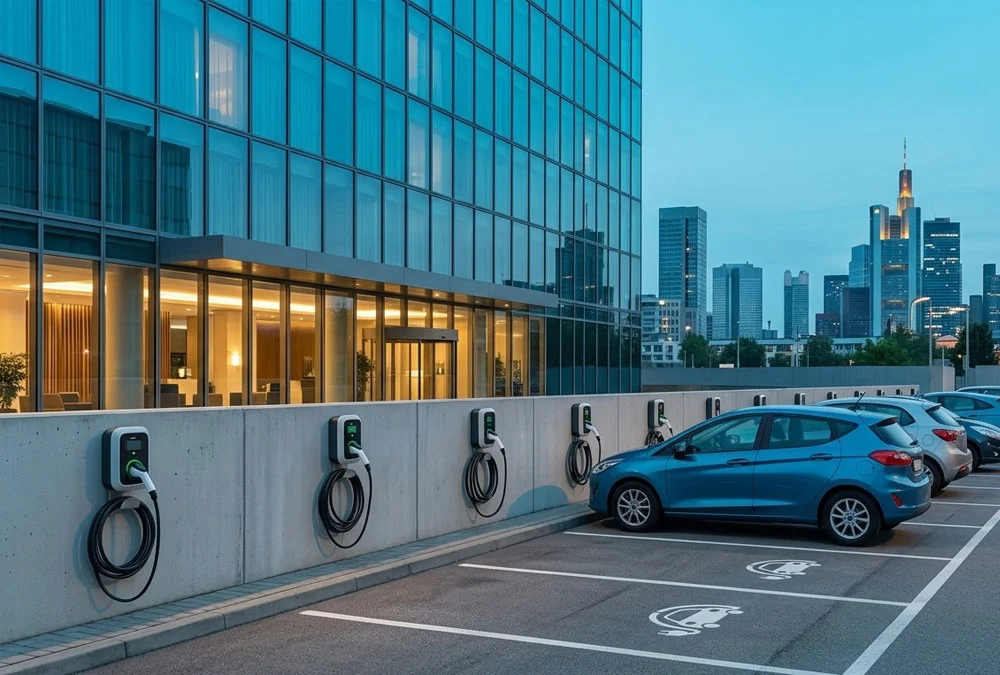
Choosing between 11 kW vs 22 kW EV chargers for hotels looks simple until the car park fills at check-in. Eight 11 kW-capable ports and four 22 kW ports both add up to 88 kW of charger nameplate power. Yet only the first layout gives eight overnight guests a connector without asking four people to move their cars during the night.
That difference matters because a hotel sells time at the destination, not minutes at a roadside charging stop. The UK hotel report Rebooting Hotel EV Charging frames the decision around the right location, time and charging speed. For an overnight property, 11 kW is usually the first three-phase power level to evaluate. A 22 kW charger earns its place only when the vehicle, parking window and site power can use the additional capacity.
Direct answer: Choose 11 kW as the starting point for broad overnight coverage. Evaluate 22 kW for verified short-stay guests, valet rotation, hotel fleets or vehicles that accept more than 11 kW AC. Do not approve either option until you have checked required energy by departure, connector demand, vehicle onboard-charger limits and the hotel’s controlled electrical capacity.
In this guide
11 kW vs 22 kW Hotel EV Chargers: The 60-Second Decision
| Hotel condition | 11 kW fit | 22 kW fit | Buyer benefit | Evidence to collect |
|---|---|---|---|---|
| Most cars remain parked for 8–12 hours | Strong starting option | Usually unnecessary unless another use case exists | Preserves capacity for more connected bays | Required kWh, arrival and departure times |
| Restaurant, spa or conference stays are 1–3 hours | May under-deliver energy within the window | Useful when target vehicles accept the power | Makes a short destination stop more valuable | Short-stay energy target and vehicle AC acceptance |
| Site power is constrained but guest demand is growing | Supports a wider managed charging layer | Use selectively or commission below nameplate where supported | Avoids buying unusable peak capacity | Interval building load and controller behaviour |
| Valet or fleet vehicles can be rotated predictably | Adequate for longer task windows | Can increase useful sessions per bay | Higher power now creates actual turnover | Dispatch plan, vehicle list and missed-task cost |
The choice is therefore not “slow versus fast.” It is a capacity-allocation decision. The hotel must decide whether its next kilowatt is more valuable as higher power on one bay or as reliable access across more bays.
Why a 22 kW Hotel Charger Does Not Always Charge Twice as Fast
Separate the Four Power Limits
A procurement table that contains only “11 kW” or “22 kW” is incomplete. Actual charging power is limited by the lowest applicable constraint:
- EVSE nameplate rating: the maximum the charger is designed to offer under its specified conditions.
- Configured limit: the current or power value set during commissioning.
- Site allocation: the power available after load management accounts for the hotel and other charging sessions.
- Vehicle acceptance: the limit imposed by the vehicle’s onboard charger, state and control system.
This explains a frequent guest complaint: a hotel advertises a 22 kW charger, but the dashboard shows roughly 11 kW or less. The equipment may not be faulty. The car may accept only 11 kW AC, the station may be sharing power, or the site controller may be protecting the building’s maximum demand. Hotels should publish the charger rating as “up to” and avoid promising a session power they cannot control.
The Vehicle Onboard Charger Sets the AC Ceiling
With AC charging, conversion to battery-ready DC takes place inside the vehicle. A 22 kW EVSE cannot force a vehicle with an 11 kW onboard charger to accept 22 kW. The European Alternative Fuels Observatory places three-phase AC from 7.4 kW through 22 kW in its medium-speed category and identifies Type 2 as the European AC interface baseline in its recharging systems overview. That classification describes the charging point; it does not guarantee that every connected car can use its maximum output.
Do not solve this by publishing a quickly outdated list of vehicle models. Ask for the expected guest and fleet mix, examine session records where available, and verify the current vehicle specification for any operationally important model.
Ask About Single-Phase Vehicles, Not Just Total kW
An EPC should also ask how each proposed charger behaves when a single-phase vehicle connects. An 11 kW three-phase design is commonly associated with 16 A per phase, while a 22 kW design is commonly associated with 32 A per phase. Depending on the charger, supply and configuration, that difference can affect the power available to a single-phase vehicle. Do not infer the answer from the front-page rating—request model-specific phase-current behaviour and test it during commissioning.
For Overnight Guests, More EV Charging Ports Can Beat More Power
Hotel charging has an unusual occupancy pattern. A car can finish charging at 02:00 and still occupy the bay until the guest checks out. Unless the hotel operates a staffed valet process, charging completion does not create another usable overnight session. Idle fees or instructions to move a car during the night may turn a technical success into a poor guest experience.
Worked Example: Eight 11 kW Ports vs Four 22 kW Ports
Engineering illustration—not a final design: eight overnight guests each need 24 kWh measured at the EVSE meter before departure. Their cars remain connected for ten usable hours.
Total energy: 8 × 24 kWh = 192 kWh
Ideal average site power: 192 kWh ÷ 10 h = 19.2 kW
Design caveat: add appropriate allowance for interruptions, allocation constraints and operating reserve. If the 24 kWh target is battery-side rather than meter-side, conversion losses must also be included without double-counting.
Eight 11 kW-capable ports have 88 kW of aggregate nameplate power. Four 22 kW ports also total 88 kW. But the eight-port arrangement lets every guest plug in on arrival. A compatible management system could distribute a controlled site allocation across the night instead of running every port at full rating.
The four-port design can serve only four vehicles without rotation. If no one moves cars overnight, unused nameplate power does not solve the connector shortage. This is why hotels should track denied charging requests, late arrivals and bay occupancy—not only kilowatt-hours sold.
When 11 kW EV Chargers Are the Better Hotel Starting Point
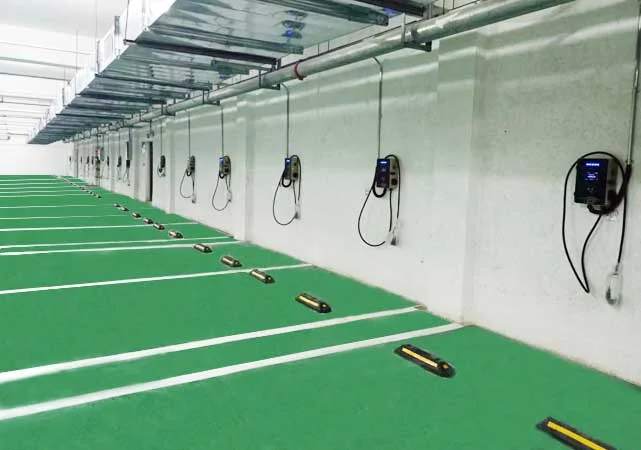
An 11 kW hotel EV charger is a strong option to evaluate when most vehicles remain parked through the night, the hotel wants to expand connector coverage, and there is no measured short-stay energy deficit. It is especially relevant when the expected vehicles cannot use more than 11 kW AC.
- Overnight guest parking: the available time often matters more than maximum per-port power.
- Multiple simultaneous arrivals: more connectors reduce the risk that a late guest finds every charging position occupied.
- Managed electrical capacity: a bank of ports can share a site limit when compatible hardware and controls are properly designed.
- Scalable deployment: civil works and electrical pathways can be prepared for additional ports instead of over-powering the first few bays.
This does not mean every 11 kW port must receive 11 kW continuously. The equipment rating and the site’s controlled allocation are different values. What matters is whether each connected vehicle receives its required energy before departure.
When 22 kW EV Chargers Create Real Value for a Hotel
A 22 kW hotel charger becomes useful when time is genuinely scarce and the vehicle population can use the output. Restaurants, spas, conferences and event parking may create two- or three-hour windows. A valet team may be able to rotate cars. A hotel shuttle or service fleet may have known vehicles, defined departure deadlines and a measurable cost of missing a charge.
Short-stay illustration: a visitor needs 30 kWh at the EVSE meter within two hours. The ideal average is 15 kW. An 11 kW session can deliver no more than 22 kWh over that window before interruptions. A 22 kW unit could theoretically deliver up to 44 kWh, but only if the car accepts the higher AC power and the site allocates it. Here, 22 kW answers a demonstrated energy deadline rather than a vague desire to “future-proof.”
A further option is 22 kW-capable hardware commissioned below its maximum output, where the selected model and control architecture support that strategy. This may preserve flexibility without allowing every port to impose 22 kW on the site from day one. The tender must specify the configurable range, simultaneous output and upgrade procedure; never assume them.
Use NIGHT to Choose Between 11 kW and 22 kW Hotel Chargers
The NIGHT framework turns a charger-power discussion into a hotel design brief.
| NIGHT input | Question | Data required | Buyer benefit |
|---|---|---|---|
| N — Needed energy | How many kWh must be delivered before departure? | Session energy, next journey, target departure energy | Prevents sizing from battery capacity alone |
| I — Incoming capacity | What controlled power remains after hotel loads? | Interval load, connection limit, switchgear and feeder capacity | Defines a realistic EV site cap |
| G — Guest window | How long does each user group remain parked? | Check-in/out, dining, spa, event and staff patterns | Separates overnight coverage from short-stay service |
| H — Hardware and vehicle limits | What can the system and cars actually use? | OBC, phase behaviour, configured limit, controller and simultaneous output | Avoids paying for unusable nameplate power |
| T — Total ports and turnover | How many cars arrive together, and can bays rotate? | Peak requests, occupancy, reservations and valet process | Produces the connector count and operating policy |
The hotel should complete NIGHT before requesting equipment quotations. Otherwise, vendors may be comparing different assumptions while presenting superficially similar 11 kW and 22 kW offers.
Compare 11 kW and 22 kW Hotel Charger Electrical Requirements
For a current AnengJi product example, the Q6 AC wallbox range lists the Q6-EH11S4 at 11 kW, AC 400 V and 16 A, and the Q6-EH22S4 at 22 kW, AC 400 V and 32 A. These values illustrate the current difference per phase. They are manufacturer-listed specifications, not a complete hotel design.
| Design item | 11 kW example | 22 kW example | What the buyer must verify |
|---|---|---|---|
| Published supply/output | 400 V AC, 16 A, 11 kW | 400 V AC, 32 A, 22 kW | Latest model datasheet and destination-market version |
| Connected load for eight ports | 88 kW nameplate | 176 kW nameplate | Controlled maximum demand and minimum allocation per active session |
| Vehicle benefit | Useful to vehicles accepting up to 11 kW or less | Extra speed only above an 11 kW vehicle limit | Expected OBC and single-/three-phase behaviour |
The cable, protection, voltage drop, earthing, metering, distribution board and inspection requirements must be designed for the local installation. The UK Office for Zero Emission Vehicles states in its technical specification that AC equipment power is measured or calculated at nominal 230 V single-phase or 400 V three-phase. This supports the electrical distinction, but the document is UK scheme guidance—not a universal hotel code for Europe.
Dynamic Load Management Must Be Specified, Not Assumed
Hotel demand changes with kitchens, laundry, hot water, lifts and heating or cooling. Guest arrivals may overlap with an evening building peak. A compatible charging-management system can reduce EV allocation while the hotel load is high and restore it later, but the RFQ must define the meter location, response time, per-port minimum, priority rules and failure behaviour.
Current GOV.UK chargepoint infrastructure guidance recognizes load balancing and building electrical upgrades as ways to provide appropriate power for multiple chargepoints. It also evaluates minimum supply at sockets used simultaneously. For a hotel buyer, the practical lesson is to request simultaneous-output evidence rather than accepting a total cabinet or product rating.
Compare Hotel EV Charging Cost Without Inventing a Universal Price
A 22 kW product may not cost twice as much as an 11 kW product, but that does not mean the completed project costs are equal. Higher current can affect distribution capacity, protective equipment, cable sizing, containment, voltage drop and the number of ports that fit inside the site’s maximum demand. Local labour, trenching, permits, taxes, grid work, communications and maintenance can outweigh the charger price.
Compare bids using one boundary:
- charger hardware and mounting;
- distribution board, protection, metering and cabling;
- civil works, containment and future pathways;
- network, backend, payment and software fees;
- commissioning, service, spare parts and fault response;
- the operational cost of too few usable connectors.
That final item is easy to miss. A cheaper four-port design can become expensive when the fifth guest cannot charge, the front desk has no alternative, and staff must manage complaints. Conversely, paying for 22 kW on every bay is poor value if vehicles and parking windows never use the added power.
Europe First: Do Not Copy the 11/22 kW Decision Directly to the US
European Hotel Projects
European specifications commonly discuss 11 kW and 22 kW at 400 V three-phase with Type 2. Even so, the EU-27, EEA and UK do not share one identical permitting, electrical, payment or building framework. Verify the destination country, public-access status and local wiring rules before finalizing equipment.
United States Hotel Projects
US buyers should translate the decision into actual service voltage, circuit current and vehicle acceptance rather than copying the European labels. The U.S. Department of Energy explains in its EVSE infrastructure training that AC Level 2 supplies AC to the vehicle’s onboard charger and describes 208 V commercial installations in the federal-site context. A hotel project must then confirm local code, utility service and the expected J1772 or J3400/NACS vehicle population.
What Should a Hotel or EPC Put in the 11 kW vs 22 kW RFQ?
Information the Hotel Should Provide
- country, utility service and applicable project rules;
- total parking spaces and proposed charging bays;
- guest, restaurant, event, staff, valet and fleet parking windows;
- estimated or measured kWh required by departure;
- interval building load, connection limit and electrical expansion plan;
- guest-only, public, paid, complimentary and reservation policies.
Questions the Charger Supplier Must Answer
- What is the output per connector when every port is active?
- Can current be configured, and what is the supported control range?
- How does the product serve single-phase and three-phase vehicles?
- What happens if the site meter, load controller or network connection fails?
- Which socket, tethered cable and connector configurations are available?
- Which OCPP, payment, environmental, certification, warranty and service claims apply to this exact model and country?
Commissioning and Acceptance Metrics
Do not accept the project after one car starts charging. Test all intended connectors, concurrent sessions, the site power cap, priority logic, controller failure, authentication paths and recovery procedures. Record session-start success, allocated versus delivered power, energy delivered by departure, check-in-period port availability and fault-response time.
Which AnengJi 11 kW or 22 kW Charger Should a Hotel Evaluate?
AnengJi currently lists Q6-EH11S4 and Q6-EH22S4 variants in its Q6 wallbox selection. The published table provides a useful starting point for comparing 400 V, 16 A, 11 kW and 400 V, 32 A, 22 kW options.
A hotel or EPC should not select the variant from power alone. Request the latest model-specific datasheet and confirm connector or socket configuration, load-management compatibility, communications, authentication, payment, protection, environmental rating, applicable certification, warranty and service arrangements for the destination market. Other commercial AC charging stations may suit floor-mounted or multi-port layouts, but each specification requires the same project-level validation.
11 kW vs 22 kW EV Chargers for Hotels FAQ
Is 11 kW enough for overnight hotel guests?
Often, but not automatically. Divide the required energy at the defined metering point by the usable charging window, then check vehicle acceptance, concurrent demand, losses where applicable and reserve. An eight- to twelve-hour stay frequently makes 11 kW a strong starting option.
Will a 22 kW charger charge every EV twice as fast?
No. A vehicle limited to 11 kW AC will not accept 22 kW from a higher-rated EVSE. Site load management and configured current can reduce power further.
Do 11 kW and 22 kW chargers require three-phase power in Europe?
Common European implementations use 400 V three-phase, with 11 kW associated with 16 A per phase and 22 kW with 32 A per phase. Verify the exact product, supply and national installation requirements.
Should a hotel install more 11 kW ports or fewer 22 kW ports?
For one-rotation overnight parking, more managed ports often provide greater guest value. Fewer 22 kW ports are justified when shorter stays, compatible vehicles or a reliable rotation process create measurable turnover.
Can a hotel cap a 22 kW charger below its rated output?
Some products and management systems allow configurable or dynamic limits, but this is model-specific. Confirm the supported range, control method, fallback behaviour and upgrade procedure in writing.
What happens when several guests charge at once?
Without load management, the system is limited by its fixed circuits and distribution design. With compatible dynamic control, the available site allocation can be shared according to defined priorities. The hotel must still confirm that every vehicle can receive its required energy by departure.
Buy the Departure Outcome, Not the Highest Number
For most overnight-focused hotels, 11 kW is the first three-phase option worth assessing because it can balance useful per-vehicle power with broader connector coverage. It is not a universal answer: short-stay amenities, valet operations and known 22 kW-capable vehicles can create a sound case for selected 22 kW bays.
The strongest specification does not begin with a charger catalogue. It begins with NIGHT: needed energy, incoming capacity, guest window, hardware and vehicle limits, and total ports and turnover. That evidence tells the hotel whether to install 11 kW, 22 kW or a managed mix—and gives the EPC a design that can be tested at handover.