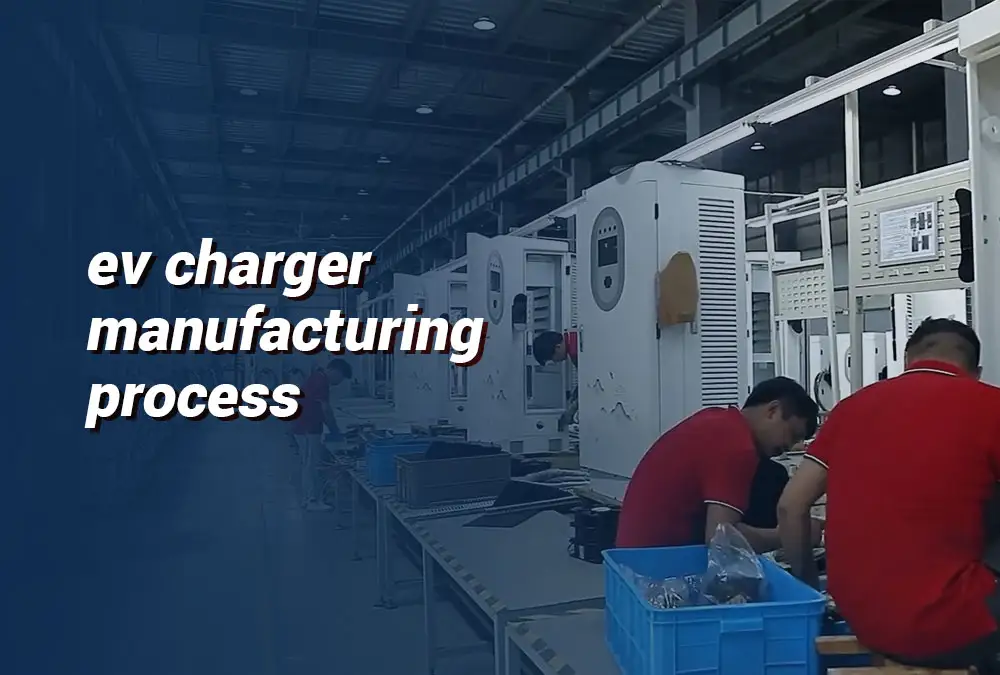
Introduction
An EV charger manufacturing process is not simply a sequence of cutting a cabinet, installing components and switching on the finished unit. For an EPC contractor, charge point operator, distributor or commercial-project buyer, the more important question is whether the delivered charger matches the approved design—and whether its components, firmware and test results can be traced to the exact unit being purchased.
That distinction matters when two chargers look similar but behave very differently in the field. One may use an approved component set, controlled terminal assembly and a tested software configuration. Another may carry the same rated power on its label while lacking clear change records, end-of-line evidence or a practical recovery path when connectivity fails. This guide follows the charger from product definition to shipment and shows how AnengJi’s AC, DC, flexible charging-stack and high-power platforms fit into that process.
The short answer: EV charger manufacturing covers requirements definition, electrical and mechanical design, approved-component sourcing, enclosure and electronics production, controlled assembly, firmware configuration, safety and functional testing, validation, traceability and shipment release. A commercial buyer should verify not only that these stages exist, but that the evidence applies to the exact model, configuration and software version being ordered.
What Products Move Through the EV Charger Manufacturing Process?
The process changes with the equipment architecture. In AC charging, the vehicle’s onboard charger performs the AC-to-DC conversion. A DC fast charger performs high-power conversion outside the vehicle and therefore adds power modules, DC output control and more demanding thermal work. A centralized charging stack separates power conversion from one or more dispensers, while a liquid-cooled high-power system introduces additional cooling-loop and interface-temperature controls.
| Product family | What is being manufactured | Manufacturing focus | Buyer benefit |
|---|---|---|---|
| AC charging stations | Supply switching, protection, control pilot, metering, access and communications | Electrical safety, contactor operation, vehicle handshake, enclosure and networking | A scalable option for homes, hotels, workplaces and other long-dwell parking |
| DC fast charging equipment | AC/DC power conversion, DC output control, vehicle communication, cooling and user systems | Power-module integration, insulation, busbars, thermal paths, output regulation and protection | Supports shorter dwell windows when the vehicle and site can accept the required power |
| Flexible charging stacks | Central power cabinets, charging terminals and coordinated power allocation | Cabinet-to-dispenser communication, multi-output testing, distribution logic and fault isolation | Allows power resources to be shared across several bays instead of fixing full power at every outlet |
| High-power and liquid-cooled configurations | High-power cabinets, dispensers and optional liquid-cooled cable or connector systems | Coolant circuit, leakage control, connector temperature, derating and sustained-load validation | Supports demanding fleet and hub applications when the vehicle, connector and grid design are aligned |
AnengJi’s published portfolio spans AC chargers, compact and commercial DC chargers, multi-output products and flexible charging systems. One example is the company’s integrated multi-output DC platform. The product page is a starting point, not the final specification: connector type, cooling method, protocol, output range, IP rating and certification evidence still need to be confirmed for the exact order code.
Step 1: Define the Product, Destination Market and Acceptance Plan
Manufacturing starts before material reaches the factory. The project team must define the destination country, site type, input supply, charger architecture, connector, expected vehicles, operating environment, user authentication, payment route, charging-station management system and service model. Without this baseline, a factory can build a functioning charger that is still wrong for the project.
For Europe, the product definition should identify the applicable EU, EEA, UK or national route rather than treating “Europe” as one approval. The European Commission explains that the manufacturer is responsible for conformity assessment, technical documentation, the EU declaration of conformity and CE marking where applicable. That responsibility makes the approved product identity important: the documents should match the delivered model and configuration. See the European Commission’s manufacturer guidance.
The IEC 61851-1 product page identifies equipment characteristics, operating conditions, the EV-to-supply-equipment connection and electrical safety among the standard’s core subjects. That does not prove a particular charger complies, but it shows why voltage, control functions, protection, markings and installation information must be considered before design release.
Before production approval, the buyer should provide:
- destination country and public/private operating model;
- vehicle types, connectors, voltage range and simultaneous charging requirement;
- available electrical supply and any site power limit;
- CSMS, OCPP, payment, RFID, telecom and offline-operation requirements;
- temperature, altitude, dust, water, corrosion and impact conditions;
- required documents, factory acceptance tests and delivery milestones.
Step 2: Convert the Approved Design Into a Controlled BOM
The bill of materials (BOM) determines much more than purchase cost. It fixes the approved power modules, controller, contactors, protective devices, energy meter, modem, display, cables, connectors, cooling parts and enclosure materials. An approved vendor list then identifies acceptable sources and, where permitted, evaluated alternatives.
This is where a common purchasing problem begins. A sample passes a laboratory evaluation, but a later production batch uses a substitute relay, modem or power module because the original part is unavailable. The exterior and model name remain unchanged, yet electrical behavior, thermal performance, software compatibility or the scope of previous evidence may change. The practical solution is a contractually defined change-notification process: no critical substitution should enter production until engineering has assessed its effect and the buyer has received the required evidence.
Incoming quality control should therefore be risk-based. Enclosures may require dimensional, coating and surface checks. PCB assemblies may need identity, workmanship and functional verification. Power modules, meters, cables and connectors should be checked against the approved part and purchase specification. Material-screening equipment can support this process, but owning an instrument does not by itself prove that every component or every restricted substance has been evaluated.
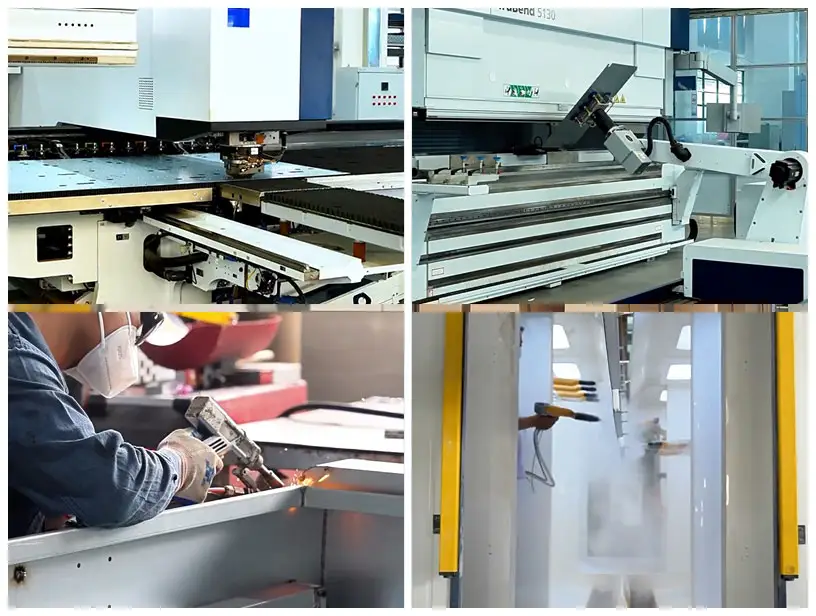
Step 3: Cut, Form, Weld and Coat the Charger Enclosure
The enclosure is part of the safety and service design, not cosmetic packaging. Its dimensions determine component clearances, airflow, cable bend radius, sealing surfaces and technician access. Poorly controlled openings can misalign a display or connector. Distorted doors can compress seals unevenly. Coating defects may not be obvious at factory acceptance but can accelerate corrosion outdoors.
AnengJi’s company-supplied manufacturing information identifies a TRUMPF automatic laser cutting machine, a YAWEI intelligent bending machine and CNC bending equipment within its production base. The typical sequence is:
- Laser cutting: sheet metal is cut to the released drawing, including mounting, ventilation and interface openings.
- CNC bending: panels and internal supports are formed to controlled angles and dimensions.
- Welding and sealing: structural parts are joined, then inspected for alignment, weld condition and sealing continuity.
- Surface preparation and coating: cleaning, preparation and powder coating create the specified finish and environmental barrier.
The buyer should not stop at machine brands. Useful evidence includes the released drawing revision, first-piece inspection, critical dimensions, coating specification and defect criteria. If a charger is offered with an IP54, IP55 or IP65 rating, request the exact model and report that support the claim. A rating achieved by one enclosure configuration does not automatically extend to every screen, payment terminal, cable gland or customized door.
Step 4: Prepare the Electronics, Power Modules and Wiring
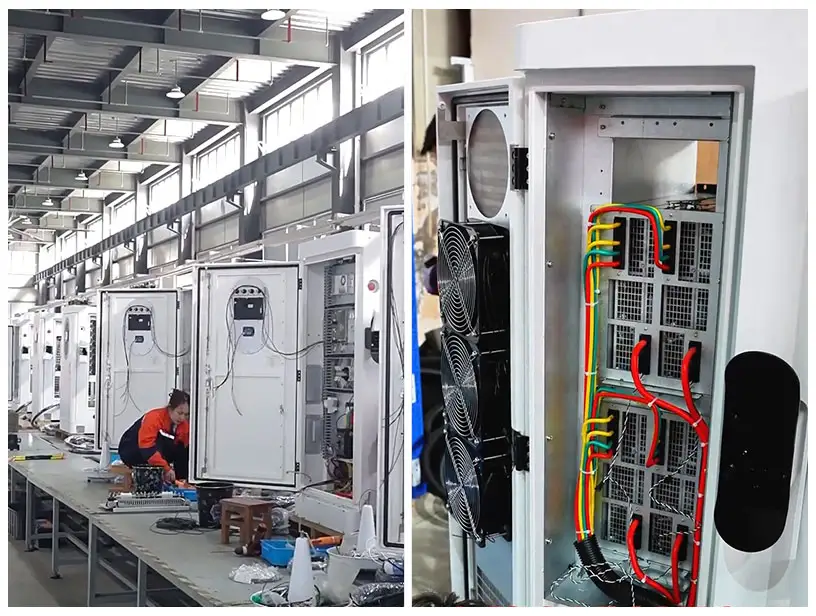
Electronic preparation differs sharply between AC and DC products. An AC charger generally controls and protects AC supply to the vehicle while exchanging the required control signals. A DC charger also converts power and regulates high-voltage DC output, so power modules, busbars, fans or pumps, insulation monitoring and thermal sensors become central to production quality.
PCB assemblies may be manufactured internally or sourced from qualified electronics suppliers. The article should not confuse component placement with system assembly: if a board is externally manufactured, the EV charger factory still needs a defined incoming inspection, firmware-loading method, functional test and traceable supplier record.
Wiring work deserves particular attention. A loose terminal can create localized resistance and heat even if the charger initially passes a basic power-on check. The manufacturing response is controlled stripping and crimping, correct conductor routing, specified tightening torque, calibrated tools and inspection of high-current joints. The installation contractor must then apply the same discipline to field supply terminals; factory quality cannot compensate for an incorrectly prepared site connection.
Step 5: Assemble the Charger and Build Serial-Number Traceability
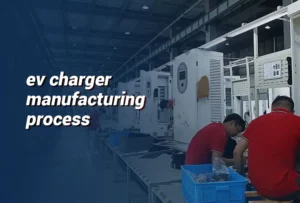
During final assembly, the enclosure, protective devices, controllers, HMI, meters, power modules, cable assemblies and communications hardware become one system. Work instructions should specify assembly order, critical fasteners, cable routes, connector seating, labels and inspections. The aim is repeatability: two units built to the same order should not depend on individual operator memory.
A useful manufacturing record links the serial number to the hardware revision, BOM revision, critical component batches, firmware, configuration, test result, operator or station and any rework. This is one of the details that matters after installation. When a fault appears in only part of a fleet, serial-level records can show whether the affected units share a component lot, firmware build or assembly event.
The golden-sample trap
A validated engineering sample is necessary, but it is not enough. Buyers need the production controls that keep later batches aligned with that sample. Ask how the factory manages alternative components, drawing revisions, firmware changes, test limits and rework. A product can retain the same cabinet and name while its risk profile changes internally.
Step 6: Load Firmware and Prove the Operating Configuration
Modern charging equipment ships as a hardware-and-software configuration. Production must establish which firmware build is loaded, which regional settings are enabled, how network credentials are provisioned and what happens if the charger loses its connection. The shipping record should identify the charger software and configuration, not merely the enclosure serial number.
This is where many operational complaints emerge. A charger powers on, but the buyer cannot change the backend endpoint, restore a failed firmware update, obtain administrator access or diagnose an offline session. These are not solved by another electrical test. They require defined ownership of credentials, logs, firmware packages, certificates, SIM/APN settings, recovery procedures and support escalation.
The Open Charge Alliance states that its certification program uses approved independent laboratories to test conformance with the OCPP specification. That provides useful evidence for a named product and software scope, but it does not test every commercial backend, payment route or site network. Review the official OCPP certification program, then repeat the required workflows with the intended CSMS. AnengJi’s OCPP procurement guide provides a more detailed acceptance path.
Step 7: Test Safety, Function, Power and Communication
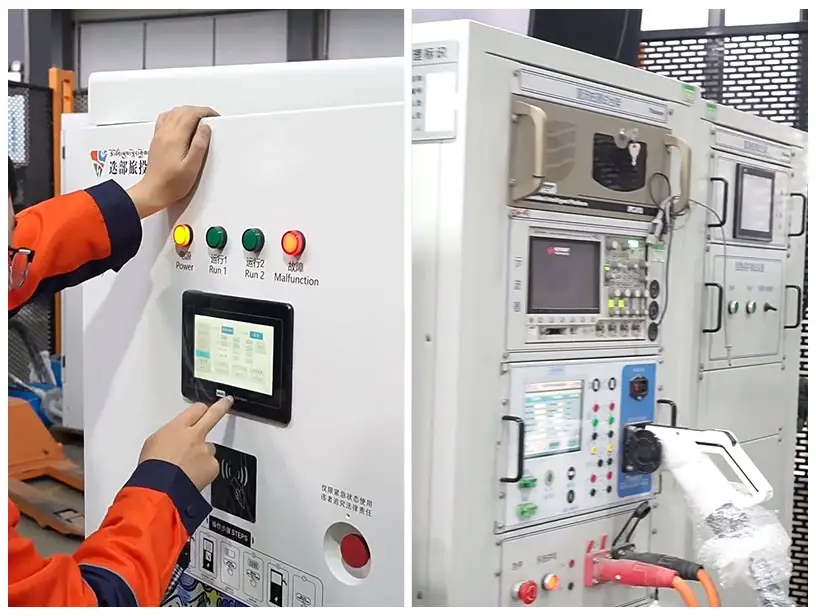
A charger can pass one test and still fail the operating chain. End-of-line testing should therefore separate electrical safety, charging function, power performance, user interface and communications. The factory acceptance test (FAT) then adds the project-specific configuration and buyer witnesses or records.
| Quality gate | Risk controlled | Evidence to request | Buyer benefit |
|---|---|---|---|
| Visual and dimensional inspection | Incorrect parts, damaged finish, misalignment or missing labels | Inspection result and defect disposition | Reduces installation delay caused by physical nonconformities |
| Protective-earth and insulation checks | Electrical shock or insulation failure | Test method, limits, instrument identity and unit result | Confirms that safety-critical checks apply to the shipped unit |
| Charging-sequence test | Authorization succeeds but energy delivery does not begin or stop correctly | Vehicle or simulator session log, stop reason and fault response | Tests the operating sequence instead of only powering the screen |
| Load and thermal test | Unstable output, excessive temperature or premature derating | Power level, duration, ambient condition, temperatures and pass limits | Shows whether the test represents the buyer’s duty cycle |
| Metering and power analysis | Incorrect energy or electrical-performance records | Defined measurement boundary, accuracy, calibration and results | Supports commissioning and billing-risk review |
| OCPP, HMI and payment workflow | A working power stage paired with failed business operations | Firmware, CSMS, network, authorization, session and recovery records | Reduces commissioning disputes among charger, backend and telecom teams |
AnengJi’s company information identifies electrical-life test equipment, an energy-dispersive X-ray fluorescence spectrometer, DC charger test benches, EV charger testers, a multi-channel power analyzer and AC test equipment. These assets can support material screening, electrical characterization, charging-function tests and component or system validation. Their real value comes from the approved method, trained operator, calibration status, test limits and retained result—not the equipment name alone.
Step 8: Separate Validation, Sampling and Routine Production Tests
The word “tested” is incomplete without scope. Design validation may expose representative samples to water, dust, temperature, impact, corrosion or endurance conditions. Process audits and periodic samples check whether production remains stable. Routine end-of-line tests are performed according to the factory’s production plan on finished units. These three layers answer different questions.
The same distinction applies to waterproof testing. A type test supporting an IP rating, a production-line leak test and a visual seal inspection are not interchangeable. When reviewing an IP claim, ask which model and enclosure configuration were evaluated, which openings and accessories were fitted, and whether the customized product remains within the documented scope.
Aging or burn-in also needs a defined boundary. “72-hour aging” sounds reassuring, but duration alone says little. A buyer should ask whether every unit or a sample is tested, at what load and ambient temperature, how start-stop cycles are applied, which faults block release and how retesting is recorded. The appropriate plan may differ between an AC wallbox, a modular DC cabinet and a liquid-cooled high-power system.
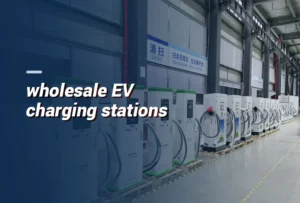
Inside AnengJi’s 40,000 m² EV Charger Production Base
AnengJi’s published company information describes a production base covering approximately 40,000 m², supported by more than 50 production and testing assets and more than 30 R&D professionals. The portfolio includes AC charging, DC fast charging, portable equipment, flexible charging stacks, high-power systems, EVSE components and OEM/ODM or SKD support. Company information also states that charging equipment has been supplied across more than 100 countries and regions.
For a buyer, these figures are useful context, but the procurement decision still belongs at model level. Factory size does not answer whether a selected charger has the correct connector, modem, meter, payment terminal, firmware, protection, environmental rating or market documents. That is why the production route should move from project requirements to a frozen configuration, then to serial-level inspection and release.
The R&D organization supports hardware, software and product adaptation across the company’s charger families. Company-supplied information also lists more than 100 patents across invention, utility-model and design categories. Patent quantity can indicate sustained development activity, but it is not a replacement for the product evidence required by an EPC specification or local authority.
How Quality Systems and Product Certificates Fit the Process
Management-system certification and product compliance answer different questions. Company-supplied records list ISO 9001, ISO 14001, ISO 45001 and IATF 16949 systems. These concern organizational processes and their certified scope. They do not automatically prove that every charger model satisfies the electrical, EMC, radio, metrology or market-access requirements of a destination country.
At product level, AnengJi information references CCC, CE, TÜV, UL and CB documentation, together with reports identified in company materials as coming from Kaipu and Taier laboratories. The formal English name of each issuing body should be taken from the report itself. These references should be reviewed against the certificate holder, exact model, hardware and firmware configuration, standard edition, issuing body, validity and any factory location in scope. IP54, IP55 and IP65 evidence should likewise be mapped to the relevant enclosure and product configuration rather than presented as one company-wide rating.
For the United States, UL Solutions identifies UL 2594 for AC EVSE and UL 2202 for DC charging equipment among the principal standards used in its EV charging infrastructure services. The page also lists IEC 61851-series routes for international markets. This supports an important sourcing rule: a European document package should not be assumed to satisfy a North American installation, and vice versa. Review the UL Solutions EV charging standards overview.
Software and hardware changes must remain part of this review. The European Commission’s 2022 Blue Guide overview specifically notes that product rules must consider physical modifications and software updates. For an OEM project, changing a controller, modem, power module, enclosure opening or firmware build may therefore require a documented compliance assessment rather than a silent production substitution.
For a deeper distinction between company qualifications, product evidence and destination-market approval, use AnengJi’s manufacturer certification guide.
Step 9: Complete FAT, Packaging and Shipment Release
Factory acceptance should close the gap between the catalogue and the ordered system. The FAT record should identify the product, serial number, hardware and firmware revision, interfaces, test setup, results, open deviations and approval status. For a networked commercial charger, the buyer may also need witnessed authorization, transaction, remote-control, offline and recovery scenarios.
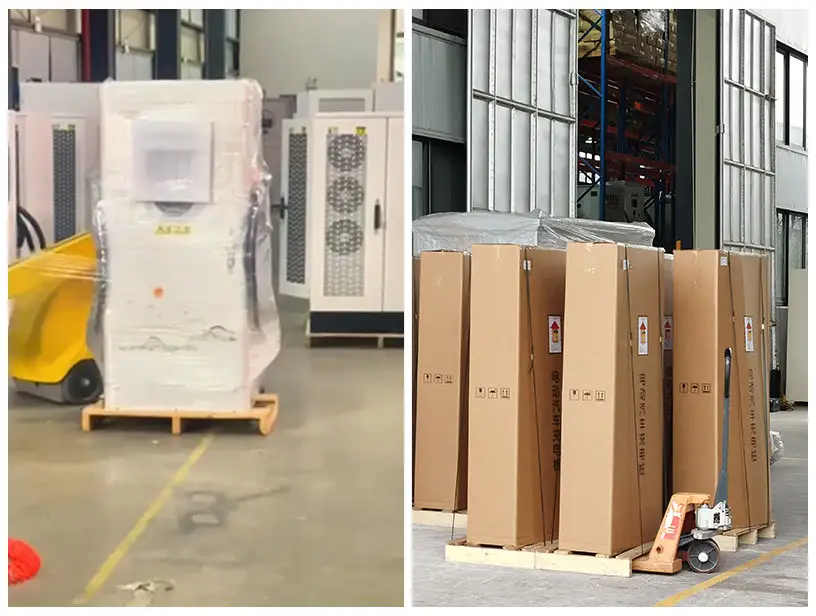
Packaging is the final quality gate. Internal supports must protect the HMI, connector holsters, cables and enclosure finish without placing damaging loads on doors or fittings. Accessories, keys, mounting parts, documents and labels should be checked against the packing list. Where transport vibration, shock or moisture protection is claimed, ask whether it comes from an approved packaging design, a validation test or only a visual packing practice.
| Release file item | Why it matters | Buyer check |
|---|---|---|
| Approved specification and order code | Defines what was purchased | Match power, connector, cable, HMI, payment and communications |
| Serial-level EOL/FAT results | Connects test evidence to delivered units | Confirm failed tests, rework and retest are visible |
| Firmware and configuration list | Defines the operating product | Record OCPP, endpoint, security, tariff and offline settings |
| Certificate/report schedule | Prevents unrelated certificates being accepted | Match legal entity, model, configuration, standard and validity |
| Installation, service and spare-parts documents | Supports commissioning and recovery | Confirm access rights, fault codes, replaceable modules and escalation path |
How to Audit an Electric Vehicle Charger Manufacturer
A useful factory audit follows three questions: Build, Prove and Trace. This framework turns a factory tour into a procurement decision.
- Build: Which parts and processes are performed at the factory? Which are sourced? What drawings, work instructions and approved suppliers control them?
- Prove: Which tests validate the design, which are sampled during production and which are performed on every finished unit? What are the limits and failure actions?
- Trace: Can the delivered serial number be linked to BOM revision, critical components, firmware, configuration, calibrated equipment, test results and rework?
If a supplier can show impressive machinery but cannot answer Prove and Trace, the buyer still carries uncertainty. Conversely, a clear control plan and evidence package can make customization safer because changes are visible and evaluated instead of being treated as informal production adjustments.
Frequently Asked Questions About EV Charger Manufacturing
How long does the EV charger manufacturing process take?
There is no reliable universal lead time. A standard repeat order depends mainly on component availability, production capacity, testing and logistics. A new OEM or destination-market configuration may also require engineering review, samples, certification work, software integration and buyer acceptance. Ask for separate dates for design freeze, material readiness, pilot build, approval, mass production and shipment.
Are all EV chargers tested before shipment?
A buyer should not accept a simple yes. Request the routine test schedule, sample-based validation plan and FAT scope. Confirm which checks are performed on every serial number and which apply only to representative units or periodic samples.
What is the difference between validation and end-of-line testing?
Validation asks whether the design can meet defined requirements under specified conditions. End-of-line testing asks whether a manufactured unit was assembled and configured correctly against routine release limits. Both are necessary; one does not replace the other.
Does OCPP support prove that the charger will work with any backend?
No. Confirm the exact OCPP version, implemented or certified scope, firmware and target CSMS. Then test the required authorization, transaction, diagnostics, smart-charging and recovery workflows across the production network.
Can a company build its own commercial EV charger?
A commercial charger requires electrical, mechanical, software, safety, manufacturing and market-compliance capability. A prototype or DIY unit is not equivalent to production EVSE that can be legally placed on a target market and supported throughout its service life.
What documents should a commercial buyer request?
Request the approved specification, model and serial-number list, hardware and firmware revisions, EOL/FAT results, applicable certificates or declarations, full report references, installation and service manuals, spare-parts schedule, warranty terms, administrator-access handover and change-notification procedure.
Turn the Manufacturing Process Into a Project Specification
The most useful outcome of understanding the EV charger manufacturing process is not a longer list of factory machines. It is a clearer specification. Define what the charger must do, what environment it must survive, which interfaces it must support, which evidence must match the product and how the completed unit will be accepted.
For an AnengJi manufacturing review, provide the destination country, application, vehicle and connector requirements, AC or DC power level, available site supply, number of simultaneous vehicles, environmental conditions, CSMS/OCPP and payment requirements, quantity, branding scope, required documents and acceptance tests. The engineering and commercial teams can then identify the appropriate product platform and the points that still require project-specific verification.