Introduction
Heavy-duty transport is reaching a turning point. As fleet managers shift from diesel to battery electric trucks, they quickly run into an uncompromising physical wall: battery capacity and downtime. Plugging a 600 kWh Class 8 electric truck into a conventional 150 kW passenger car charger takes four hours. In freight logistics, four hours of idle time kills revenue. The Megawatt Charging System is engineered to break this bottleneck by delivering extreme power safely during mandatory driver rest periods. Yet, across industry forums and fleet boardrooms, rumors persist about grid meltdowns, destroyed batteries, and unpayable capital costs. In this technical analysis, we dismantle the 10 biggest myths about MCS charging with hard engineering realities, financial metrics, and grid-integration strategies.
What Is a Megawatt Charging System and Why Does Long-Haul Electric Transport Need It?
Understanding Megawatt Charging System (MCS) Technology
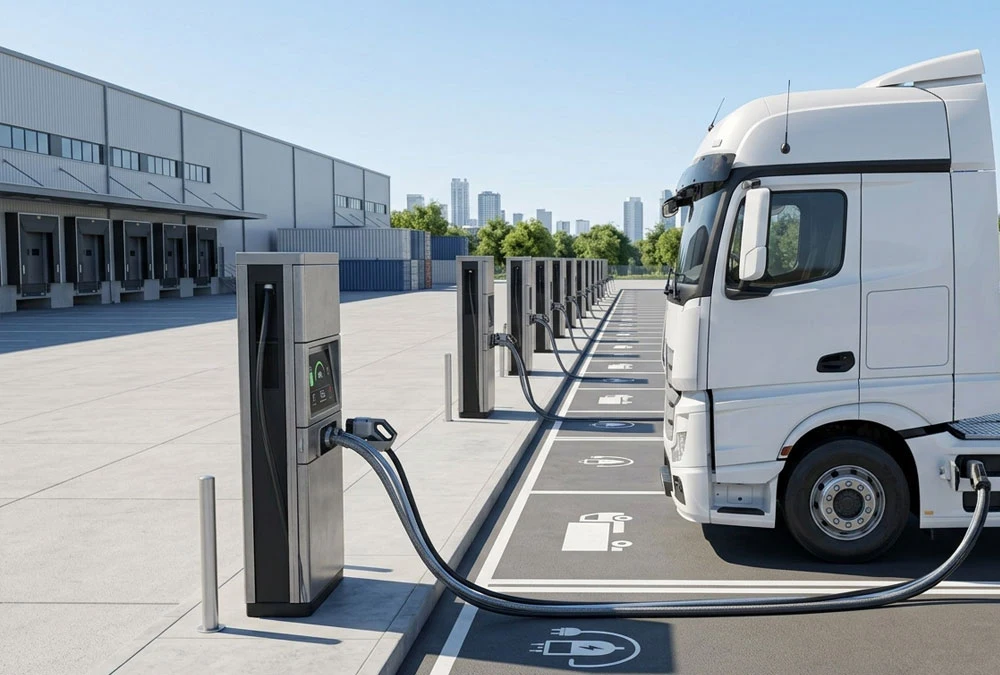
The Megawatt Charging System is a standardized high-power charging interface built specifically for heavy-duty electric commercial vehicles, marine vessels, and aviation. Operating at up to 1,250 volts DC and 3,000 amperes, the system is designed to deliver a maximum power rating of 3.75 megawatts (3,750 kW). Beyond sheer power, MCS incorporates specialized liquid-cooled connector cables, advanced digital communications via ISO 15118-20, and automated mechanical locking mechanisms to withstand daily heavy industrial usage.
Why Traditional DC Fast Charging Cannot Fully Support Long-Haul Trucks
Conventional Combined Charging System (CCS2) infrastructure was designed primarily for light-duty vehicles. CCS2 connectors top out around 500 amperes continuous current, even with active liquid cooling, capping total deliverable power around 350 kW to 400 kW. For a light passenger EV with an 80 kWh pack, 350 kW provides an 80% charge in 15 minutes. For a Class 8 long-haul tractor pulling a full payload with a 600 kWh to 800 kWh traction pack, 350 kW requires over an hour and a half to replenish sufficient energy. This extends turnaround cycles, reduces daily haulage trips, and degrades logistics asset utilization.
How MCS Supports Future Electric Truck Electrification
Long-haul logistics operates under strict legal driving hours. In the United States, Hours of Service (HOS) rules require a 30-minute break after eight hours of driving. In Europe, tachograph rules mandate a 45-minute rest every four and a half hours. MCS aligns vehicle charging with these exact legal rest breaks. By pumping 1.2 MW to 2.0 MW directly into the vehicle during a 30-minute stop, drivers gain 300 to 400 kilometers of additional range without adding a single minute of operational delay to their freight schedule.
Myth 1: Megawatt Charging System Is Just an Enlarged CCS Charger
Reality: MCS Is Designed for Heavy-Duty Vehicle Requirements
Assuming MCS is simply a scaled-up CCS2 connector fundamentally misunderstands high-voltage power electronics and mechanical engineering. Pushing 3,000 amperes creates extreme thermal and physical stresses. Heat generation inside a conductor scales quadratically with current, governed by Joule’s Law ($P = I^2 R$). Pushing six times the current of a standard CCS charger through a cable generates up to 36 times the raw heat energy. MCS addresses this not merely by adding bigger copper wires, but by reimagining the entire physical, electrical, and thermal interface.
Key Differences Between MCS and CCS2 Charging
| Engineering Parameter | CCS2 Standard | Megawatt Charging System (MCS) | Direct User & Fleet Operational Advantage |
|---|---|---|---|
| Max Voltage | 1,000 V DC | 1,250 V DC | Higher Electrical Efficiency: Higher voltage reduces current demands, minimizing resistive heat losses and cable weight. |
| Max Continuous Current | 500 A (Liquid-Cooled) | 3,000 A (Liquid-Cooled) | Ultra-Fast Energy Transfer: Delivers up to 6x faster energy delivery into large battery packs during short stops. |
| Max Power Output | 350 kW – 500 kW | 3.75 MW (3,750 kW) | Eliminates Idle Downtime: Replenishes commercial vehicle range within mandatory driver break windows. |
| Connector Geometry | Combo oval layout, dual DC pins | Ergonomic triangular layout, isolated signal pins | Enhanced Operator Safety: Prevents arcing, minimizes insertion force, and simplifies single-handed or automated plugging. |
| Automated Coupling | Not supported natively | Designed for automated robotic coupling | Depot Automation: Enables hands-free charging in automated logistics yards and autonomous fleet hubs. |
Buyer Advantage: Choosing an MCS-compliant architecture future-proofs your charging yard against connector obsolescence, ensuring compatibility with upcoming Class 8 electric trucks from global OEMs.
Myth 2: Megawatt Charging Will Damage Electric Truck Batteries Faster
Reality: Intelligent Battery Management Enables Safe High-Power Charging
A common concern among fleet operators is that feeding megawatts of power into a battery will trigger rapid cell degradation or thermal runaway. In reality, cell degradation is driven by heat accumulation, localized voltage spikes, and lithium plating—not high power alone. Modern heavy-duty traction batteries use specialized lithium iron phosphate (LFP) or high-nickel NMC chemistries specifically designed for higher C-rate acceptance. When controlled by intelligent thermal management circuits and high-speed Battery Management Systems (BMS), high-power charging remains safely within the cell stability envelope.
How Battery Management Systems Protect EV Truck Batteries
During an MCS charging session, the BMS maintains continuous control over the charging station via ISO 15118-20 CAN/Ethernet communications. The BMS measures thousands of sensor data points per second, monitoring cell-level temperatures, voltage differentials, and internal resistance. If a specific battery module rises above its optimal temperature threshold (typically 25°C to 35°C), the BMS commands the MCS dispenser to throttle current dynamically while the vehicle’s onboard chiller system ramps up coolant flow.
Why Faster Charging Does Not Automatically Mean Shorter Battery Life
Battery longevity depends heavily on the charging curve. MCS does not blast 3.75 MW into a battery from 0% to 100% state of charge (SoC). Instead, it applies a stepped or continuous step-down charging profile. High power is delivered primarily during the low-to-mid SoC window (10% to 60%), where internal resistance is lowest and lithium intercalation occurs smoothly. According to testing metrics published by the Charging Interface Initiative, pre-conditioning the battery pack to an optimal thermal window prior to charging eliminates localized hot spots, preserving cycle life across thousands of heavy commercial duty cycles.
Myth 3: Megawatt Charging Systems Are Unstable or Unproven Technology
Reality: MCS Is Built on Proven Industrial Power Electronics
Some industry observers view MCS as experimental. In truth, the power conversion technology behind MCS has been proven for years in industrial applications such as electric arc furnaces, high-speed rail, utility-grade static var compensators, and marine electric propulsion systems. The core innovation of MCS lies in miniaturizing these industrial power conversion systems into outdoor-rated, modular charging cabinets.
Key Technologies Behind Reliable MCS Charging
- Silicon Carbide (SiC) Power Inverters: Modern MCS chargers use SiC MOSFET modules operating at high switching frequencies. This reduces heat loss, achieves conversion efficiencies exceeding 97.5%, and shrinks transformer footprints.
- Closed-Loop Liquid-to-Liquid Cooling: Both the power conversion cabinet and the charging cable dispenser use active glycol or synthetic oil chillers to remove thermal loads instantly during 3,000 A charging runs.
- Galvanic Isolation & Active Protection: High-frequency medium-voltage isolation transformers protect the vehicle’s traction pack from grid surges, ground faults, and common-mode noise.
Industry Adoption of MCS for Commercial Transportation
Major commercial vehicle manufacturers, port authorities, and corridor operators are already validating MCS installations globally. From port drayage operations in California to long-haul freight corridors in Europe, pilot projects demonstrate that modular MCS architectures can maintain high uptime even under continuous daily multi-shift operations.
Myth 4: Megawatt Charging Systems Are Too Expensive and Impractical
Reality: MCS Reduces Long-Term Fleet Operating Costs
Looking strictly at the capital expenditure (CapEx) of an MCS dispenser overlooks the broader total cost of ownership (TCO) equation. In commercial freight, revenues are earned per ton-mile. A truck parked at a slow charger for three extra hours every day loses revenue, increases driver labor overhead, and forces fleet managers to buy additional backup trucks to maintain route schedules. By maximizing vehicle utilization, MCS generates far more revenue per asset, driving down overall cost per kilometer.
Total Cost Factors of MCS Deployment
Understanding the true financial picture of a megawatt charging depot requires evaluating three core cost buckets:
- Equipment CapEx: Power conversion cabinets, liquid-cooled dispensers, software licenses, and protective enclosures.
- Site Civil & Electrical CapEx: Step-down medium-voltage transformers, switchgear, underground duct banks, and concrete pads.
- Operational Expenditures (OpEx): Utility energy consumption tariffs, demand charges, network management fees, and routine preventive maintenance.
How Battery Energy Storage Reduces MCS Infrastructure Costs
The single biggest financial risk in deploying an MCS charging station is the utility demand charge. Electric utilities assess heavy penalties based on your highest power draw during a monthly billing cycle. Drawing 2 MW directly from the grid for just 30 minutes can trigger demand charges running into tens of thousands of dollars per month.
Integrating an industrial Battery Energy Storage System (BESS) provides a practical solution. The BESS acts as an electrical buffer: it recharges slowly from the grid at low power levels (e.g., 200 kW) during off-peak hours, then discharges rapidly at 2 MW to power the MCS charger when a truck arrives. This flattens peak grid demand, eliminates extreme utility penalty fees, and avoids costly medium-voltage utility substation upgrades.
Myth 5: Megawatt Charging Will Overload the Power Grid
Reality: Smart Energy Management Enables Grid-Friendly Charging
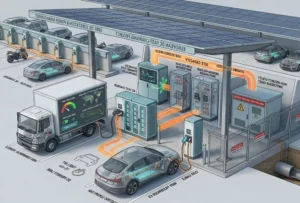
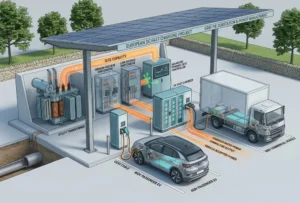
A common topic across fleet forums and industry groups—such as discussions on Reddit’s r/electricvehicles regarding megawatt charging power demand—is whether adding multiple megawatt chargers will collapse local distribution grids. While plugging ten 2 MW chargers directly into an unmanaged grid connection would overwhelm local feeder circuits, modern fleet yards use localized microgrids and intelligent energy management software to avoid overloading the grid.
How BESS Supports High-Power Truck Charging
By pairing your high-power charging hub with a local battery storage system, you control exactly how much power your site draws from the utility grid. The grid sees a steady, predictable baseload draw, while the trucks receive full megawatt charging bursts from the storage system.
| BESS Capacity Rating | Thermal Management Type | Target Fleet Depot Application | Key Commercial & Technical Benefits |
|---|---|---|---|
| 100 kWh Industrial BESS | Air-Cooled / Compact | Small fleet depots, delivery van hubs | Low Entry Cost: Ideal for buffering low-power DC chargers (120kW-180kW) and eliminating minor peak demand charges. |
| 261 kWh Outdoor Cabinet BESS | Liquid-Cooled | Mid-sized truck depots, logistics yards | High Power Density: Compact footprint with high C-rate output; easily scales by connecting multiple cabinets in parallel on a shared DC bus. |
| 418 kWh Heavy-Duty BESS | Advanced Liquid-Cooled | High-turnaround freight terminals | Extended Discharge Duration: Handles back-to-back rapid truck charging sessions while protecting internal battery cell temperatures. |
| 1 MWh Containerized BESS | Centralized Liquid Chiller | Highway megawatt charging hubs | Utility-Scale Peak Shaving: Completely isolates high-power MCS stations from weak local utility grids; integrates directly with megawatt solar PV arrays. |
Buyer Advantage: Selecting a modular liquid-cooled BESS configuration lets you start with a smaller capacity today and add additional battery cabinets seamlessly as your electric truck fleet grows.
Solar + BESS + MCS Creates a Sustainable Charging Ecosystem
Combining rooftop or canopy Solar PV arrays with an outdoor industrial BESS and MCS dispensers creates an autonomous, zero-emission charging microgrid. Solar energy generated during daylight hours charges the local BESS at zero incremental cost. When trucks dock at night or during shift handovers, they draw clean solar energy directly from the BESS. This lowers net electricity costs per kilowatt-hour, shields operators from volatile utility rate hikes, and fulfills strict enterprise carbon reduction mandates.
Myth 6: MCS Will Replace All Other EV Charging Standards
Reality: CCS and MCS Will Serve Different Applications
MCS is not designed to render CCS2 or NACS obsolete. Instead, it completes the commercial charging hierarchy. Selecting the right charger depends entirely on vehicle battery size, daily duty cycles, and parked dwelling times.
Why Multiple Charging Standards Will Coexist
A well-designed commercial charging depot deploys a mixed architecture based on operational needs:
- Level 2 AC Chargers (11 kW – 22 kW): Best for light service vehicles and yard tractors parked overnight for 8 to 12 hours.
- DC Fast Chargers (120 kW – 360 kW): Ideal for mid-mile delivery box trucks, regional transit buses, and depot overnight charging for heavy trucks.
- Megawatt Charging Systems (1.2 MW – 3.75 MW): Essential for long-haul freight corridors, port drayage rigs, and high-turnaround multi-shift fleet hubs.
Myth 7: MCS Charging Stations Can Be Installed Anywhere Without Planning
Reality: MCS Requires Professional Infrastructure Design
Deploying megawatt-level charging hardware is a major industrial power project. It requires careful site engineering, medium-voltage utility coordination, civil layout planning, and safety code compliance long before equipment arrives on site.
Key Requirements for MCS Charging Sites
Developing an MCS-ready charging yard requires four essential steps:
- Interconnection & Capacity Audit: Evaluating local utility feeder voltages (e.g., 11kV, 33kV), transformer margins, and short-circuit current ratings at the property line.
- Civil Design & Turning Radius Planning: Designing drive-through bay layouts with wide turning radiuses so Class 8 tractor-trailers can enter, charge, and exit without unhooking loads or maneuvering in tight spaces.
- Thermal & Sound Mitigation: Positioning medium-voltage transformers, liquid chillers, and power cabinets to ensure adequate airflow while complying with local noise ordinances.
- Safety & Protection Protocols: Installing physical bollards, automatic fire suppression systems, isolation monitoring, and emergency stop circuits integrated with site safety controllers.
Myth 8: MCS Only Benefits Truck Manufacturers, Not Fleet Operators
Reality: Fleet Operators Gain Higher Productivity
Some fleet managers view MCS as an unnecessary standard pushed by vehicle manufacturers. In reality, the financial return on investment accrues directly to the fleet operator. In freight logistics, vehicle downtime is a direct loss of earning potential. Every hour saved during a charging session increases the daily earning capacity of both the truck and the driver.
How MCS Improves Commercial Transportation Efficiency
Consider a heavy drayage fleet operating between an inland logistics hub and a seaport 250 kilometers away. Using traditional 150 kW DC charging, a truck can complete only one round trip per shift due to mid-day charging delays. Upgrading to a high-power MCS system slashes charging stops from 90 minutes to 25 minutes. This allows the same truck to complete two full round trips per shift, doubling daily freight capacity without adding extra vehicles to the fleet.
Myth 9: MCS Requires Completely New Charging Infrastructure
Reality: MCS Can Integrate With Existing Energy Systems
Upgrading to megawatt charging does not require demolishing your existing depot power setup. Modern industrial charging systems use modular DC bus architectures that integrate directly with existing site electrical infrastructure, back-up generators, and renewable energy assets.
Modular Deployment Makes MCS Expansion Easier
By using centralized power conversion cabinets connected to a common DC bus, operators can install a modest 500 kW power cabinet today to service early electric truck trials. As new electric vehicles join the fleet, additional power modules can be installed into the existing cabinet chassis, scaling total power output to 1.5 MW or 3.0 MW without needing to replace core underground cabling or site switchgear.
Myth 10: Megawatt Charging Systems Are Only for the Distant Future
Reality: MCS Is Becoming Critical for Heavy Transportation Electrification
Megawatt charging is not a distant concept—it is a present-day operational requirement. Regulatory frameworks are pushing freight electrification at an unprecedented pace. For example, the European Union’s AFIR Regulation 2023/1804 mandates high-power commercial charging pools along the trans-European transport network (TEN-T), setting strict capacity targets for heavy-duty vehicle infrastructure.
Preparing Your Business for the Next Generation of EV Charging
Fleet operators who wait until their first batch of electric trucks arrives before planning their charging infrastructure risk long delays. Utility interconnection queue times can stretch from 12 to 24 months in busy industrial zones. Initiating site power audits, securing grid interconnection rights, and designing modular BESS-buffered charging yards today ensures your business stays competitive as zero-emission regulations take effect.
How AnengJI Helps Businesses Deploy Megawatt Charging Solutions
Integrated EV Charging and Energy Storage Solutions
Deploying high-power charging infrastructure requires a complete energy management vision. AnengJI delivers integrated commercial energy systems that connect high-efficiency DC fast chargers, modular MCS power cabinets, and industrial liquid-cooled Battery Energy Storage Systems into a single, cohesive power platform.
Customized Solutions for Electric Truck Fleets
Our engineering team works directly with logistics companies, site developers, and fleet managers across every phase of project execution. From initial site power audits and customized OEM hardware manufacturing to microgrid integration and commissioning, we tailor every system to match your specific fleet duty cycles and site power limits.
By pairing high-power chargers with our proprietary 261kWh and 418kWh liquid-cooled BESS cabinets, intelligent Power Conversion Systems (PCS), and smart EMS cloud software, AnengJI enables commercial fleets to bypass utility upgrade delays, eliminate severe demand charges, and build future-proof charging yards.
Supporting the Future of Long-Haul Electric Transportation
Whether you are electrifying a port drayage fleet, setting up a regional logistics hub, or building a public highway truck charging station, AnengJI provides the hardware reliability, technical expertise, and energy management software required to maximize fleet uptime and minimize overall operating costs.
Frequently Asked Questions About Megawatt Charging System
What is a Megawatt Charging System (MCS)?
MCS is a high-power charging standard engineered specifically for heavy-duty commercial electric vehicles, buses, marine vessels, and aircraft, capable of delivering up to 3.75 MW (3,750 kW) of direct current power.
How powerful is an MCS charger compared to standard DC fast chargers?
An MCS charger can deliver up to 3,000 amperes at 1,250 volts DC (up to 3,750 kW), making it roughly seven to ten times more powerful than standard 350 kW CCS2 fast chargers.
Does megawatt charging accelerate battery degradation?
No. When controlled by an advanced Battery Management System (BMS) and dynamic liquid cooling, MCS keeps battery cells within optimal temperature limits (25°C to 35°C), preventing lithium plating and heat degradation.
Why should fleet operators combine battery storage (BESS) with MCS chargers?
Integrating a BESS buffers high power draws, preventing extreme utility demand charges, flattening site power load curves, and allowing high-power MCS chargers to operate even on grid connections with limited power capacity.
How fast can an MCS charger charge a Class 8 electric truck?
An MCS charger can replenish a typical 600 kWh Class 8 electric truck battery from 20% to 80% state of charge in approximately 20 to 30 minutes, aligning perfectly with mandatory driver rest periods.
Will MCS replace CCS2 charging stations?
No. CCS2 and NACS will continue serving passenger cars and light-duty commercial vans, while MCS will handle heavy-duty trucks, long-haul freight fleets, marine vessels, and heavy industrial transport.
What electrical infrastructure is required to install an MCS charger?
An MCS installation requires a medium-voltage utility connection, a dedicated step-down transformer, liquid-cooled power conversion cabinets, high-capacity switchgear, and ideally an integrated BESS to buffer grid power demands.
Build Your Megawatt Charging System for Electric Truck Fleets
Ready to electrify your heavy-duty fleet without risking costly grid upgrades or operational delays? Contact the engineering team at AnengJI today. Share your fleet size, daily mileage, and site grid capacity to receive a customized, turnkey MCS charging and BESS energy storage proposal tailored precisely to your operational goals.
Request Your Custom MCS & BESS Fleet Solution