Introduction
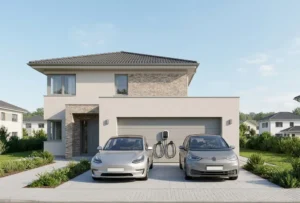
Two EVs do not automatically require two full-power charging circuits. If Car A needs 10 kWh and Car B needs 18 kWh before morning, their combined 28 kWh demand averages only 3.5 kW across an eight-hour window. The real decision is whether both cars can connect conveniently and whether the home can safely allocate that energy alongside its other electrical loads. That is a better starting point than buying the first dual car charger that appears to support two plugs.
A 2024 best-practice paper from EV Belgium on households with two or more BEVs makes a similar point: a second charger should not be installed automatically when one correctly configured charge point can meet both vehicles’ energy needs. That Belgian industry position is not a Europe-wide law, but its decision logic is useful. A two-EV household should buy two reliable morning departures—not simply two maximum-power boxes.
The short answer
- Share one single charger when both cars have modest, flexible energy needs and changing the plug is genuinely convenient.
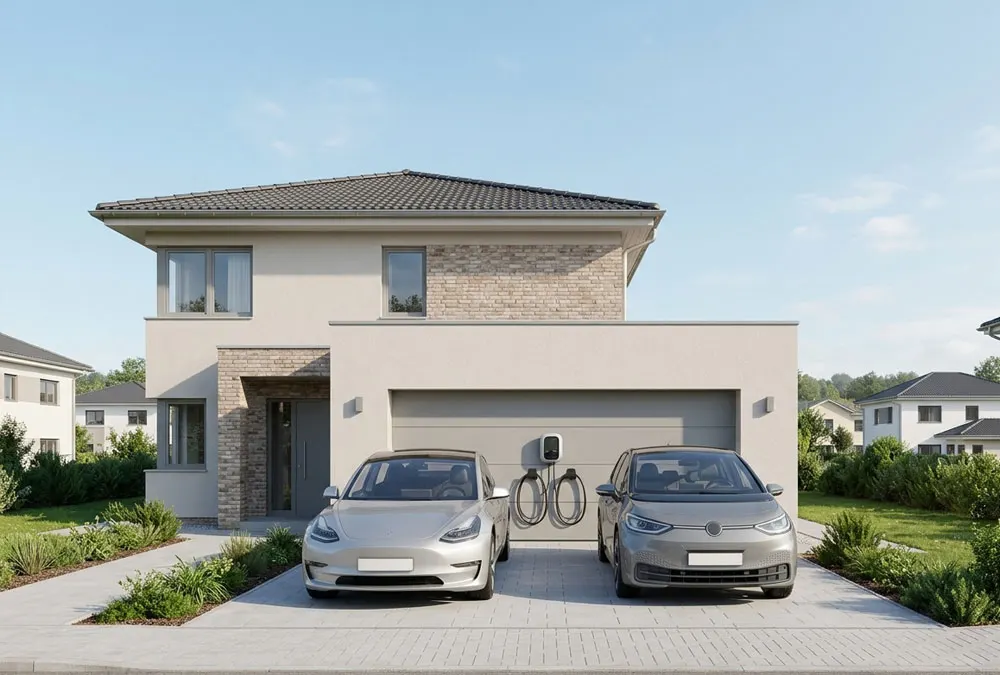
- Choose one dual-port EV charger when both cars park within safe cable reach and should remain connected overnight.
- Install two coordinated wallboxes when parking positions or cable reach matter, but the home still needs a controlled charging-power limit.
- Use two independent circuits only when both cars regularly need high energy at the same time and the electrical service can support it.
Dual EV Charger vs Single Charger: The 60-Second Comparison
| Home charging setup | Can both cars stay connected? | Power arrangement | Best fit | Buyer consequence |
|---|---|---|---|---|
| One single charger | No; the cable must be moved | Full available output goes to one car | Low or alternating nightly demand | Lowest project scope, but the household owns the swapping problem |
| One dual-port charger | Yes | Two ports share a defined total limit, depending on the model | Cars park close to one installation point | Convenient connection, but one enclosure can become a single point of failure |
| Two coordinated wallboxes | Yes | The units communicate or follow a common control limit | Cars park apart or need different cable positions | Better layout flexibility, with more hardware and control dependencies |
| Two independent circuits | Yes | Each charger has its own designed electrical capacity | Two high-mileage cars with overlapping deadlines | Maximum independence, but potentially the largest electrical and civil scope |
The most expensive option is not automatically the most dependable one. A pair of high-power chargers may still be constrained by the home’s main service, while a carefully managed lower-power arrangement may deliver everything both cars need overnight. Conversely, a technically adequate single charger may become irritating if somebody must go outside at midnight to change the cable.
Start With the Energy Both Cars Need by Morning
Calculate nightly energy instead of comparing battery sizes
A 70 kWh battery does not require 70 kWh every night. What matters is the energy used since the previous charge and the next trip. Use measured charger energy where possible, then calculate:
Suppose Car A needs 10 kWh and Car B needs 18 kWh by 07:00. If both can charge from 23:00 to 07:00, they need 28 kWh over eight hours, or an ideal average of 3.5 kW. On an energy-only basis, a shared 7 kW-class allocation may be sufficient. The final design must still allow for shorter individual windows, high-mileage days, household load restrictions, session interruptions and the power each vehicle can accept.
Keep the calculation boundary consistent. If the inputs come from the charger meter, do not add a second loss factor that is already included in those readings. If the inputs represent energy added to the battery, the designer must explicitly account for conversion and auxiliary losses rather than hiding them inside an unexplained percentage.
When one shared charger is still the sensible choice
A single charger may be enough when:
- the cars do not both need charging every night;
- their departure times are flexible or alternate across the week;
- one cable reaches the normal parking position of both vehicles;
- the household can change the plug before bed without moving a vehicle; and
- an occasional public charge is an acceptable contingency for an unusual long-distance day.
The problem is rarely the arithmetic alone. Manual sharing fails in ordinary ways: one driver comes home late, the other forgets to switch the cable, it is raining, or the car that needs an early start is blocked in. If those events regularly threaten a morning departure, simultaneous connection has practical value even when the household does not need more total power.
What Counts as a Dual EV Charger for Two Cars?
One enclosure with two true charging ports
A dual-port EV charger has two charging connections that can serve two vehicles. However, two connectors on an enclosure do not always mean two cars can charge simultaneously. The U.S. Department of Energy’s charging-infrastructure terminology distinguishes a charging port from a connector: one port can have several connector options while still supplying only one vehicle at a time. Buyers should therefore ask for the number of simultaneously usable ports, not count cable ends in a product image.
Two wallboxes with coordinated power sharing
A second architecture uses two separate wallboxes that communicate with each other or follow one site controller. The boxes can be mounted near each car while staying within a defined EV charging limit. This is often more useful than one dual-port unit when the vehicles park on opposite sides of a garage, one stays outside, or their inlets are too far apart for safe cable routing.
Two independent chargers
Two independent chargers can each receive their designed capacity without coordinating with the other. This arrangement may suit two high-mileage vehicles that both arrive late and leave early. It can also require more breaker capacity, panel or consumer-unit space, cable, protection and possibly an electrical-service upgrade. A qualified installer must determine whether it is permissible and useful at the specific home.
How a Dual Car Charger Shares Power
Do not assume every dual level 2 EV charging station permanently divides its output in half. Product behaviour may be simultaneous, sequential, priority-based or dynamically allocated:
- Simultaneous sharing: both cars charge under a common total limit.
- Sequential charging: one vehicle charges first; the second starts when capacity becomes available.
- Priority allocation: a selected vehicle receives more power until its demand falls or a schedule changes.
- Dynamic reallocation: unused power moves to the remaining vehicle when the other reduces or stops its demand.
Separate four power values before comparing products
| Power value | What it means | Why the homeowner should care |
|---|---|---|
| EVSE nameplate rating | The charger’s maximum stated capability under defined conditions | It is not a promise that every car or both ports receive that power |
| Configured site or circuit limit | The maximum the installation permits the charging system to draw | A high-rated charger may be deliberately capped below its nameplate power |
| Allocated port power | The power offered to one connection at that moment | It changes as the other car and household loads change |
| Vehicle-accepted power | What the onboard AC charger actually takes | The car may accept less because of its OBC, phase support, battery condition or charging strategy |
Ask the supplier what happens when one car finishes. Does the second port automatically receive more power? How quickly? Does a scheduled priority remain in place? A credible answer should describe the specific product logic and configured limits, not simply say “smart load balancing.”
Power Sharing Is Not the Same as Whole-Home Load Management
This distinction is easy to miss in a product comparison. Two charging ports may share a 32 A EV allocation and stay within that value, yet the charging system may know nothing about a heat pump, oven, electric water heater or other household demand. Sharing the EV circuit protects the configured charging limit; it does not automatically prove that the home’s main service is protected under every operating condition.
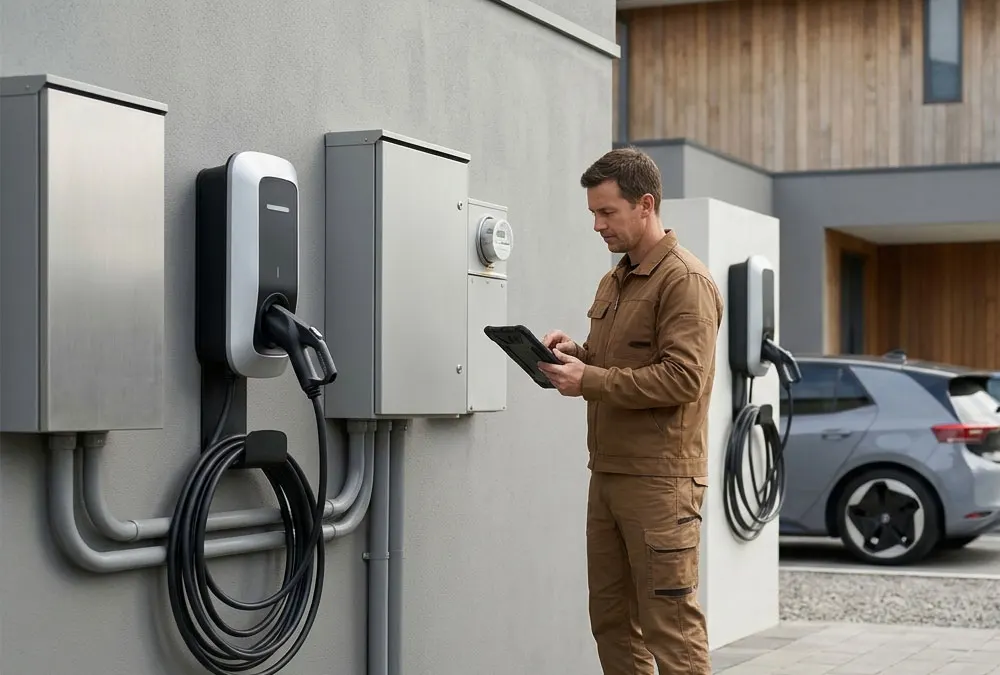
Ask the installer to show the control path
Grid/service → home-load measurement → approved EV site limit → port A + port B
Whole-home dynamic load management uses a validated measurement and control point to reduce EV charging when the rest of the home approaches an approved threshold. Its communication may be wired, local wireless or cloud-assisted. The topology matters because the system needs a defined response when its meter, current sensor, network or controller becomes unavailable.
Regulation 7 of Great Britain’s Electric Vehicles (Smart Charge Points) Regulations 2021 requires covered private charge points to remain capable of charging if communications-network access is lost. That does not tell a homeowner exactly how a particular dual-charging system will allocate current after losing Wi-Fi, a cloud service or a local measurement signal. Those behaviours remain model- and design-specific and should be written into the specification and acceptance test.
One Dual Charger or Two Wallboxes? Check the Parking Layout
A single dual electric car charger may look tidy on a product page but prove awkward in the driveway. Do not assume both vehicle inlets are at the right rear, or that both cars will always reverse into their spaces. Ask the household to park each car as it does on a normal evening, then mark the real inlet locations before deciding where equipment belongs.
Check five physical details
- Normal parking direction: forward or reverse, including whether one vehicle blocks the other.
- Actual charge-port positions: for both current vehicles and any near-term replacement.
- Cable reach without tension: the cable should not pull across a body panel or depend on perfect parking.
- Pedestrian and vehicle paths: avoid permanent trip routes and places where a tyre may repeatedly cross the cable.
- Cable storage: two tethered leads require deliberate holsters and daily housekeeping.
One dual unit is a single equipment point: neat to mount and potentially efficient to cable, but both connections may be lost during a device failure. Two coordinated wallboxes add hardware and installation work, yet they can sit closer to each vehicle and may preserve one charging point during some faults. They are not automatically redundant—a shared upstream breaker, controller or supply fault can still affect both.
Compare Dual and Single EV Charger Costs Without Guessing
A universal dual car charger price is not useful across Europe and the United States. The hardware may not be the largest cost. Compare quotations using the same scope:
- charger hardware and mounting;
- protective devices, distribution work and spare panel/consumer-unit space;
- cable length, conduit, trenching and surface restoration;
- meter, CT, controller and communications hardware;
- service, panel or consumer-unit changes where required;
- permits, inspection, commissioning and documentation;
- software or subscription charges, if applicable; and
- warranty coverage for the unit, cables, connectors and installation.
Ask each bidder to price the same four alternatives: retain one shared charger, install one dual-port unit, install two coordinated wallboxes, and install two independent circuits. If a quotation recommends a service upgrade, request the load calculation and ask whether a permitted dynamic-management alternative was evaluated. The objective is not to avoid necessary electrical work; it is to avoid paying for capacity that the household’s measured charging schedule does not need.
Europe First: Type 2, Phase Supply and Local Rules
European homes
In European projects, the buyer should verify Type 2 connectivity, whether the product is tethered or socketed, and whether the home has a suitable single-phase or three-phase supply. Annex II of the amended EU Alternative Fuels Infrastructure Regulation uses Type 2 for interoperable AC recharging points from 8 January 2026; the cited rules primarily address interoperability requirements and should not be treated as a complete private-home installation code. See the current EUR-Lex text for Regulation (EU) 2023/1804.
A 7 kW-class wallbox is commonly associated with 230 V single-phase service, while 11 kW and 22 kW AC configurations commonly use 400 V three-phase service. That does not mean the car can accept the full rating. The vehicle’s onboard charger and phase support set another ceiling, and local connection, protection, earthing and notification rules remain country-specific.
Great Britain
Great Britain has its own smart-charge-point requirements and should not be presented as if it follows every EU rule. The GOV.UK residential charge-point technical specification is especially useful for procurement discipline: where equipment has multiple outlets, its classification should reflect output with all outlets operating simultaneously. It also points installers to the applicable wiring and charging-equipment standards. Grant eligibility requirements and current local rules still need separate confirmation.
United States
A US homeowner should translate the same decision into actual 120/240 V service, available panel capacity, branch-circuit design and Level 2 current—not copy a European 7/11/22 kW comparison. The U.S. Department of Energy’s home-charging guidance recommends checking electrical capacity with a qualified contractor and complying with national, state and local requirements. A two-EV household should also review J1772 and J3400/NACS compatibility across both current and planned vehicles.
Use the TWO-CAR Framework Before Buying
| TWO-CAR check | What to record | Decision it changes |
|---|---|---|
| T — Travel energy | Charger-meter kWh required by each car over 14–30 representative days | Whether one shared power allocation is sufficient |
| W — Window | Arrival, low-tariff start and must-leave time for each car | Average power, priority and simultaneous need |
| O — Onboard acceptance | Vehicle-specific AC limit, phases and connector | Useful charger rating for each vehicle |
| C — Capacity | Main service, panel/consumer unit, spare ways and household load | Site limit and whole-home management requirement |
| A — Access | Parking direction, inlet locations, cable route and pedestrian path | One dual box or two separated wallboxes |
| R — Resilience | Offline behaviour, control dependencies, warranty and repair path | Architecture, supplier and acceptance test |
This framework also helps an installer or distributor avoid a weak recommendation. “Two cars need two chargers” is not a specification. “These cars need 24 kWh and 31 kWh by 06:30, park six metres apart, and share a defined household limit” is.
What to Ask a Dual EV Charger Supplier or Installer
Hardware and simultaneous output
- Are there two true charging ports or two connector choices for one port?
- What are the total output and each port’s output with both vehicles actively requesting charge?
- Is allocation simultaneous, sequential, priority-based or configurable?
- What changes when a single-phase vehicle connects to a three-phase-capable product?
Control and failure behaviour
- Does the system only share an EV circuit, or does it measure whole-home demand?
- Is coordination local, wired, Wi-Fi-based or cloud-dependent?
- What happens after loss of internet, meter/CT signal or the main controller?
- Does power return automatically after communications recover?
Installation and lifecycle
- Which circuits, protective devices, earthing arrangement and permits are required locally?
- Are cables tethered or socketed, and what replacement options exist?
- Which certificates apply to the exact model, configuration and destination market?
- What is covered by the hardware and installation warranties?
- How are firmware, app accounts and ownership transfer handled?
Commission Both Vehicles, Not Just the Charger Screen
A successful session on one car proves very little about a dual EV charging station. The handover should test the conditions the household is paying to manage.
| Acceptance test | Evidence to capture |
|---|---|
| Start Car A alone | Stable session and actual current/power |
| Start Car A and Car B together | Total remains within the configured limit; each port behaves as specified |
| Stop or disconnect Car A | Car B receives the documented reallocation, if supported |
| Apply a high household load | EV power follows the approved whole-home control design |
| Interrupt internet or cloud access | Charging and schedules follow the documented fallback |
| Interrupt the CT, meter or controller signal | System enters its documented safe state |
| Restore communications | Stable recovery without exceeding the configured limit |
Record the configured limits and test results in the handover pack. Otherwise, a later app update, vehicle replacement or controller change can turn a working arrangement into a difficult troubleshooting exercise.
Which AnengJi AC Charger Options Can Be Evaluated?
AnengJi’s current product table lists Q6 AC wallbox options at 7 kW/230 V/32 A, 11 kW/400 V/16 A and 22 kW/400 V/32 A. Installers, distributors and residential-project buyers can compare the current 7 kW, 11 kW and 22 kW AC wallbox options when defining a market-specific product range.
Important product boundary: the published ratings do not by themselves verify a dual-port configuration or coordinated load sharing between two Q6 units. Before specifying a two-EV installation, request the latest model-specific datasheet, simultaneous-output architecture, load-management topology, destination-market certificates and commissioning requirements.
For importers, installers and private-label buyers, the useful enquiry is not simply “Do you have a dual charger?” It should state the country, supply, connector format, number of simultaneous ports, total controlled power, local/whole-home management requirement, offline behaviour, quantity and compliance documents required. You can also review AnengJi’s broader AC charging equipment range before preparing that specification.
Dual EV Charger FAQ
Can you charge two cars with one EV charger?
Yes, if the unit has two independently usable charging ports, or if two coordinated EVSE units operate under one controlled system. A charger with two connector types may still serve only one vehicle at a time, so verify simultaneous-port capability.
Is a dual EV charger slower than a single charger?
Each car may receive less power when both are active under a shared limit. That does not necessarily make the household’s outcome worse: if both cars receive their required energy before departure, simultaneous connection can be more convenient than giving one car full power and forgetting to switch.
Do two EV chargers need two circuits?
Not in every architecture or jurisdiction. Some compatible systems can coordinate under a shared limit; other products require dedicated circuits. The allowed arrangement, protection and conductor sizing must be designed under the applicable local electrical rules.
Is one 7 kW charger enough for two electric cars?
It can be, when the two cars’ combined nightly kWh requirement fits their real charging window and manual or automatic sharing is practical. Use measured energy and departure times rather than assuming from the number of vehicles.
Is a dual-port charger better than two smart wallboxes?
A dual-port unit is often neat when both cars park together. Two coordinated wallboxes may be better when the bays are separated or cable routing differs. Compare simultaneous output, control topology, fault impact, installation scope and the actual parking plan.
What happens when one car finishes charging?
Some systems reallocate unused power to the other vehicle; others follow a different schedule or priority. Ask for the model-specific behaviour and test it during commissioning.
Can a dual car charger work without Wi-Fi?
It depends on what functions rely on Wi-Fi or the cloud. Basic charging, port coordination, tariff scheduling and whole-home control may have different dependencies. Require documented offline behaviour and test it before handover.
What is the best setup for a European two-EV home?
There is no universal best model. Start with two-car energy and departure data, then check Type 2 configuration, vehicle OBC limits, single- or three-phase supply, whole-home capacity, parking geometry and country-specific installation requirements.
Conclusion: Buy Two Reliable Departures, Not Two Maximum-Power Boxes
A dual EV charger is valuable when it removes a real connection or scheduling problem. It is not automatically necessary because two electric cars are parked at one home. Measure each vehicle’s required energy and departure window, assess the home’s capacity, and map the actual parking layout before choosing the hardware.
Then look beyond the headline power. Verify simultaneous output, vehicle acceptance, EV-circuit sharing, whole-home load control and the system’s failure behaviour. That process will show whether the right answer is one shared charger, one dual-port unit, two coordinated wallboxes or two independent circuits.
Product and planning resources
Sources
- EV Belgium — Best Practice: Two (or More) BEVs in One Household, 19 April 2024
- The Electric Vehicles (Smart Charge Points) Regulations 2021
- GOV.UK — Residential Chargepoints: Minimum Technical Specification
- EUR-Lex — Regulation (EU) 2023/1804, current consolidated text
- U.S. Department of Energy AFDC — Charging Electric Vehicles at Home
- U.S. Department of Energy AFDC — Electric Vehicle Charging Stations and Terminology