Integrating a utility-scale battery storage system transforms modern grid reliability. Large clean energy generation creates severe congestion. Utility scale battery storage solves this balance gap efficiently. It captures cheap off-peak power and stabilizes transmission networks. Deploying a high-performance battery energy storage system BESS lowers levelized costs while improving asset yield.
What Is Utility-Scale Battery Storage and How Does It Work?
Understanding Utility-Scale Battery Storage Systems
I see grid operators face massive daily power mismatch challenges as renewable penetration increases. Solar and wind farms generate electricity based on weather, not human demand profiles.
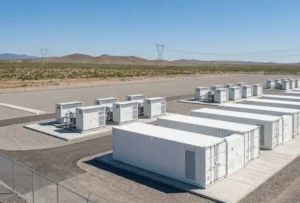
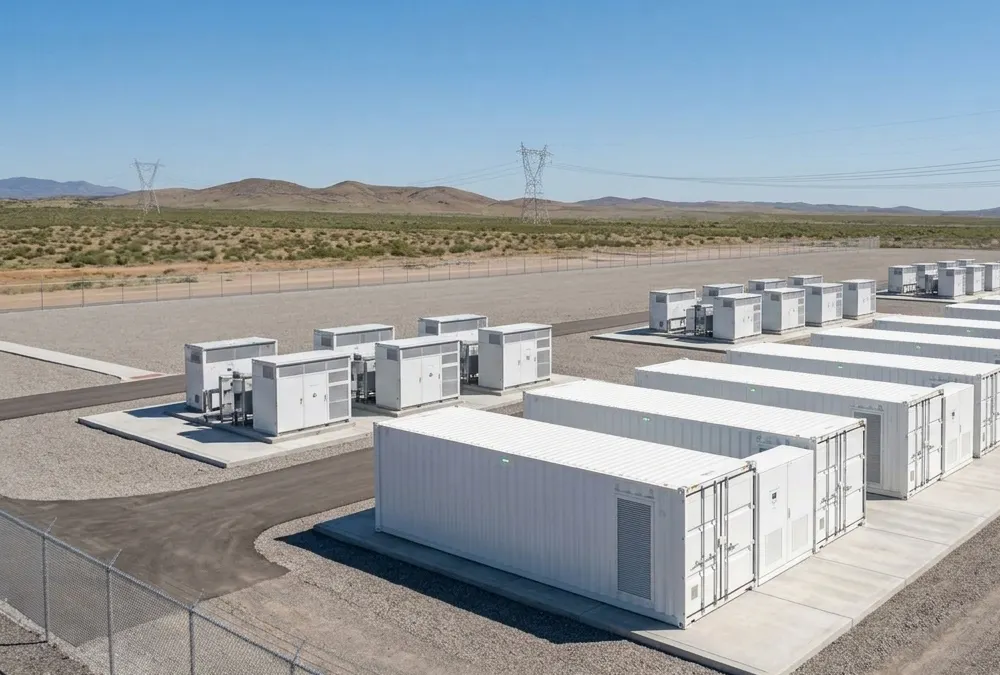
A utility-scale battery storage system acts as an industrial-grade buffer for regional transmission networks. These grid scale battery storage plants start around 5 MW in capacity. They scale up past 1,000 MW or several Gigawatt-hours (GWh).
These assets connect to high-voltage transmission lines directly. They do not feed single buildings.
Instead, a battery energy storage system BESS stabilizes entire regional utilities. It absorbs gigawatt-hours of excess energy during midday sun peaks. Then it injects power back during dark evening demand hours.
How Battery Energy Storage Systems Store and Release Electricity
The core physics behind how utility-scale battery storage works involves precise bidirectional electricity conversion.
During charging, high-voltage AC electricity flows from regional transmission substations to site step-down transformers. Voltage steps down to 1,500V DC busbars.
The power conversion system PCS rectifies AC current into stable DC energy. Direct current flows into sealed lithium ion battery storage system container racks.
Chemical energy stores inside dense lithium iron phosphate crystalline structures safely.
When grid frequency drops or power spot prices surge, energy dispatches immediately.
DC flows out of battery modules into the PCS inverters within 20 milliseconds. Inverters convert DC back to clean 60Hz or 50Hz AC power.
Main step-up transformers push voltage back to 115kV, 230kV, or 400kV lines instantly.
Standalone Battery Storage vs Co-Located Battery Storage Systems
Developers ask whether standalone BESS installations outperform co-located renewable setups economically.
A standalone battery storage plant connects to strategic transmission hubs independently. It trades energy across wholesale spot markets without local solar generation constraints.
Co-located systems share land, step-up transformers, and civil switchgear with massive solar farms directly.
Integrating a solar battery storage system directly behind the meter reduces total project CAPEX by 12% to 18%.
It stops solar curtailment instantly. Extra energy feeds battery containers rather than going to waste.
Commercial & Distributed Utility Infrastructure Alternatives
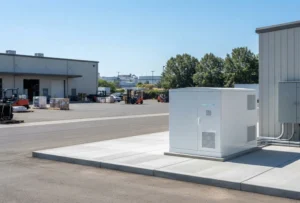
Not every site requires a 100MWh transmission footprint. Pre-configured outdoor cabinets offer faster deployment for commercial feeders:
- 100kWh / 261kWh Outdoor Cabinets: Compact liquid-cooled designs ideal for EV charging station buffer nodes and small industrial peak shaving.
- 418kWh / 1MWh Container Block Units: Modular building blocks for scaling sub-station energy storage projects progressively.
Utility-Scale Battery Storage Components and System Architecture
A utility scale battery energy storage system relies on integrated electro-mechanical hardware layers working together seamlessly.
Battery System: The Core Energy Storage Unit
Prismatic LFP cells form the foundational storage chemistry inside large installations.
Individual cells join in series to build high-voltage modules. Modules mount into vertical steel racks inside insulated 20-foot or 40-foot enclosures.
Modern containerized battery energy storage system designs feature liquid cooling distribution plates.
Coolant maintains uniform cell temperatures across thousands of internal battery cells under heavy load.
Power Conversion System (PCS): Connecting Batteries With the Grid
The power conversion system PCS handles two-way energy conversion between DC batteries and the AC power grid.
Advanced PCS designs utilize Silicon Carbide (SiC) semiconductor switches. They achieve round-trip efficiency (RTE) rates exceeding 98.5% at the inverter level.
They regulate active power (MW) and reactive power (MVAR) for grid stability support.
Battery Management System (BMS): Ensuring Battery Safety
A robust multi-tier battery management system oversees continuous operational parameters.
Layer 1 tracks cell voltage, temperature, and internal impedance every millisecond.
Layer 2 balances rack currents dynamically to eliminate electrical mismatches.
Layer 3 controls high-voltage contactors and communicates safety data to the central plant controller.
Energy Management System (EMS): Intelligent Energy Dispatch
The energy management system EMS acts as the master software brain across the entire installation.
It evaluates day-ahead power market pricing, local weather feeds, and grid congestion metrics.
The EMS automates charge and discharge schedules to maximize financial arbitrage gains continuously.
| Storage Scale Class | System Busbar Voltage | Round-Trip Efficiency (RTE) | Buyer Advantage & Economic Impact |
|---|---|---|---|
| Commercial & Industrial (C&I) | 400V – 1000V DC | 85% – 88% System Level | Low upfront installation cost, rapid site permitting, direct peak demand charge reduction on utility bills. |
| Large Scale Energy Storage | 1000V – 1500V DC | 88% – 90% System Level | Balanced investment scale, versatile participation in local ancillary market services and solar buffering. |
| Utility Scale Energy Storage System | 1500V DC Standardized | 90% – 92% System Level | Lowest Levelized Cost of Storage (LCOS), optimized cabling cross-sections, maximum wholesale revenue stacking. |
Valuable Grid Services Provided by Utility-Scale Battery Storage
Grid operators rely on utility scale lithium battery storage solution sites because batteries react far faster than legacy gas peaker plants.
Energy Services: Improving Renewable Energy Integration and Grid Reliability
Solar and wind production varies wildly minute by minute.
Deploying renewable energy storage system assets captures excess power during overgeneration periods.
Instead of curtailing green power, batteries store energy safely.
Power dispatches into high-demand evening periods seamlessly.
Arbitrage revenue opportunities depend on spread margins. Operators charge containers when wholesale prices clear near zero.
They discharge when spot market prices peak, driving maximum project ROI.
Ancillary Services: Frequency Regulation and Grid Stability
Grids require continuous 50Hz or 60Hz frequency balance.
Frequency regulation battery storage systems respond in under 100 milliseconds to unexpected load drops.
They deliver synthetic inertia support, preventing regional blackout events without burning fossil fuels.
Transmission and Distribution Services: Supporting Grid Infrastructure
Permitting new transmission corridors takes up to ten years.
Buyer Inquiry: “Can energy storage really replace transmission upgrades?”
Yes. Installing grid stabilization battery storage at congested substation nodes defers expensive line upgrades. Batteries absorb local peak surges, keeping existing cables operating safely below thermal limits.
Utility-Scale Battery Storage Safety Standards and Protection Systems
Safety represents the paramount evaluation criteria for utility infrastructure investors.
Meeting International Battery Storage Safety Standards
Engineering teams enforce strict adherence to international safety frameworks.
Key certifications include NFPA 855 for energy storage installations, UL 9540 for complete systems, and IEC 62619 for cell integrity.
Buyer Inquiry: “What does UL 9540A testing actually prove to insurers?”
UL 9540A evaluates thermal runaway fire propagation at cell, module, and rack levels intentionally. Passing UL 9540A proves fire will not spread between adjacent battery containers, lowering insurance premiums significantly.
Real-Time Battery Monitoring and Intelligent Protection
Safety depends on early hazard detection.
Containers feature dedicated off-gas detection sensors monitoring trace hydrogen and carbon monoxide.
Sensors detect cell venting minutes before thermal events start, isolating problem racks automatically.
Safe Battery Enclosures and Thermal Management
Modern sites specify liquid cooling rather than forced air systems.
Direct liquid cooling keeps internal cell temperature variances within 2.0°C across the container.
Tight thermal control prevents localized hot spots, extending overall operational lifespan by up to 25%.
Emergency Preparedness for Utility Battery Storage Systems
Enclosures incorporate specialized explosion deflagration venting panels.
Clean agent gas systems fire first to extinguish localized electrical flames.
Secondary dry-pipe water connections allow fire departments to cool containers safely if external hazards threaten the site.
Why Utility-Scale Battery Storage Is Critical for Europe’s Energy Transition
Market insights from BloombergNEF confirm massive growth trends across European grid markets.
Supporting Renewable Energy Growth Across European Power Markets
Rapid expansion of offshore wind and solar farms creates severe grid bottlenecks across European corridors.
Deploying grid scale energy storage Europe projects mitigates transmission bottlenecks between regional market bidding zones.
Improving European Grid Stability With Battery Energy Storage
Retiring legacy coal plants removes physical spinning inertia from transmission systems.
Grid scale BESS plants supply fast frequency response, replacing legacy synchronous generators cleanly.
Enabling a More Flexible and Sustainable Energy System
Adding large scale battery storage system for renewable energy sites ensures reliable power supply.
Flexible energy storage protects electricity consumers against volatile fossil gas market spikes.
Why Choose Lithium Battery Technology for Utility-Scale BESS Projects?
LiFePO4 Battery Provides Superior Safety for Large Energy Storage
Lithium Iron Phosphate (LiFePO4) chemistry dominates large-scale BESS deployments globally.
LiFePO4 chemical bonds resist oxygen release up to 270°C.
Choosing lithium battery energy storage technology guarantees higher thermal runaway thresholds compared to legacy Nickel Manganese Cobalt (NMC) chemistries.
Alternative Energy Storage Technologies Decoded
Evaluating alternative energy storage technologies helps buyers make informed procurement choices:
- LiFePO4 (LFP) Lithium-Ion: Features 92% RTE, 6,000 to 10,000 cycle lifetime, and exceptional thermal safety. It represents the global utility benchmark.
- NMC Lithium-Ion: Higher volumetric energy density, but lower thermal tolerance. Requires higher safety margins and insurance costs.
- Vanadium Redox Flow Batteries: Excellent for 8+ hour long-duration storage without cell degradation. However, initial CAPEX and footprint requirements remain high.
- Sodium-Ion Batteries: Emerging option for extreme freezing environments. Cycle life and commercial supply chains are still scaling up.
Long Cycle Life Reduces Utility BESS Lifecycle Costs
Project financial models evaluate Levelized Cost of Storage (LCOS).
LCOS factors initial equipment CAPEX, round-trip efficiency losses, ongoing operational OPEX, and total throughput energy.
LFP cells maintain 80% residual capacity after 8,000 full cycles.
High cycle life lowers long-term LCOS below $0.07 per kWh delivered over 20-year project lifespans.
Modular Design Enables Future Expansion
Modular containerized layouts allow planned capacity augmentation.
Project developers install baseline storage initially. They add battery containers in year 7 or 10 to offset natural cell degradation without interrupting operations.
How to Select a Reliable Utility-Scale Battery Storage Supplier?
Evaluate Battery Technology and System Integration Capability
Working with an experienced utility scale BESS supplier prevents integration errors.
Choose suppliers offering fully integrated packages containing cells, PCS, BMS, and EMS controls engineered into pre-tested enclosures.
Verify Certifications, Testing, and Safety Compliance
Request third-party Factory Acceptance Testing (FAT) documentation, UL 9540A test reports, and UN 38.3 transport certifications.
Consider Long-Term Service and Project Support
Ensure your vendor guarantees annual throughput performance, offers 24/7 remote monitoring, and maintains local technical service hubs.
Frequently Asked Questions About Utility-Scale Battery Storage
How does utility-scale battery storage work?
It charges using low-cost off-peak grid or solar power, stores it as DC energy, and discharges AC electricity back to the grid during high-demand hours.
What is the difference between standalone and co-located battery storage?
Standalone systems connect directly to grid substations for market energy trading. Co-located installations share grid interconnections with solar or wind farms to prevent curtailment.
How does BESS support renewable energy?
It captures curtailed generation during sunny or windy periods, releasing steady electricity into transmission networks whenever weather conditions shift.
What services can utility-scale battery storage provide?
Primary services include frequency regulation, spinning reserves, energy arbitrage, peak demand shaving, voltage support, and transmission deferral.
Are large-scale battery storage systems safe?
Yes. Tier-one installations utilize safe LiFePO4 cells, 3-tier BMS protection, direct liquid cooling loops, and UL 9540A certified fire suppression systems.
How long does a utility-scale battery storage system last?
With active liquid thermal management and scheduled module augmentation, tier-one installations operate reliably for 15 to 20 years.
Why is LiFePO4 used in utility BESS projects?
LiFePO4 provides superior thermal safety, long cycle life beyond 8,000 cycles, and optimal Levelized Cost of Storage (LCOS) economics.
Build Your Utility-Scale Battery Storage Solution With an Experienced BESS Partner
Consult with our EPC engineering team today to design a fully integrated utility BESS solution optimized for your project’s technical and revenue goals.