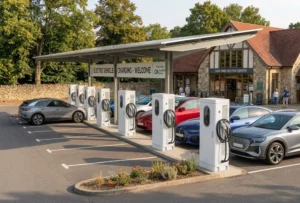
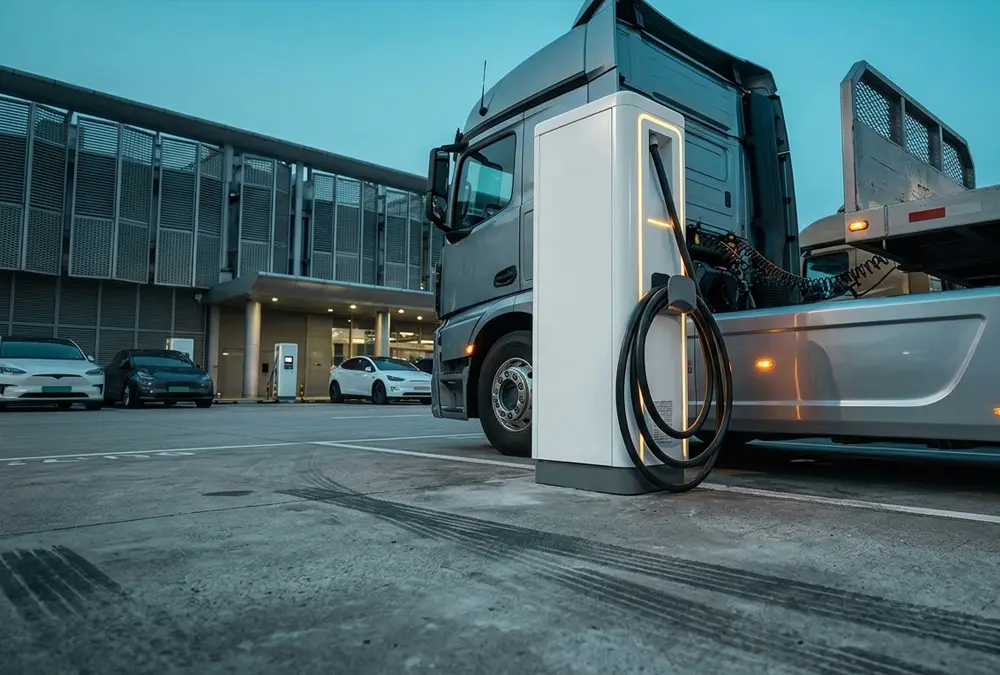
How much power does your EV charging site really need to handle the next generation of electric vehicles?
Deploying high power EV charging has shifted from a forward-looking amenity to a critical business requirement for commercial hubs, logistics fleets, and highway charging corridors. Driven by the rapid transition to 800V vehicle architectures and larger commercial battery capacities, high-power DC infrastructure is essential for minimizing vehicle dwell times. According to the IEA Global EV Outlook 2026, demand for high-power DC fast charging (180kW+) is expanding at over 35% compound annual growth (CAGR) globally. However, deploying high-rated dispensers is only part of the solution. True system performance requires balancing grid connection, power distribution switchgear, ISO 15118 smart communication protocols, dynamic load management, and optional Battery Energy Storage Systems (BESS) to suppress peak demand charges.
Planning a new commercial fast charging site?
The Evolution of EV Charging: From Slow AC to High Power EV Charging
How EV Charging Has Evolved: The Technical Shift from Level 1 to DC Fast Charging
In the early adoption phase of electric mobility, standard alternating current (AC) power dominated charging sites. Level 1 wall sockets delivered 1.4kW–1.9kW for low-rate residential charging, while Level 2 AC chargers expanded power delivery up to 22kW for overnight depot and workplace parking. However, AC charging speed is bottlenecked by the vehicle’s On-Board Charger (OBC), which rectifies AC grid power to DC battery power within thermal and spatial limitations. High-power DC fast charging bypasses the vehicle OBC entirely, rectifying grid AC power inside industrial-grade stationary cabinets and feeding high-voltage Direct Current directly into the battery pack under strict IEC 61851-23 standards.
Why Modern EVs and 800V Architectures Drive Demand for High Charging Power
Vehicle battery design is undergoing a major paradigm shift. Legacy 400V battery architectures are rapidly giving way to 800V high-voltage platforms equipped with Silicon Carbide (SiC) power electronics. Larger battery capacities—ranging from 85kWh–100kWh in passenger EVs to 300kWh–600kWh+ in commercial trucks and buses—require ultra-high current and voltage to maintain practical charging speeds. Data from BloombergNEF Electric Vehicle Outlook 2026 demonstrates that high-power charging sites (>180kW) reduce vehicle dwell times by up to 70%, allowing commercial fleets to maintain high operational availability and preventing highway charging bottlenecks during peak hours.
From Charging Speed to Vehicle Turnaround Time: The Business ROI Metric
In commercial EV charging operations, maximum peak power (kW) on paper is secondary to true vehicle turnaround time. Higher power delivery translates directly to shorter stall occupancy, higher daily charger rotation rates, reduced driver operational delays, and maximized revenue throughput per square meter of site footprint.
What Is High Power EV Charging? Understanding High-Power DC Infrastructure
Technical Definition: What Qualifies as High Power EV Charging?
While general industry parlance labels anything above 50kW as “fast charging,” engineering standards defined by CharIN and international regulatory bodies classify equipment supplying 180kW up to 480kW+ continuously per charging point as High Power Charging (HPC). Equipment pushing output above 1MW (1,000kW) falls into the Megawatt Charging System (MCS / SAE J3271) standard, designed specifically for heavy-duty commercial freight. High-power DC chargers utilize high-efficiency rectifiers, active liquid-cooling for charging cables to handle continuous currents up to 500A+, and wide output voltage windows (typically 150V–1000V DC) to service both legacy 400V and modern 800V vehicle platforms.
How High-Power DC EV Charging Systems Operate
High-power DC charging converts medium-voltage or low-voltage grid AC input into ultra-regulated DC power. Advanced station controllers establish bidirectional handshake communications with the vehicle’s Battery Management System (BMS) using ISO 15118-2 / ISO 15118-20 (Plug & Charge) protocols. The BMS constantly communicates exact real-time voltage and current demand based on cell temperature, state of charge (SoC), and thermal limits, allowing the charger’s modular power cabinets to dynamic-match output instantly.
High Power EV Charging vs. Standard AC and DC Fast Charging Benchmark
| Charging Level | Output Power & Voltage | Charging Speed (10%-80%) | Core Technical Specification | Primary Commercial Application |
|---|---|---|---|---|
| Level 1 AC | 1.4kW – 1.9kW (120V 1-Phase) | 15 – 24 Hours | Standard household grid socket, unmanaged | Emergency residential topping up |
| Level 2 AC | 7kW – 22kW (230V–400V AC) | 4 – 8 Hours | Pass-through AC, limited by internal vehicle OBC | Overnight parking, hotels, & employee hubs |
| DC Fast Charging | 50kW – 150kW (400V/800V DC) | 30 – 50 Minutes | Air-cooled charging cables (≤200A continuous) | Urban shopping centers, supermarkets & public lots |
| High Power DC (HPC) | 180kW – 480kW+ (Up to 1000V DC) | 10 – 20 Minutes | Liquid-cooled cable (up to 500A+), modular power sharing | Highway travel corridors, commercial fleet depots |
| Megawatt (MCS) | 1.2MW – 3.75MW (1250V / 3000A) | < 15 Minutes (600kWh Pack) | Automated/specialized liquid-cooled industrial connectors | Class 8 electric heavy trucks, buses & logistics freight |
High Power EV Charging Power Levels: Architecture & Deployment Scenarios
60kW–120kW DC Fast Chargers: Entry-Level Commercial Solutions
Ideal for sites with medium vehicle dwell times (45–90 minutes), such as retail plazas, municipal parking garages, and hospitality locations. Equipment in this class delivers steady charging without forcing expensive utility grid transformer replacement.
180kW–240kW DC Fast Chargers: The Workhorse of Public and Fleet Charging
The backbone of modern commercial charging hubs and delivery fleet yards. Featuring dynamic matrix power allocation, a 240kW EV charger cabinet can output full 240kW power to a single vehicle requiring rapid charge or split dynamic power across dual connectors (e.g., 120kW + 120kW or 180kW + 60kW) based on real-time BMS feedback.
360kW–480kW Ultra-Fast Chargers: Next-Gen Highway and Transit Infrastructure
Engineered specifically for heavy-traffic highway travel plazas and intensive commercial vehicle operations. Integrated with active liquid-cooled cable assemblies, a 360kW or 480kW charger replenishes up to 300km of driving range in 10 to 12 minutes on 800V-capable passenger EVs and heavy vans.
1MW+ Megawatt Charging Systems (MCS): Decarbonizing Commercial Heavy Transport
Designed to meet international SAE J3271 standards for heavy-duty freight electrification. Megawatt chargers output up to 3,000 Amperes, enabling Class 8 long-haul trucks with 600kWh+ battery packs to recharge fully during mandatory 45-minute driver rest periods.
High Power EV Charging Benefits and Operational Challenges for Commercial Operators
Maximizing Bay Utilization and Revenue Throughput
Reducing charging session times from 45 minutes down to 15 minutes increases daily charger turnover by 300%. For commercial operators, this translates directly to higher kWh sales per charging bay per day, turning site footprint into a high-yield asset.
Ensuring Operational Uptime for Fleet Logistics
Commercial logistics fleets operate on tight delivery schedules. Implementing modular high-power charging infrastructure allows logistics hubs to execute “opportunity charging”—topping up delivery vans during shift changes or loading bay operations without disrupting routes.
Capital Investment (CAPEX) and Civil Infrastructure Demands
Deploying multi-dispenser high-power hardware requires substantial capital upfront. A typical 4-bay 240kW charging site project costs including hardware, civil trenching, medium-voltage transformer connection, and safety protection switchgear can exceed €150,000.
Peak Demand Charges and Operational Expenses (OPEX)
Unmanaged high-power charging creates severe instantaneous power spikes on local utility feeders. Analysis from the EURELECTRIC Infrastructure Insights Report 2025 shows that peak demand charges (kW capacity tariffs) can account for up to 55% of a charging station operator’s monthly utility bill if dynamic load management is not implemented.
High Power EV Charging Challenges: Can Your Grid Handle the Load?
How Much Grid Capacity Does a High-Power EV Charging Station Need?
Consider a standard highway location deploying ten 240kW high-power charging dispensers. Operating simultaneously at peak capacity, the site demands 2.4 MegaVolt-Amperes (MVA) of continuous grid supply. Standard low-voltage commercial connections typically provide under 200kW, creating a severe grid capacity gap.
Navigating Transformer Upgrades and Utility Connection Queue Delays
When requested site load exceeds local distribution substation headroom, utilities require dedicated medium-voltage (MV) step-down transformers and new feeder lines. According to the IEA Grid Integration Study 2026, grid connection queues across Europe and North America currently average 12 to 18 months for multi-megawatt commercial interconnections, representing a major bottleneck for charging station developers.
Why High-Power Charging Requires a Full System Infrastructure Stack
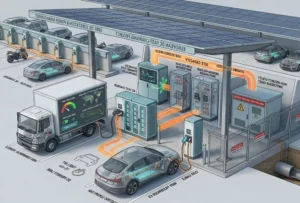
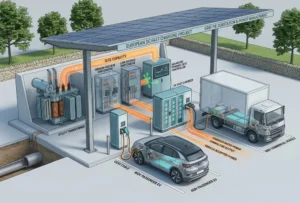
High-power EV charging site engineering requires coordinating “The High-Power Charging Infrastructure Stack”: aligning vehicle battery voltage capabilities, high-efficiency liquid-cooled rectifiers, dynamic load management software, medium-voltage transformers, and intelligent energy management systems.
Integrating on-site renewable solar PV alongside Battery Energy Storage Systems (BESS) creates an autonomous smart microgrid. This setup buffers high-power demand surges, allowing developers to deploy high-power charging even on grid-constrained sites.
Smart High Power EV Charging Solutions: How to Overcome Grid and Cost Challenges
Dynamic Load Balancing for High-Power EV Charging
Dynamic load balancing software monitors real-time facility electricity consumption. By dynamically throttling output power across active charging dispensers, the system prevents breaker trips and keeps peak demand strictly under utility contract thresholds.
OCPP and Cloud-Based EV Charging Management Platforms
Utilizing open-protocol OCPP (Open Charge Point Protocol 1.6J / 2.0.1) hardware enables site owners to connect charging hardware seamlessly with cloud billing software, manage dynamic user tariffs, monitor equipment uptime, and perform over-the-air (OTA) remote diagnostics.
BESS + High Power EV Charging: Microgrid Peak Shaving Architecture
Integrating a stationary Battery Energy Storage System (BESS) provides an active power buffer. The BESS charges slowly from the grid during low-demand periods or off-peak tariff hours, then discharges rapidly during high-power vehicle charging sessions to offset peak demand surcharges.
| BESS Commercial Model | Specs & Chemistry | Core Technical Feature | Target Application | Buyer Economic Benefit |
|---|---|---|---|---|
| Industrial 100kWh BESS | LFP / 100kWh / 50kW | Liquid-cooled integrated cabinet | Small Commercial & Retail Lots | Enables 120kW fast charging on limited 50kW site grid connections. |
| Commercial 261kWh BESS | LFP / 261kWh / 125kW | Smart EMS Peak Shaving Controller | Fleet Depots & Charging Hubs | Cuts heavy peak demand charges while supporting dual 180kW chargers. |
| Enterprise 418kWh BESS | LFP / 418kWh / 200kW | Modular Parallel Architecture | High-Turnover Transit Depots | Supports simultaneous fast charging for multiple vans without breaker trips. |
| Utility-Grade 1MWh BESS | LFP / 1000kWh / 500kW | Containerized HVAC & Fire Suppression | Highway Corridors & Solar PV Parks | Stores cheap solar generation to supply megawatt-scale charger hubs. |
Battery Tech Breakdown: Lithium Iron Phosphate (LiFePO4/LFP) leads stationary energy storage. It delivers superior thermal stability, safety, and over 6,000 cycle lives. The BNEF Stationary Storage Tech Report 2025 shows LFP accounts for 80%+ of commercial energy storage projects. While Sodium-Ion handles sub-zero cold better and Flow Batteries suit long durations, LFP remains the best choice for fast charging peak shaving ROI.
High Power EV Charging Infrastructure in Europe
Why Europe Needs More High-Power EV Charging Infrastructure
European Union AFIR regulations require high-power charger hubs every 60km along major highways. Expanding reliable high power EV charging infrastructure is urgent as commercial fleets electrify rapidly across the continent.
European High-Power Charging Networks and Charging Hubs
Charge point operators across Europe are replacing older 50kW chargers with 240kW and 360kW liquid-cooled units. Upgrade initiatives target highway plazas and logistics corridors.
CCS2, NACS and Charging Connector Compatibility in Europe
The CCS2 EV charger standard dominates European transport. Dual-cable dispensers featuring CCS2 and NACS EV charger plugs ensure seamless vehicle compatibility across commercial networks.
European Grid and Site Planning Considerations
European utilities enforce strict rules regarding harmonic distortion and power factor levels. Site developers should perform power quality audits early during site planning.
High Power EV Charging for Different Commercial Applications
High Power EV Charging for Highway Charging Stations
Highway plazas need robust liquid-cooled dispensers and contactless terminal payments to ensure rapid turnaround for cross-country travelers.
High Power EV Charging for Commercial Fleets
Logistics hubs rely on heavy-duty fleet charging station hubs connected to intelligent EMS platforms to streamline overnight and turnaround charging schedules.
High Power EV Charging for Electric Trucks
Heavy-duty transport requires specialized high power EV charging infrastructure built to supply steady voltage directly into multi-pack battery systems.
High Power EV Charging for Shopping Centers, Hotels and Commercial Properties
Commercial properties gain an edge by adding high power charger pedestals. High-speed amenities attract premium EV drivers and boost overall retail spend.
How to Choose the Right High Power EV Charging Station
| Application Site | Typical Dwell Time | Recommended Power Direction | Key Decision Factor | Buyer Strategic Benefit |
|---|---|---|---|---|
| Hotels & Hospitality | Overnight / 4-8 hrs | 22kW AC + 60kW DC Fast | Guest Parking Convenience | Attracts EV guests without overloading property electrical service. |
| Shopping Centers | 45 – 90 mins | 120kW – 180kW DC Fast Charger | Foot Traffic & Retail Upsell | Increases customer dwell time while generating direct charge revenue. |
| Highway Travel Hubs | 10 – 20 mins | 240kW – 480kW High Power DC | Maximum Bay Turnover | Delivers high vehicle throughput and maximum daily transaction volume. |
| Fleet Logistics Hubs | Shift-Dependent | 180kW – 360kW + BESS Storage | Zero Fleet Downtime Guarantee | Protects fleet schedule while capping utility demand charges. |
Choose Charging Power Based on Vehicle Type and Dwell Time
Match hardware output to typical parking duration. Highway stops require ultra-fast chargers, while overnight depots are well served by moderate DC power levels.
Evaluate Connector Compatibility
Choosing dual-dispenser pedestals built with localized connectors ensures your site accommodates varied electric vehicle models easily.
Check OCPP and Smart Charging Capabilities
Partner with a trusted high power EV charger manufacturer supplying open-protocol hardware. Native OCPP compliance prevents software lock-in and simplifies network integration.
Plan for Future Charging Demand
Don’t design today’s site solely for current EV adoption levels. Selecting scalable, modular power cabinets lets you expand capacity as vehicle traffic grows.
High Power EV Charging Cost: What Should You Budget For?
Data from the McKinsey Clean Transport Infrastructure Report 2025 indicates hardware represents under 40% of overall project costs. A comprehensive budget plan covers five main pillars (“The 5-Cost Budget Check”):
- Charger Hardware: Commercial 180kW to 360kW DC cabinets run between €25,000 and €75,000 based on power rating and dispenser count.
- Grid Upgrade Costs: Step-down transformers and distribution switchgear add €20,000 to €60,000 when site capacity is constrained.
- Civil & Electrical Works: Concrete foundations, trenching, and heavy cabling average €10,000 to €30,000 per installation site.
- Software & Networking: Management platform subscriptions and network billing process about 3% to 5% of hardware capital annually.
- Maintenance & Servicing: Cable maintenance, cooling inspections, and service contracts average €1,500 to €3,500 per charger annually.
High Power EV Charging ROI: Is the Investment Worth It?
Evaluating ROI requires analyzing the “Charging ROI Triangle”: balancing charger utilization rates, electricity demand charges, and retail pricing per kWh.
How Charger Utilization Affects ROI
Low charger utilization cuts profitability. Combining public daytime fast charging with scheduled overnight fleet charging keeps chargers generating revenue around the clock.
How Dynamic Load Management Can Improve Operating Economics
Smart load management caps total facility draw during peak billing hours, shielding your operating budget from severe demand penalties.
When High-Power Charging Makes Financial Sense
High power installations make sound financial sense for highway plazas, commercial logistics hubs, and high-traffic commercial real estate where throughput drives profit.
High Power EV Charging FAQs
What is considered high power EV charging?
It refers to DC equipment outputting 180kW to 480kW+ directly to vehicle batteries, bypassing slow AC on-board chargers.
Is 350kW charging really faster than 150kW?
Yes, provided the vehicle features an 800V battery architecture. It cuts a 10% to 80% charging session from 30 minutes down to under 15 minutes.
Does high-power EV charging damage the battery?
No. Modern EV battery management systems monitor current and thermal levels continuously to safeguard long-term battery cell health.
How much does a high-power EV charging station cost?
Hardware costs range from €20,000 for standard 120kW units to over €80,000 for ultra-fast 360kW systems. Civil works and grid connection add extra cost.
Can the existing grid support high-power EV charging?
It depends on site transformer capacity. Adding dynamic load balancing or BESS energy storage helps avoid expensive grid expansion.
Can BESS reduce the cost of high-power EV charging?
Yes. BESS units store energy off-peak and supply extra power during high-rate charging sessions, preventing peak demand surcharges.
What is the difference between high-power charging and DC fast charging?
Standard DC fast chargers supply 50kW to 150kW. High-power systems deliver 180kW to 480kW+, utilizing liquid-cooled cables to transfer high current safely.
What connector is used for high-power EV charging?
CCS2 is standard in Europe, while NACS and CCS1 lead in North America. Heavy electric commercial trucks use specialized MCS connectors.
Build Your High Power EV Charging Solution with AnengJi
From High-Power DC Chargers to Complete Charging Infrastructure
AnengJi manufactures high-performance DC fast systems from 120kW up to 480kW. Equipped with open OCPP software and dynamic load balancing, our solutions integrate smoothly with commercial BESS storage units to overcome grid limits.
Engineering Support for Commercial and Fleet Charging Projects
Our engineering team supports site developers and EPC contractors through every project phase: from site load evaluation to hardware selection and on-site commissioning.
Factory-Direct High-Power EV Charging Solutions
Partner directly with the manufacturer to gain direct pricing, customized hardware setups, and reliable technical support for your EV infrastructure deployment.