Introduction
EV charging for hotels can influence where an electric-vehicle driver stays, but installing a charger does not automatically create a booking advantage. The guest is buying certainty: accurate information before booking, a usable bay on arrival, a simple way to start charging, a clear price and enough energy for the next journey.
That promise is easy to break. A hotel may advertise charging while the only space is occupied by a vehicle that is not charging. A guest may arrive without the cable the socketed unit requires. An underground garage may block the mobile connection needed for an app. Reception may know that chargers exist but not who can reset them or resolve a payment problem.
This article focuses on the booking and guest-experience side of hotel charging: how to present the amenity, set access and pricing rules, prevent operational failures and measure whether it contributes to direct bookings or repeat stays. For equipment configuration, site power and project delivery, use AnengJi’s separate hotel EV charging solutions page.
Booking rule: Do not promote “EV charging available” as a simple checkbox. State how many ports exist, who may use them, whether availability is guaranteed, which connectors are provided, what charging costs and what the hotel will do if the service is unavailable.
Article navigation
Why EV Charging Can Affect a Hotel Booking Decision
For a driver travelling beyond the comfortable range of a home charge, overnight charging changes the next day’s plan. A suitable hotel can replace a separate charging stop before departure. That saves time, reduces route uncertainty and lets the guest begin the morning with the required energy. In that context, charging is not a decorative sustainability feature; it is part of the stay’s practical value.
However, the effect on bookings depends on visibility and credibility. A charger that is not shown on the hotel website, booking channels or mapping services cannot influence consideration. A listing that says only “EV charger” may still fail to answer the questions that determine whether the driver can rely on it.
The US Department of Energy’s Alternative Fuels Data Center overview of charging networks explains that network services can let drivers find stations, view status, start sessions and pay, while operators manage access, fees, health and utilisation data. For a hotel, those functions connect two sides of the same promise: discovery before arrival and operational control during the stay.
This does not prove that a charger will increase occupancy by a fixed percentage. Location, traveller mix, room price, seasonality and nearby charging alternatives all matter. The hotel should treat booking influence as a measurable hypothesis rather than a guaranteed return.
Use the BOOK Framework to Turn Charging Into a Guest Benefit
The BOOK framework keeps the article’s commercial promise separate from the technical solution page. It follows the guest’s decision while giving hotel teams clear operating responsibilities.
| BOOK element | Hotel action | Guest question answered | Commercial benefit |
|---|---|---|---|
| B — Be discoverable | Publish consistent information across the website, booking channels and charging maps | “Can I charge where I stay?” | Makes the amenity visible during hotel selection |
| O — Offer certainty | Explain access, availability, connectors, price and expected service | “Can I rely on it for tomorrow’s drive?” | Reduces booking hesitation and expectation gaps |
| O — Operate reliably | Control bays, train staff and define fault recovery | “What happens if something goes wrong?” | Protects reviews, loyalty and front-desk time |
| K — Know the result | Track booking influence, session success, complaints and repeat use | “Was charging worth choosing this hotel?” | Supports evidence-based expansion and pricing |
What Guests Need to Know Before They Book a Hotel With EV Charging
A useful hotel listing answers practical questions without forcing the guest to call reception. Publish the information in plain language and keep it consistent wherever the property appears.
- Availability: number of charging ports and whether a bay is reservable, guest-priority or first come.
- Compatibility: connector type, tethered or socketed design, and whether the guest must bring a cable.
- Service level: maximum power, whether power is shared and a warning that actual charging depends on the vehicle and site allocation.
- Access: car-park opening hours, barriers, check-in validation, app, QR, payment card or RFID process.
- Price: free allowance, electricity tariff, session fee, parking fee and any occupancy charge.
- Support: who guests contact when a session fails and what alternative the hotel can offer.
Avoid promising that every guest will leave with a full battery. A vehicle’s charging acceptance, arrival state of charge, departure time and shared site limit all affect the outcome. “Overnight charging available” is credible when followed by the conditions; “guaranteed full charge” is not credible without reservation, energy and operating controls that can deliver it.
Recommended website wording: “Registered guests can use six Type 2 charging ports in the main car park. Charging is subject to availability and shared site power. View the current tariff, access steps and cable requirements before arrival.” Adapt every detail to the actual property.
Design the Charging Experience From Arrival to Departure
Arrival: Make the Correct Bay Easy to Find
Wayfinding should begin at the car-park entrance, not at the charger. Signs, lighting and bay markings must distinguish charging spaces from ordinary parking without creating an inaccessible route. If a driver has to circle the property or park at reception to ask where the charger is, the amenity has already added friction.
Accessibility must also be designed into the route, space and interface. The US Access Board’s EV charging design recommendations cover accessible routes, access aisles, cable reach, operable parts, payment interfaces and customer support. Although the document is US technical assistance rather than a universal hotel code, it shows why accessibility cannot be added after kerbs, bollards and chargers are fixed in place.
Starting a Session: Minimise Accounts and Instructions
Choose authentication around the user group. An RFID card may suit repeat staff or loyalty members, while a QR or payment-card flow may suit occasional guests. An app-only process can frustrate an international traveller who must create an account after a late arrival. The hotel should test every screen and instruction as a first-time user, including the case where mobile coverage is weak.
RFID identifies a user or account; it is not automatically the same as contactless bank-card payment. For the access and payment differences, see the commercial EV charging cards guide.
During the Stay: Protect Charging Bays Without Waking Guests
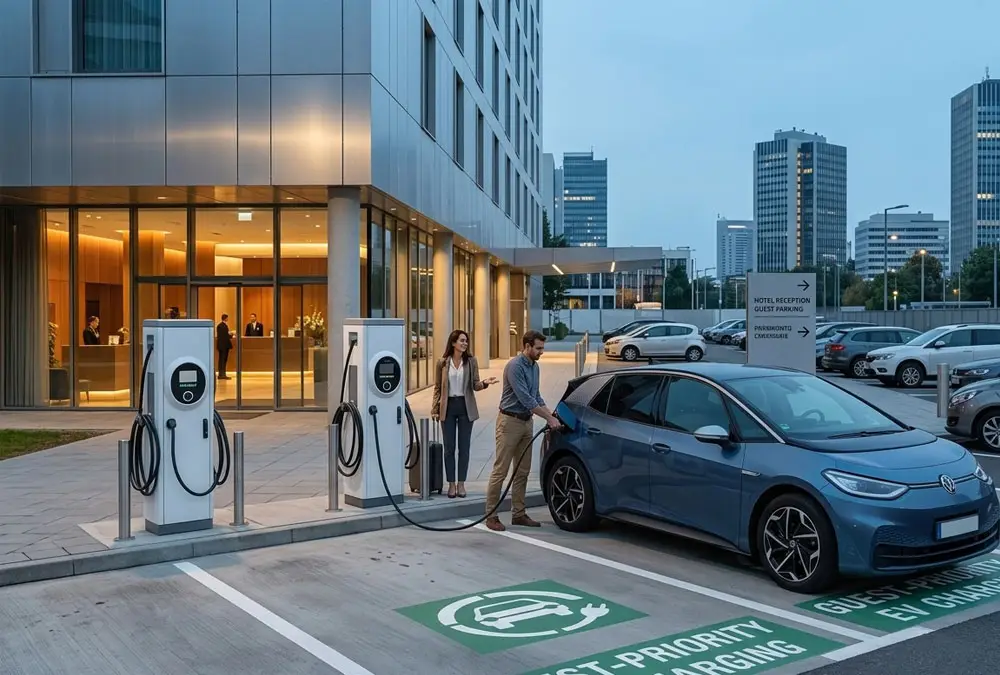
A charging bay blocked by a combustion vehicle or a fully charged EV creates a service failure even when the charger is healthy. Hotels need a practical policy: visible guest-priority signage, licence-plate or room validation, a reception escalation path and a record of denied requests. Valet properties may rotate vehicles; self-parking properties may benefit from more lower-power ports so guests can remain connected overnight.
An occupancy fee that begins immediately after charging ends may work at a short-stay public hub but is poorly matched to a sleeping guest. An overnight grace period, a checkout-linked rule or a morning move request can protect turnover without demanding that guests leave their rooms in the middle of the night.
When Charging Fails: Own the Service Recovery
Reception needs a one-page response guide: how to check whether a unit is online, who can reset it, who handles payment disputes, the operator’s support channel, the expected response time and the nearest dependable alternative. If the charger vendor, backend provider and hotel each assume another party owns the fault, the guest becomes responsible for coordinating the system. A modest room credit or parking adjustment may be appropriate, but the first remedy is useful information and accountable support.
Match the Charging Promise to the Hotel’s Guest Pattern
Hotel categories do not require identical promises. Charging should reflect how guests use the property rather than forcing every hotel into the same “fastest available” message.
| Hotel context | Guest need | Credible promise | Operational risk | Buyer benefit |
|---|---|---|---|---|
| Boutique city hotel | Reliable overnight access in limited parking | Guest-priority managed charging with clear reservation status | One blocked bay affects a large share of capacity | Certainty matters more than headline speed |
| Resort | Charging across multi-night stays and day visits | Separate rules for hotel guests, staff and public visitors | Unclear user priority during events | Charging can support rooms and other on-site services |
| Motorway hotel | Overnight charging plus possible short public stops | Clearly separate guest amenity and public charging offers | Public traffic displaces staying guests | Two offers can be measured and priced independently |
| Airport or valet property | A vehicle ready at an agreed collection time | Managed handover with recorded target energy and responsibility | Missed charging deadline becomes a travel disruption | Charging becomes part of a premium parking service |
The technical team can then select the suitable AC/DC mix. Overnight guests often value access to more managed AC ports, while short-turn uses may justify DC charging. The separate AC versus DC commercial guide explains the power, vehicle-acceptance and cost implications without duplicating them here.
Set Pricing, Reservations and Access Rules Guests Can Understand
Free charging can support a premium room or loyalty benefit, but it still has electricity, software, maintenance and parking opportunity costs. Paid charging can recover costs, yet an unclear tariff can damage trust. The hotel may offer an included allowance, a per-kWh price, a session fee, bundled parking and charging, or different rates for guests and public users. The selected method must be permitted in the local market and explained before the session starts.
For publicly accessible charging in the European Union, the Alternative Fuels Infrastructure Regulation (EU) 2023/1804 establishes requirements concerning ad-hoc access, payment, price transparency and data. A hotel must first determine whether its access model falls within the publicly accessible scope and then check national electrical, metering and consumer rules.
The United Kingdom is not governed by AFIR. The UK government’s Public Charge Point Regulations 2023 guidance describes separate contactless and price-display duties for qualifying public charge points. These rules should not be copied automatically to a private guest-only system or another country.
Reservations need the same honesty. If the hotel cannot enforce a reserved bay, do not imply that a charger is guaranteed. A request field can still help reception plan demand, but its confirmation message should state whether it is a firm reservation, a priority request or simply notice that the guest intends to charge.
How to Measure Whether Hotel EV Charging Wins More Bookings
Charging revenue and hotel revenue influence are different. A session can have a low direct margin while helping secure a room booking; it can also earn charging revenue from a driver who never books a room. Separate the two effects before calculating value.
Track the Booking Funnel
- Visits to the charging-information page and clicks into room availability.
- Bookings using an EV package, charging request field or trackable direct-booking promotion.
- Guests who requested charging versus guests who completed a successful session.
- Charging-related calls, complaints, refunds, failed starts and unavailable-bay incidents.
- Repeat stays by guests who previously used charging, assessed with appropriate privacy controls.
A useful internal measure is the charging-request conversion rate:
This reveals whether the advertised service is being delivered. It does not prove that charging caused the booking. To study influence, compare direct-booking behaviour, guest surveys and relevant referral or campaign data while controlling for season, room price, property and traveller type.
Measure the Cost of Friction
Record staff time spent explaining access, moving vehicles, resolving payment disputes and directing guests elsewhere. These costs are easy to overlook because they sit in hotel operations rather than the charging invoice. If one access method produces repeated late-night calls, the cheapest software subscription may not be the lowest-cost guest experience.
Turn the Guest Promise Into a Technical Project Brief
Once the hotel defines the service, the solution team can engineer it. The South Australia Department for Energy and Mining’s Electric Vehicle Charging Integration Report for overnight accommodation treats load management, scheduling, access control, payment, maintenance and booking capability as connected operating decisions. This supports a crucial handoff principle: the electrical design and the hotel workflow must be specified together.
Give the EPC or charging supplier the country, property type, room and parking count, user groups, arrival and departure patterns, charging requests, desired reservation promise, access and payment policy, support hours, interval building load and expansion goal. The technical team can then evaluate port count, AC/DC mix, connector, cable arrangement, site power, load management, communications, backend and civil works.
Keep the boundaries clear. This Blog explains why the guest offer matters and how the hotel should operate and measure it. The hotel charging solution page should carry the equipment, system architecture and project-conversion content.
Ready to Turn the Guest Promise Into a Charging Plan?
Share your hotel type, parking pattern, access policy and available site information with AnengJi.
Frequently Asked Questions About EV Charging for Hotels
Does EV charging guarantee more hotel bookings?
No. It can remove a practical barrier for EV travellers and strengthen the property’s offer, but booking impact depends on location, guest mix, visibility, price, availability and nearby alternatives. Track the effect instead of assigning a universal uplift.
What charging information should a hotel publish?
Publish port count, connector, cable requirement, access hours, guest eligibility, reservation status, pricing, parking fees, shared-power conditions and support details.
Should hotel charging be free?
It may be included as a room or loyalty benefit, charged separately or bundled with parking. Compare electricity, transaction, software, maintenance and parking costs, then communicate the policy before booking and charging.
Can guests reserve an EV charging bay?
Yes, when the hotel can enforce the reservation through parking operations, access control or valet service. Otherwise, describe it as a request or first-come service rather than a guarantee.
How should a hotel handle a fully charged vehicle overnight?
Use an overnight grace period, checkout-linked policy, valet rotation or enough lower-power ports to avoid a midnight move. A public-hub overstay rule may not suit a sleeping guest.
What should reception do when a charger fails?
Staff need a short procedure showing status checks, remote-reset ownership, payment support, repair escalation, expected response time and the nearest reliable alternative.
Does a hotel Blog replace a technical charging solution page?
No. The Blog answers booking, guest-experience and operating-policy questions. The solution page should explain hardware, site power, load management, backend options and the path to a project proposal.
Make Charging a Promise the Hotel Can Keep
The booking advantage comes from certainty, not the charger alone. Be discoverable, offer accurate information, operate the service reliably and measure the outcome. When those four conditions are met, charging can remove travel friction and give EV drivers a concrete reason to choose—and return to—the property.