Selecting the best ev charging companies isn’t about blindly trusting a famous brand name. There is no single best EV charging company for every project; the right choice depends on whether you need commercial EV charging hardware, a public charging network, back-end CSMS software, fleet infrastructure, or direct-factory OEM manufacturing. Navigating the global market requires looking past simple brand hype. We evaluate suppliers across Company Type, Technology, Field Reliability, Project Fit, and Total Cost of Ownership (TCO) so you get maximum uptime without overpaying.
Market projections highlight why hardware selection is so critical today. Precedence Researchestimates the global EV charging station market will surge past $73.92 billion in 2026, heading toward $548.05 billion by 2035. Meanwhile, the International Energy Agency (IEA) Global EV Outlookhighlights that over 150 million charger points will be added globally through 2030. With massive capital pouring into infrastructure, choosing the wrong vendor causes severe grid connection delays, broken chargers, and dead investments.
Top 10 Best EV Charging Companies in the World
Here is our evaluated ranking of the leading manufacturers and network operators globally. We compare their core hardware, target applications, and strategic advantages for commercial buyers.
| Company | Primary Business Type | AC Chargers | DC Fast Chargers | CSMS Software | Best Project Fit | Buyer Advantage |
|---|---|---|---|---|---|---|
| ABB E-mobility | Manufacturer / Industrial | ✓ | ✓ | ✓ | Highway & Transit Depots | Proven heavy-duty reliability for high-voltage public charging corridors. |
| ChargePoint | Network / Turnkey Provider | ✓ | ✓ | ✓ | Commercial Workplace & Retail | Turnkey driver app and software features simplify operations for site hosts. |
| AnengJi | Direct Manufacturer / OEM | ✓ | ✓ | ✓ | Commercial, Fleet & Solar-BESS Sites | Factory-direct OEM flexibility paired with integrated BESS energy storage. |
| EVBox | Manufacturer / Solution Provider | ✓ | ✓ | ✓ | European Destination & Fleet | Clean modular designs compliant with strict European electrical safety codes. |
| Tritium | DC Hardware Specialist | ✗ | ✓ | ✓ | Ultra-Fast Urban & Corridor Charging | Liquid-cooled engineering delivers ultra-compact high-power DC footprints. |
| Siemens eMobility | Industrial Conglomerate | ✓ | ✓ | ✓ | Industrial Depots & Microgrids | Seamless integration with complex industrial power distribution setups. |
| Kempower | Dynamic DC Manufacturer | ✗ | ✓ | ✓ | Logistics & Heavy Fleet Hubs | Dynamic power allocation redirects available grid power to active vehicles. |
| Blink Charging | Network Operator / Supplier | ✓ | ✓ | ✓ | Hospitality & Retail Parking | Flexible turnkey business models for commercial property site owners. |
| Wallbox | Smart Hardware Specialist | ✓ | ✓ | ✓ | Workplace & Multi-Family Parking | Compact form factors with build-in dynamic power sharing technology. |
| Delta Electronics | Electronics OEM Manufacturer | ✓ | ✓ | ✓ | Commercial Infrastructure OEMs | High industrial power conversion efficiency built into durable hardware housings. |
1. ABB E-mobility
Company Overview: As a global heavy electrical technology giant, ABB E-mobility stands at the absolute forefront of industrial-grade EV charging infrastructure. Leveraging decades of power grid, transformer, and power conversion expertise, ABB has deployed over 1 million EV chargers across 85+ global markets. Their flagship Terra series powers major public highway networks and heavy municipal transit fleets worldwide, backed by extensive local engineering field teams and continuous hardware R&D investments.
Main Products: Terra AC wallboxes (7kW-22kW), Terra DC fast chargers (60kW-180kW), Terra HP ultra-fast charging systems (up to 360kW)
Key Strengths: Worldwide field engineering support, extreme grid compliance stability, and proven performance across high-voltage public charging corridors.
Best For: High-volume public highway corridors, municipal transit depots, and heavy utility projects.
Potential Limitations: Premium brand positioning results in higher initial equipment CAPEX.
B2B Project Fit: Ideal for large corporate utility initiatives with strict corporate procurement requirements.
2. ChargePoint
Company Overview: ChargePoint operates one of the largest public EV charging networks in North America and Europe, managing hundreds of thousands of active charging locations. Rather than acting strictly as an equipment vendor, ChargePoint delivers an integrated ecosystem bridging hardware, cloud software, driver mobile apps, and payment processing. Their business model empowers commercial site hosts—from corporate campuses to retail shopping centers—to deliver managed charging amenities while collecting automated driver fees.
Main Products: CP6000 commercial Level 2 series, Express Plus modular high-power DC platform, ChargePoint Cloud Management Software
Key Strengths: Seamless driver app interface, massive brand recognition, and plug-and-play network management for commercial site hosts.
Best For: Commercial office parks, shopping centers, municipal garages, and hospitality sites.
Potential Limitations: Ongoing software subscription costs add predictable yet permanent operational fees over time.
B2B Project Fit: Great for property managers seeking a hands-off, fully managed software and hardware package.
3. AnengJi
Company Overview: AnengJi is a high-tech EV charging station manufacturer and microgrid solution provider specializing in direct OEM/ODM production and integrated energy storage architectures. Operating advanced manufacturing facilities equipped with automated PCB assembly and rigorous thermal test bays, AnengJi builds commercial AC chargers, modular DC fast charging stations, and industrial Battery Energy Storage Systems (BESS). By controlling internal power module design and software firmware development, AnengJi helps EPC contractors, fleet operators, and regional distributors deploy white-label hardware at factory pricing without locked-in third-party platform licensing fees.
Main Products: Commercial AC chargers (7kW-22kW), DC Fast Chargers (30kW-360kW), 30kW/40kW high-efficiency power modules, and paired C&I Battery Energy Storage Systems (100kWh to 1MWh)
Key Strengths: Deep factory OEM/ODM customization, open OCPP compliance, direct factory pricing, and native integration with industrial BESS storage.
Best For: Commercial site hosts, electric fleet depots, regional equipment distributors, EPC engineers, and private-label brand operators.
Potential Limitations: Operates strictly as a B2B manufacturer rather than running a consumer-facing public retail app.
B2B Project Fit: Perfect for commercial buyers looking to cut out middleman markups, rebrand hardware, or bypass severe site grid capacity constraints using integrated battery storage.
4. EVBox
Company Overview: Headquartered in the Netherlands, EVBox is a pioneer in the European e-mobility landscape, supplying flexible charging solutions across 70+ countries. EVBox focuses heavily on clean architectural design, modular field-replaceable components, and compliance with Europe’s stringent grid integration standards. Their commercial hardware is widely deployed across workplace parking lots, fleet depots, and public municipal charging sites throughout western Europe.
Main Products: EVBox Livo commercial AC charging units, Troniq High Power modular DC fast charger series (up to 320kW)
Key Strengths: Architectural form factors, full compliance with European calibration regulations (Eichrecht), and modular maintenance setups.
Best For: European destination charging, public municipal parking lots, and corporate fleets.
Potential Limitations: Firmware updates have occasionally required extra site testing during field rollouts.
B2B Project Fit: Well-suited for European commercial property developers requiring certified hardware.
5. Tritium
Company Overview: Originating in Australia, Tritium gained global fame as a hyper-focused DC fast charger manufacturer. Tritium revolutionized hardware design by introducing fully liquid-cooled DC fast chargers. By eliminating air filter vents, Tritium’s sealed IP65 enclosures protect internal electronics from dust, salt air, snow, and debris, allowing high-power charging units to operate reliably in harsh outdoor conditions.
Main Products: Veefil-PK 175kW to 350kW liquid-cooled high-power DC chargers, PKM modular fast charging platforms
Key Strengths: Sealed liquid-cooled architecture, narrow physical footprints, and high performance in extreme environmental conditions.
Best For: Highway charging plazas, coastal sites, and tight urban footprints with minimal ground area.
Potential Limitations: Liquid-cooling fluid systems demand specialized technician training during routine maintenance.
B2B Project Fit: Highly effective for dense urban locations where space is at a premium.
6. Siemens eMobility
Company Overview: Backed by one of the largest industrial engineering conglomerates in history, Siemens eMobility integrates charging equipment directly into broader electrical distribution and smart building management networks. Siemens designs hardware built to communicate smoothly with site transformers, switchgear, and solar installations, providing heavy commercial facilities with end-to-end power management control.
Main Products: VersiCharge AC commercial series, SICHARGE D flexible high-power DC fast charger systems
Key Strengths: Direct integration with industrial building management systems (BMS), high electrical safety ratings, and robust industrial construction.
Best For: Heavy industrial plants, logistics hubs, bus depots, and corporate campuses.
Potential Limitations: Corporate procurement processes can extend quote and delivery timelines.
B2B Project Fit: Ideal for industrial facilities already running Siemens switchgear and electrical panels.
7. Kempower
Company Overview: Based in Finland, Kempower has emerged as a major force in DC fast charging by developing dynamic, user-centric charging architectures. Their modular design separates central power cabinets from slim user satellite posts. Kempower’s proprietary software dynamically routes power in 25kW increments to connected vehicles based on real-time battery needs, preventing grid power waste at busy fleet hubs.
Main Products: C-Station central power cabinets, S-Station satellite charging posts, C-Mini compact fleet power units
Key Strengths: Dynamic power allocation, intuitive touchscreen interfaces, and slim cable management satellites.
Best For: Heavy electric bus depots, commercial delivery fleets, and high-volume highway truck stops.
Potential Limitations: Central cabinet plus satellite wiring setups increase initial civil installation planning.
B2B Project Fit: Outstanding for fleet operators charging dozens of commercial vehicles with varying battery levels.
8. Blink Charging
Company Overview: Blink Charging is a major provider and operator of EV charging equipment across North America, Latin America, and Europe. Blink is known for flexible business deployment models, including turnkey site host options where Blink covers equipment purchase and installation costs in exchange for sharing ongoing charging revenue with the property owner.
Main Products: Series 7 & 8 commercial Level 2 chargers, Series 60 DC fast charging stations
Key Strengths: Flexible site partnership business models and straightforward credit card payment hardware options.
Best For: Hotels, multi-family residential complexes, commercial retail strips, and restaurant parking.
Potential Limitations: Turnkey revenue-share arrangements trade away long-term margin potential.
B2B Project Fit: Excellent for property owners wanting charging amenities without spending upfront capital.
9. Wallbox
Company Overview: Wallbox is a Barcelona-based smart charging company known for sleek hardware aesthetics and intelligent energy management software. While famous for residential chargers, Wallbox has expanded aggressively into commercial spaces with touchscreen-enabled chargers and dynamic load balancing systems that link multiple chargers to shared building power feeds.
Main Products: Pulsar Max, Commander 2 commercial AC chargers, Supernova public DC fast charger
Key Strengths: Compact form factors, touchscreen displays, and integrated dynamic power sharing software.
Best For: Workplace parking structures, hospitality sites, and multi-family residential developments.
Potential Limitations: Lightweight casing designs require extra protective bollards in heavy industrial loading bays.
B2B Project Fit: Great for commercial venues seeking intuitive, touchscreen-enabled charging hardware.
10. Delta Electronics
Company Overview: Delta Electronics is a global leader in power electronics and thermal management solutions. Drawing on deep engineering experience in high-efficiency power supplies, Delta builds durable commercial AC chargers and DC fast charger units for global infrastructure developers. Their internal power modules achieve outstanding efficiency, minimizing power conversion loss and reducing operating thermal stress.
Main Products: City Charger AC units, 100kW-200kW ultra-fast DC charging stations, modular power components
Key Strengths: High industrial power conversion efficiency, robust electrical design, and deep OEM manufacturing capacity.
Best For: Commercial infrastructure suppliers, utility providers, and system integrators.
Potential Limitations: Less focused on developing consumer-facing software applications.
B2B Project Fit: Excellent for integrators needing reliable industrial power conversion hardware.
What Are the Best EV Charging Companies in the World?
The best EV charging companies are those that consistently deliver verified hardware efficiency, open OCPP software integration, strict global safety certifications, and reliable field support. Instead of treating every provider as equal, top industry players are evaluated based on their core domain expertise.
What Makes an EV Charging Company “The Best”?
A massive marketing budget doesn’t stop a charging station from breaking down in extreme winter weather. Evaluating hardware vendors demands clear operational metrics: charging reliability, product portfolio depth, DC fast charging capability, native OCPP compliance, field uptime, global certifications, scale, technical support, direct OEM capability, and true total cost of ownership. On Reddit forums like r/evcharging, site hosts frequently voice frustration over uncommunicative vendors, locked-in software backends, and weeks of waiting for simple replacement modules. Buyers need a reliable framework to cut through the noise.
| Pillar | Core Operational Focus | Strategic Value to Buyer | Buyer Benefit & Competitive Advantage |
|---|---|---|---|
| Product | AC & high-power DC ranges | Covers 7kW to 360kW+ requirements | Allows single-vendor sourcing across all site types, dropping management overhead. |
| Platform | OCPP 1.6J / 2.0.1, CSMS integration | Open API & dynamic load management | Prevents software lock-in, letting you swap network backends without discarding hardware. |
| Performance | ≥96% module efficiency, 99% uptime | Thermal control & liquid cooling | Maximized energy throughput lowers station power waste and boosts driver turnover. |
| Project Fit | Grid tie-in, microgrid compatibility | Modular power allocations | Avoids costly utility transformer upgrades by adjusting dynamic power limits on demand. |
| Partnership | OEM/ODM customization & spare parts | Direct technical service SLAs | Ensures long-term component availability, reducing unit repair turnaround from weeks to days. |
EV Charging Companies vs EV Charger Manufacturers: What Is the Difference?
One major point of confusion for commercial buyers is mixing up network providers with physical equipment manufacturers. Searching for top EV charging companies usually pulls up operators, white-label resellers, and hardware producers all mixed together. Deciding who to contract with changes your control over equipment, long-term costs, and software flexibility.
EV Charging Network Operators
Operators focus on public-facing networks, driver apps, payment handling, and roaming access. They monetise charging transactions. While convenient for turnkey turn-ons, their hardware options are often limited, and their subscription fees eat into your operating margins over time.
EV Charger Manufacturers
An EV charger manufacturer or EV charging station manufacturer manufactures the physical hardware: AC wallboxes, high-power DC fast chargers, power modules, and internal control boards. They provide raw hardware, offer custom OEM options, and sell directly to commercial operators, EPC contractors, and distributors at factory prices.
EV Charging Software and CSMS Providers
Software platforms build Charging Station Management Systems (CSMS). Using open OCPP protocols, these systems handle remote diagnostics, access authorization, dynamic power distribution, fleet management, and billing processing without building physical charging hardware.
Turnkey EV Charging Solution Providers
Turnkey providers handle the entire deployment path. They coordinate initial site feasibility, electrical civil engineering, utility interconnections, charger procurement, physical installation, and long-term maintenance contracts.
How We Rank the Best EV Charging Companies
To maintain complete objectivity, we apply our proprietary framework: the EV Charging Company Selection Score™. This scoring model ranks manufacturers and operators using clear, weighted technical criteria rather than commercial sponsorship.
| Evaluation Factor | Weight | Engineering & Commercial Standard |
|---|---|---|
| Charger Reliability | 15% | Verified MTBF rates, thermal performance, and IP/IK housing durability. |
| Product Portfolio | 12% | Availability of Level 2 AC to 360kW+ DC split-cabinet systems. |
| DC Fast Charging Capability | 12% | Module efficiency (>96%), peak output, and matrix power sharing. |
| OCPP & Software Integration | 10% | Native compliance with OCPP 1.6J and OCPP 2.0.1 backends. |
| Certifications & Safety | 10% | Full CE, UL, IEC, and CB third-party laboratory certifications. |
| Global Deployment Track Record | 10% | Proven installations across North America, Europe, and Asia-Pacific. |
| Scalability for Commercial Projects | 8% | Dynamic load management and multi-dispenser master-slave setups. |
| After-Sales & Warranty Support | 8% | Spare parts dispatch speed, field service SLAs, and remote patching. |
| OEM/ODM Customization Capability | 8% | Hardware re-branding, custom firmware, and housing modification flexibility. |
| Total Cost of Ownership (TCO) | 7% | Competitive initial CAPEX combined with low ongoing OPEX costs. |
Product Portfolio
A robust portfolio spans every project demand. Sourcing both AC wallboxes for overnight workplace parking and high-power DC fast charger units from a single manufacturer simplifies procurement and guarantees consistent communication protocols.
Charging Reliability and Uptime
A station that drops off the network frustrates drivers and burns revenue. Leading EV charging companies build redundant power modules into their hardware so if one 30kW module fails, the charger stays active at reduced capacity instead of going down completely.
OCPP and Smart Charging Compatibility
Proprietary communication locks you into a single vendor’s ecosystem forever. Demanding true OCPP 1.6J or OCPP 2.0.1 compliance ensures your EV charging infrastructure integrates cleanly with third-party billing, fleet management, and smart grid systems.
Global Certifications and Safety
Deploying uncertified chargers is a massive liability. Leading manufacturers hold complete, verified laboratory certifications for UL, CE, IEC, and FCC standards to clear municipal inspections and local utility connections.
Scalability for Commercial Projects
Commercial sites rarely stay fixed in size. Scalable hardware supports master-slave controller links and dynamic load management, allowing you to double your charging ports without upgrading your physical utility connection.
OEM/ODM and Customization Capability
For network operators and distributors, custom hardware options are essential. Top manufacturers support factory branding, custom housing paint, distinct cable lengths, and tailored firmware out of the box.
Total Cost of Ownership
The initial hardware price is only part of the equation. Low-efficiency modules waste substantial power as heat, while high recurring network licensing fees silently eat away at site profits over a 5- to 10-year lifespan.
Best EV Charging Companies by Business Use Case
Best EV Charging Companies for Commercial Parking
Commercial parking facilities require reliable workplace charging with automated billing. Systems like the Wallbox Commander 2 or AnengJi 11kW/22kW commercial AC chargers combine sleek enclosures with built-in RFID cards and dynamic power sharing to support multi-vehicle charging on shared utility lines without tripping local breakers.
Best EV Charging Companies for Fleet Charging
Logistics hubs charging delivery vans, buses, or heavy trucks need dedicated best ev charging companies for fleet charging. Systems built by Kempower and Siemens stand out here thanks to dynamic load management. Route schedules sync directly with CSMS software to prioritize vehicles launching earliest, maximizing fleet availability across shifts.
Best EV Charging Companies for Highway DC Fast Charging
Highway stops prioritize rapid charge times above all else. Best dc fast charging companies like ABB, Tritium, and AnengJi deploy 180kW to 360kW ultra-fast DC charger units. Liquid-cooled cables handle sustained 400A+ current draws, adding 200 kilometers of range in under fifteen minutes.
Best EV Charging Companies for Shopping Malls and Hotels
Destination sites want clean charger designs that attract high-value drivers. ChargePoint and Blink offer turnkey models where drivers pay easily via app or credit card reader, while property owners collect automated passive revenue while visitors shop or stay overnight.
Best EV Charging Companies for OEM and ODM Projects
Distributors and regional network operators looking to build an independent brand need a true ev charger manufacturer for oem contracts. Direct factory partners like AnengJi let you customize every hardware detail—from exterior casing colors and logo placement to internal controller firmware, cable lengths, and custom connector types—all backed by direct factory guarantees.
Best EV Charger Manufacturers for Commercial and Industrial Projects
AC EV Charger Manufacturers
Commercial Level 2 AC chargers (7kW, 11kW, and 22kW) are the backbone of long-dwell parking. High-quality manufacturers construct these units with die-cast aluminum housings, IP65 weather ratings, and internal Type B RCD earth-leakage protections to ensure non-stop outdoor operation.
DC Fast Charger Manufacturers
Leading commercial dc fast charger manufacturers build modular power systems spanning 30kW, 60kW, 120kW, 180kW, 240kW, and 360kW. Converting incoming grid AC power straight into vehicle battery DC power requires heavy-duty internal matrix switching, allowing full output to route dynamically to whichever vehicle needs it most.
EV Charging Module Manufacturers
The true heart of any DC fast charger is its internal power module. Advanced 30kW and 40kW air-cooled or liquid-cooled modules feature >96% power conversion efficiency. High module efficiency cuts internal heat build-up, lowers cooling fan energy draw, and extends hardware service life.
EV Charger Manufacturers with OCPP Support
Never buy closed, locked-down hardware. Best ev charging station suppliers provide fully tested OCPP 1.6J and OCPP 2.0.1 backends. Open protocols allow site owners to switch CSMS software management tools anytime without paying to replace physical chargers on site.
How to Choose the Best EV Charging Company for Your Project
Match your site needs to hardware parameters using our EV Charging Project Fit Matrix™.
| Project Demand | Primary Hardware Focus | Critical Technical Feature | Actionable Operational Benefit |
|---|---|---|---|
| Public Highway Charging | 180kW – 360kW DC Fast Chargers | Liquid cooling + credit card POS terminal | Fast charging turns over bays quickly, boosting revenue during peak transit hours. |
| Commercial Workplace | 11kW / 22kW Commercial AC Chargers | Dynamic Load Balancing + RFID access | Prevents panel overloads while allowing authorized employee charging. |
| Logistics Fleet Depot | 60kW – 240kW Split DC Cabinets | OCPP CSMS + priority scheduling | Ensures vehicles are fully charged before shift launch without incurring peak power penalties. |
| Regional OEM Branding | Direct Factory AC / DC Lines | Custom housing + tailored firmware | Builds brand equity with custom-labeled equipment bought at factory prices. |
| Grid-Constrained Site | EV Charging + Industrial BESS | Peak shaving EMS controller | Unlocks high-power DC charging without paying massive transformer upgrade fees. |
- Step 1 – Define Your Charging Scenario: Determine average vehicle dwell times. Short stops need high-power DC fast charging; long stays are best served by cost-effective Level 2 AC units.
- Step 2 – Determine AC or DC Charging Requirements: Balance site electrical budgets against user charging expectations.
- Step 3 – Calculate Required Charging Power: Audit site breaker margins to determine maximum simultaneously supported power.
- Step 4 – Check OCPP and Backend Compatibility: Verify hardware supports open OCPP 1.6J or 2.0.1 integrations.
- Step 5 – Verify Certifications: Confirm third-party CE, UL, or IEC lab test reports match target installation region rules.
- Step 6 – Evaluate Warranty and Spare Parts Support: Verify spare parts availability and direct factory technical response times.
- Step 7 – Compare Total Cost of Ownership: Calculate CAPEX, subscription fees, power conversion loss, and maintenance over 5 years.
What Should You Check Before Buying From an EV Charger Manufacturer?
Before signing hardware purchase agreements, audit four key areas to avoid buying low-grade equipment:
EV Charger Certifications and Compliance
Don’t accept simple supplier self-declarations. Demand official third-party lab documentation covering CE, UL, IEC, CB, or FCC compliance. Make sure safety certificates list your exact charger models rather than a general manufacturing facility.
OCPP Compatibility and Charging Management Software
Test how hardware communicates with your chosen CSMS management platform. Confirm that remote rebooting, live diagnostics, dynamic load adjustments, and over-the-air (OTA) firmware updates work smoothly via standard OCPP protocols.
Charger Uptime and Field Reliability
Review hardware thermal design and ingress ratings. Industrial chargers need IP54 or IP65 weather ratings alongside IK10 impact protection to withstand severe outdoor wear, vandalism, and extreme weather.
Warranty, Spare Parts and Technical Support
Clarify warranty policies upfront. Confirm whether replacement power modules ship directly from local warehouses or if broken parts must be mailed overseas for slow repairs.
EV Charging Company vs Direct EV Charger Manufacturer: Which Is Better?
Deciding whether to contract with a turn-key charging network or order directly from an ev charger manufacturer depends on internal technical skills and long-term business goals.
| Procurement Route | Core Commercial Advantage | Primary Operational Limitation | User Selection Benefit |
|---|---|---|---|
| Public Charging Network | Turnkey operational setup | High ongoing fees & software lock-in | Delivers a completely hands-off service for non-technical site hosts. |
| Local Equipment Distributor | Local stock & rapid dispatch | 15% – 35% middleman pricing markups | Ideal for small projects needing fast local hardware delivery. |
| Direct Factory Manufacturer | Factory CAPEX & full OEM branding | Requires basic installation coordination | Unlocks maximum hardware margin and control for commercial fleet operators and EPCs. |
When Should You Buy Directly From a Manufacturer?
Fleet operators, commercial property chains, EPC engineers, and distributors should deal directly with factories. Direct procurement drops unit CAPEX, avoids annual platform fees, and opens up direct engineering support for custom hardware builds.
When Is a Local Charging Integrator Better?
Small commercial locations buying only one or two chargers often benefit from local integrators who manage civil trenching, permits, physical mounting, and initial network commissioning in one package.
When Does OEM/ODM Make Sense?
If you are launching a regional charging brand, building out large commercial fleet depots, or bidding on municipal tenders, OEM sourcing allows you to apply your own logo, set custom controller software, and secure protected regional distribution rights.
How Much Does It Cost to Work With an EV Charging Company?
Evaluating infrastructure investments requires looking past upfront purchase prices to calculate full project costs across all key expense areas:
- EV Charger Hardware Cost: Level 2 commercial AC units range from $500 to $1,800. Fast DC charger units (30kW to 360kW) range from $8,000 to over $60,000 depending on output and cooling style.
- Installation and Electrical Infrastructure Cost: Trenching, heavy conduit runs, transformer updates, and panel installations often cost as much as the charging hardware itself ($3,000 to $50,000+).
- Software and Network Cost: Network operators usually charge $100 to $300 annually per port for app integration and billing connections. Open-source factory hardware avoids these mandatory fees.
- Maintenance Cost: Standard preventative maintenance budgets range from $200 to $800 per charger yearly for inspections, filter swaps, and cable checks.
The 5-Year EV Charging TCO Model™
Total Cost of Ownership (TCO) = Hardware CAPEX + Civil Installation + Electrical Grid Upgrades + (5 Years x Annual CSMS Software Fees) + Power Loss Efficiency Cost + Preventative Maintenance – Dynamic Energy Offset Value
EV Charging Infrastructure and Energy Storage: The Next Step
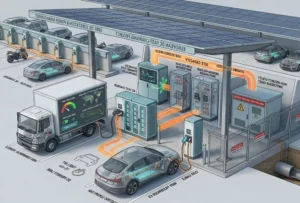
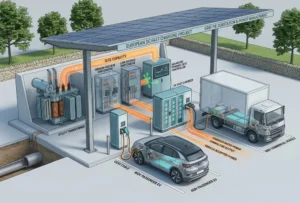
What happens when a commercial site needs high-power DC fast charging, but the local utility demands $200,000 and 18 months to upgrade your site transformer? This bottleneck is where commercial solar PV, dynamic charging, and industrial Battery Energy Storage Systems (BESS) work together.
Pairing EV charging stations with battery storage allows sites to draw grid energy slowly during off-peak hours, store it in stationary batteries, and discharge it rapidly when EV fleets arrive to charge. This peak shaving strategy eliminates expensive utility demand charges entirely.
| BESS Capacity Product | Ideal Commercial Application | Core Value Proposition & Selling Point | Buyer Strategic Advantage |
|---|---|---|---|
| 100kWh Industrial BESS | Small Commercial Parking & Retail | Compact footprint, integrated Liquid Cooling PCS + EMS | Supplies instant peak power boosts for dual 60kW DC chargers without upgrading site transformers. |
| 261kWh Commercial BESS | Logistics Depots & Medium Charging Stations | High-density LFP cells with dynamic peak shaving algorithm | Shaves off extreme afternoon power surges, saving thousands in monthly utility demand charges. |
| 418kWh Modular BESS Cabinet | High-Power Highway Stations & Industrial Parks | Multi-cabinet parallel expansion with active fire protection | Delivers continuous high-current discharge to support multiple 180kW fast chargers simultaneously. |
| 1MWh Utility-Scale Containerized BESS | Transit Bus Depots & Solar Microgrids | All-in-one containerized system with central thermal balancing | Enables fully off-grid or solar-assisted heavy fleet charging hubs at scale. |
Questions to Ask an EV Charging Company Before Signing a Contract
- Does the charger support open OCPP natively? Confirm you can point hardware to any back-end software server without paying unlocks.
- What specific certifications does the charger carry? Ask for verified CE, UL, or IEC third-party laboratory test sheets.
- What is the expected charger uptime rate? Demand verified field reliability data and clear component MTBF numbers.
- Does the manufacturer provide direct OEM/ODM customization? Verify if casing, firmware, and cable options can be tailored in-factory.
- What is the standard hardware warranty period? Ensure key power conversion modules are covered for at least 2 to 5 years.
- Are spare components stocked locally? Check how fast replacement power modules or cables arrive during outages.
- Can hardware integrate cleanly with third-party CSMS platforms? Confirm standard open API compatibility.
- Can the system handle dynamic fleet load management? Ensure chargers dynamically split power across active vehicles without manual resetting.
Best EV Charging Company: Frequently Asked Questions
What is the best EV charging company in the world?
There isn’t a single universal winner. ABB leads in high-voltage public transit infrastructure, ChargePoint excels in managed North American commercial parking, while factory manufacturers like AnengJi offer top value for direct commercial B2B procurement, direct OEM projects, and integrated solar-BESS sites.
Who is the largest EV charging company?
By total connected commercial charging ports, ChargePoint leads in North America, while major manufacturing groups in China drive the largest global hardware volume across public networks.
What is the best EV charger manufacturer?
The best manufacturer produces high conversion efficiency modules (>96%), provides open OCPP software compatibility, holds verified UL/CE third-party safety certifications, and supports factory OEM adjustments.
Which EV charging company is best for commercial use?
For workplaces and parking structures, select companies offering Level 2 AC and mid-range DC fast chargers backed by dynamic load sharing to keep installation costs reasonable on existing utility connections.
Which company makes the best DC fast chargers?
ABB, Kempower, and AnengJi are standout options for fast DC equipment. Their modular power units allow stations to keep running even if an individual power module requires service.
What is the best EV charging company for fleet charging?
Kempower, Siemens, and AnengJi deliver strong fleet charging configurations featuring dynamic scheduling and centralized power distribution, ensuring logistics vans and buses charge reliably between shifts.
What should I look for in an EV charger manufacturer?
Focus on module efficiency ratings, third-party certification scope, open OCPP compliance, spare part dispatch speed, direct factory customization, and total cost of ownership over 5 to 10 years.
Choose the Right EV Charging Manufacturer for Your Next Project
Planning a commercial charging site, fleet depot, or regional network deployment? Partner directly with an experienced engineering manufacturer to skip middleman markups, secure custom hardware, and future-proof your power infrastructure.
Related Article
- The 10 Biggest Electric Vehicle Charging Companies in the World
- Electric Car Charging Stations Cost: 2026 Commercial Installation Guide
- Benefits of Commercial EV Charging Stations: ROI & Energy Strategy
- Commercial DC Fast Charging Solutions: Complete Guide for Business
- EV Charging Business Model: Commercial Guide to Profits