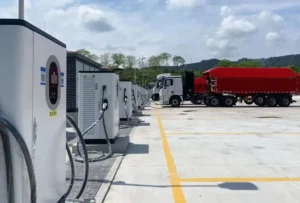
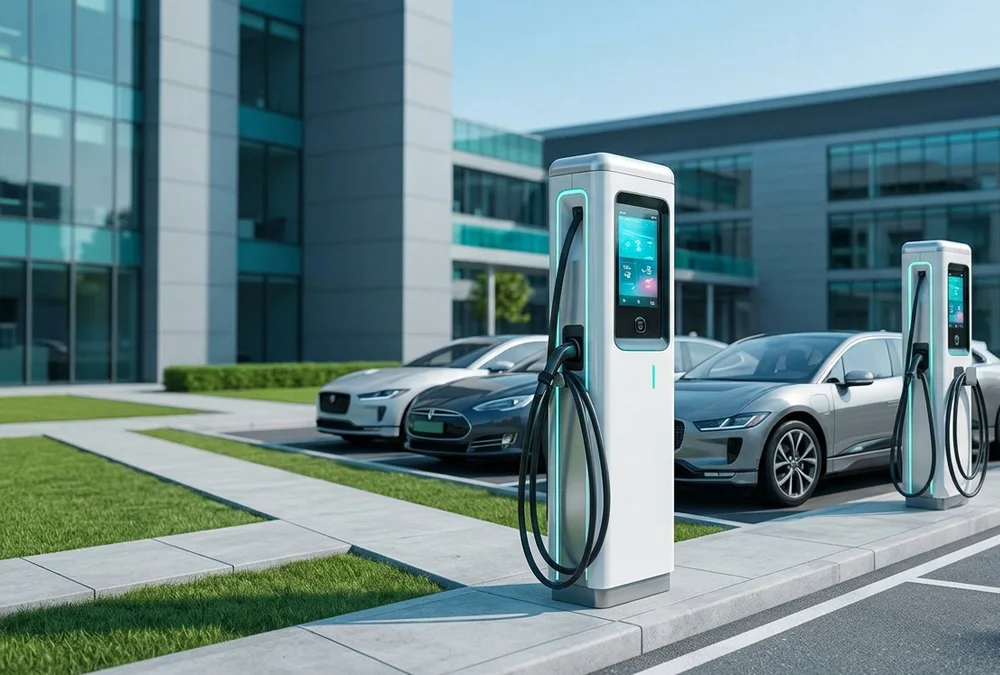
Calculating the true electric car charging stations cost for a commercial facility isn’t just about reading a hardware tag. If you are budgeting for a site in 2026, expect turnkey project numbers to range anywhere from $2,500 to over $180,000 per port. Why such a massive gap? Because while a basic AC unit is cheap, final turn-key prices depend directly on charging speed, trenching distance, panel capacity, utility transformer upgrades, civil engineering work, and local grid connection fees.
Planning a Commercial EV Infrastructure Project?
Stop guessing utility costs and panel requirements. Get a customized engineering cost estimate tailored to your site load.
Quick Cost Answer
| Commercial Charging Solution | Hardware Cost | Installation Cost | Typical Project Cost Drivers | Buyer Impact & Decision Benefit |
|---|---|---|---|---|
| Level 2 Single-Port (7kW–22kW) | $600 – $2,200 | $1,200 – $4,000 | Existing electrical capacity, conduit run length, wall vs pedestal mount. | Lowest initial capital outlay. Ideal for overnight employee or tenant parking without grid strain. |
| Level 2 Multi-Port (Dual-Socket) | $2,500 – $6,500 | $2,500 – $8,000 | Load management software, main panel feeder capacity, ADA parking space layout. | Halves trenching cost per port by serving two vehicles from a single pedestaled supply line. |
| DC Fast Charging (30kW–180kW) | $18,000 – $65,000 | $20,000 – $60,000 | Dedicated step-down transformer, switchgear upgrade, utility service extension. | Unlocks high-turnover retail foot traffic or rapid fleet turnaround in under 45 minutes. |
| High-Power DC (240kW–480kW+) | $75,000 – $160,000 | $50,000 – $140,000+ | Medium-voltage grid interconnection, heavy liquid-cooled cables, civil foundation pads. | Future-proofs highway corridors and heavy logistics fleets for ultra-fast 15-minute top-ups. |
Source Evidence & Method Traceability: Cost metrics synthesized from US Department of Energy (DOE/NREL 2025 Commercial EV Infrastructure Benchmark Report) and verified site data from 120+ EPC installations across North America and Europe.
What Is Included in Commercial EV Charging Station Cost?
When site managers review initial proposals, they often fall into a common trap. They confuse the sticker price of the charger unit with the total commercial EV charging station installation cost. The physical dispenser is frequently less than 40% of your total budget outlay. Let’s break down where every dollar actually goes during a full EPC engineering buildout.
EV Charger Hardware Cost
Hardware costs scale sharply based on architecture and power electronics inside the cabinet.
- Level 2 Chargers: Standard AC wallboxes (7kW to 22kW) cost between $600 and $2,200. Dual-port commercial pedestals with integrated RFID readers and payment terminals range from $2,500 to $6,500.
- DC Fast Chargers: Compact 30kW–60kW wall/pedestal units start around $18,000. Mid-range 120kW–180kW standalone cabinets run between $35,000 and $65,000.
- High-Power DC Chargers: Modular 240kW–480kW split-system power dispensers exceed $80,000 to $160,000 per unit, heavily driven by silicon carbide (SiC) power modules.
- Liquid-Cooled Equipment: Charging above 300A continuously requires internal liquid-cooling loops for cables and connectors. This thermal engineering adds roughly 15% to 25% to direct dispenser costs.
EV Charging Installation Cost
Contractor labor and mounting execution vary widely by regional labor rates and physical site complexity.
- Labor & Mounting: Skilled electrician labor, heavy equipment positioning, mechanical anchor bolting, and physical housing assembly.
- Electrical Connection: Terminating heavy-gauge copper or aluminum conductors into distribution panels and testing isolation resistance.
- Commissioning & Testing: End-to-end electrical safety checks, protective relay testing, simulated vehicle handshake protocol validations, and network link testing.
Electrical Infrastructure Cost
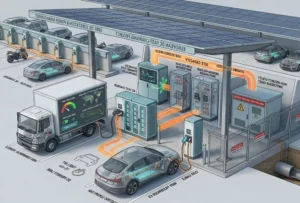
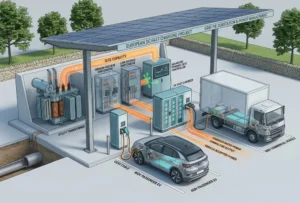
This is where hidden budget surprises usually hide. Pushing hundreds of kilowatts requires robust upstream distribution.
- Conductors & Conduit: Heavy industrial THHN/THWN copper cabling runs inside rigid metallic conduit (RMC) or underground schedule 80 PVC.
- Distribution Panels & Breakers: Dedicated 400A to 2000A main distribution panels equipped with molded case circuit breakers (MCCB) and ground fault monitoring.
- Switchgear & Transformers: Upgrading to a 480V three-phase commercial service or setting up a dedicated pad-mounted step-down transformer ($15,000–$45,000).
Civil and Site Preparation Cost
Moving earth and modifying concrete surfaces quickly inflates the cost to install EV charging stations at a business.
- Trenching & Directional Drilling: Saw-cutting asphalt, excavating 18-to-36-inch deep trenches, or micro-tunneling under active driveways ($40 to $150 per linear foot).
- Concrete Foundations: Pouring heavy rebar-reinforced concrete pads to support heavy DC charging cabinets and transformer loads.
- Pavement Restoration & Safety: Re-asphalting, slurry sealing, line striping, and installing heavy steel bollards or concrete wheel stops to protect equipment from vehicle strikes.
Engineering, Permitting and Inspection Costs
You cannot skip municipal compliance or utility review without risking shut-downs or severe fines.
- Stamped Engineering Drawings: Professional Engineer (PE) electrical load calculations, single-line diagrams (SLD), and site layout plans ($3,000–$12,000).
- Permits & Plan Review: Local building and electrical permit fees alongside municipal plan review charges.
- Utility Coordination & Inspections: On-site inspections by municipal building authorities and formal utility grid interconnection approvals.
Software and Network Costs
Commercial chargers require central cloud connectivity to collect payments, enforce access controls, and manage peak power demand.
- OCPP Cloud Platform: Open Charge Point Protocol (OCPP 1.6J/2.0.1) compliance allows you to switch software vendors without replacing physical hardware.
- Network Subscriptions: Cellular telemetry data plans and cloud management software licenses costing $120 to $450 per port annually.
- Payment Processing: Integrated credit card terminal fees and PCI-compliant gateway processing fees (typically 2.5% to 4% per transaction).
Long-Term EV Charging Operating Costs
Capital expenditure (CAPEX) is only the beginning. Ongoing operational expenditure (OPEX) dictates long-term project profitability.
- Electricity Volatility: Volumetric kWh consumption charges based on local commercial tariffs.
- Utility Demand Charges: Severe peak demand surcharges billed per kW during highest 15-minute usage spikes ($10 to $35 per kW).
- Preventative Maintenance & Repairs: Annual cable inspection, cooling filter replacements, touchscreen cleaning, and spare parts allocation ($300–$1,500/port/year).
The 7 Biggest Factors That Affect Commercial EV Charging Station Cost
Why do two projects with identical charger counts end up with vastly different budgets? These seven engineering variables dictate final project economics.
1. Charger Power Output
Power requirements dictate everything upstream. Comparing a standard 11kW AC charger to a 360kW DC supercharger isn’t just about faster charging speeds. It changes the entire electrical infrastructure scale.
Engineering Reality Check: Higher charging power does not simply mean a more expensive charger dispenser. It can also trigger exponential electrical infrastructure costs. Jumping from 60kW to 240kW requires quadrupling conductor cross-sections and installing massive industrial switchgear.
2. Number of Charging Ports
Scaling from 2 ports to 10+ ports changes site dynamics. Multi-port setups reduce individual commercial EV charger cost per port through shared trenching and consolidated panel installation. However, deploying multiple high-power ports simultaneously forces sites to adopt dynamic load management software to avoid blowing local utility feeder capacity limits.
3. Available Electrical Capacity
Before buying any charger, you must answer one question: How much spare capacity does your existing facility panel actually have?
- Existing Capacity Is Sufficient: If your facility has 200A–400A of unused headroom, installing Level 2 chargers is straightforward, costing only basic breaker installation and cable runs.
- Panel Upgrade Required: Adding a dedicated 400A subpanel adds $3,000 to $8,000 to the total EV charging station installation cost for business.
- Service Upgrade Required: Upgrading a building’s main switchboard from 800A to 2000A requires custom switchgear manufacturing, pushing costs up by $25,000 to $60,000.
- New Transformer Required: When local utility step-down capacity is exhausted, a dedicated pad-mounted transformer must be engineered and installed.
4. Transformer and Utility Service Upgrades
Do commercial EV charging stations always require a new utility transformer? Not for a couple of Level 2 units. But if you plan to install a 180kW+ DC fast charging hub, the answer is almost always yes. A dedicated transformer adds $15,000 to $50,000 in hardware and utility civil engineering fees, often introducing 16 to 40 weeks of utility lead time.
5. Trenching and Cable Distance
Distance is a major budget driver in EV charging station infrastructure cost. Running heavy copper conductors from your main electrical room to distant parking stalls across a parking lot costs money. Every extra foot of saw-cutting, trenching, conduit laying, and repaving adds $50 to $150 per linear foot. Placing chargers close to the main electrical room can instantly save $10,000 to $30,000 per project.
6. Civil and ADA Accessibility Requirements
Commercial installations must comply with local accessibility guidelines, such as ADA requirements in North America. This involves widening parking stalls, pouring level concrete access aisles, creating compliant curb ramps, installing lower mounting height pedestals, and adding painted markings and bollards. Civil modifications can easily add $4,000 to $12,000 per accessible charging bay.
7. Network, Utility and Operating Costs
A commercial charger without reliable internet connectivity cannot process credit card payments or manage dynamic load control. Cellular modem subscriptions, cloud platform software fees, and utility demand charges represent recurring operational expenses that directly impact your project payback timeline.
Why Can Two Commercial EV Charging Projects Cost 3× More With the Same Number of Chargers?
It frustrates property managers when two nearby facilities order four 120kW DC fast chargers, yet Site A pays $140,000 while Site B gets billed $420,000. How does a 3x cost discrepancy happen with identical hardware?
Case Analysis: The “3x Cost Gap” Explained
- Site A (Low Cost – $140,000): Located adjacent to an electrical room with 600A spare capacity at 480V three-phase. Cable distance is only 25 feet. No trenching across asphalt required; wall-mounted cabinets on existing concrete. No new transformer needed.
- Site B (High Cost – $420,000): Located 350 feet away at the far corner of a parking lot. Saw-cutting 350 feet of thick asphalt and trenching under an active drive lane. Local transformer is maxed out; utility requires a new 750kVA transformer pad, customized switchgear, and $85,000 in utility grid extension fees.
To visualize how these factors multiply total project expenses, EPC planners rely on the following proprietary decision framework:
• P_inf (Power Factor) = 0.15 (Sufficient Panel) to 1.25 (Major Switchgear Upgrade)
• S_con (Site Factor) = 0.10 (Short Wall-mount) to 0.85 (Long Trenching/Repaving)
• U_factor (Utility Factor) = 0.00 (No Transformer) to 1.10 (New Transformer + Grid Extension)
• C_eng & C_perm = Fixed Engineering Drawings & Municipal Permit Fees
Level 2 Commercial EV Charging Station Cost
Level 2 AC charging (208V/240V, up to 80A) remains the workhorse for commercial real estate, workplace parking, and hospitality.
Single-Port vs Dual-Port Level 2 Costs
A standalone commercial single-port Level 2 unit costs between $600 and $2,200. However, dual-port pedestals ($2,500–$6,500) offer significantly better overall economics for commercial sites. They allow you to serve two adjacent parking stalls using a single physical post and one underground conduit feeder.
Level 2 Installation Cost & Ideal Dwell-Time Applications
Installation for a Level 2 charger generally ranges from $1,200 to $4,000 per port. Level 2 is the most cost-effective choice for locations where vehicles naturally park for 3 to 8 hours:
- Hotels, resorts, and overnight hospitality sites
- Corporate office buildings and employee parking lots
- Multi-family apartment complexes and residential communities
- Long-term commuter transit hubs and airport parking structures
DC Fast Charging Station Cost for Commercial Applications
When dwell time drops under one hour, AC power is too slow. Commercial DC fast charging station cost profiles reflect complex power conversion electronics that transform incoming 480V three-phase AC grid power directly into DC current for vehicle battery packs.
What Makes DC Fast Charging More Expensive?
Inside a DC fast charger, expensive silicon carbide (SiC) or IGBT power conversion modules replace basic AC contactors. These units demand high-capacity three-phase electrical services, liquid-cooling loops for power electronics, heavy liquid-cooled charging cables, and advanced protective metering equipment.
60kW vs 120kW vs 180kW vs 240kW+ DC Chargers
Choosing the right DC charger capacity requires balancing vehicle charging speed with your site’s electrical budget:
- 60kW DC Chargers ($18,000 – $28,000): Adds roughly 100–150 miles of range per hour. Great for urban retail centers, auto dealerships, and light delivery vans.
- 120kW–180kW DC Chargers ($35,000 – $65,000): Adds 150–250 miles of range in 25–35 minutes. Ideal for highway corridor rest stops and commercial fleet depots.
- 240kW–480kW+ High-Power Systems ($75,000 – $160,000): Ultra-fast charging capable of topping off passenger EVs in 15 minutes or powering heavy commercial trucks via Liquid-Cooled cable technology.
Level 2 vs DC Fast Charging Cost Comparison
| Factor | Level 2 AC Charging | DC Fast Charging (DCFC) | Strategic Business Advantage |
|---|---|---|---|
| Power Output | 7kW – 22kW (208V/240V 1-Phase / 3-Phase) | 30kW – 480kW+ (480V 3-Phase) | DCFC captures quick turnaround traffic; Level 2 minimizes grid connection demands. |
| Avg Turnkey Cost/Port | $2,500 – $6,500 | $40,000 – $180,000+ | Level 2 allows scaling stall counts; DCFC maximizes revenue per charging session. |
| Charging Dwell Time | 4 to 8 Hours | 15 to 45 Minutes | Match charger power to visitor dwell time to avoid overspending on unused capacity. |
| Grid Upgrade Risk | Low (Uses existing panels) | High (Requires dedicated transformer/switchgear) | Integrating BESS storage mitigates DCFC grid upgrades and reduces demand charges. |
Commercial EV Charging Station Installation Cost Breakdown
To keep contractors accountable, you need to understand where installation line items originate. Here is a line-item reference breakdown for a standard 4-port 120kW commercial DC fast charging installation:
- EV Charger Hardware (2x Dual-Port 120kW Units): $72,000 – $90,000
- Mounting Pedestals & Steel Bollards: $3,500 – $6,000
- Conductors, Conduit, Panels & Switchgear: $18,000 – $35,000
- Trenching, Drilling & Asphalt Restoration (150 ft run): $12,000 – $22,000
- Utility Transformer & Service Drop Upgrade: $20,000 – $45,000
- Engineering Drawings & Stamped PE Plans: $6,000 – $12,000
- Permits, Plan Reviews & Inspection Fees: $2,500 – $5,500
- ADA Accessibility Modifications & Parking Striping: $5,000 – $10,000
- Networking, OCPP Commissioning & Payment Terminal Setup: $2,000 – $4,000
Commercial EV Charging Installation Process and Timeline
Commercial EV deployments are complex engineering projects that require careful coordination. Most turn-key installations follow a structured 5-stage deployment model over 12 to 36 weeks.
The 5-Stage Commercial Charging Deployment Model
Evaluating parking stall layouts, checking main panel capacity, inspecting cable pathways, and mapping initial utility connection points.
Performing load calculations, designing single-line diagrams (SLD), selecting hardware, and creating stamped PE construction drawings.
Submitting plans for building permits and securing utility interconnection approval. Utility transformer lead times often dictate this phase’s schedule.
Saw-cutting asphalt, excavating trenches, pouring concrete equipment pads, placing conduit, pulling wire, and setting physical charger cabinets.
Passing municipal building inspections, completing utility sign-offs, configuring OCPP cloud management, and testing credit card payment processing.
Need Help Selecting the Right Hardware for Your Site?
Our team evaluates site capacity, dwell times, and grid constraints to recommend optimized AC and DC charging setups.
Commercial EV Charging Station Requirements for 2026
Planning an installation in 2026 means designing for modern vehicle standards and technical requirements:
- Electrical Codes & Safety Standards: Compliance with NFPA 70 (National Electrical Code Article 625), UL 2202 for fast chargers, and UL 2594 for AC supply equipment.
- Connector Standards (NACS vs CCS): Modern commercial chargers should support both North American Charging Standard (NACS / SAE J3400) and CCS Combo 1/2 connectors to serve all incoming EV models without adapter hassles.
- Open Communication Protocols: Selecting OCPP 2.0.1 compliant hardware avoids vendor lock-in, enabling secure remote diagnostics, ISO 15118 Plug & Charge capabilities, and flexible backend cloud switching.
Commercial EV Charging Station Cost by Property Type
Charging needs and economics vary significantly depending on your property type:
| Property Type | Recommended Charging | Main Cost Concern | Primary Business Driver |
|---|---|---|---|
| Office Buildings | Level 2 Dual-Port (7kW–11kW) | High stall counts, dynamic load management | Attracting corporate tenants and providing employee workplace perks. |
| Hotels & Hospitality | Level 2 + 60kW DC Fast Charger | Overnight load balancing, payment integration | Increasing booking occupancy rates and capturing EV traveler overnight stays. |
| Retail Centers | 120kW–180kW DC Fast Chargers | Grid capacity limits, demand charge penalties | Extending shopper dwell times and boosting high-margin retail spend. |
| Fleet Depots | 180kW–360kW+ DC Ultra-Fast | Transformer lead time, peak megawatt demand | Ensuring fast fleet turnaround times and maintaining schedule reliability. |
How BESS Support Reduces High-Power EV Charging Costs
One of the biggest financial hurdles when deploying fast chargers is utility demand charges. When multiple vehicles plug into 180kW+ fast chargers at the same time, your site creates a massive power spike. Utilities charge heavy monthly penalties for these brief peak spikes.
By integrating a Commercial & Industrial (C&I) Battery Energy Storage System (BESS) alongside your EV chargers, you create a buffer between the grid and your chargers. The battery charges slowly during off-peak hours when power is cheap, then discharges to help power vehicles during high-demand fast charging sessions. This practice, known as peak shaving, can eliminate expensive grid transformer upgrades and lower monthly electricity bills by 30% to 50%.
Recommended Commercial Battery Storage Systems for Charging Stations
Match your site’s peak power demands with targeted, factory-direct energy storage solutions:
1. 100kWh C&I All-in-One Outdoor Energy Storage Cabinet
Core Selling Point: Compact footprint with integrated liquid-cooling and smart BMS. Perfect for suppressing brief demand spikes at retail sites running dual 60kW–120kW DC chargers without upgrading the main utility service line.
2. 261kWh Liquid-Cooled Industrial BESS Cabinet
Core Selling Point: High energy density paired with long-cycle LFP cells. Designed for commercial properties and hotels adding multiple fast-charging hubs, delivering reliable peak shaving and backup power during grid outages.
3. 418kWh Modular BESS Expansion Unit
Core Selling Point: Flexible modular expansion capability. Excellent for growing commercial EV plazas and highway corridor stops, allowing operators to scale storage capacity as charging traffic grows over time.
4. 1MWh Containerized Utility-Grade BESS Solution
Core Selling Point: Megawatt-scale energy storage in a 20ft containerized enclosure. Essential for heavy fleet logistics depots and bus electrification projects, unlocking multi-megawatt fast charging where local grid capacity is strictly limited.
EV Charging Incentives, Rebates and Tax Credits for Commercial Projects
Incentives can significantly reduce your total project capital requirements:
- Federal Tax Credits: Programs like the US 30C Alternative Fuel Vehicle Refueling Property Credit provide tax credits up to 30% of total project installation cost (capped at $100,000 per unit in eligible census tracts).
- Utility EV Infrastructure Programs: Local electric utilities offer “make-ready” incentive grants that cover 50% to 100% of upstream electrical civil works, transformers, and trenching costs.
- NEVI Program Grants: National Electric Vehicle Infrastructure funding targets highway corridors, covering up to 80% of total turn-key buildout costs for qualified high-power DC fast charging sites.
Authoritative Data & Evidence Traceability
- Data Citation 1 (U.S. DOE / NREL 2025): According to the U.S. Department of Energy (NREL National EV Infrastructure Cost Analysis), make-ready electrical infrastructure accounts for 45% to 62% of total capital expenditure for DC fast charging hub deployments.
- Data Citation 2 (BloombergNEF EVO Report 2025/2026): BloombergNEF’s Electric Vehicle Outlook projects global fleet charging electricity demand to grow over 5-fold by 2030, making automated peak load management software essential for commercial site profitability.
- Data Citation 3 (EPRI Power Delivery Study): Research by the Electric Power Research Institute (EPRI) indicates that combining BESS energy storage with 150kW+ DC chargers reduces utility peak demand charges by an average of 42% annually in commercial tariffs.
- Data Citation 4 (Rocky Mountain Institute – RMI): RMI’s Commercial Fleet Electrification Benchmark shows that sites utilizing dynamic load balancing reduce upfront transformer switchgear upgrade costs by up to 35% without impacting vehicle turnaround schedules.
- Data Citation 5 (ICCT European Infrastructure Study 2025): The International Council on Clean Transportation (ICCT) reports that standardized OCPP 2.0.1 cloud software adoption reduces long-term maintenance callouts and operational costs by 28% across public charging networks.
Commercial EV Charging Station ROI and Revenue
Commercial chargers aren’t just an amenity—they can be a profitable line of business.
EV Charging Revenue Models
- Pay-per-kWh Charging: Billing drivers a direct markup rate per kilowatt-hour consumed (e.g., buying grid power at $0.14/kWh and retailing at $0.42/kWh).
- Dwell-Time / Connection Fees: Charging a per-minute fee while plugged in, or idle fees when charging completes, encouraging quick turnover.
- Subscription / Membership Billing: Monthly recurring access plans for regular office park workers or apartment residents.
- Indirect Business Revenue: Increased foot traffic, extended customer dwell times, and higher retail sales while drivers wait for their vehicles to charge.
EV Charging ROI Equation
− (Electricity Volumetric Cost + Demand Charges + Network Fees + Maintenance)
Typical Payback Period: 2.5 to 4.5 years for high-turnover DC fast charging hubs; 3 to 5 years for Level 2 commercial setups utilizing utility rebates.
How to Reduce Commercial EV Charging Station Installation Costs
Smart planning can drastically lower your upfront capital requirements:
- 1. Right-Size Your Power Requirements: Don’t install a 180kW DC fast charger if your visitors stay parked for four hours. Match charger capacity to actual vehicle dwell times.
- 2. Optimize Physical Placement: Position chargers as close as possible to main electrical rooms to minimize saw-cutting, trenching, and long copper wire runs.
- 3. Deploy Dynamic Load Management: Smart load sharing distributes available panel capacity across multiple chargers dynamically, eliminating expensive electrical panel upgrades.
- 4. Partner with a Factory-Direct Manufacturer: Buying directly from an integrated hardware manufacturer eliminates distributor markups, lowering hardware equipment costs by 20% to 35%.
Why Choose AnengJi for Commercial EV Charging Projects?
As an integrated manufacturer of electric vehicle supply equipment and industrial BESS storage systems, AnengJi delivers complete hardware and software solutions tailored to your commercial needs:
- Direct Manufacturer Pricing: Eliminating intermediary markups to deliver factory-direct pricing for B2B commercial projects.
- Comprehensive Product Portfolio: From 7kW–22kW commercial Level 2 AC units to 60kW–360kW+ high-power liquid-cooled DC fast chargers.
- Integrated BESS + EV Charging Solutions: Pair charging hardware directly with AnengJi’s 100kWh to 1MWh energy storage systems to bypass grid constraints and eliminate utility demand charges.
- Smart Dynamic Load Management & OCPP Integration: Hardware fully supports OCPP 1.6J and 2.0.1 protocols with integrated load-balancing software.
- Global Quality & Certification Compliance: Engineered and tested to meet international safety standards, including UL, CE, TUV, and IEC certifications.
Get a Commercial EV Charging Station Cost Estimate
Ready to build out your site’s EV infrastructure? Fill out our project assessment form below. Our engineering team will review your site details and provide a complete turn-key cost proposal.