What Is Bidirectional Charging?
Standard EV chargers only push current in one direction. You plug in, power enters the vehicle battery, and that is where the transaction ends. A bidirectional ev charger breaks this one-way street. By using advanced internal power electronics, it handles two-way EV charging, taking direct current (DC) out of the battery and converting it back into usable alternating current (AC) for external loads.
Bidirectional Charging vs. Conventional EV Charging
Conventional Charging (Unidirectional / V1G): Grid → EV
Bidirectional Charging: Grid ↔ EV ↔ Home / Building / Load / Utility Grid
What Can Bidirectional Charging Actually Do?
| Technology | Energy Flow | Main Use Case | User Value & Decision Benefit |
|---|---|---|---|
| V1G / Smart Charging | Grid → EV | Charging speed & time optimization | Avoids peak electricity rates without added hardware cost. |
| V2L (Vehicle-to-Load) | EV → Appliance / Tool | Portable power via AC outlets | Instant plug-and-play power for job sites, camping, or minor outages. |
| V2H (Vehicle-to-Home) | EV → Home Panel | Home energy backup & solar storage | Replaces expensive fixed home generators; powers home for days. |
| V2B (Vehicle-to-Building) | EV → Commercial Building | Peak demand shaving & facility backup | Slashes utility demand charges on monthly commercial electricity bills. |
| V2G (Vehicle-to-Grid) | EV → Power Grid | Frequency regulation & energy export | Generates direct revenue through utility grid service payments. |
Bidirectional Charging vs. Smart Charging: What’s the Difference?
Buyers often mix up these two terms. Smart charging controls when and how fast an EV charges, while bidirectional charging enables electricity to flow from the EV battery back to another electrical system. Smart charging is a one-way control logic; bidirectional charging is a physical hardware capability.
What Smart Charging Can Do
- Automates charging schedules around off-peak tariff hours.
- Executes dynamic load balancing to stop main circuit breakers from tripping.
- Pushes real-time energy usage updates to facility management dashboards.
What Bidirectional Charging Adds
- Discharges the EV to power home appliances during grid blackouts (EV battery backup).
- Feeds power back into commercial facilities during expensive peak demand windows.
- Monetizes parked fleet vehicles via utility demand-response programs.
What Are V2H, V2B, V2G and V2L?
Vehicle-to-Everything (V2X) is the umbrella term covering every way an electric car interacts with external electrical systems. Let’s break down how these operational modes function in the real world.
V2H — Vehicle-to-Home
Energy flow: EV → Home Electrical Panel
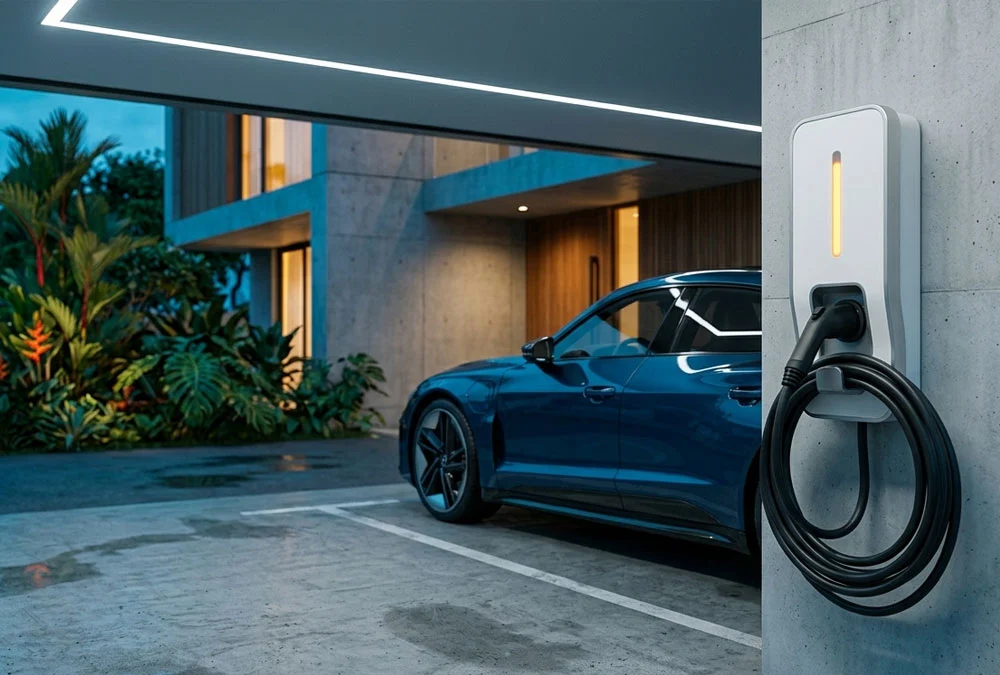
A V2H bidirectional EV charger transforms your car into a residential generator. When power lines drop during storms, a microgrid transfer switch isolates your house from the grid within milliseconds, drawing continuous energy from your car’s 60 kWh to 100+ kWh battery pack. It also enhances solar self-consumption by storing daytime PV generation inside the vehicle to run your air conditioner at night. Best for: Residential homeowners aiming for energy resilience.
V2B — Vehicle-to-Building
Energy flow: EV → Commercial Building Subpanel
For commercial premises, peak demand spikes set your monthly utility tariffs. A commercial bidirectional EV charger coordinates with your building management system to discharge parked employee or fleet EVs right when HVAC loads peak. This process, called peak shaving, shaves off thousands of dollars in utility surcharges without interrupting business workflows. Best for: Commercial real estate, factories, and offices.
V2G — Vehicle-to-Grid
Energy flow: EV → Public Power Grid
With an EV charger with V2G, your vehicle acts as a mini power plant. During heatwaves when grid operators face generation shortfalls, thousands of plugged-in EVs discharge back to the grid. According to pilot data published by the University of Delaware, fleet EVs participating in V2G frequency regulation programs earned around $1,200 per vehicle per year. Keep in mind that regional revenues depend strictly on local market rules, utility interconnection approvals, and tariff structures. Best for: Fleet operators, municipal depots, and energy aggregators.
V2L — Vehicle-to-Load
Energy flow: EV → Plugged Electrical Appliance
V2L is the simplest form of two-way power. It provides standard AC power sockets directly on the car or via an onboard adapter. Most passenger cars output between 1.5 kW and 3.6 kW, while heavy-duty pickups like the Ford F-150 Lightning push up to 9.6 kW. It requires no stationary bidirectional wall charger, making it ideal for powering power tools, tailgating equipment, or portable lights on job sites. (Note: Vehicle-to-Vehicle, or V2V, uses similar V2L AC output adapters to boost stalled EVs in roadside emergencies).
How Does Bidirectional EV Charging Work?
How does a bidirectional ev charger push energy backwards safely into a building or grid? It relies on four synchronized steps across software and hardware layers.
Step 1: The EV Stores Electrical Energy
The high-voltage lithium battery pack stores chemical energy as DC power. The internal Battery Management System (BMS) acts as the safety gatekeeper, closely tracking cell state of charge (SOC), thermal stability, and maximum safe current discharge limits.
Step 2: The Bidirectional Charger Controls Power Flow
In discharge mode, the charger’s power conversion stage takes high-voltage DC electricity from the vehicle battery and converts it into synchronized, ultra-clean AC power. Silicon Carbide (SiC) power switches allow top-tier DC bidirectional chargers to deliver conversion efficiencies above 97%.
Step 3: The EMS Determines When to Charge or Discharge
An Energy Management System (EMS) processes live feed variables: building electrical load, real-time spot prices, rooftop solar generation, vehicle departure schedules, and minimum driver SOC thresholds. The EMS sends instant commands specifying whether to charge, hold, or discharge.
Step 4: Communication and Grid Controls Coordinate the System
| Protocol / Layer | Main Operational Role | Technical Function |
|---|---|---|
| BMS | Battery Health Management | Monitors temperature, cell voltages, and safe current boundaries. |
| ISO 15118 (-20) | EV ↔ Charger Communication | Handles digital handshakes, Plug & Charge, and bidirectional power flow schedules. |
| OCPP (2.0.1 / 2.1) | Charger ↔ CSMS Cloud | Transmits remote commands, smart charging profiles, and metering telemetry. |
| IEEE 1547 / UL 1741 SB | Charger ↔ Grid Interconnection | Ensures rapid islanding protection to keep utility grid workers safe. |
Which EVs Support Bidirectional Charging?
Here is a truth buyers must realize early on: a bidirectional ev charger cannot magically make an incompatible vehicle bidirectional on its own. Vehicle firmware, onboard hardware, and OEM warranty settings must support discharge mode.
Why EV Compatibility Matters
If an EV lacks bi-directional discharge firmware or uses older inlet pin designs, the wall station cannot initiate power export. Buyer hesitation often stems from this exact issue: “Will my current vehicle fleet support V2G without voiding battery warranties?” The short answer is yes, provided you pair certified vehicle models with compliant chargers.
EV Models With Bidirectional Charging Capabilities
Last updated: August 2026. Features depend on region, trim level, and active OTA software updates.
| EV Model | V2L | V2H | V2G | Connector | Technical & Market Notes |
|---|---|---|---|---|---|
| Ford F-150 Lightning | Yes (9.6 kW) | Yes (9.6 kW) | Pilot | CCS1 / NACS | Requires Ford Charge Station Pro & Sunrun Integration System. |
| Nissan Leaf (2013+) | No | Yes | Yes | CHAdeMO | Mature commercial V2G track record; fully approved by Nissan under Fermata FE-20. |
| GM Ultium (Silverado EV, Sierra) | Yes (10.2 kW) | Yes (10.2 kW) | Yes | CCS1 / NACS | Works with GM Energy PowerShift Chargers and home enablement kits. |
| Tesla Cybertruck | Yes (11.5 kW) | Yes (11.5 kW) | Yes | NACS | Uses Tesla Powershare Gateway; expansion to V2G support rolled out in select markets. |
| Hyundai Ioniq 5 / Kia EV6 | Yes (1.9-3.6 kW) | In Pilot | In Pilot | CCS1 / CCS2 / NACS | E-GMP platform supports native V2L; broader V2H/V2G capabilities expanding via software. |
What Are the Benefits and Applications of Bidirectional Charging?
Backup Power for Homes and Buildings
The Problem: Utility blackout events disrupt daily home living and freeze commercial business operations.
How Bidirectional Helps: A typical EV battery stores 60 kWh to 130 kWh—matching 3 to 10 typical wall-mounted stationary batteries combined. A bidirectional EV charger for home discharges the vehicle during outages, powering critical circuits, refrigeration, and light HVAC for days.
Solar Self-Consumption
The Problem: Rooftop solar generation often hits peak output around midday when household or commercial building consumption drops, causing cheap power export to the grid.
How Bidirectional Helps: A bidirectional EV charger with solar panels directs excess daytime solar production straight into your car. In the evening, energy flows back into the building, maximizing clean energy usage and cutting grid electricity imports.
Peak Demand Management & Time-of-Use Energy Optimization
The Problem: Time-of-Use (TOU) utility rate plans charge heavy premiums for power during early evening hours.
How Bidirectional Helps: The system charges the vehicle during inexpensive off-peak overnight windows and discharges to cover building loads during costly peak tariff hours. This continuous energy arbitrage yields direct, recurring operational bill savings.
Bidirectional EV Charging for Commercial and Fleet Applications
Commercial deployments demand strict ROI metrics. A bidirectional ev charger shifts fleet vehicles from cost centers into revenue-generating energy assets.
EV Fleet Depots & Logistics Fleets
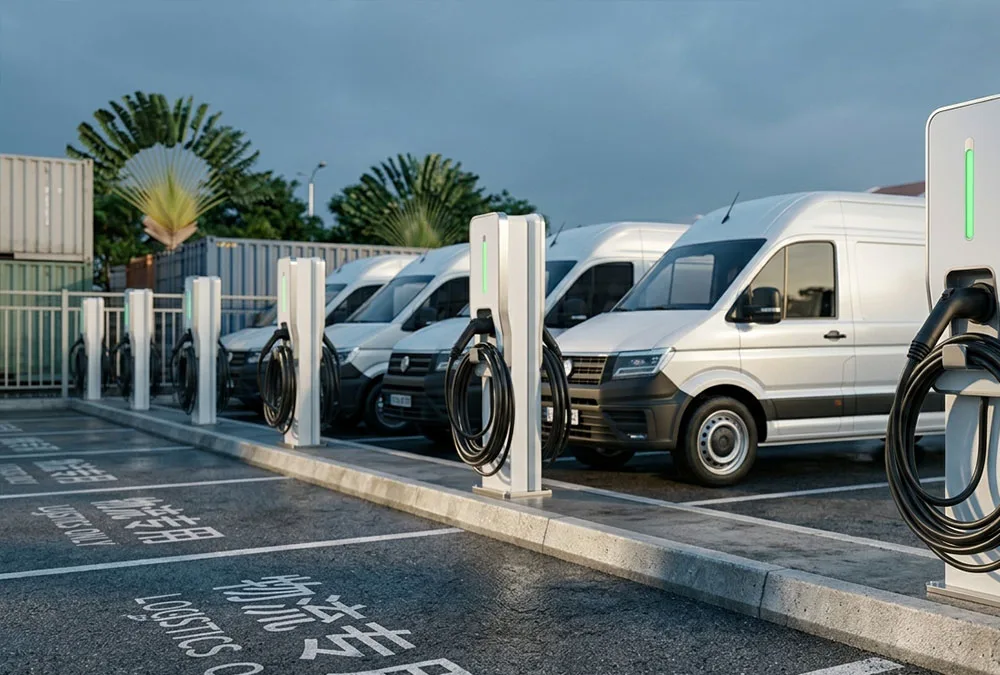
Logistics delivery vans, school buses, and municipal fleets follow fixed, predictable routes. They sit idle in fleet depots for long dwell periods—overnight or across summer breaks. Installing a bidirectional EV charger for fleet charging allows depot operators to discharge dozens of school bus or truck batteries simultaneously during regional peak demand hours, offsetting high utility demand charges.
Solar + EV Charging + BESS Microgrids
In large commercial facilities, combining rooftop PV generation with high-power bidirectional chargers creates a responsive microgrid. To handle high power spikes without triggering expensive utility grid upgrades, smart operators often integrate dedicated commercial stationary energy storage systems into the loop.
Bidirectional EV Charging vs. BESS: Which Energy Storage Option Is Better?
Project managers often ask: “Should I buy a commercial bidirectional EV charger or install a stationary Battery Energy Storage System (BESS)?” The answer depends on vehicle availability and duty cycles.
| Comparison Factor | EV Battery Energy Storage (V2X) | Stationary BESS | User Selection Advantage |
|---|---|---|---|
| Capital Expenditure (CapEx) | Lower add-on cost (battery expense is paid via the vehicle purchase). | Higher initial outlay (requires buying battery enclosures and PCS). | V2X offers significantly lower initial cost if EV fleets already exist. |
| System Availability | Intermittent (energy availability relies on vehicles being parked and plugged in). | 100% stationary uptime (permanently wired and online 24/7). | Stationary BESS ensures uninterrupted backup for critical facility operations. |
| Commercial Deployment | Ideal for fleet depots with long, predictable overnight parking. | Ideal for continuous factory peak shaving and solar smoothing. | Hybrid “EV + BESS” designs deliver maximum grid stability and resilience. |
Expert Hybrid Deployment Recommendation
For commercial facilities running heavy daytime operations while managing electric fleet charging, stationary energy storage acts as a high-speed buffer. Dedicated commercial and industrial BESS solutions deliver steady, reliable power support regardless of vehicle dispatch schedules:
- 100 kWh BESS Cabinet: Compact liquid-cooled energy storage tailored for small commercial sites and auto workshops.
- 261 kWh Outdoor Energy Storage System: All-in-one cabinet featuring built-in PCS and intelligent liquid cooling loops, ideal for peak demand shaving on commercial building feeds.
- 418 kWh / 1 MWh BESS Solutions: High-density modular enclosures engineered for major industrial factories, large fleet depots, and utility microgrid integration.
AC vs. DC Bidirectional EV Charging: What’s the Difference?
Choosing between AC bidirectional charging and DC bidirectional charging shapes system topology, conversion efficiency, and installation costs.
AC Bidirectional Charging
AC architectures rely on the vehicle’s internal onboard charger to convert DC battery power into AC grid power. The wall box acts mainly as a smart controller and gateway. While hardware costs are lower, power output is strictly capped by the onboard charger capacity (usually 7.4 kW to 11 kW).
DC Bidirectional Charging
DC architectures bypass the vehicle’s onboard charger entirely. High-voltage DC power flows directly out of the battery inlet into inverter electronics inside the external bidirectional wall box. This design unlocks faster charge and discharge rates (15 kW up to 50+ kW) and delivers ultra-high power conversion efficiencies.
Does Bidirectional Charging Affect EV Battery Life?
The single biggest concern buyers raise is battery degradation: “Will using V2G wear out my EV battery pack premature, voiding my warranty?”
What the Data Says About Battery Degradation
Extensive validation testing conducted by the U.S. Department of Energy (DOE) along with joint studies from Nissan and the University of Warwick confirms that controlled, low-power V2H/V2G discharge causes negligible additional capacity loss. Battery wear depends far more on extreme State of Charge (SOC) extremes and high thermal stress than on steady, low-C-rate bidirectional cycling.
Key Factors Controlling Battery Health:
- Depth of Discharge (DoD): Restricting daily discharge windows between 20% and 80% SOC prevents degradation.
- Discharge C-Rate: Low, steady power discharge (e.g., 5 kW to 10 kW) causes minimal thermal stress compared to repeated fast charging.
- Smart EMS Safeguards: Intelligent software automatically pauses discharge if battery temperatures climb beyond safe limits.
Is Bidirectional Charging Worth It? Benefits, Costs and Limitations
Key Hardware & Infrastructure Limitations
- Upfront Capital Cost: Bidirectional hardware costs more than standard Level 2 chargers due to built-in power electronics and microgrid isolation switches.
- Interconnection Permitting: V2G installations exporting power back to the grid require utility review, anti-islanding certification, and net-metering approvals.
- Vehicle Compatibility Gates: Legacy EV fleets may require connector upgrades or software firmware patches before enabling bidirectional energy export.
Is Your Project Ready for Bidirectional Charging?
Before placing equipment orders, review this project engineering checklist to confirm site readiness:
✓ 1. Vehicle Fleet Compatibility: Do your target EVs feature confirmed bi-directional V2H/V2G firmware support?
✓ 2. Electrical Service Capacity: Does your facility electrical panel support required AC/DC interconnection limits?
✓ 3. Grid Interconnection Terms: Has your local utility established clear V2G interconnection standards and net metering tariffs?
✓ 4. EMS & Software Protocol: Do your stations support OCPP 2.0.1 and ISO 15118-20 protocols for automated energy management?
✓ 5. Backup & Energy Storage Alignment: Would your site benefit from combining fleet V2X with stationary commercial BESS units?
How to Choose a Bidirectional EV Charger
Selecting the best bidirectional EV charger for commercial use requires matching technical equipment specs with long-term operational goals. Use this checklist to guide procurement decisions:
| Specification | What to Inspect | Buyer Selection Benefit |
|---|---|---|
| Rated Output Power | Select 7 kW to 11 kW AC for home V2H; select 22 kW to 50+ kW DC for commercial fleet V2G. | Higher DC power delivers fast peak demand reduction during tight utility windows. |
| Connector Standard | Verify CCS1, CCS2, NACS, or CHAdeMO inlet compatibility across your vehicles. | Prevents cable adapter bottlenecks and ensures reliable plug-and-play handshakes. |
| Interconnection Standards | Look for UL 9741, IEEE 1547, and UL 1741 SB certifications. | Ensures smooth utility interconnection permitting without costly project delays. |
| Software Communication | Ensure ISO 15118-20 and OCPP 2.0.1 compliance. | Protects investment via smooth integration with third-party EMS platforms. |
How Much Does a Bidirectional EV Charger Cost?
Evaluating bidirectional EV charger cost requires analyzing total system installation expenses rather than focusing on hardware tags alone. Current residential V2H hardware packages range from $3,500 to $10,000+, while complete residential turnkey installations (including transfer switches and panel work) sit between $5,000 and $15,000+. Commercial DC bidirectional chargers cost more upfront due to robust power conversion stages, but deliver higher ROI by unlocking commercial demand-charge savings and grid revenue streams.
The Future of Bidirectional EV Charging
The industry is shifting from early V2G pilots to full-scale commercial deployments. Driven by wider adoption of ISO 15118-20 standards, native NACS bidirectional support, and next-generation Gallium Nitride (GaN) and Silicon Carbide (SiC) semiconductors, bidirectional chargers are getting lighter, cheaper, and more efficient. In the coming years, bidirectional EV charging and stationary storage will serve as cornerstones of resilient commercial microgrids.
Frequently Asked Questions About Bidirectional EV Charging
What is a bidirectional EV charger?
A bidirectional EV charger is an advanced charger capable of two-way power flow. It charges the vehicle battery from the grid and converts stored DC battery power back into AC electricity to power homes, commercial buildings, or the utility grid.
How does a bidirectional EV charger work?
It relies on onboard or external inverter electronics synchronized via digital communication protocols (ISO 15118). An Energy Management System directs when the charger draws grid power or discharges stored battery energy based on real-time electricity rates and facility demand.
Can an EV power a house during a blackout?
Yes. Using V2H mode alongside a microgrid transfer switch, a compatible EV and bidirectional wall station can supply backup power to your home for 2 to 5 days during grid outages.
Does bidirectional charging affect EV battery warranty?
Major automakers like Nissan, Ford, GM, and Tesla explicitly support V2H/V2G capabilities under factory warranties when used with certified bidirectional charging equipment. Always check the OEM’s specific warranty terms for details.
Can bidirectional EV charging work alongside stationary BESS?
Yes. Combining V2X fleet chargers with stationary BESS units creates a robust microgrid architecture. The stationary BESS handles constant peak shaving, while fleet EVs deliver extra discharge capacity during heavy demand spikes.
Ready to Upgrade Your Energy Infrastructure?
Whether you are designing a commercial EV depot, integrating solar PV microgrids, or deploying industrial BESS storage systems, our engineering team is ready to help.
Related Article
- Commercial Bidirectional EV Charging: V2G Benefits & System Selection
- Level 1 vs. Level 2 vs. Level 3 Charging: Which EV Charger Do You Need?
- Hotel EV Charging Solutions: Complete Infrastructure Guide
- EV Charging Business Model: Commercial Guide to Profits
- The 10 Biggest Electric Vehicle Charging Companies in the World