Introduction
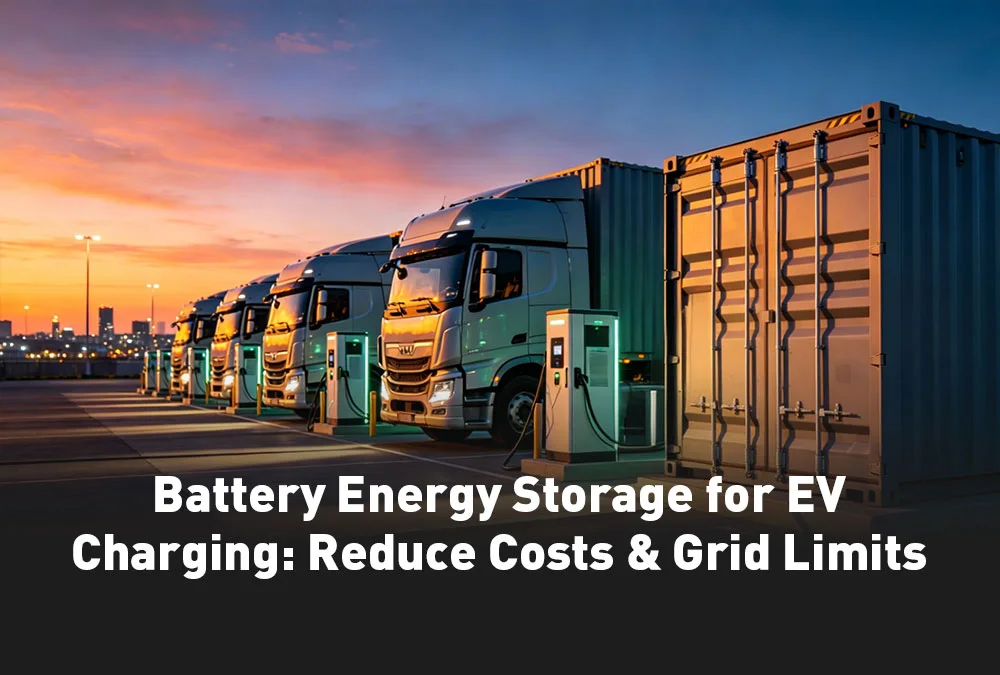
The global transition to electric mobility has reached a critical inflection point where the demand for ultra-fast charging is outstripping the capacity of existing electrical grids. For commercial site operators, fleet managers, and developers, the primary obstacle is no longer vehicle availability, but the “Grid Wall”—the physical and financial limitation of the utility infrastructure. This is where battery energy storage for EV charging has become a transformative asset. By decoupling instantaneous power demand from the steady-state grid supply, these systems allow for the deployment of high-power DC fast chargers in locations previously deemed “grid-constrained.” As we move into 2026, integrating energy storage is no longer just an optional upgrade; it is a strategic necessity to ensure reliability, reduce operational costs, and accelerate the ROI of charging infrastructure projects.
What is Battery Energy Storage for EV Charging?
To understand the value of a Battery Energy Storage System (BESS) in a charging context, one must view it as an intelligent “power reservoir.” It bridges the gap between the slow, steady flow of the utility grid and the sudden, high-intensity thirst of an electric vehicle’s battery.
Definition of BESS in EV Charging Infrastructure
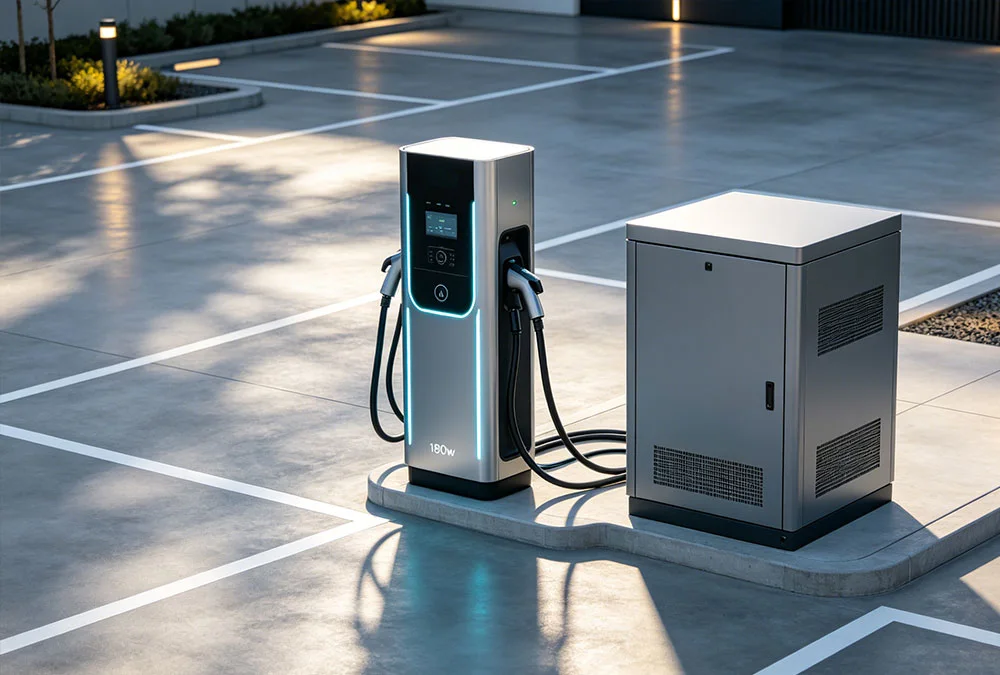
At its core, battery storage for EV charging is an integrated system of batteries, power electronics, and software designed to capture electricity during off-peak hours (or from onsite renewables) and release it when the demand for vehicle charging peaks. In a typical charging station, the BESS acts as a “buffer.” Without it, the grid must bear the full 150kW or 360kW load of a fast charger instantly. With it, the BESS provides the “heavy lifting,” drawing only a small, consistent current from the grid while delivering high-power bursts to the car.
System Architecture (Battery + PCS + BMS + EMS)
A professional-grade EV charging station energy storage system is composed of four critical subsystems that must work in perfect harmony:
- Battery System (Battery Pack): The physical storage medium. Modern industrial units predominantly use lithium battery energy storage for EV infrastructure, specifically Lithium Iron Phosphate (LFP) chemistry, for its high safety profile and 6,000+ cycle life.
- PCS (Power Conversion System): The bi-directional inverter that manages the flow of energy. It converts AC from the grid to DC to charge the batteries and converts DC from the batteries into the regulated power required for the chargers.
- BMS (Battery Management System): The “internal guardian.” It monitors cell voltage, temperature, and State of Health (SoH) to ensure the system operates within safe thermal limits.
- EMS (Energy Management System): The “brain” of the operation. The EMS monitors grid prices, charger demand, and battery levels to decide exactly when to store or discharge energy for maximum efficiency.
Recommended Reading:What Is Energy Storage?
Why EV Charging Needs Energy Storage
The engineering challenge of 2026 is that our grids were built for predictable, slow-moving loads—not the erratic, high-demand spikes of a dc fast charger with battery storage.
Problem 1 – Grid Capacity Limitation
In many prime commercial locations, the local transformer is already at 80% capacity. Adding even two 120kW fast chargers would require a complete utility overhaul. Grid-constrained EV charging environments often face wait times of 12–24 months for transformer upgrades. A BESS bypasses this by allowing high-power charging on low-power grid connections.
Problem 2 – High Demand Charges
Commercial electricity bills aren’t just based on how much you use (kWh), but how fast you use it (kW). “Demand Charges” can account for up to 50% of an industrial electricity bill. If four EVs plug in simultaneously, that 15-minute peak creates a massive demand charge. Peak shaving for EV charging uses the battery to supply those peaks, keeping the grid draw below the expensive threshold.
Problem 3 – Unstable Charging Experience
When multiple vehicles share a grid-tied charger without storage, the output is often “throttled.” A driver expecting 150kW might only get 50kW because the grid is stressed. Battery storage for ev charging ensures a consistent “flat line” of high-power delivery, regardless of external grid fluctuations.
Key Benefits of Battery Energy Storage for EV Charging
Beyond solving technical hurdles, the integration of a BESS solution for EV charging peak shaving offers a suite of commercial advantages:
1. Reduce EV Charging Costs
By utilizing “Energy Arbitrage,” the EMS charges the BESS at night when electricity rates are at their lowest and discharges them during the day. This reduces the average cost per kWh of energy delivered.
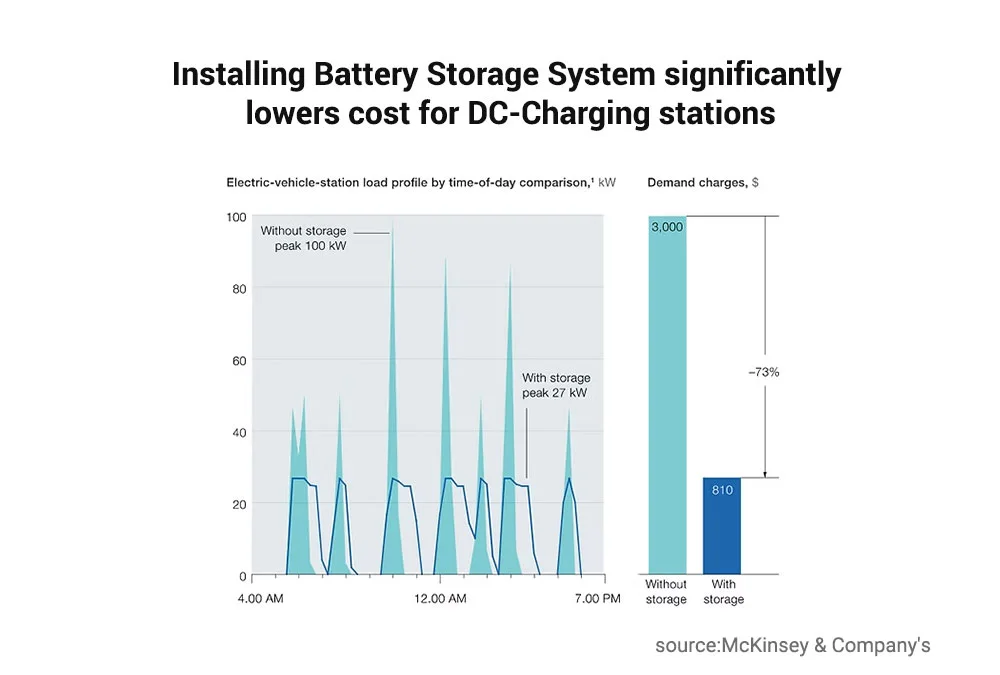
Graphs by McKinsey & Company’s: “How battery storage can help charge the electric-vehicle market“
2. Reduce Demand Charges
By capping the maximum power pulled from the utility, you effectively implement demand charge reduction. This is the most immediate way to improve the profitability of a commercial charging site.
3. Improve Reliability and Resilience
In the event of a grid brownout, an off-grid EV charging with battery configuration allows the station to continue operating in “island mode,” providing critical backup power for emergency vehicles or fleet operations.
4. Increase Charging Capacity Without Grid Upgrade
This is the ultimate integrated EV charger with battery storage system supplier value proposition. You can deploy 480kW of total charging power on a 100kW grid connection, saving hundreds of thousands in infrastructure costs.
5. Enable Renewable Energy Integration (LSI: solar + storage + EV charging)
A solar + storage + EV charging system captures “green” electrons during the day. This not only reduces carbon footprint but also provides a buffer against rising utility rates.
6. Enhance Grid Stability
By smoothing out load curves, your facility becomes a “grid-friendly” asset. In some regions, utilities even pay operators for “frequency regulation” services provided by their BESS.
7. Improve System Efficiency
Modern lithium battery energy storage for EV infrastructure has a round-trip efficiency of over 90%. When managed by a smart EMS, energy waste is minimized compared to traditional transformer-heavy setups.
8. Improve Charging Convenience
Faster, more reliable charging leads to higher throughput. Higher throughput means more “turns” per charger per day, which is the key metric for commercial EV charging with energy storage system cost recovery.
Battery Energy Storage System Solutions for EV Charging
Engineering a BESS requires precise sizing. A system too small fails to shave the peaks; a system too large wastes capital.
Typical System Sizing for EV Charging Stations
| Scenario | Charger Configuration | Recommended BESS Sizing | Primary Goal |
| Small Commercial Hub | 4 x 60kW DC chargers | 215 kWh / 100 kW BESS | Peak Shaving & TOU Arbitrage |
| Mid-sized Fleet Depot | 6 x 120kW DC chargers | 500 kWh / 250 kW BESS | Demand Charge Reduction |
| Highway Ultra-Fast Hub | 8 x 180kW DC chargers | 1.2 MWh / 500 kW BESS | Grid Expansion Avoidance |
How to Size Battery Storage for EV Charging Station
As an engineer, I recommend a text-based calculation to determine your baseline requirements:
Formula:
Required Capacity (kWh) = (Total Peak Load - Grid Power Limit) x Duration of Peak (Hours) / Depth of Discharge
Example: If your chargers demand 400kW, your grid only allows 150kW, and your peak lasts for 2 hours with a 90% Depth of Discharge:
(400 - 150) x 2 / 0.9 = 555.5 kWh battery required.
On-grid vs Off-grid EV Charging with Storage
- On-Grid: Focuses on EV charging demand management system optimization and cost saving.
- Off-Grid: Relies on high-capacity battery storage for DC fast charging paired with solar/wind, ideal for remote sites where the grid is non-existent.
How Battery Storage Reduces EV Charging Costs
In the 2026 market, the commercial EV charging with energy storage system cost must be viewed through the lens of Total Cost of Ownership (TCO).
Electricity Cost Optimization Strategy
The EMS uses “Dynamic Load Balancing.” If the grid price jumps at 2:00 PM, the system automatically switches to battery power. According to the IEA Electricity Report 2025, industrial users who utilize BESS for load shifting can reduce energy procurement costs by up to 30%.
ROI & Payback Period
A typical BESS for commercial charging stations sees an ROI within 3 to 5 years. This is driven by:
- Avoided Capex: No $200k transformer upgrade.
- Opex Savings: Lower demand charges and cheaper off-peak energy.
- Revenue Growth: Ability to support more vehicles simultaneously.
Why Choose Our Battery Energy Storage Solutions for EV Charging
As a leading integrated EV charger with battery storage system supplier, AnengJi provides factory-direct, engineered solutions that simplify the transition to high-power charging.
Easy Integration with EV Charging Infrastructure
Our systems are modular and “Plug-and-Play.” We utilize a smart energy management system EMS EV charging interface that integrates directly with existing OCPP (Open Charge Point Protocol) chargers.
Extensive Industry Experience
From heavy-duty logistics centers in North America to public charging hubs in Southeast Asia, our project portfolio demonstrates the reliability of our lithium battery energy storage for EV infrastructure.
Global After-Sales and Factory Direct Supply
With spare parts warehouses in the Netherlands and Belgium and multiple overseas service points, we eliminate the logistics anxiety often associated with BESS. Being a factory-direct provider, we offer significant cost advantages without compromising on engineering quality.
International Certifications
Safety is non-negotiable. Our flagship products, such as the ECO-E261LP and the ECO-E20FT2170LP-2, carry full CE and UL9540A certifications, ensuring compliance with the world’s most stringent fire and electrical safety standards.
FAQ – Battery Energy Storage for EV Charging
H3: How does battery storage support EV charging?
Answer: It acts as a power buffer. By storing electricity during low-demand periods, battery storage for ev charging provides the high-intensity power required for fast charging without overloading the local utility grid.
How much battery capacity is needed for EV charging stations?
Answer: It varies based on charger load and grid limits. Most commercial applications use systems between 200 kWh and 1.2 MWh. For a specific project, an engineer would calculate the how to size battery storage for EV charging station requirements based on peak traffic patterns.
Can battery storage reduce EV charging electricity costs?
Answer: Yes. It enables demand charge reduction and “Time-of-Use” arbitrage, allowing you to bypass peak utility rates and lower your monthly operational expenses.
Is BESS necessary for fast charging stations?
Answer: It is essential in grid-constrained EV charging scenarios or where the cost of utility transformer expansion is prohibitively high or slow to implement.
Conclusion: Is Battery Energy Storage Worth It for EV Charging?
The landscape of electric vehicle infrastructure is shifting from simple connectivity to sophisticated energy management. Battery energy storage for EV charging is the key that unlocks the potential of high-speed charging in an era of limited grid capacity. By integrating a BESS, you are doing more than just adding a battery; you are installing a smart energy management system EMS EV charging hub that slashes demand charges, avoids expensive grid upgrades, and provides a premium, “always-available” charging experience for your users.
As we look toward a future dominated by 360kW+ superchargers, the ability to store and dispatch energy locally is the ultimate competitive advantage. Whether your goal is to reduce costs, integrate solar, or scale your infrastructure rapidly, the ROI of a battery-backed charging station is clearer than ever.
Battery energy storage is becoming essential for EV charging stations to reduce costs, increase power availability, and enable scalable infrastructure without grid limitations.
For more information on sizing and system design, contact our engineering team to discuss the best BESS solution for EV charging peak shaving for your specific facility.