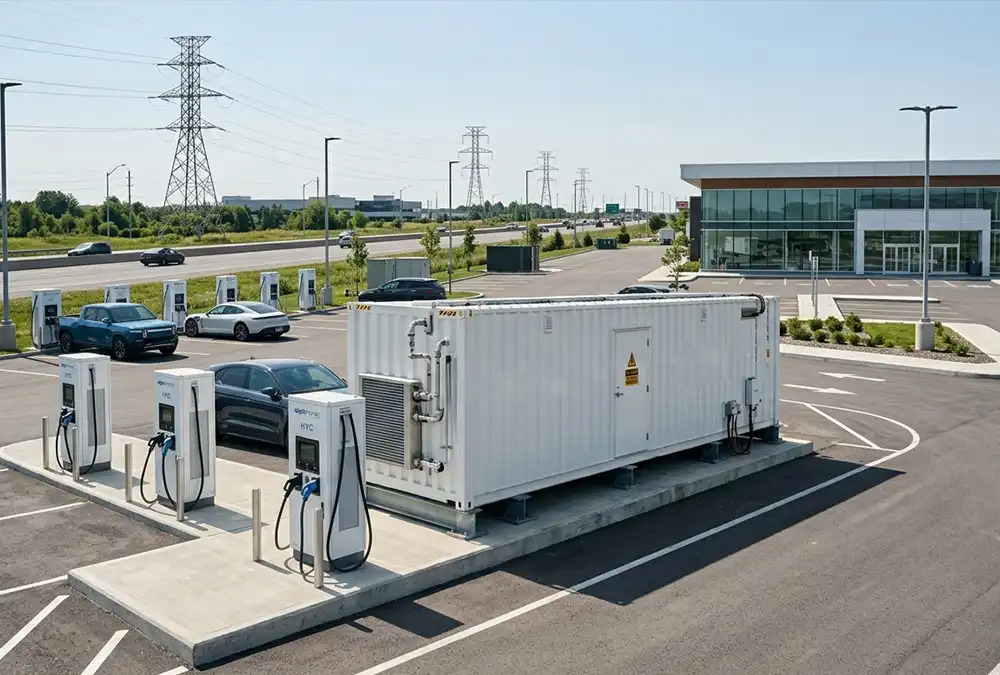
Introduction
Deploying large-scale high-power charging networks requires balancing immense power demands against strict grid constraints. As fleet operators and developers race to build megawatt-level infrastructure, integrating a 1MW Battery Storage for EV Charging Stations has shifted from an experimental upgrade to an operational necessity. High-output charging grids draw immense currents that can trigger steep utility fees or exceed local power availability entirely. Incorporating a dedicated Battery Energy Storage System (BESS) helps operators manage electricity loads, capture alternative revenue streams, and lower structural expenses without sacrificing service speed. Deciding on the correct infrastructure configuration requires evaluating how integrated hardware matches fluctuating load profiles, capital expenditures, and long-term investment returns.
What Is a 1MW Battery Storage System for EV Charging Stations?
Definition of a 1MW Battery Energy Storage System
A 1MW battery energy storage system represents a stationary, commercial-grade energy management array designed to absorb, store, and discharge up to 1 Megawatt (1,000 kilowatts) of instantaneous electrical power. The system’s power rating determines its delivery speed, while its overall operational window depends on its storage duration—measured in Megawatt-hours (MWh). This infrastructure serves as a highly responsive electrical buffer between the high-voltage utility grid and heavy vehicle loads.
How a 1MW BESS Supports EV Charging Infrastructure
In high-power charging applications, the BESS works as a flexible energy reservoir. When local grid capacity falls short of vehicle power demands, the system discharges its stored energy to fill the gap. This prevents voltage drops, eliminates grid strain during peak usage hours, and ensures that dispensers can deliver full rated power simultaneously, even on highly constrained electrical lines.
Typical Power and Energy Configurations
The operational runway of a 1MW system is tailored using specific capacity layouts based on site demands:
- 1MW/2MWh (2-Hour Duration): Engineered primarily for high-throughput hubs requiring rapid power injections to smooth out short, sharp spikes in vehicle charging demand.
- 1MW/4MWh (4-Hour Duration): The current commercial benchmark, configured to deliver continuous support across multi-hour peak times and manage extended grid mitigation.
- 1MW/6MWh (6-Hour Duration): A high-capacity configuration designed for deep energy time-shifting and supporting heavy fleet depots during extended overnight charging blocks.
Why EV Charging Stations Need Battery Storage
Modern electric vehicles demand faster turnaround times, causing single dispensers to draw anywhere from 180kW to 400kW. When multiple vehicles hook up to fast chargers simultaneously, the total power demand can easily spike from zero to over a Megawatt in seconds. Unbuffered charging networks face extreme electricity bills due to utility demand charges, along with potential grid rejection if local substations lack the capacity to supply that level of current.
Featured Snippet: How Does a 1MW Battery Storage System Work for EV Charging Stations?
A 1MW battery storage system stores electricity during off-peak hours and supplies power during high-demand charging periods. It helps EV charging stations reduce grid dependency, avoid expensive grid upgrades, lower demand charges, and support ultra-fast charging by delivering additional power when multiple vehicles charge simultaneously.
Battery Energy Storage System (BESS) Components for EV Charging Stations
A reliable 1MW system depends on the seamless integration of several core technical components working in unison:
Battery System (Lithium-ion Battery Packs)
The fundamental storage core consists of individual cell blocks connected into modules and high-voltage racks. Modern industrial installations rely almost exclusively on Lithium Battery Storage System engineering—specifically Lithium Iron Phosphate (LFP) chemistry. LFP tech offers exceptional safety margins, excellent thermal resilience, and a long cycle life, making it perfect for daily fast-charging applications.
Battery Management System (BMS)
The BMS acts as the internal electronic safety layer. It monitors cell-level parameters, handles state-of-charge tracking, manages cell balancing, and shuts down systems if it detects overvoltage, undervoltage, or thermal issues.
Power Conversion System (PCS)
The PCS is the high-power, bi-directional inverter platform that bridges the batteries and the station’s AC bus. It converts grid AC into DC to charge the batteries, and instantly flips to invert DC back to AC when dispensers demand extra power.
Energy Management System (EMS)
The EMS is the intelligent software brain of the project. It monitors dispenser consumption, tracks real-time utility rates, and runs algorithmic dispatches to optimize financial returns and system efficiency.
HVAC and Thermal Management
Heavy charging and discharging generates significant heat. Advanced systems use liquid-cooling loops running through the battery modules to maintain stable operating temperatures, which extends cell life and ensures safe performance.
Fire Protection and Safety System
Built to comply with strict NFPA 855 regulations, modern enclosures incorporate multi-stage gas detection, deflagration venting, and clean-agent fire suppression systems to manage thermal risks effectively.
EV Fast Charging Infrastructure Challenges Solved by 1MW Battery Storage
Integrating a 1MW Battery Storage for EV Charging Stations resolves the primary technical bottlenecks that complicate fast-charging projects:
Limited Grid Connection Capacity
Many prime highway and commercial sites are restricted by low regional Grid Connection Capacity. If a location only has 300kW of available grid supply, it cannot support four 250kW dispensers without storage. A 1MW system covers that gap, letting operators build high-power hubs on restricted grid lines.
High Demand Charges
Utilities penalize commercial users with heavy demand charges based on their single highest 15-minute consumption spike during the month. Unbuffered fast-charging hubs often generate extreme spikes, resulting in massive utility bills even if total energy consumption remains low.
Utility Upgrade Delays
Requesting a dedicated substation upgrade or a new medium-voltage line from a local utility can stall projects for 12 to 24 months. Deploying an integrated storage solution offers a fast alternative, allowing sites to go live months ahead of schedule.
Peak Power Requirements
Ultra-fast charging requires instant access to intense power. Stored energy acts as a high-speed buffer, delivering the necessary power immediately without causing local grid disruptions or voltage drops.
EV Charging Load Fluctuations
Vehicle charging profiles are highly unpredictable, shifting rapidly as cars plug in, ramp up, or disconnect. A stationary battery dampens these fluctuations, presenting a smooth, stable, and highly predictable load curve to the utility provider.
Peak Shaving for EV Charging Stations Using Battery Storage
What Is Peak Shaving?
Peak shaving is an active load-management strategy where a facility deliberately limits its power draw from the utility grid during peak hours by covering excess demand with an alternative on-site power source.
How Peak Shaving Reduces Electricity Costs
By configuring the EMS to monitor real-time grid consumption, the station can cap its grid draw at a predetermined threshold (e.g., 200kW). When incoming cars push total demand to 800kW, the battery discharges the remaining 600kW. This practice achieves significant Peak Demand Reduction, eliminating the steep demand charges that undermine station profitability.
Real-World Peak Demand Scenarios
Consider a busy highway hub during holiday travel blocks. Dozens of electric vehicles pull in to fast-charge within a brief window, driving power demand to extreme levels. Without peak shaving, that single afternoon of high usage sets an expensive demand charge baseline for the entire billing cycle.
Peak Shaving ROI Analysis
In areas with aggressive demand tariffs, shaving down consumption peaks can lower monthly utility bills by thousands of dollars. These consistent savings speed up project payback timelines, turning the storage asset into a clear driver of long-term profitability.
Load Management System and EMS Optimization for EV Charging Stations
Maximizing efficiency requires linking a smart Load Management System directly with the site’s overall storage controls:
- Dynamic Load Management: Smart controllers monitor vehicle connections, automatically distributing available power between battery reserves and the main grid connection based on real-time station demand.
- Smart Charging Strategies: The station can balance charging speeds dynamically based on battery state-of-charge and current utility rates, prioritizing fast delivery when storage is full or grid power is inexpensive.
- EMS-Controlled Energy Dispatch: The control software handles millisecond-level shifts, ensuring the battery responds immediately to sudden charging spikes before the utility grid registers the surge.
- Grid Interaction Optimization: The system automatically shifts charging blocks to off-peak night hours, refilling the storage units at the lowest possible energy rates.
- AI-Based Energy Scheduling: Advanced platforms track historical station usage, local weather patterns, and traffic flow data to predict daily charging spikes and optimize battery readiness.
1MW Battery Storage Capacity Options for EV Charging Applications
Selecting the right asset duration depends on a site’s daily traffic patterns and operational goals. The matrix below outlines how these typical configurations perform in real-world deployment:
| System Layout | Power Rating | Energy Storage Capacity | Continuous Duration | Best Application Profile |
|---|---|---|---|---|
| 1MW/2MWh | 1,000 kW | 2,000 kWh | 2 Hours | Urban hubs focused on peak shaving and short fast-charging spikes. |
| 1MW/4MWh | 1,000 kW | 4,000 kWh | 4 Hours | Highway corridors and commercial depots with high multi-vehicle traffic. |
| 1MW/6MWh | 1,000 kW | 6,000 kWh | 6 Hours | Heavy logistics fleets requiring overnight charging and deep solar integration. |
Commercial Energy Storage Benefits for EV Charging Stations
Deploying a Commercial Energy Storage System provides comprehensive operational advantages:
- Reduced Electricity Costs: Combines peak shaving and smart energy arbitrage to cut monthly operating costs.
- Avoiding Grid Expansion Costs: Eliminates the need for expensive utility transformer upgrades, saving substantial upfront capital.
- Improved Charging Reliability: Provides robust backup power during grid outages, ensuring the station stays online and operational.
- Faster EV Charging Services: Guarantees dispensers can deliver maximum rated power simultaneously, keeping customer charge times short.
- Increased Charging Revenue: Allows sites to service more vehicles during busy hours without worrying about grid limits or demand caps.
- Enhanced Energy Independence: Protects the business from local power reliability issues and volatile grid pricing shifts.
Product Recommendation: Premium 1MW/2MWh Integrated Smart Storage Container
For high-traffic fast-charging stations, we recommend our factory-assembled 1MW/2MWh liquid-cooled storage system. Featuring Tier-1 LFP chemistry, multi-stage safety controls, and an integrated EMS, this compact container delivers efficient thermal performance and seamless integration with all leading high-power DC fast chargers.
Renewable Energy Integration with EV Charging and Battery Storage
Solar + Battery + EV Charging Solutions
Co-locating local solar arrays with battery storage creates a highly efficient clean energy circle. On-site solar generation recharges the batteries directly during low-traffic mid-day hours, storing clean energy to power vehicles after dark.
Wind Energy and Charging Stations
For remote rest stops or specialized industrial hubs, pairing local wind generation with large-scale storage smooths out variable wind patterns, turning fluctuating wind resources into a stable power supply for vehicle charging.
Microgrid EV Charging Applications
Integrating solar panels, stationary storage, and fast chargers into an independent Microgrid EV Charging Solution allows depots to run reliably outside the standard utility grid, which is perfect for remote sites or strategic fleet yards.
Net-Zero Charging Infrastructure
Combining renewable generation with advanced battery storage allows operators to verify the green source of their electricity, offering a true net-zero fast-charging experience that attracts sustainable fleets and eco-conscious drivers.
1MW Battery Storage System Cost for EV Charging Stations
A comprehensive 1MW Battery Storage for EV Charging Stations financial assessment shows that project costs depend on duration requirements, local site conditions, and specific grid connection needs.
Based on global clean energy infrastructure indices from 2025 and early 2026, a standard integrated 1MW/2MWh LFP container setup averages between **$620,000 and $880,000** for hardware. Moving to a longer-duration 1MW/4MWh system increases the hardware cost to a range of **$1,100,000 to $1,450,000**.
The total project investment includes cell packs, the bi-directional PCS, integrated EMS software, site preparation, civil engineering foundations, and utility commissioning. While the initial capital cost is significant, it often proves more economical than paying for major utility grid upgrades or enduring multi-year project delays.
ROI and Payback Period of Battery Storage for EV Charging Stations
Evaluating the ROI of Battery Storage for EV Charging Stations requires looking at both direct cost savings and added station revenues. Financial models show that payback timelines vary by application profile:
| Project Deployment Profile | Primary Financial Drivers | Estimated Payback Window |
|---|---|---|
| Public Fast Charging Station | Peak demand charge mitigation & increased charging capacity | 3 to 5 Years |
| Fleet Charging Depot | Off-peak overnight energy charging & reliable uptime backup | 2 to 4 Years |
| Highway Charging Hub | Managing intense traffic spikes & avoiding grid expansion fees | 3 to 6 Years |
1MW Battery Storage vs Grid Upgrade for EV Charging Infrastructure
Cost Comparison
A traditional utility grid upgrade requiring new high-voltage lines, dedicated substations, and large transformers can cost anywhere from $500,000 to over $2 million, depending on site distance from main distribution lines. A 1MW battery system provides a competitive, predictable cost profile that scales directly with your equipment needs.
Deployment Time Comparison
Utility approvals, design reviews, and transformer production delays can stall site launches for up to two years. In contrast, an integrated battery container can be delivered, installed, and commissioned on-site in a matter of months.
Operational Flexibility Comparison
Grid upgrades are fixed assets that offer no protection against power outages or fluctuating utility pricing. A smart battery system provides complete operational flexibility, supporting backup power needs, peak shaving, and active participation in utility demand response programs.
Which Option Is Better?
For locations facing utility upgrade delays over 12 months or high demand fees, investing in a 1MW battery system is usually the superior choice. It gets the station running quickly and provides ongoing tools to manage operational electricity costs.
Best Applications of 1MW Battery Storage for EV Charging Stations
- Highway Fast Charging Corridors: Delivers instant power buffers at remote highway exits where local grid connections are limited but travel traffic spikes heavily during holidays.
- Fleet Charging Depots: Supports delivery and logistics fleets, ensuring multiple commercial vehicles can fast-charge simultaneously without triggering extreme utility demand fees.
- Bus Charging Stations: Provides steady power blocks for high-voltage transit buses during short midday turnarounds and scheduled overnight charging windows.
- Logistics and Warehouse Facilities: Allows distribution hubs to add heavy electric truck chargers without disrupting normal facility power operations.
- Commercial Parking Lots: Helps shopping centers and office parks introduce fast-charging amenities without exceeding their existing property power allocations.
How to Choose the Right 1MW Battery Energy Storage System
When selecting a system configuration, project managers should follow a structured engineering review:
- Analyze Charging Demand: Map out expected vehicle traffic profiles and peak charger utilization to determine your true daily power and energy needs.
- Assess Grid Capacity: Check your facility’s current spare power capacity to see how much charging demand the grid can handle directly before needing battery support.
- Determine Battery Duration Requirements: Decide if your site needs a short, intense power buffer (1MW/2MWh) or extended multi-hour support (1MW/4MWh) based on your peak traffic windows.
- Evaluate Future Expansion Plans: Choose a system with modular structural foundations so you can easily scale up storage capacity as vehicle charging demand grows over time.
- Select a Reliable BESS Manufacturer: Partner with an experienced manufacturer that uses Tier-1 cell chemistry, carries full safety certifications, and provides comprehensive long-term warranty and service support.
Frequently Asked Questions About 1MW Battery Storage for EV Charging Stations
How Many EV Chargers Can a 1MW Battery Support?
A 1MW battery can support roughly four to six 150kW DC fast chargers operating at full capacity simultaneously by combining battery discharge with the site’s baseline grid connection power.
What Is the Best Battery Size for Fast Charging Stations?
The ideal size depends on your site traffic. For smaller urban stations, a 200kW to 500kW system is often sufficient. For high-volume highway rest stops, commercial fleet depots, and ultra-fast charging hubs, a 1MW configuration is the industry standard for reliable load management.
How Much Does a 1MW Battery Storage System Cost?
A full 1MW integrated container project typically ranges from $620,000 to over $1.4 million. The final price varies based on whether you select a 2-hour (2MWh) or 4-hour (4MWh) storage capacity, as well as specific site integration needs.
Can Battery Storage Eliminate Grid Upgrades?
Yes. By acting as an on-site power buffer that refills during off-peak times, a 1MW battery system can completely eliminate the need for expensive utility transformer upgrades, letting you launch projects on constrained power lines.
What Is the Typical Lifespan of a BESS?
High-quality Lithium Iron Phosphate (LFP) storage systems are engineered to last 15 to 20 years, typically rated for 6,000 to 8,000 full charge-discharge cycles before cell capacity naturally drops to 70% of its original rating.
How Long Is the Payback Period?
Most commercial charging installations achieve a full payback within 3 to 6 years, driven by monthly demand fee savings, smart energy arbitrage, and increased vehicle throughput revenue.
Future Trends of Battery Energy Storage for EV Charging Infrastructure
As the energy landscape evolves toward 2030, several key technology shifts are reshaping the sector:
- Ultra-Fast Charging Networks: The expansion of 350kW+ passenger vehicle systems and Megawatt Charging Systems (MCS) for heavy trucks will make large-scale battery buffers a standard part of station design.
- Vehicle-to-Grid (V2G) Integration: Future software platforms will allow vehicles to interact bi-directionally with station batteries, turning parked fleets into active grid support assets.
- AI-Driven Energy Management Systems: Control platforms will increasingly rely on advanced machine learning algorithms to automate power trading and maximize cost savings.
- Second-Life EV Batteries: Re-purposing decommissioned electric vehicle batteries for stationary commercial storage will offer lower-cost options for budget-conscious projects.
- Virtual Power Plant (VPP) Participation: Networked station batteries will be able to combine forces, acting as virtual power plants to support the main utility grid during regional emergencies and earning lucrative service payouts.
Conclusion: Is a 1MW Battery Storage System the Right Choice for Your EV Charging Station?
Key Benefits Summary
Deploying a 1MW Battery Storage for EV Charging Stations delivers a powerful combination of financial and operational advantages. It effectively cuts down expensive utility demand fees, bypasses lengthy grid upgrade delays, provides essential backup reliability, and ensures your dispensers can always deliver top charging performance.
Ideal Use Cases
This scale of storage is ideal for high-volume commercial fleet yards, major highway fast-charging plazas, urban logistics hubs, and any location where grid capacity limits expansion plans.
Investment Considerations
While the initial capital spend is significant, strong project payback periods and substantial monthly operating savings make large-scale battery storage a highly viable and strategic investment for modern clean energy infrastructure.
Next Steps for Project Developers
For developers looking to secure their charging infrastructure, the next step is conducting a detailed site load evaluation. Partnering with an experienced system manufacturer allows you to design a customized configuration that maximizes efficiency and keeps your station ahead of growing EV demands.