Introduction: The New Era of Electrified Mobility
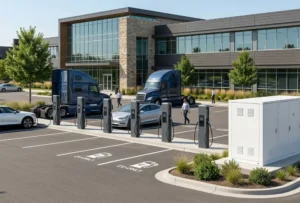
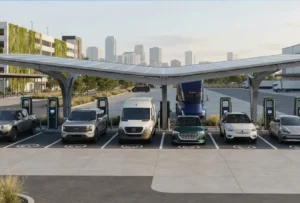
The global transition toward electric mobility is placing unprecedented pressure on localized electrical grids worldwide. For charge point operators (CPOs), fleet managers, and commercial property developers, integrating advanced energy storage for EV charging has transitioned from a progressive sustainability option to an absolute infrastructure mandate. As high-power direct current (DC) fast chargers become the market standard, the physical limitations of the traditional grid infrastructure threaten commercial scalability. Without localized buffering, deploying multi-megawatt charging plazas can lead to exorbitant utility fees, prolonged grid interconnection delays, and systemic voltage instability. This comprehensive guide outlines how tactical battery integration resolves these engineering bottlenecks, optimizes site operational expenses, and unlocks highly scalable revenue models for forward-thinking charging network developers.
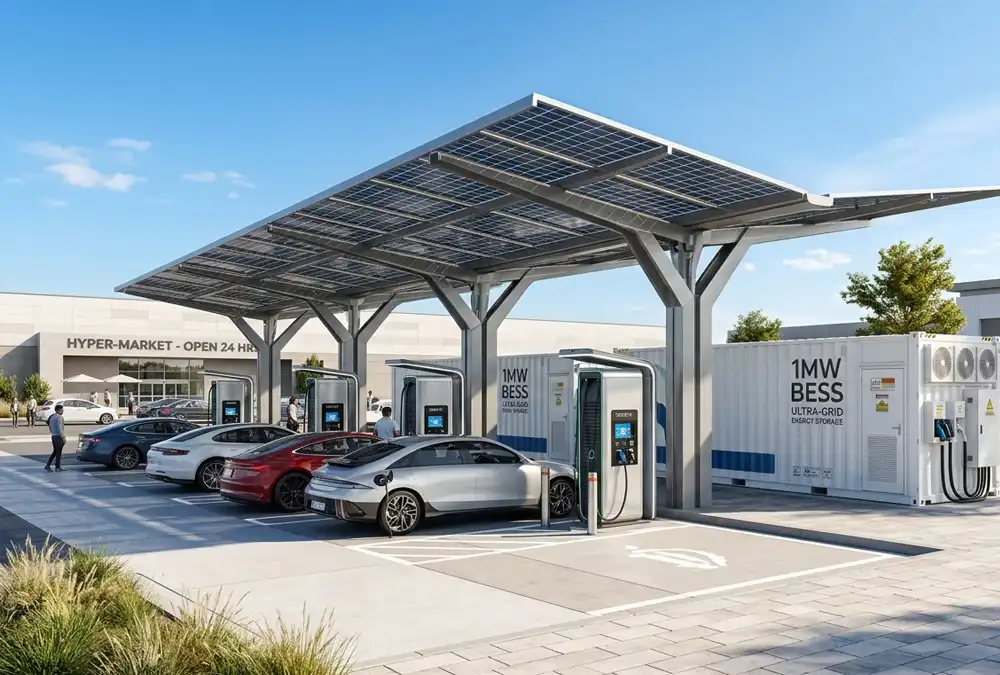
Battery Energy Storage Systems (BESS) for EV charging store electricity during low-demand periods and release it when charging demand peaks. By reducing grid dependency, lowering demand charges, supporting fast charging, and integrating renewable energy, battery storage enables more reliable, cost-effective, and scalable EV charging infrastructure.
What Is Battery Energy Storage for EV Charging?
At its engineering core, utilizing energy storage for EV charging sites involves placing an intelligent, stationary electrochemical buffer between the high-voltage utility grid feed and the localized vehicle charging dispensers. This hardware acts as a bidirectional energy reservoir, decoupling immediate vehicle power consumption from the utility provider’s instantaneous grid supply capabilities.
Understanding Battery Energy Storage Systems (BESS)
A stationary battery energy storage system for EV charging operations is not merely a collection of backup cells; it is an active, microgrid-capable power plant. It captures power from various inputs—such as standard medium-voltage utility lines, on-site solar photovoltaic arrays, or localized wind generation—and holds that energy securely until a high-current vehicle demand profile triggers a high-speed dispatch cycle.
How Battery Storage Works with EV Charging Stations
The system operates via automated state-of-charge management. When an EV site experiences low occupancy, the battery storage draws a low, continuous current from the grid to maintain its chemical capacity. When multiple electric vehicles arrive simultaneously and plug into high-capacity ultra-fast dispensers, the system instantly engages. Instead of drawing a massive, disruptive power spike directly from the local utility grid, the station pulls a significant percentage of the required operating current directly from the stationary battery packs, protecting the grid connection from severe overloads.
Key Components of a Battery Energy Storage System
A utility-grade BESS consists of highly synchronized subsystems working together to deliver reliable, high-power performance:
- Battery Packs: The foundational chemical storage layer, typically utilizing high-density lithium-ion cells configured in robust structural strings.
- Battery Management System (BMS): The primary safety system that monitors cell voltages, internal state-of-charge tracking, and physical module thermal balances.
- Power Conversion System (PCS): High-power bidirectional inverters that manage AC-to-DC conversion during storage charging and DC-to-AC grid inversion during discharge.
- Energy Management System (EMS): The master control software that handles intelligent load dispatch, real-time demand monitoring, and economic spot-market optimization.
- Thermal Management and Safety Systems: Advanced liquid or air climate controls integrated with automated fire suppression loops to ensure stable continuous operation.
EV Charging Infrastructure Challenges That Battery Energy Storage Solves
Building high-capacity ev charging station battery storage infrastructure presents several clear engineering and financial challenges. Stationary batteries offer an elegant solution to these common site development issues.
Limited Grid Connection Capacity
Many commercial properties and highway rest stops have older grid connections capped at 100 kW to 200 kW. Adding even a single modern 150 kW DC fast charger will immediately exceed these local capacities, while a multi-dispenser supercharging plaza requires megawatts of capacity that local utilities often cannot provide without major infrastructure overhauls.
High Demand Charges and Electricity Costs
Commercial utility tariffs are split into volume usage fees and hefty peak demand charges. Demand charges are based on the single highest 15-minute consumption spike recorded during a billing cycle. When an EV station delivers 350 kW of peak power to an electric truck, it creates a massive demand spike that can result in thousands of dollars in monthly utility penalties, severely impacting station profitability.
Expensive and Time-Consuming Grid Upgrades
Requesting a physical grid upgrade from a local utility provider to support a high-power charging hub frequently involves installing new substations, running miles of medium-voltage lines, and replacing local transformers. This process can cost hundreds of thousands of dollars in upfront capital expenditure and introduce civil engineering permitting delays that can stall projects for years.
Power Fluctuations During Peak Charging Hours
When multiple high-power fast chargers engage simultaneously, they create severe local voltage drops and harmonic distortions. These localized power sags can disrupt nearby automated commercial machinery, trigger safety shut-offs on standard electrical panels, and cause vehicle charging sessions to prematurely drop or fail.
Renewable Energy Integration Challenges
While installing rooftop solar can help power EV charging sites, solar generation rarely matches real-world vehicle charging profiles. Peak solar output occurs during midday solar noon, whereas peak fleet charging demands typically concentrate in the early morning or evening hours, resulting in clean solar energy being wasted or sold back to the grid for minimal return.
Battery Energy Storage System Integration with Fast Charging Infrastructure
Deploying reliable battery storage for fast charging stations requires precise structural design. Site engineers must choose between two main structural layouts to manage the flow of high-power DC electricity.
How BESS Supports DC Fast Charging Stations
DC fast charging bypasses a vehicle’s slow onboard charger, delivering high-voltage DC power directly to the battery pack. Localized storage provides an immediate, low-impedance DC source that supports these high-power charging sessions, allowing operators to deploy ultra-fast dispensers even in areas with limited grid connections.
AC-Coupled vs DC-Coupled Architectures
In an AC-coupled setup, the stationary battery and EV chargers connect via a common AC bus, with each component requiring its own dedicated inverter system. This layout offers exceptional installation flexibility and simplifies modular site expansion. In contrast, a DC-coupled architecture links solar arrays, stationary storage, and EV dispensers directly onto a shared internal high-voltage DC bus. This design eliminates multiple inefficient AC-to-DC conversion steps, boosting overall round-trip energy efficiency by 5% to 8% and significantly reducing equipment component wear.
Load Balancing Between Grid, Battery, and Chargers
Advanced station control involves dynamic, real-time load balancing. The system constantly monitors the facility’s total grid draw. When an EV plugs in, the controller calculates the exact maximum power the local grid can safely supply without triggering penalty fees, and then dynamically injects the remaining required power directly from the stationary battery system.
Smart EMS Control Strategies
Modern Energy Management Systems use advanced predictive algorithms to coordinate station operations. By analyzing historical vehicle arrival rates, real-time weather forecasts, and shifting utility time-of-use pricing, the EMS automatically determines the most economical times to charge the internal batteries and the most profitable moments to discharge them to support vehicle charging sessions.
Supporting Ultra-Fast Charging Networks
Next-generation electric vehicles utilize advanced 800V battery architectures capable of accepting ultra-fast charging speeds up to 350 kW or higher. Sustaining these extreme charging speeds across a multi-dispenser network is virtually impossible on standard grid infrastructure without integrating a localized, high-output BESS buffer to manage the massive power demands.
Industrial Product Recommendation: AnengJi BESS-EV HyperSeries
For high-capacity commercial charging hubs and fleet depots integrated with bess for ev charging architectures, we highly recommend the AnengJi BESS-EV HyperSeries. This premium, all-in-one containerized system features an advanced PCS and EMS integration layout optimized for high-power DC fast charging applications. Equipped with long-lifecycle Liquid-Cooled LFP modules, the HyperSeries maintains precise cell temperatures within a tight 2.5°C variance, ensuring maximum safety and exceptional system longevity. Fully certified to UL 9540 and NFPA 855 standards, it provides seamless plug-and-play load balancing and high-current dispatch capabilities, allowing site operators to deploy profitable ultra-fast charging networks without facing expensive grid upgrade delays.
Battery Storage Technologies Used in EV Charging Applications
Selecting the right battery chemistry is a critical decision that directly impacts an EV charging project’s upfront investment, safety profile, and long-term operational lifespan.
Lithium Iron Phosphate (LFP) Batteries
Lithium Iron Phosphate (LFP) has become the dominant chemistry for stationary energy storage for EV charging applications. LFP technology offers exceptional thermal stability and completely eliminates the risk of oxygen release during a thermal event, making it incredibly safe for public commercial properties. Furthermore, premium LFP cells deliver an outstanding operational lifespan, often sustaining over 6,000 complete charging cycles before experiencing noticeable capacity degradation.
Nickel Manganese Cobalt (NMC) Batteries
Nickel Manganese Cobalt (NMC) chemistries provide significantly higher volumetric energy density, allowing engineers to pack substantial power capacity into a much smaller physical footprint. This makes NMC systems highly effective for compact urban charging hubs where available land is at a premium. However, NMC chemistry requires highly sophisticated, multi-tiered thermal management systems and robust fire containment barriers due to its lower thermal runaway threshold.
Sodium-Ion Battery Technology
Sodium-ion technology is emerging as a highly promising alternative for stationary applications. By replacing scarce lithium with abundant sodium, these systems offer a lower raw material cost profile and provide exceptional performance across extreme temperature ranges. While their lower energy density requires a larger physical footprint, their excellent safety characteristics and low production costs make them highly attractive for next-generation budget-conscious infrastructure projects.
Flow Battery Energy Storage
Flow batteries store chemical energy in external liquid electrolyte tanks that circulate through a central cell stack. This unique design decouples total power output from overall energy capacity, allowing operators to expand duration simply by installing larger fluid tanks. Flow batteries suffer zero chemical degradation over tens of thousands of cycles, making them ideal for heavy-duty, long-duration fleet charging depots, though their complex plumbing requires dedicated maintenance oversight.
Hybrid Energy Storage Systems
Hybrid configurations combine multiple storage technologies within a single installation to maximize performance. For example, pairing a high-power supercapacitor array with a high-capacity LFP battery bank allows the system to handle sudden, high-current vehicle start-up surges without putting stress on the primary chemical batteries, significantly extending the operational lifespan of the entire asset.
Future Battery Technologies for EV Charging
The energy storage sector continues to advance rapidly. Ongoing research into solid-state electrolytes and advanced lithium-sulfur chemistries aims to double current energy densities while completely eliminating flammable components, promising a future generation of ultra-safe, compact, and ultra-high-power charging infrastructure solutions.
Key Benefits of Battery Energy Storage for EV Charging Stations
Integrating a high-performance BESS provides multi-dimensional advantages that transform an EV charging station from a basic electrical load into a highly efficient, profitable asset.
Peak Shaving and Demand Charge Reduction
The most immediate financial benefit of a BESS is its ability to flatten the facility’s peak electricity demand. By capping the amount of power drawn from the utility grid during busy charging periods, operators can avoid expensive peak demand fees, often reducing monthly utility bills by 30% to 50%.
Avoiding Utility Grid Expansion
By leveraging an internal battery buffer to supply peak charging currents, site developers can completely bypass the need for expensive, time-consuming grid upgrades. This allows companies to deploy fast-charging stations years ahead of utility timelines and save hundreds of thousands of dollars in upfront capital costs.
Improving Charging Reliability
Stationary storage provides a reliable backup power reserve. If the primary utility grid experiences a localized blackout or severe voltage fluctuation, the BESS instantly transitions into island mode, allowing the station to continue delivering stable, uninterrupted fast-charging services to customers.
Enabling Ultra-Fast EV Charging
Integrating a localized battery buffer allows operators to deploy ultra-fast 350 kW charging dispensers on standard, low-voltage commercial power connections. This enables rural rest stops and urban parking structures to offer premium, high-speed charging capabilities that would otherwise be structurally impossible.
Increasing Charging Station Revenue
By eliminating grid-capacity bottlenecks, a BESS allows a station to power multiple fast chargers simultaneously at full speed. This higher throughput reduces customer wait times, increases daily vehicle turnover rates, and significantly boosts overall station revenue.
Enhancing Grid Stability
A high-capacity BESS can provide beneficial ancillary services back to the local utility provider. When regional grids experience stress, the station’s EMS can aggregate its collective battery capacity to provide rapid frequency regulation and voltage support, earning direct incentive revenue from the grid operator.
Supporting Renewable Energy Integration
A BESS acts as a reliable bridge for on-site clean energy, allowing a station to capture and store excess daytime solar power. This stored clean energy can then be deployed to charge vehicles during the night, maximizing renewable utilization and ensuring true zero-emission mobility.
Reducing Carbon Emissions
By charging internal batteries during low-demand night intervals—when utility grids typically rely on cleaner baseline power sources—and discharging during peak daytime hours, a BESS helps reduce operational carbon footprints and supports corporate sustainability objectives.
Peak Shaving and Demand Charge Reduction with Battery Energy Storage
To fully understand the economic value of deploying solar and battery storage for ev charging networks, it is essential to analyze the mathematics of peak demand management.
What Is Peak Shaving?
Peak shaving is the process of actively reducing the maximum power drawn from the utility grid during short, high-demand intervals. In an EV charging context, this involves using the localized stationary battery to supply the upper portion of a vehicle’s charging curve, ensuring the total grid draw remains below a fixed, low threshold.
How Demand Charges Impact Charging Station Profitability
Many commercial utility companies charge over $20 per kilowatt for peak demand. If an EV site without storage experiences a brief, 15-minute consumption spike of 400 kW when two vehicles charge simultaneously, the business faces a $8,000 demand fee on that single month’s bill, erasing the operational margins earned from hundreds of individual charging sessions.
Real-World Peak Shaving Example
Consider a commercial retail station equipped with four 150 kW DC fast chargers, facing a strict grid capacity limit of 150 kW. When four vehicles plug in simultaneously demanding 400 kW of total power, an integrated 300 kW BESS instantly fills the 250 kW deficit, allowing all cars to charge at full speed while keeping the facility’s grid draw safely within its 150 kW limit.
Annual Cost Savings Analysis
By consistently flattening these daily demand spikes, a high-capacity BESS can reliably eliminate thousands of dollars in monthly demand charges. Over a standard calendar year, these cumulative utility savings can amount to $60,000 to $100,000 per site, significantly improving the overall profitability of the charging infrastructure investment.
Best Practices for Demand Management
To maximize financial returns, operators should program their EMS with conservative, dynamic threshold targets. These targets automatically adjust based on seasonal utility pricing rates and real-time building power demands, ensuring the stationary battery maintains enough reserve capacity to handle expected afternoon charging surges.
Economic Benefits of Battery Energy Storage Systems for Fast Charging
Analyzing the complete lifecycle economics of an energy storage project demonstrates how a BESS effectively lowers operational costs and shortens overall payback periods.
Reducing Operational Expenses (OPEX)
A BESS lowers ongoing operational expenses by eliminating peak demand penalties and exploiting time-of-use tariff differences, allowing operators to manage a highly predictable, lower-cost utility bill.
Deferring Grid Upgrade Investments
By avoiding the need for expensive utility infrastructure overhauls, site developers can save significant upfront capital expenditure. These saved capital funds can be redirected to purchase additional charging dispensers or expand to new geographic locations.
Increasing Charger Utilization Rates
When multiple vehicles plug in at a grid-constrained station without storage, the system is forced to throttle charging speeds, leading to longer wait times and frustrated customers. A battery buffer ensures every dispenser delivers maximum power, accelerating charging sessions and increasing daily station utilization rates.
Maximizing Time-of-Use (TOU) Electricity Savings
Many regional utility companies utilize shifting time-of-use pricing models, where electricity costs during peak evening hours can be five times higher than off-peak night rates. An intelligent BESS automatically charges its batteries during cheap night intervals and runs the station on battery power during expensive peak hours, significantly lowering total energy procurement costs.
Revenue Opportunities Through Energy Arbitrage
In deregulated energy markets, operators can use their BESS to engage in wholesale energy arbitrage. By buying energy when market prices drop below baseline levels and selling excess battery capacity back to the grid during regional peak demand spikes, operators can generate an additional, high-margin revenue stream.
ROI and Payback Period Analysis
While adding a premium containerized BESS increases the initial project purchase price, the combination of lower demand charges, avoided grid upgrades, and increased vehicle throughput rapidly offsets the investment. According to BloombergNEF’s 2025/2026 infrastructure reports, an integrated fast-charging BESS project typically achieves a full return on investment within 3.5 to 5 years, delivering robust long-term profitability over its 15-year operational life.
| Benefit Factor | Financial and Operational Impact |
|---|---|
| Peak Shaving | Lowers demand charges, saving 30% to 50% on monthly utility bills. |
| Energy Arbitrage | Maximizes time-of-use savings by shifting energy purchases to low-cost intervals. |
| Grid Deferral | Reduces initial CAPEX by bypassing expensive utility infrastructure upgrades. |
| Higher Charging Throughput | Increases daily station utilization rates and boosts overall charging revenue. |
Solar and Battery Storage Solutions for EV Charging Stations
Combining local solar generation with advanced stationary storage creates a highly efficient, self-sustaining energy ecosystem for modern fast-charging infrastructure.
How Solar + Storage + EV Charging Works
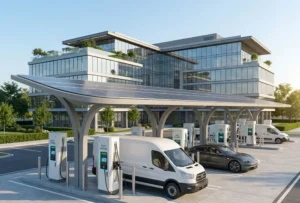
An integrated solar-powered EV station links on-site solar panels, stationary battery storage, and charging dispensers through a central, intelligent inverter system. The EMS constantly balances these three elements, directing clean solar power to charging vehicles, storing excess generation in the battery bank, and drawing grid power only when local resources are fully depleted.
Benefits of Solar-Powered EV Charging
This integrated configuration drastically reduces ongoing grid dependence, protects the facility against volatile utility rate hikes, and allows companies to market a premium, true zero-emission charging service to environmentally conscious consumers.
Real-World Applications of Energy Storage for EV Charging
Stationary battery storage provides critical advantages across a wide variety of real-world commercial and industrial charging environments.
Battery Storage for Off-Grid and Remote EV Charging Stations
In remote national parks, highway rest stops, or isolated mining sites, bringing in high-voltage utility lines is often financially impossible. Combining a robust solar array with a large-capacity BESS allows developers to deploy entirely self-sufficient, off-grid fast-charging hubs that provide reliable power in the most challenging locations.
Battery Storage for Fleet Charging Depots
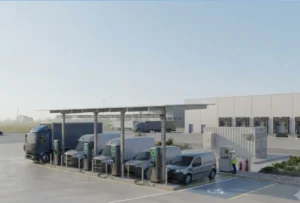
Commercial logistics hubs that manage fleets of electric delivery vans or transit buses face unique charging challenges. These vehicles return to the depot simultaneously in the evening and require immediate, high-power charging to be ready for the next day’s routes. A containerized BESS manages this massive concentrated load, preventing depot overloads and ensuring fleet schedules are met without disruption.
Energy Management System (EMS) Optimization for EV Charging and Battery Storage
The ultimate performance and financial return of an integrated charging hub depend heavily on the software intelligence powering its Energy Management System.
AI-Driven Energy Optimization
Modern, high-performance systems utilize advanced AI algorithms to manage site power. By continuously analyzing real-time vehicle charging profiles, historical site data, local weather forecasts, and shifting grid pricing models, the AI automatically calculates the most efficient power routing configuration every second, maximizing operational cost savings.
Virtual Power Plant (VPP) Integration
By linking multiple distributed battery storage systems together through a unified cloud platform, a charge point operator can create a powerful Virtual Power Plant (VPP). This aggregated storage network can negotiate directly with regional grid operators, offering large-scale grid stabilization services and earning lucrative incentive payments that are shared back with the station owners.
Challenges and Considerations When Deploying Battery Storage for EV Charging
While the business case for integrating a BESS is highly compelling, project developers must carefully plan for several technical and regulatory challenges during the initial design phase.
- Initial Capital Investment: Adding a utility-grade BESS increases upfront project costs, requiring careful financial modeling to secure funding.
- Battery Lifecycle and Degradation: Lithium cells experience natural capacity loss over time, requiring intelligent EMS programming and advanced thermal controls to minimize long-term degradation.
- Safety and Thermal Management: High-power systems require robust, multi-tiered safety controls and automated fire suppression systems to completely mitigate thermal risks.
- System Sizing and Capacity Planning: Accurately matching battery capacity with unpredictable vehicle charging demands requires sophisticated data analysis to prevent under- or over-sizing.
- Regulatory and Grid Compliance: Navigating regional interconnect standards and securing utility approvals can introduce unexpected administrative hurdles and delays.
How to Choose the Right Battery Energy Storage System for EV Charging
Selecting the ideal system configuration requires a systematic analysis of your facility’s specific operational requirements. Developers should begin by gathering detailed historical utility billing records and analyzing expected daily vehicle charging profiles. This data allows engineers to calculate the exact battery capacity and inverter power output needed to manage peak loads effectively. It is vital to evaluate the core software capabilities of the system’s EMS, ensuring it supports advanced dynamic load balancing and seamless integration with your existing charging network management platforms. Additionally, prioritize highly scalable, modular system designs that allow you to easily expand capacity as vehicle charging demands grow over time. Finally, partner with an established, fully certified energy storage manufacturer who provides long-term performance warranties and comprehensive field maintenance support to protect your infrastructure investment over its entire operational lifespan.
Frequently Asked Questions About Energy Storage for EV Charging
Why Do EV Charging Stations Need Battery Storage?
Battery storage acts as an essential electrical buffer. It stores power during low-demand periods and releases it during peak vehicle charging sessions, allowing operators to support high-power fast chargers without overloading the local utility grid or facing expensive demand fees.
Can Battery Storage Eliminate Grid Upgrades?
Yes. By using an internal battery to supply the peak currents required for fast-charging sessions, developers can completely bypass the need for expensive, time-consuming utility infrastructure upgrades, accelerating station deployment timelines by several months or years.
What Size Battery Is Needed for a Fast Charging Station?
The ideal battery size depends on your facility’s available grid capacity, the number of charging dispensers installed, and daily vehicle turnover rates. A standard commercial hub typically deploys systems ranging from 100 kW/200 kWh up to multi-megawatt configurations for heavy-duty fleet depots.
What Is the ROI of Battery Storage for EV Charging?
While adding a BESS increases upfront equipment costs, the combination of reduced demand charges, avoided grid upgrades, and increased vehicle throughput allows most commercial projects to achieve full payback within 3.5 to 5 years.
How Long Does a BESS Last?
A premium utility-grade BESS utilizing high-quality Lithium Iron Phosphate (LFP) cells combined with advanced liquid cooling systems typically delivers an operational lifespan of 12 to 15 years, sustaining over 6,000 complete charging cycles before reaching end-of-life thresholds.
Conclusion: Why Battery Energy Storage Is Essential for the Future of EV Charging
Integrating advanced stationary battery storage is no longer just an optional feature for modern EV charging networks; it is the foundational technology that enables scalable, high-power charging infrastructure. By successfully resolving grid capacity constraints, eliminating expensive demand fees, and unlocking advanced multi-market revenue streams, a localized BESS ensures that fast-charging stations remain highly reliable, financially profitable, and fully prepared to support the next generation of electric mobility. For forward-looking developers, fleet operators, and energy investors, partnering with an experienced, certified energy storage manufacturer to deploy intelligent, future-proof battery systems is the ultimate strategy to secure a competitive advantage in the rapidly growing electrified transportation landscape.