Introduction
The transition toward renewable energy has shifted from a corporate social responsibility goal to a core financial necessity for European enterprises. As of early 2026, the 100kW solar battery storage system cost in Europe has reached a critical stabilization point, offering a powerful hedge against volatile wholesale electricity markets. For businesses operating in high-tariff regions like Germany or Italy, integrating a battery energy storage system (BESS) with existing or new solar arrays is no longer just about “going green”—it is about locking in energy price certainty for the next two decades. This guide provides a deep-dive into the current pricing landscape, technical components, and the strategic ROI drivers that define the European market today.
Introduction: Is a 100kW Solar Battery Storage System Worth the Investment in Europe?
In the current economic climate, European businesses face a “triple threat”: rising grid fees, geopolitical energy instability, and tightening carbon regulations. A 100kW solar plus storage solution addresses these by allowing onsite generation to be used when it is most valuable, rather than selling it back to the grid at unfavorable feed-in rates.
The Shift in the European Energy Landscape
- Rising electricity prices across Europe: Despite stabilization in some sectors, the “peak” prices during industrial shifts remain high.
- Growing demand for energy independence: Reducing reliance on external gas-linked power is now a strategic priority for manufacturing and logistics.
- Solar + storage synergy: In 2026, the efficiency of lithium battery storage systems has improved such that round-trip efficiency (RTE) now consistently exceeds 95%.
Common Business Concerns
- High upfront cost: While prices have dropped 30% since 2020, the initial capital expenditure remains significant.
- ROI uncertainty: Calculating the payback period requires understanding local “time-of-use” (TOU) tariffs.
- Grid compliance challenges: Each EU member state has unique requirements for grid-connected energy storage.
What This Guide Will Cover
We will analyze the average 100kW solar battery storage system cost in Europe, break down the hardware variables, and explore how 100kW battery energy storage system ROI for Europe is calculated in 2026’s market.
Featured Snippet: A 100kW solar battery storage system in Europe can reduce electricity costs by up to 70% for commercial users. While total installed costs range from €50,000 to over €250,000, the ROI is typically achieved within 4–8 years due to high energy arbitrage potential.
What Is a 100kW Solar Battery Storage System?
Before discussing costs, we must clarify the technical distinction between “Power” and “Capacity.” A 100kW solar battery storage system typically refers to the discharge power (how much energy can be delivered at once), while the storage capacity is measured in kilowatt-hours (kWh).
Defining the Commercial Solar Battery Storage System
A standard commercial setup for a factory or hotel often pairs a 100kW solar array with a 100kWh to 200kWh battery. In 2026, the trend is moving toward “Long Duration” storage, where the battery capacity is 2x or 4x the power rating (e.g., a 100kW/400kWh system) to support overnight operations.
Typical Applications in 2026
- Factories & Industrial Plants: Utilizing peak shaving battery systems to lower demand charges.
- Commercial Buildings & Hotels: Ensuring 24/7 power for critical HVAC and lighting.
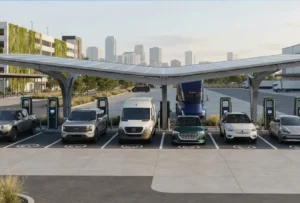
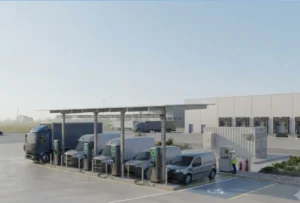
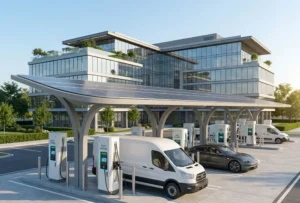
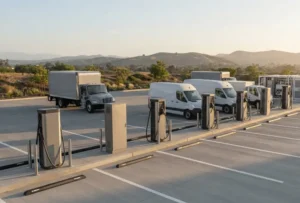
- EV Charging Stations: Buffering the grid against high-power DC fast chargers.
Core Components of the System
| Component | Function |
| Solar Panels | Photovoltaic generation (Monocrystalline/N-Type). |
| BESS | The battery unit, typically using LiFePO4 (Lithium Iron Phosphate). |
| PCS | Power Conversion System—the bi-directional inverter. |
| BMS | Battery Management System—monitors cell health and safety. |
| EMS | Energy Management System—the “brain” that decides when to store or sell. |
What Factors Affect the Cost of a 100kW Solar Battery Storage System in Europe?
Pricing is not a flat rate; it is a composite of hardware quality, regional labor, and system integration.
1. Solar Panel Type and Quality
In 2026, Tier 1 monocrystalline panels are the standard. While N-Type TOPCon and HJT cells carry a slight premium, their lower degradation rates significantly improve the 100kW battery energy storage system ROI for Europe by producing more energy over a 25-year lifespan.
2. Installation and EPC Costs
Labor costs vary wildly. An installation in Germany or Switzerland may cost 40% more in labor than in Poland or Spain. Furthermore, roof-mounted vs. ground-mounted systems change the racking and wiring complexity.
3. Inverter Type and Capacity
The Hybrid Inverter is the heart of the system. In 2026, integrated PCS sizing is critical. A high-quality PCS allows for seamless “island mode” during grid outages, which is a major selling point for industrial battery storage Europe projects.
4. Battery Energy Storage System (BESS) Chemistry
LFP (LiFePO4) has effectively replaced NMC in the stationary storage market. LFP is safer, has a longer cycle life (6,000+ cycles), and is roughly 20-30% cheaper than NMC equivalents per kWh in 2026.
5. Government Subsidies and Incentives
Programs like Germany’s KfW loans or Italy’s tax credits can offset up to 40% of the European commercial solar battery storage pricing 2026 targets, making the “sticker price” much more manageable.
Average Cost of a 100kW Solar Battery Storage System in Europe
Based on BloombergNEF 2026 and IRENA data, the cost of lithium-ion systems has reached record lows due to manufacturing gluts.
Typical Price Range in 2026
For a 100kWh solar battery storage system for European businesses, the total turnkey price (including panels, battery, and installation) typically falls between:
- Solar Only (100kWp): €50,000 – €90,000
- Solar + Storage (100kW/100kWh): €110,000 – €180,000
- Premium/High-Capacity (100kW/200kWh+): €220,000+
Cost Breakdown by Component (2026 Estimate)
| Component | Typical Cost Share | Estimated Amount (€) |
| Battery System (BESS) | 35–50% | €52,500 – €75,000 |
| Solar Panels (PV) | 25–35% | €37,500 – €52,500 |
| PCS/Inverter | 10–15% | €15,000 – €22,500 |
| Installation/EPC/Permits | 10–20% | €15,000 – €30,000 |
| EMS & Safety Systems | 5–10% | €7,500 – €15,000 |
Regional Price Variations
Germany & UK: Higher labor and permitting costs, but strong commercial solar plus storage system installation cost Europe support.
Spain & Italy: Best solar irradiance, leading to the fastest ROI despite slightly higher equipment import costs.
How to Maximize ROI from a 100kW Solar Battery Storage System
The goal of any renewable energy storage systems investment is to shorten the payback period. In Europe, this is achieved through four primary mechanisms.
1. Peak Shaving and Load Shifting
Grid operators charge commercial users based on their highest “peak” usage. By discharging the battery during these peaks, a factory can significantly reduce its monthly demand charges.
2. Time-of-Use (TOU) Optimization
The Energy Management System (EMS) automatically stores solar power during midday (low price/high generation) and discharges it during evening peaks (high price).
3. Increasing Solar Self-Consumption
Without a battery, a business might only use 30% of its generated solar power. With a 100kW solar battery storage system cost in Europe justified by a 100kWh battery, self-consumption can rise to 70-80%.
ROI Calculation Formula
To estimate your payback period, use this standard industry calculation:
Payback Period (Years) = (Total Installed Cost - Incentives) / Annual Energy Savings
Where Annual Savings = (Direct Solar Usage * Grid Price) + (Battery Discharge * Peak Shaving Value).
Featured Snippet: In 2026, most commercial solar storage solutions in Europe see a full return on investment in 5.5 years when electricity prices average above €0.25/kWh.
Benefits of Installing a 100kW Solar Battery Storage System in Europe
Beyond the 100kW solar battery storage system cost in Europe, the qualitative benefits are driving the 2026 market.
- Energy Independence: Insulation from the 14% wholesale price volatility predicted by SolarPower Europe for 2026.
- Reduced Carbon Footprint: Direct alignment with the EU Green Deal and ESG reporting requirements.
- Grid Stability: High-quality grid-connected energy storage helps stabilize the local network, occasionally allowing for “Frequency Regulation” revenue.
Common Challenges and Risk Mitigation
Investing in a solar plus storage solution isn’t without hurdles.
- Grid Approval: Some regions in the UK and Germany have “grid saturation,” making it harder to get export permits.
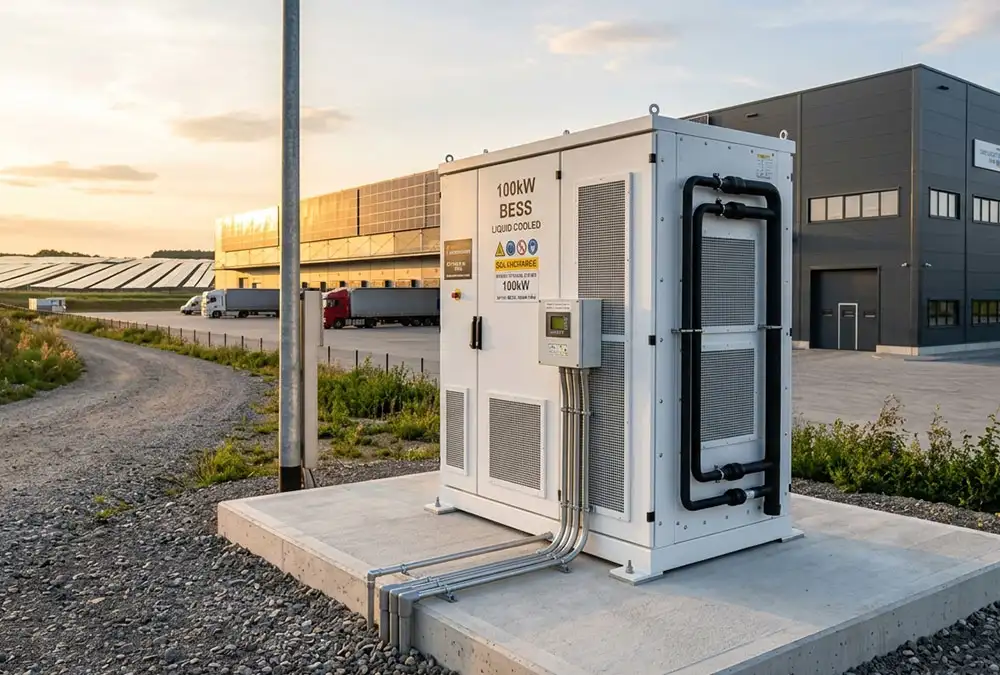
- Space & Safety: A 100kW BESS requires dedicated, fire-rated space. Modern systems now utilize liquid cooling to prevent thermal runaway.
- Maintenance: While solar is “set and forget,” a BESS requires annual thermal and firmware checks.
Choosing the Right Industrial Energy Storage Product
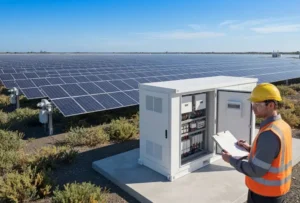
For industrial applications, we recommend systems that integrate the BMS and EMS into a single containerized or modular cabinet.
Recommended System Specs for 2026
- Battery Type: LiFePO4 (LFP) with a cycle life of >6,000 cycles at 80% DoD.
- Inverter: Bi-directional Hybrid with <10ms switching time for UPS-level backup.
- Compliance: Must meet IEC 62619 (Safety) and VDE-AR-N 4105 (European Grid Code).
Future Trends: What Happens After 2026?
According to BloombergNEF, annual storage installations are expected to double over the next decade.
- AI-Driven EMS: Software will predict weather and market prices to trade energy automatically via Virtual Power Plants (VPP).
- Falling Battery Prices: Prices are expected to drop another 10-15% by 2028 as sodium-ion batteries enter the stationary market.
- V2G Integration: Your fleet of electric trucks could soon act as additional battery storage for your factory.
FAQs About 100kW Solar Battery Storage System Costs in Europe
How much does a 100kW solar battery system cost in Europe?
In 2026, a fully installed 100kW/100kWh system typically costs between €110,000 and €180,000 before subsidies.
What affects the cost the most?
The battery energy storage system (BESS) capacity and the complexity of the electrical integration (switchgear upgrades) are the largest variables.
What is the typical ROI for European businesses?
Depending on the country’s electricity rates, most systems pay for themselves within 4 to 8 years.
Is LFP better than NMC for commercial use?
Yes. For stationary storage, LFP (Lithium Iron Phosphate) offers superior safety and nearly double the cycle life of NMC, making it the preferred choice for industrial applications.
100kW Solar Battery Storage System in Europe: Key Takeaways
| Metric | 2026 Market Standard |
| Average Turnkey Cost | €1,100 – €1,800 per kW (Solar+Storage) |
| Main ROI Drivers | Peak Shaving, Arbitrage, Self-Consumption |
| Battery Life | 10–15 Years (6,000+ Cycles) |
| Best Locations | Germany, Italy, Spain, Poland |
Conclusion: Is a 100kW Solar Battery Storage System a Smart Investment?
As we move through 2026, the 100kW solar battery storage system cost in Europe has finally aligned with corporate financial goals. The combination of falling hardware prices and high grid tariffs has created a “Golden Window” for investment. While the upfront cost is significant, the protection it offers against energy inflation and the immediate reduction in operational expenses make it one of the most reliable assets a European business can own today.
When planning your project, prioritize lifecycle value over the lowest initial bid. A system with a 15-year warranty and a high-efficiency EMS will yield a much higher total ROI than a cheaper, uncertified alternative.