Introduction
The rapid electrification of global transportation has placed unprecedented demands on local utility grids. As businesses, logistics fleets, and public operators rapidly deploy high-power direct current (DC) fast-charging infrastructure, they encounter significant bottlenecks: localized grid capacity limitations, soaring peak demand charges, and complex project integration hurdles. Overcoming these challenges requires a comprehensive, turn-key engineering approach. Relying on an experienced Solar EPC partner ensures that commercial solar solutions, high-capacity energy storage, and ultra-fast charging networks are seamlessly designed, procured, and constructed to optimize long-term return on investment (ROI).
What Is Battery Energy Storage for EV Charging?
Featured Snippet Answer:
Battery Energy Storage Systems (BESS) for EV charging store electricity from the grid or renewable energy sources such as solar power and release it when charging demand peaks. This helps reduce grid stress, lower charging costs, support fast charging stations, and improve energy reliability.
—
What Is Solar EPC and Why Is It Important for EV Charging Projects?
Executing an integrated renewable energy charging project involves navigating highly complex structural, electrical, and regulatory frameworks. A specialized Solar EPC company serves as a single-point responsibility partner, managing the complete project lifecycle from early-stage feasibility analysis through commissioning and utility interconnection.
What Does Solar EPC Mean?
- Engineering: This phase covers comprehensive electrical engineering, civil design, structural analysis for solar canopies, PV system design, and protection coordination. Advanced simulation tools model site specific solar irradiance profiles against projected EV charging loads.
- Procurement: Leveraging global supply chains to source Tier-1 BloombergNEF (BNEF) listed PV modules, high-efficiency smart inverters, racking systems, and balance-of-system (BOS) components at competitive commercial scales.
- Construction: On-site execution, including civil works, foundation pouring, structural erection, high-voltage electrical wiring, and the physical installation of the entire photovoltaic array.
- Commissioning: Stringent performance testing, safety validation, compliance auditing, and execution of final grid interconnection agreements to ensure the asset performs optimally from day one.
Role of Solar EPC in EV Charging Infrastructure
An integrated EV charging asset is vastly different from a standalone solar farm. A turnkey Solar EPC contractor for energy storage projects must synchronize the dynamic, unpredictable power draws of electric vehicle chargers with the variable generation profiles of solar photovoltaic systems. This involves complex solar system design, specialized equipment procurement, meticulous on-site construction, managed grid connection approvals, and life-cycle operation and maintenance support to guarantee uptime.
Why Businesses Choose Turnkey Solar EPC Solutions
Opting for a turnkey solar EPC contractor for commercial projects mitigates the substantial execution risks associated with multi-vendor management. It yields a significantly faster deployment schedule, reduces project risks through standardized engineering metrics, establishes unambiguous single-point responsibility, and minimizes long-term lifecycle costs via optimized system integration.
—
What Is Battery Energy Storage in EV Charging?
Integrating a Battery Energy Storage System (BESS) acts as a high-capacity power buffer between the utility grid, the solar array, and the EV chargers. It decouples energy generation and consumption timeframes, yielding immense operational flexibility.
How Battery Energy Storage Systems (BESS) Work
The system operates through an automated three-part cycle:
- Energy Storage Process: During periods of low charging utilization or high solar generation, power is channeled through a bidirectional Power Conversion System (PCS) into the stationary battery packs.
- Energy Discharge Process: When an electric vehicle connects to a DC fast charger, drawing hundreds of kilowatts, the BESS instantly discharges its stored energy to satisfy the demand.
- Peak Demand Management: The software monitors utility meter thresholds, ensuring that grid draw never exceeds pre-configured limits, effectively clipping peak spikes.
Key Components of an EV Charging Energy Storage System
Battery Packs
The electrochemical core of the system. While various formulations exist, the market is overwhelmingly dominated by high-safety Lithium-ion variants, specifically Lithium Iron Phosphate (LFP) chemistries due to their superior thermal stability and long cyclic degradation life.
Battery Management System (BMS)
The critical electronic control layer operating at the cell, module, and rack levels. The BMS performs continuous cell monitoring (voltage, temperature, state of charge), provides active safety protection against thermal runaway, and handles real-time battery balancing to maximize capacity utilization.
Power Conversion System (PCS)
The bidirectional inverter hardware that facilitates highly efficient AC/DC conversion. The PCS regulates charging power dynamically, responding within milliseconds to grid fluctuations or sudden, localized steps in EV charging demand.
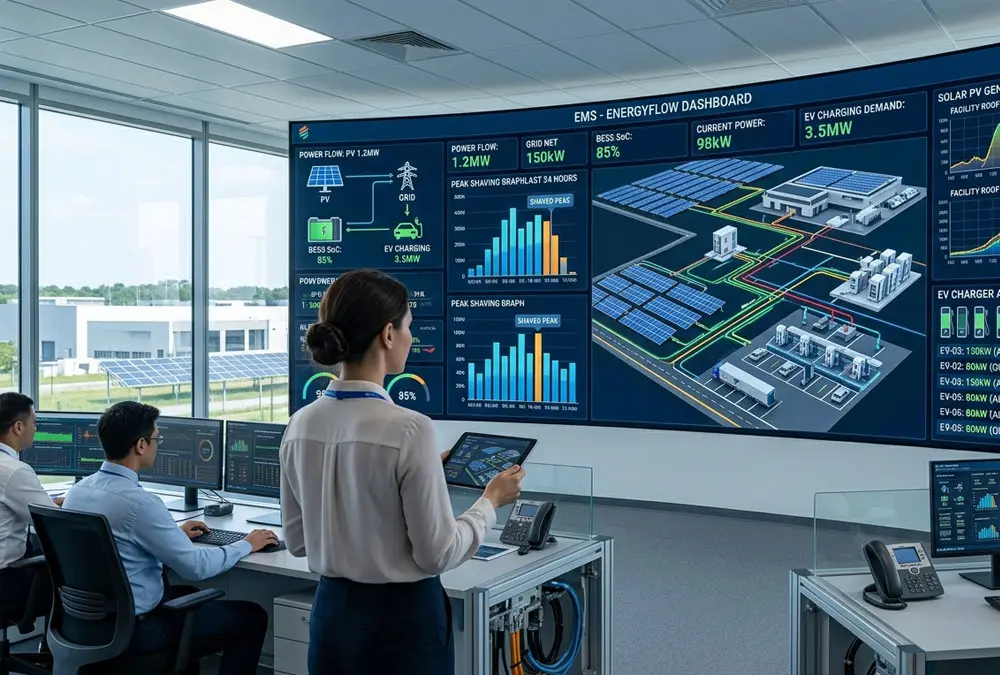
Energy Management System (EMS)
The intelligent software brains of the entire architecture. An advanced Energy Management System (EMS) utilizes predictive algorithms, weather forecasting data, and utility tariff schedules to execute automated, real-time energy scheduling and peak shaving optimization.
—
Challenges Facing Modern EV Charging Infrastructure
Developing high-capacity charging infrastructure forces project developers to confront major commercial and operational challenges.
Grid Capacity Limitations
High-power charging facilities can easily require megawatts of instantaneous power. In many commercial zones, local distribution transformers are already operating near capacity limits, leading to potential transformer overload and multi-year utility grid expansion delays that stall project deployment.
Growing Demand for DC Fast Charging
Consumer and fleet expectations have shifted toward ultra-fast charging requirements. Vehicles capable of accepting 150 kW, 350 kW, or even megawatt-level charging inputs mean that a multi-bay depot creates massive, concentrated power shocks on local distribution lines.
High Electricity Demand Charges
Commercial utility tariffs include steep demand charges based on the single highest peak-power consumption interval during a billing cycle. Unmanaged charging networks can cause exorbitant peak power pricing penalties, occasionally rendering the operational economics of the charging station unviable.
Remote Locations Without Grid Access
For rural charging stations, national park facilities, or long highway charging corridors, extending high-voltage distribution lines out to the site is often cost-prohibitive, leaving developers stranded without conventional utility grid access.
—
Battery Energy Storage System (BESS) Integration with Fast EV Charging Infrastructure
Deploying an integrated Solar Plus Storage architecture resolves grid limitations while amplifying site sustainability.
How BESS Supports DC Fast Charging Stations
A stationary BESS serves as an energy buffer. Instead of drawing 350 kW directly from the utility transformer during a fast-charging session, the station draws a steady, low-amperage current from the grid over time, utilizing instant power delivery from the battery system to fulfill the high-power vehicle demand safely.

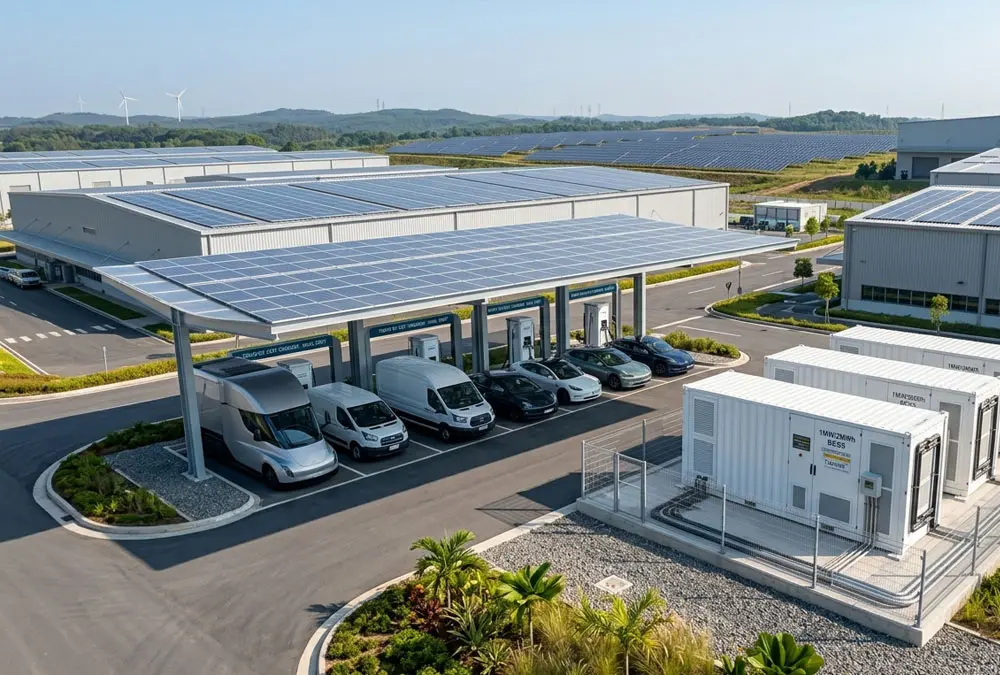
Solar Plus Storage EV Charging Architecture
The standard system consists of four primary technical layers:
- Solar PV Generation: Rooftop or custom ground-mount bifacial solar arrays coupled with high-efficiency commercial solar solutions to generate low-cost, zero-emission local energy.
- Battery Storage: Containerized, liquid-cooled industrial energy storage platforms featuring modular LFP chemistry and advanced dual-stage fire suppression systems.
- Fast Charging Equipment: Multi-protocol DC fast chargers (CCS, NACS, MCS) capable of dynamic power sharing across connected vehicles.
- Smart EMS Control Platform: A localized microgrid edge-controller that constantly optimizes power flow between the solar array, the BESS, the grid, and the charging vehicles based on real-time economic parameters.
Microgrid-Based EV Charging Solutions
By blending distributed energy resources (DERs) into unified Microgrid Solutions, charging infrastructure can operate in complete off-grid isolation or as highly resilient hybrid energy systems that protect critical transport fleets from wider grid blackouts.
—
Common Technologies Used in Battery Energy Storage Systems
Understanding the specific chemical and technical characteristics of different core technologies is vital for selecting appropriate commercial equipment.
Lithium Iron Phosphate (LFP) Batteries
LFP ($LiFePO_4$) has become the gold standard for stationary energy storage integration. Unlike alternative chemistries, LFP offers an exceptionally long cycle life (often exceeding 6,000 to 8,000 cycles at 80% Depth of Discharge) and enhanced safety due to a high thermal runaway threshold ($270^\circ\text{C}$ vs $210^\circ\text{C}$ for standard cobalt formulations). It does not suffer from oxygen-releasing decomposition phases during high-temperature anomalies.
Nickel Manganese Cobalt (NMC) Batteries
NMC ($LiNiMnCoO_2$) batteries provide significantly higher volumetric energy density compared to LFP. This makes them ideal for space-constrained urban vaults. However, they require highly sophisticated, multi-tiered liquid cooling systems and intensive BMS thermal tracking to manage their narrower safe operating windows during rapid charging and discharging states.
Flow Battery Technology
Flow systems, such as Vanadium Redox Flow Batteries (VRFB), store chemical energy in external liquid electrolyte tanks. Because the power rating (kW) and energy capacity (kWh) are decoupled, they represent excellent long-duration storage alternatives for multi-hour fleet charging. They feature virtually zero cyclic degradation over 20+ years, though they exhibit lower round-trip efficiency ($\approx 65\text{–}75\%$) compared to lithium chemistries ($\approx 85\text{–}92\%$).
Advanced Energy Management Systems (EMS)
Modern EMS platforms go beyond simple logic controllers; they leverage cloud-based AI optimization engines. By running real-time predictive energy control models, these systems forecast upcoming fleet schedules, anticipate regional weather patterns affecting solar yield, and bid available battery capacity into grid ancillary markets when chargers are empty.
Power Conversion Systems (PCS)
The latest generation of PCS hardware integrates grid-forming capabilities. Unlike standard grid-following inverters that require an existing voltage reference to operate, grid-forming bidirectional PCS units can independently establish local voltage and frequency, allowing seamless transitions into islanded microgrid mode during utility outages.
—
Industrial Product Recommendation for High-Power EV Charging
For industrial facilities, manufacturing plants, and fleet depots seeking high-duty cycle integration, selecting pre-engineered, modular hardware is crucial. We highly recommend specifying industrial-grade, liquid-cooled, all-in-one containerized BESS enclosures for these environments.
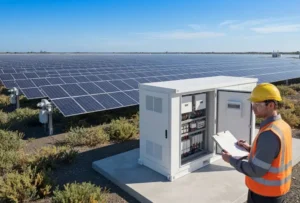
Leading industry solutions, such as the Tesla Megapack 2XL or the CATL EnerOne / EnerC series, are ideal choices. These systems integrate LFP cell configurations, bidirectional grid-forming PCS units, liquid thermal management systems, and master-level EMS controls inside a single, weather-sealed IP55/NEMA 3R enclosure. This integrated architecture dramatically simplifies on-site construction requirements for your Solar EPC contractor, significantly reduces field wiring errors, and ensures full compliance with rigid safety standards like UL 9540.
—
Key Benefits of Battery Energy Storage for EV Charging Stations
Deploying a decentralized utility scale solar project or commercial solar infrastructure integrated with storage yields clear operational advantages:
| Operational Challenge | Conventional Approach (Grid Only) | Solar Plus Storage Integrated Solution | Primary Business Benefit |
|---|---|---|---|
| High Peak Demand Charges | Pay expensive, unmanaged time-of-use (TOU) utility demand penalties. | Automated peak shaving and load shifting via smart EMS tracking. | Reduces operational electricity costs by up to 40-60%. |
| Grid Infrastructure Constraints | Pay for multi-million dollar substation and transformer upgrades. | BESS acts as a power buffer, drawing low, continuous grid power. | Avoids massive CAPEX; bypasses long utility interconnection delays. |
| Ultra-Fast Charging Support | Limited by local distribution line limits (e.g., restricted to 50kW). | Instantaneous high-amperage delivery (150kW – 350kW+) from storage. | Enables true ultra-fast charging capabilities anywhere on site. |
| Power Resiliency & Reliability | Total site shutdown during utility grid blackouts. | Seamless islanding capabilities with grid-forming PCS. | Guarantees continuous operation for critical transport fleets. |
—
Economic Benefits of Energy Storage Systems in Fast Charging Applications
Investing in integrated renewable energy infrastructure is a highly calculated capital deployment backed by clear, measurable financial benefits.
Reducing Electricity Costs
By leveraging time-of-use arbitrage, the system instructs the battery storage unit to charge from the grid when rates are lowest or directly captures localized excess solar output. This energy is then discharged into EVs during peak billing windows, mitigating high demand charges.
Deferring Grid Infrastructure Investments
According to recent utility economic consensus reports, upgrading a standard commercial distribution transformer to handle a multi-megawatt charging hub can cost anywhere from $250,000 to over $1.5 million. Implementing a containerized BESS significantly lowers immediate CAPEX and allows faster project deployment timelines.
Creating New Revenue Streams
When charging station utilization is low, the asset can participate in utility-sponsored demand response programs, supply reactive power support, or engage in automated energy trading within wholesale power markets via a localized virtual power plant (VPP) framework.
Improving Project ROI
A rigorous payback period analysis demonstrates that while initial capital equipment costs are higher, the sharp drop in monthly utility operational costs leads to a rapid amortization of the initial investment. Evaluating the complete Total Cost of Ownership (TCO) reveals that a properly managed BESS delivers high lifetime value, lasting over fifteen years of steady operational performance.
—
Solar EPC and BESS EV Charging Solutions: Real-World Applications
Integrated energy configurations perform exceptionally well across a wide range of standard commercial use cases.
EV Charging in Remote or Off-Grid Locations
In heavy industrial mining sites, remote eco-resorts, or long-distance highway charging corridors, expanding standard high-voltage utility lines is often logistically impossible. By engineering an off-grid system consisting of high-yield solar PV arrays, a containerized LFP BESS, and automated diesel replacement generation, operators establish complete energy independence while eliminating high fuel transportation logistics costs.
Urban Fast Charging Stations
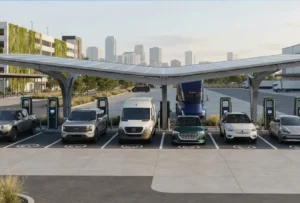
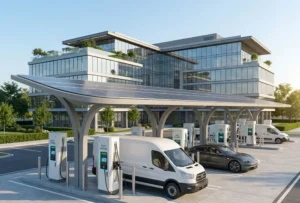
Urban charging networks frequently struggle with severe grid congestion and tight physical space constraints. Deploying architectural solar canopies over parking bays linked to compact, liquid-cooled battery storage systems provides immediate power buffering. This configuration enables ultra-fast charging access in densely populated business districts without requiring disruptive, large-scale utility street excavations.
Fleet Charging Depots
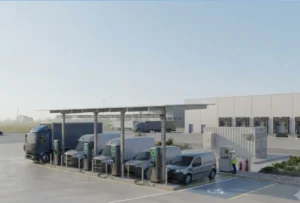
For municipal transit authorities operating electric buses or logistics companies managing large delivery fleets, maintaining precise, predictable charging schedules is essential for operational uptime. Integrating a dedicated utility-scale BESS EPC solution allows operators to manage large-scale overnight block charging, significantly reduce overall fleet operating costs, and protect vital transport assets from localized grid distribution failures.
—
Challenges and Considerations for Solar Plus Storage EV Charging Projects
Successful execution requires addressing several key technical risks early in the project design phase.
Battery System Sizing
Undersizing a battery system leads to early capacity exhaustion and high peak demand charge penalties, while oversizing ties up unnecessary capital. Engineers use advanced load forecasting models to calculate optimal capacity planning based on vehicle arrival patterns, seasonal temperature variations, and solar generation curves.
Safety and Compliance Requirements
Deploying large-scale stationary energy storage assets requires strict adherence to international safety standards. Systems must be certified under UL 9540 (standard for energy storage systems and equipment), comply with IEC 62619 for safety of lithium cells, and fully satisfy NFPA 855 (standard for the installation of stationary energy storage systems) to manage spatial separation and thermal safety requirements.
System Integration Complexity
Achieving stable operation requires seamless communication across multi-vendor components. If the local BMS, master EMS coordination layer, and bidirectional PCS compatibility protocols fail to sync perfectly, system efficiency drops, leading to communication lag and potential safety shutdowns.
Project Economics
Balancing initial investment capital with future financial returns is key. Successful financial modeling requires careful long-term battery replacement planning, factoring in natural electrochemical degradation over a 10-year or 15-year operational lifecycle.
—
How to Choose the Right Solar EPC Contractor for EV Charging Infrastructure
Selecting an experienced, Tier-1 turnkey partner is the single most critical factor determining long-term asset profitability and safety.
- Evaluate EPC Experience: Review the provider’s track record across solar installations, deep high-voltage BESS projects, and direct high-power EV charging deployments.
- Assess Technical Capabilities: Ensure the contractor possesses deep internal expertise in multi-layer EMS software programming, grid integration services, and microgrid solutions.
- Review Project References: Request verified case studies detailing completed commercial projects or utility-scale solar farms operating under similar grid conditions.
- Understand Long-Term Support Services: Confirm the contractor provides robust, multi-year Operations and Maintenance (O&M) support, remote scada monitoring, and comprehensive warranty management.
—
The Future of Battery Energy Storage Systems (BESS) for EV Charging
Looking ahead toward 2030, the energy landscape is shifting rapidly, driven by deep technical innovations.
The rise of integrated solar plus storage charging stations will accelerate as local zoning boards increasingly mandate localized self-consumption models. Simultaneously, Vehicle-to-Grid (V2G) technology will enable stationary BESS platforms to work alongside connected EV fleets, transforming parked vehicles into active decentralized storage networks. AI-powered energy management systems will automate complex energy trading, while next-generation megawatt charging systems (MCS) will support ultra-fast refueling for long-haul commercial fleets. Ultimately, integrating these assets with smart grids via Virtual Power Plants (VPPs) will enable charging network operators to provide critical grid stabilization services, turning a standard fleet asset into a highly profitable clean energy node.
—
FAQ – Solar EPC and Battery Energy Storage for EV Charging
Can battery storage reduce EV charging costs?
Yes. Battery storage can charge during off-peak periods and discharge during peak hours, significantly reducing electricity demand charges and operational costs.
How large should a battery storage system be for a fast charging station?
The required size depends on charger power, charging frequency, peak demand, and available grid capacity. Most commercial fast charging sites deploy systems ranging from 100kWh to several MWh.
Can solar panels and battery storage power EV charging stations completely off-grid?
Yes. In remote locations, solar PV combined with BESS and intelligent EMS can provide reliable off-grid EV charging without utility grid access.
What is the ROI of a Solar Plus Storage EV Charging project?
Depending on electricity tariffs, utilization rates, and incentives, payback periods typically range from 3 to 8 years.