Introduction
The global transition toward high-density power solutions has made the Liquid Cooling Energy Storage System the gold standard for thermal management in 2026. As renewable energy integration accelerates, the limitations of traditional air-cooling—such as uneven cell temperatures and thermal runaway risks—have forced a pivot toward more sophisticated cooling architectures. A Liquid Cooling Energy Storage System provides a 30% higher heat dissipation efficiency compared to air-cooled alternatives, ensuring that battery clusters operate within the optimal temperature “sweet spot” of 20°C to 30°C. In this comprehensive guide, we will analyze why liquid-cooled Battery Energy Storage Systems (BESS) are essential for modern grids, their intricate internal structure, and how they maximize ROI for commercial and utility-scale projects.
Introduction: Why Liquid Cooling Energy Storage Systems Are Becoming Essential
In the 2026 energy landscape, the demand for high-density energy storage has never been higher. However, as manufacturers squeeze more kilowatt-hours (kWh) into smaller footprints, thermal management becomes the primary bottleneck.
Rising Demand for High-Density Battery Energy Storage
Modern industrial applications and utility-scale solar farms now require storage containers to exceed 5MWh in a standard 20-foot footprint. This density generates significant heat during rapid charge and discharge cycles (high C-rates).
Challenges of Traditional Air-Cooled Systems
- Thermal Runaway Risks: Air cooling often fails to prevent localized “hot spots,” which are the leading cause of fire propagation in lithium-ion racks.
- Uneven Temperature Distribution: In air-cooled systems, the temperature difference between the front and back of a battery rack can exceed 5°C, leading to uneven aging.
- Reduced Battery Lifespan: For every 10°C rise above the ideal operating temperature, the chemical life of a Lithium Iron Phosphate (LFP) battery is roughly halved.
Common User Concerns About Liquid Cooling
Many operators ask: Is liquid cooling safer than air cooling? The answer is a definitive yes. By utilizing a closed-loop coolant circulation system, heat is removed directly from the cell surface or module plate, preventing the heat accumulation that leads to catastrophic failure. Furthermore, while the initial CAPEX is higher, the Liquid Cooling Energy Storage System significantly reduces degradation, often extending the system’s operational life by 2–3 years.
Featured Snippet:
Liquid cooling energy storage systems use coolant circulation to efficiently control battery temperature, improving safety, energy efficiency, and battery lifespan by maintaining cell temperature uniformity within ±3°C.
What Is a Liquid Cooling Energy Storage System?
A Liquid Cooling Energy Storage System is a thermal management architecture that uses a liquid medium (typically a water-glycol mixture or dielectric fluid) to transfer heat away from battery cells.
How Liquid Cooling Technology Works
The system operates on the principle of high thermal conductivity. Liquid has a heat capacity approximately 4 times higher than air and a thermal conductivity that is nearly 25 times greater. The coolant is pumped through cold plates that are in direct contact with the battery modules. As the coolant absorbs heat, it is circulated to an external heat exchanger or chiller, where the heat is rejected into the atmosphere before the cooled liquid returns to the cycle.
Core Components of a Liquid Cooling System
- Battery Packs: High-capacity LFP cells arranged in series-parallel configurations.
- Cooling Plates & Pipelines: Precision-engineered aluminum plates with internal flow channels.
- PCS (Power Conversion System): Converts DC from batteries to AC for the grid.
- BMS (Battery Management System): The “brain” that monitors cell voltage and temperature.
- EMS (Energy Management System): High-level software that optimizes dispatch and thermal cycles.
- Thermal Management Unit (TMU): Includes the pump, expansion tank, and chiller/heater.
Advantages of Liquid Cooling Energy Storage Systems
1. High-Efficiency Heat Dissipation
Liquid cooling provides a much faster heat transfer process. During frequency regulation tasks where batteries cycle rapidly, air cooling cannot keep up with the instantaneous heat surge. Liquid systems maintain stable conditions even during 1C or higher discharge rates.
2. Uniform Temperature Distribution
Temperature consistency is the “Holy Grail” of battery engineering. A Liquid Cooling Energy Storage System can keep the temperature difference between any two cells in a containerized system within 3°C. This consistency prevents “weak link” cells from aging faster than the rest of the pack.
3. Improved Safety and Thermal Runaway Prevention
According to the 2026 Global BESS Safety Report, liquid-cooled systems have shown a 40% reduction in fire incidents compared to air-cooled systems in high-ambient-temperature regions. The coolant acts as a thermal buffer, absorbing excess energy before it can trigger a chain reaction.
4. Smaller Footprint and Higher Energy Density
Because liquid cooling is so efficient, battery cells can be packed more tightly without the need for large air gaps or heavy-duty fans. This allows for up to 50% higher energy density per square meter, which is critical for urban data centers and space-constrained industrial sites.
Structure and Design of a Liquid Cooling Energy Storage System
The design of a Liquid Cooling Energy Storage System requires meticulous engineering to ensure zero leaks and maximum flow efficiency.
Battery Module Structure
Each battery rack consists of multiple modules. Between these modules (or integrated into the module base) are the Integrated Cooling Plates. These plates are usually made of brazed aluminum to maximize thermal contact with the cells.
Liquid Cooling Circuit Design
The hydraulic circuit is designed to ensure “equal flow” to every module. This is often achieved through a manifold system:
- Main Inlet/Outlet Pipes: Distribute coolant to each rack.
- Branch Pipes: Direct the flow to individual cold plates.
- Valves & Sensors: Monitor pressure and flow rates to detect potential leaks early.
Intelligent BMS and EMS Integration
In 2026, the integration of AI into the Energy Management System (EMS) allows for “Predictive Cooling.” The system analyzes upcoming weather data and grid demand to pre-cool the battery racks before a high-load event occurs.
Applications of Liquid Cooling Energy Storage Systems
As we move into 2026, the versatility of this technology has allowed it to dominate several key sectors:
Large-Scale Battery Energy Storage Power Stations
Utility-scale BESS projects (100MWh+) almost exclusively use liquid cooling to ensure grid stability and manage the massive thermal loads of grid-balancing services.
Commercial and Industrial (C&I) Energy Storage
For factories and large retail complexes, a Liquid Cooling Energy Storage System is used for Peak Shaving and Demand Charge Reduction. By discharging during peak hours, businesses avoid high utility tariffs.
Industrial Storage Product Recommendation: BESS-I Series
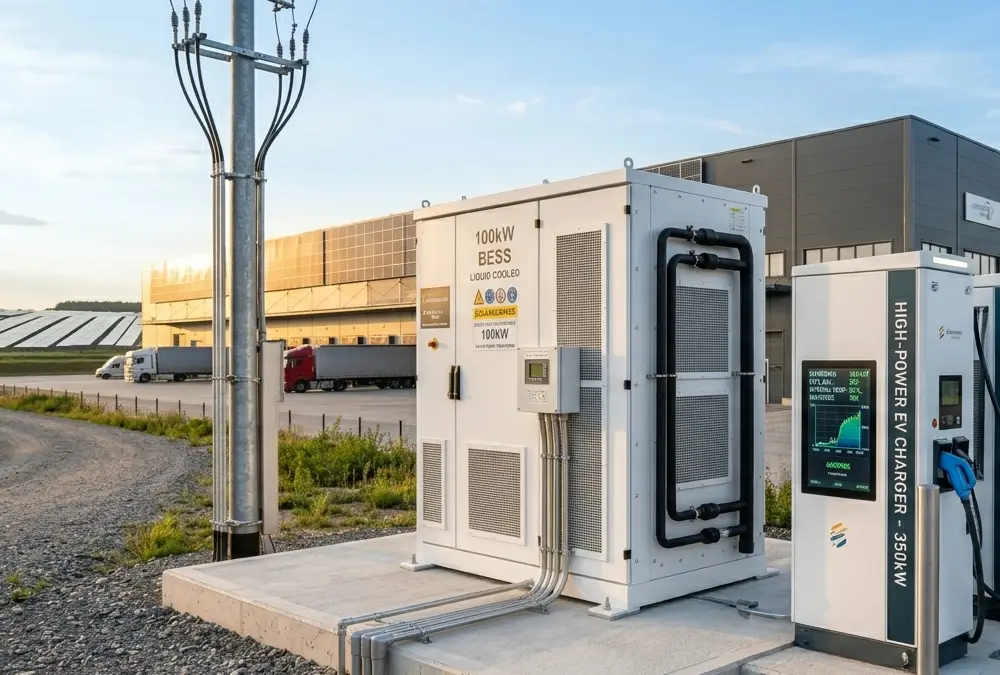
For industrial users, we recommend the BESS-I 215kWh Liquid-Cooled Cabinet. This unit integrates the PCS, BMS, and liquid cooling TMU into a single outdoor-rated enclosure. It is ideal for EV charging stations and manufacturing plants requiring reliable backup power.
Data Centers and Critical Infrastructure
Data centers require 99.999% uptime. The low-noise and high-reliability nature of liquid cooling makes it the preferred choice for UPS (Uninterruptible Power Supply) applications where thermal stability is a non-negotiable requirement.
How Liquid Cooling Improves Battery Cooling Efficiency
To understand the superiority of liquid systems, we must look at the physical properties of the cooling mediums.
Liquid Cooling vs Air Cooling Efficiency Comparison (2026 Data)
| Feature | Liquid Cooling | Air Cooling |
| Thermal Conductivity | ~0.6 W/(m·K) | ~0.026 W/(m·K) |
| System Efficiency | 98.5% | 96.0% |
| Temp. Uniformity | < 3°C | 5°C – 10°C |
| Auxiliary Power Loss | 2% – 3% | 5% – 8% |
| Noise Level | < 65 dB | 75 – 85 dB |
| Space Utilization | High (Compact) | Medium (Requires Air Gaps) |
Industry Insight 2026: A report by BloombergNEF highlights that as of early 2026, over 75% of new utility-scale energy storage tenders specifically mandate liquid cooling technology to meet stricter safety and longevity requirements.
Technical Analysis: Calculations and Battery Technology
Energy Efficiency Calculation
To calculate the efficiency gain of a Liquid Cooling Energy Storage System, we look at the auxiliary power consumption ($P_{aux}$).
Total System Efficiency = (Energy Discharged / Energy Charged) * (1 - P_aux/P_total)
In liquid systems, $P_{aux}$ is significantly lower because a pump moving liquid is more energy-efficient than high-RPM fans moving large volumes of air to achieve the same thermal delta.
Battery Technology: LFP and Alternatives
Most current systems utilize Lithium Iron Phosphate (LFP) due to its high thermal stability. However, 2026 is seeing the rise of Sodium-Ion Batteries and Solid-State Batteries as alternatives.
- Sodium-Ion: Lower cost and excellent low-temperature performance, though lower energy density.
- Solid-State: Theoretically the safest option, eliminating flammable liquid electrolytes entirely.
Is Liquid Cooling Energy Storage Worth the Investment?
Lifecycle Cost and ROI Analysis
While the initial purchase price of a Liquid Cooling Energy Storage System is roughly 15% to 20% higher than an air-cooled system, the Total Cost of Ownership (TCO) is lower.
- Extended Lifespan: By keeping cells 5°C cooler on average, the system lifespan increases from 8 years to 10+ years.
- Reduced Maintenance: Closed-loop systems are protected from dust and humidity, common killers of air-cooled fans and filters.
- Higher Round-Trip Efficiency (RTE): Higher RTE means more of your stored energy is available to sell back to the grid, improving the Energy Arbitrage revenue.
2026 Market ROI Projection
For a typical 2MWh industrial project, the transition from air to liquid cooling results in an estimated Internal Rate of Return (IRR) increase of 2.5% over a 10-year period, primarily due to lower degradation rates and higher system availability.
Future Trends in Liquid Cooling Energy Storage Technology
The industry is not standing still. By the end of 2026, we expect to see:
- AI-Driven Thermal Management: Machine learning models that adjust flow rates based on real-time cell aging data.
- Immersion Cooling: Submerging battery cells directly in dielectric fluid for the ultimate thermal interface.
- V2G Integration: Using the liquid cooling systems of parked Electric Vehicles to supplement grid-side energy storage thermal management.
FAQs About Liquid Cooling Energy Storage Systems
Is liquid cooling safer than air cooling?
Yes. It provides superior temperature control, prevents hot spots, and reduces the risk of thermal runaway propagation.
Does liquid cooling improve battery lifespan?
Yes. By maintaining a uniform and optimal temperature, it slows down the chemical degradation of the battery cells, often adding 20% to the total cycle life.
Is liquid cooling suitable for commercial energy storage?
Absolutely. It is the best choice for high-density systems and environments with high ambient temperatures where air cooling is ineffective.
Does liquid cooling require more maintenance?
While it involves pumps and coolants, modern systems are largely “maintenance-free” for the first 5 years, requiring only periodic fluid checks and sensor calibrations.
Liquid Cooling Energy Storage System: Key Takeaways
- Main Advantage: High-efficiency thermal management and superior safety.
- Best Application: Utility-scale, high-density industrial, and data center projects.
- Core Technologies: Liquid cold plates, intelligent BMS, and integrated EMS.
- Value Proposition: Higher ROI through extended battery life and increased efficiency.
Conclusion: Why Liquid Cooling Is the Future
The Liquid Cooling Energy Storage System is no longer a luxury—it is a functional necessity for the modern energy grid. As we look ahead through 2026, the push for higher C-rates, better safety standards, and maximized energy density makes liquid cooling the only viable path for large-scale BESS. By investing in liquid-cooled technology today, operators are securing their assets against the thermal challenges of tomorrow, ensuring a more resilient and profitable energy future.