Introduction
As the global transition to clean energy intensifies, modern enterprises are expanding beyond simple power generation to implement highly dynamic, integrated energy ecosystems. For commercial and industrial (C&I) facility owners, utilities, and infrastructure developers, deploying multi-megawatt photovoltaic assets presents deep structural and electrical complexities. Maximizing long-term asset value requires partnering with a Tier-1 Solar EPC Company capable of synchronizing high-output solar arrays with high-capacity Battery Energy Storage System (BESS) installations and fast EV charging infrastructure. This comprehensive guide details the critical considerations for choosing an execution partner, optimizing procurement supply chains, managing lifecycle project risks, and evaluating the technical frameworks necessary to secure high asset returns.
What Is a Solar EPC Company?
Featured Snippet Answer:
A Solar EPC Company provides Engineering, Procurement, and Construction services for solar energy projects. The company is responsible for system design, equipment sourcing, project construction, commissioning, and delivery, ensuring the solar plant meets performance, budget, and timeline requirements.
Definition of Solar EPC (Engineering, Procurement and Construction)
The term EPC represents a standard comprehensive project delivery model utilized throughout complex infrastructure industries. In renewable energy development, a turnkey Solar EPC Company provides full end-to-end liability management. This single-point contract model shifts all execution risk—including architectural PV system design, sub-vendor supply chain management, civil works, utility grid connection services, and performance testing—away from the project owner and onto the contractor. The asset is delivered fully integrated, tested, and operational (“turnkey”) to the client upon final commissioning.
What Types of Solar Projects Require a Solar EPC Company?
- Commercial Rooftop Solar: Structural optimization and distributed energy architecture built for factory spaces, distribution warehouses, and large-scale corporate real estate.
- Industrial Solar Projects: High-voltage systems tailored to supply power directly to energy-intensive industrial processing facilities, chemical plants, and data centers.
- Ground-Mounted Solar Farms: Multi-megawatt fixed-tilt or single-axis tracker developments built across expansive acreage, requiring rigorous civil engineering and land preparation.
- Utility-Scale Solar Power Plants: Massive public utility energy assets constructed directly for regional Independent Power Producers (IPPs) to feed power directly into high-voltage transmission lines.
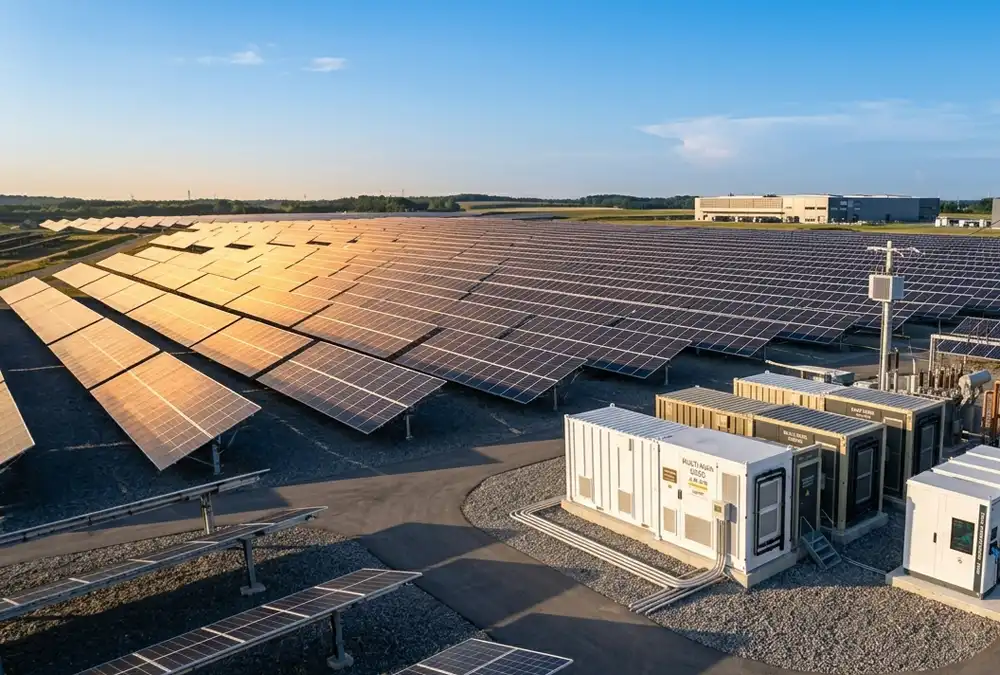
- Solar Plus Storage Projects (BESS): Advanced hybridized generation facilities coupling high-power solar arrays with stationary commercial energy storage systems to support grid stability or rapid fleet electrification.
Who Typically Hires a Solar EPC Contractor?
Industrial solar project developers, corporate sustainability executives, manufacturing plant owners, utility operators, and independent infrastructure funds require professional Solar EPC Contractor services. These stakeholders look to optimize capital expenditures (CAPEX), guarantee tight project timelines, secure definitive equipment performance warranties, and ensure total compliance with strict local regional interconnection regulations.
—
Why Solar EPC Services Are Critical for Project Success
Large-scale solar engineering involves managing complex, interconnected variables where minor planning errors can lead to cascading delays, severe structural degradation, or prolonged utility grid rejection.
Reducing Project Risks Through EPC Management
By using an integrated execution model, project owners gain unambiguous single-point accountability. Rather than managing separate architectural teams, independent equipment vendors, and localized electrical sub-contractors, the project owner works through a unified point of contact. This tight organizational structure streamlines stakeholder coordination, prevents miscommunication between engineering designs and physical field installations, and significantly reduces the construction delays that commonly impact fragmented multi-vendor projects.
Ensuring Budget and Schedule Control
A premier Solar EPC Company brings institutionalized project management systems to the site. This includes comprehensive cash-flow forecasting, multi-tiered procurement planning, and expert construction supervision. Through established global supply chains, an EPC provider locks in tier-1 component pricing early, shielding the developer from unexpected commodity price spikes and logistics volatility.
Maximizing Solar Plant Performance
Long-term project profitability depends heavily on initial engineering choices. Experienced EPC partners design custom layouts optimized for localized weather, shifting shadow profiles, and site-specific topography. Sizing string layouts correctly, optimizing tracking algorithms, and selecting matching high-efficiency inverters helps maximize real-world performance ratios and prevents premature asset degradation over decades of continuous operation.
Engineering Procurement and Construction: The Three Pillars of Solar EPC
Engineering Design in Solar EPC Projects
Industrial engineering requires comprehensive site assessments and precise technical specifications long before any ground is broken.
Site Assessment and Feasibility Study
Engineers evaluate geological soil core samples, perform 3D topographical laser scans, run shade analysis using advanced software, and analyze historic meteorological datasets to model accurate solar irradiance expectations.
PV System Design
This phase optimizes panel spacing, tilt angles, and electrical string configurations. Selecting between bifacial modules or active single-axis tracking systems depends heavily on a site’s specific spatial profile and long-term energy goals.
Electrical Engineering Design
Engineers develop detailed single-line diagrams (SLDs), map high-voltage cable routing paths, size DC/AC distribution boxes, design grounding fields, and specify transient surge protection networks.
Grid Connection Design
EPC teams engineer dedicated substation interfaces, step-up transformers, and protection coordination networks to meet utility interconnection demands, power factor constraints, and telemetry requirements.
Solar Plus Storage Integration Design
For hybrid microgrids, teams design complex electrical balance-of-system networks that connect photovoltaic arrays directly to high-capacity battery units via specialized DC-coupled or AC-coupled topologies.
Procurement in Solar EPC Projects
Strategic sourcing requires securing tier-1 technology while optimizing logistical delivery timelines.
Solar Modules
EPCs leverage direct manufacturer agreements to purchase high-power N-type TOPCon or HJT monocrystalline modules from globally certified tier-1 manufacturers, ensuring multi-decade linear performance warranties.
Solar Inverters
Sourcing smart central or decentralized string inverters featuring high-efficiency multi-MPPT tracking, advanced grid-support features, and rapid-shutdown safety mechanisms.
Mounting Structures
Procuring heavy-duty, corrosion-resistant galvanized steel or anodized aluminum racking structures engineered to withstand extreme regional wind loads and seismic requirements.
Battery Energy Storage Systems (BESS)
Procuring scalable, liquid-cooled lithium iron phosphate (LFP) containers, complete with integrated thermal management systems and advanced fire protection.
Balance of System (BOS) Components
Bulk procurement of cross-linked solar cabling, heavy-duty outdoor switchgear, combiners, fuses, and digital SCADA monitoring hardware.
Construction Services in Solar EPC
On-site execution transforms theoretical blueprints into high-performing physical power assets.
Civil Works
Site preparation, land clearing, grading, drainage channel excavation, road construction, and driving deep steel pile foundations into the ground.
Mechanical Installation
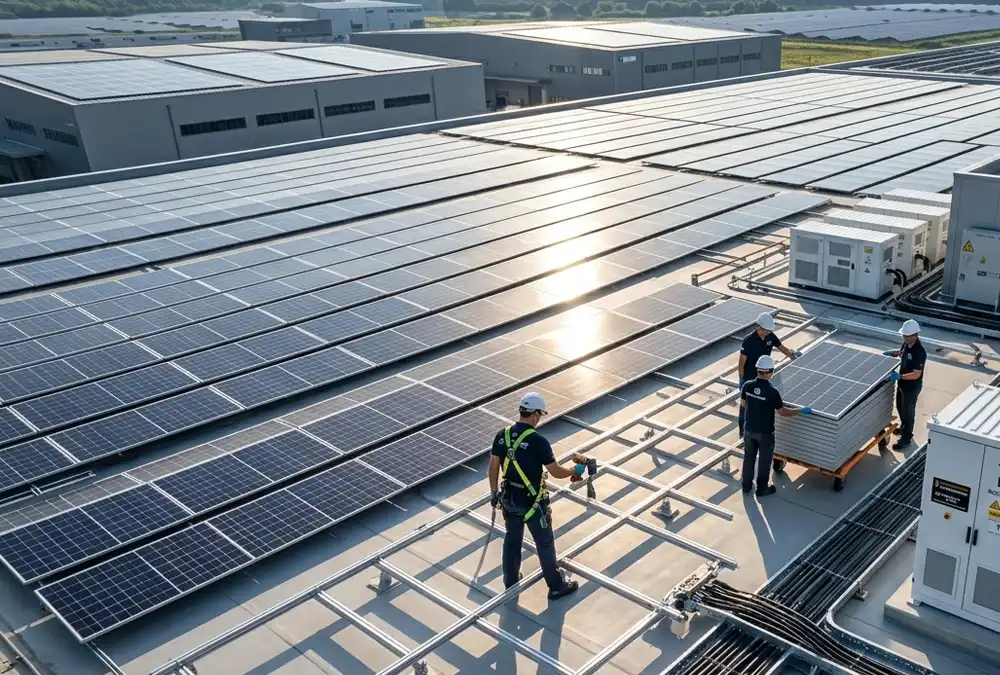
Assembling structural steel racking networks, tracking drive-arms, and manually mounting thousands of photovoltaic modules to design tolerances.
Electrical Installation
Low-voltage and medium-voltage cable trenching, combiner box installation, DC string wiring, inverter integration, and high-voltage transformer hookups.
Testing and Commissioning
Performing stringent insulation resistance checks, I-V curve trace analysis, thermal imaging scans, protective relay testing, and final utility cold/hot commissioning validation.
—
Solar EPC Company Roles and Responsibilities Throughout the Project Lifecycle
A professional Solar EPC Company provides full accountability across every stage of development:
- Project Planning and Feasibility Analysis: Reviewing financial models, evaluating environmental impacts, and running energy generation simulations to prove long-term economic viability.
- Permitting and Regulatory Compliance: Managing complex local structural, environmental, FAA, and electrical building approvals alongside utility interconnection agreements.
- Equipment Procurement and Logistics Management: Managing international shipping schedules, customs clearance, and secure on-site storage to eliminate field implementation downtime.
- Construction Management: Directing sub-contractor teams, enforcing strict OSHA safety protocols, and conducting daily quality assurance inspections.
- Performance Testing and Commissioning: Verifying actual system output metrics against contractual baselines using standard international criteria.
- Project Handover and Documentation: Delivering full as-built electrical schematics, operational manuals, component warranties, and localized staff training packages.
—
Solar EPC Process Explained Step by Step
Following a standardized execution process ensures clear milestone visibility and predictable project delivery timelines.
- Step 1 – Project Inquiry and Requirement Assessment: Initial discovery meetings to define the client’s energy consumption goals, operational budget, and site constraints.
- Step 2 – Site Survey and Feasibility Study: Physical on-site inspections evaluating structural roof capacity, soil mechanics, and proximity to local utility connection points.
- Step 3 – Preliminary Engineering Design: Generating initial 3D solar layouts, estimating potential generation capacity, and determining optimal component matching.
- Step 4 – Budget Estimation and Proposal Submission: Delivering transparent, itemized commercial quotes covering complete CAPEX, projected levelized cost of energy (LCOE), and ROI timelines.
- Step 5 – EPC Contract Negotiation: Finalizing technical scopes of work, scheduling binding completion dates, establishing payment milestones, and confirming performance guarantees.
- Step 6 – Procurement and Supply Chain Management: Ordering raw materials, coordinating factory inspections, and managing secure logistics delivery to the site.
- Step 7 – Construction and Installation: Executing civil, mechanical, and high-voltage electrical engineering works under strict quality control supervision.
- Step 8 – Commissioning and Performance Testing: Rigorous system testing, safety verification, and acquiring final utility Permission to Operate (PTO).
- Step 9 – Project Acceptance and Final Payment: Asset handover to the owner, delivering as-built documentation, and initiating operations and maintenance (O&M) protocols.
—
Solar EPC Contract Models: EPC vs EPCM and Other Delivery Approaches
Choosing the right contractual framework establishes how project execution risks and liabilities are shared between the owner and the developer.
What Is a Traditional EPC Contract?
Often referred to as a “Lump Sum Turnkey” (LSTK) contract, the traditional EPC model places full execution accountability on a single partner. The contractor guarantees a fixed price and a fixed completion date, assuming direct liability for any cost overruns or construction delays.
Benefits: Absolute price certainty, minimal management effort for the owner, and clear performance guarantees backed by contractual liquidated damages.
Limitations: Higher initial risk premium included in the contractor’s pricing, and less direct owner input into specific minor sub-vendor selections.
What Is EPCM (Engineering, Procurement and Construction Management)?
Under an EPCM framework, the contractor acts purely as a professional consultant and project manager representing the owner. The owner signs separate, direct procurement and construction contracts with various sub-vendors, while the EPCM firm manages the coordination of those entities.
Benefits: Increased flexibility for design modifications during construction, full transparency over actual material costs, and direct control over sub-vendor selection.
Limitations: The project owner assumes all final cost and schedule risks, and managing multiple contracts requires significant internal administrative resources.
EPC vs EPCM: Key Differences
| Comparison Area | Turnkey Solar EPC Model | EPCM Management Model |
|---|---|---|
| Primary Responsibility | Single entity holds full execution liability | Contractor advises; owner holds sub-contracts |
| Cost Overrun Risk | Assumed entirely by the Solar EPC Company | Assumed entirely by the Project Owner |
| Schedule Delays Risk | Contractor faces liquidated damages (LDs) | Owner bears costs of extended timelines |
| Owner Management Involvement | Low – single point of contract reporting | High – active multi-vendor administration |
Which Contract Model Is Best for Your Solar Project?
For most commercial and industrial enterprises looking to deploy capital efficiently without adding internal engineering overhead, the traditional turnkey **Solar EPC contract** is highly recommended. It offers maximum budget certainty and protects the corporate balance sheet from unexpected project execution risks. The EPCM model is typically reserved for large-scale utilities or experienced independent power producers who maintain dedicated internal engineering departments.
—
Solar EPC Pricing and Cost Drivers
Developing commercial solar solutions requires a clear understanding of the underlying variables that impact capital expenditures.
How Much Does a Solar EPC Project Cost?
According to comprehensive industry cost benchmarks from reports like the NREL Solar Market Insight, utility-scale ground-mounted projects range from $0.85 to $1.20 per watt DC. Industrial rooftop installations typically average $1.15 to $1.65 per watt DC, depending on structural layout complexities, localized labor rates, and the proximity of the distribution interconnection points.
Major Cost Drivers in Solar EPC Projects
- Solar Modules: Typically accounts for 25% to 35% of total CAPEX, driven by international material commodity pricing (polysilicon) and shipping logistics.
- Inverters: Represents 8% to 12% of costs, varying based on whether the architecture utilizes decentralized string inverters or large central inverter blocks.
- Structural Components: Costs depend on wind load tolerances, roof tilt brackets, or whether ground systems require tracking systems.
- Labor and Civil Works: Highly variable costs tied to local prevailing wage rates, soil excavation difficulties, and site clearing demands.
- Grid Interconnection Costs: Costs depend on utility-mandated substation upgrades, high-voltage switchgear requirements, and the physical distance to the point of common coupling (PCC).
How Solar Plus Storage Impacts EPC Pricing
Integrating a modern Battery Energy Storage System (BESS) adds to initial capital expenditures but dramatically increases an asset’s long-term commercial value. Incorporating storage requires additional expenditures for bi-directional Power Conversion Systems (PCS), advanced intelligent Energy Management System (EMS) software licenses, and specialized fire suppression containment, along with deep electrical protection coordination engineering.
—
Solar EPC Quality Control Standards and Testing Requirements
Securing long-term project bankability requires maintaining strict adherence to rigorous international technical quality baselines.
Quality Assurance During Engineering Design
All structural designs must undergo peer review, and electrical schematics should be validated using advanced digital modeling software to ensure correct circuit breaker trip curves, thermal cable limits, and optimal short-circuit ratings.
Procurement Quality Inspections
EPC contractors conduct detailed quality audits directly at the manufacturing facilities. This includes checking specialized electroluminescence (EL) imagery on solar modules to catch micro-cracks before shipping and verifying factory acceptance testing (FAT) for large central inverters.
Construction Quality Control Procedures
On-site quality management includes conducting regular torque verification testing on structural racking bolts, using digital pull-out tests to verify foundation pile stability, and maintaining precise control over all cable terminations.
Commissioning and Acceptance Testing
Final system acceptance requires completing a comprehensive testing sequence, including insulation resistance validation, thermal imaging scans to detect cell hot-spots, and testing automated safety shutdowns under full load conditions.
Important Industry Standards
- IEC Standards: IEC 61215 for crystalline PV module design validation and IEC 62446 for grid-connected system documentation and testing requirements.
- UL Certifications: UL 9540 for complete energy storage systems safety, and UL 1741 for grid-interactive inverters and power conversion equipment.
- IEEE Standards: IEEE 1547 governing the strict technical interconnection requirements for connecting distributed energy resources directly to the utility grid.
- NEC Requirements: Adhering to National Electrical Code Article 690 (Solar Photovoltaic Systems) and Article 706 (Energy Storage Systems) for fire and electrical safety compliance.
—
Key Performance Indicators (KPIs) and Solar EPC Warranty Requirements
Contractual warranties must clearly define measurable metrics to guarantee real-world power production performance over time.
Performance Ratio (PR)
The Performance Ratio measures the relationship between a solar plant’s actual energy output and its theoretical maximum output under ideal conditions, independent of changing solar irradiance. Tier-1 EPC contractors typically guarantee a commissioned PR between 80% and 85%, adjusted for temperature degradation.
Specific Yield (kWh/kWp)
An essential metric that tracks total annual kilowatt-hours produced per kilowatt-peak of installed solar capacity. This KPI allows direct comparison of asset performance across different geographic regions.
System Availability
A contractually binding percentage metric (typically guaranteed at 98% or higher) that measures the total hours a solar plant is fully capable of feeding power into the utility grid, excluding force majeure events or scheduled maintenance windows.
Equipment Warranty vs EPC Warranty
Project developers should note that equipment warranties from manufacturers (e.g., 25-year linear module performance warranties, 5-to-10 year inverter warranties) are entirely separate from the EPC contractor’s workmanship warranty. The Solar EPC Contractor provides a dedicated short-term workmanship warranty (typically 2 to 5 years) covering structural installation, electrical wiring, and physical integration quality.
Performance Guarantees After Handover
To secure long-term project bankability, EPC contracts often include definitive minimum generation guarantees over the initial operational years. If the solar plant underperforms due to faulty engineering design or poor construction quality, explicit liquidated damages provisions require the contractor to financially compensate the owner for lost energy revenue.
—
Common Solar EPC Risks and How EPC Contracts Reduce Them
Large-scale solar development involves managing significant engineering, logistical, and regulatory risks.
Engineering Design Risks
Incorrect structural wind load sizing or poor site soil analysis can lead to catastrophic racking failures during extreme weather events. EPC contracts mitigate this risk by requiring comprehensive professional liability insurance and strict adherence to localized structural building codes.
Procurement Risks
Global supply chain blockages or sudden component shortages can delay construction schedules. Tier-1 contractors manage this risk by diversifying their supplier networks and utilizing pre-vetted equipment alternatives.
Construction Risks
Unforeseen subterranean rock formations or localized labor shortages can lead to significant construction cost overruns. A fixed-price turnkey contract protects the project owner by shifting these civil execution risks directly to the contractor.
Grid Connection Risks
Utility approval delays or unexpected grid compliance challenges can stall project deployment. Experienced EPC partners mitigate this by engaging local utility engineers early and initiating interconnection studies during the preliminary design phase.
—
Industrial Product Recommendation for High-Power Energy Storage
For industrial facilities, manufacturing plants, and fleet depots seeking high-duty cycle integration, selecting pre-engineered, modular hardware is crucial. We highly recommend specifying industrial-grade, liquid-cooled, all-in-one containerized BESS enclosures for these environments.
For large-scale industrial settings, we highly recommend utilizing fully integrated, liquid-cooled containerized LFP energy storage systems. These modular platforms combine battery cells, liquid thermal management networks, bidirectional grid-forming power conversion systems (PCS), and multi-tiered safety systems into a single pre-engineered enclosure. This integrated design streamlines on-site construction for your EPC partner, ensures compliance with strict safety standards like UL 9540, and delivers stable performance across high-duty-cycle industrial charging applications.
—
How to Choose the Right Solar EPC Company
Selecting an execution partner requires careful evaluation of their technical expertise, past project portfolio, and financial strength.
Evaluate Technical Expertise
Verify that the contractor maintains a dedicated in-house engineering team with deep experience in complex electrical system design, utility substation integration, and microgrid controls. Ask about their experience with specialized energy storage software, as managing active peak shaving requires advanced programming capabilities.
Review Project Portfolio
Look for a contractor with a proven track record of successfully commissioning similar commercial, industrial, or utility-scale projects. Request detailed case studies that demonstrate real-world performance matching original generation estimates over multiple years of operation.
Assess Financial Stability
Large infrastructure projects require significant upfront capital. Ensure your chosen partner possesses a strong balance sheet, solid credit ratings, and robust bankability status with major financial institutions to secure competitive project financing terms.
Verify Certifications and Compliance
Confirm the contractor holds all necessary state and regional licensing, maintains robust liability insurance coverage, and operates under certified quality and safety management systems like ISO 9001 and ISO 45001.
—
Solar EPC Company Selection Checklist
Use this evaluation checklist during your developer selection process to score prospective EPC partners across critical capabilities:
Technical Evaluation Checklist
- [ ] Maintains an experienced, certified internal electrical and civil engineering team.
- [ ] Utilizes advanced 3D simulation and shade-modeling software for layout optimization.
- [ ] Demonstrates a proven track record of successfully integrating complex BESS and microgrid components.
Commercial Evaluation Checklist
- [ ] Provides completely transparent, itemized fixed-price quotes without hidden cost exclusions.
- [ ] Offers contractually binding performance ratios and energy production guarantees.
- [ ] Demonstrates strong financial bankability status backed by verifiable credit references.
Execution Capability Checklist
- [ ] Maintains established, long-term supply agreements with certified tier-1 equipment manufacturers.
- [ ] Demonstrates a clean workplace safety record with a low Experience Modification Rate (EMR).
- [ ] Possesses extensive experience navigating regional utility grid interconnection processes.
Post-Completion Support Checklist
- [ ] Provides 24/7 automated remote SCADA performance tracking and diagnostic services.
- [ ] Offers dedicated, full-service internal Operations and Maintenance (O&M) contracts.
- [ ] Manages all aspects of component manufacturer warranty claims and rapid field servicing.
—
Project Handover and Operations & Maintenance After EPC Completion
A seamless project handover ensures that facility operations teams are fully prepared to manage the new generation asset safely and efficiently.
Upon final commissioning, the contractor delivers a complete documentation package, including comprehensive as-built electrical schematics, structural engineering certifications, equipment operation manuals, and formal warranty certificates. The engineering team conducts extensive on-site training for the owner’s maintenance staff, covering emergency shutdown procedures, safety protocols, and basic system troubleshooting. To protect the asset’s long-term performance, owners should implement a preventative maintenance program that includes regular thermal camera inspections of electrical connections, annual structural torque testing, and continuous remote SCADA tracking to quickly diagnose and resolve any performance anomalies.
—
Future Trends in Solar EPC and Solar Plus Storage Projects
Looking toward 2030, the utility and commercial solar industries are evolving rapidly through advanced technological innovation.
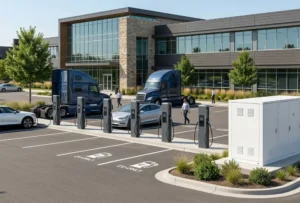
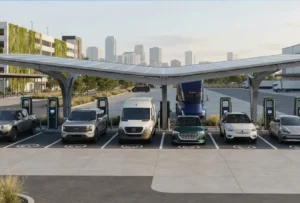
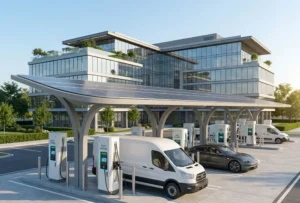
The market is shifting rapidly toward integrated Solar Plus Storage EPC projects, driven by utility mandates for localized self-consumption and grid stability support. Next-generation energy management systems are leveraging cloud-based AI optimization engines to automate energy trading, while large-scale utility battery storage installations are increasingly using grid-forming power conversion systems to provide virtual inertia and frequency regulation services. Additionally, expanding high-power EV charging networks are integrating directly with commercial solar infrastructure, turning standard parking structures into active distributed energy nodes that generate clean power, buffer grid demand, and create new corporate revenue streams.
—
FAQ About Solar EPC Companies
What does a Solar EPC Company do?
A Solar EPC Company manages the complete end-to-end lifecycle of a solar energy project, including detailed engineering design, strategic equipment procurement, full-scale site construction, final utility commissioning, and asset handover.
What is the difference between EPC and EPCM?
An EPC contractor assumes full turnkey execution, budget, and schedule liability for a project at a fixed price. An EPCM contractor acts as a professional management consultant representing the owner, while the owner directly signs separate contracts with individual equipment and construction vendors.
How do I choose the best Solar EPC Company?
Evaluate their in-house engineering capabilities, verify past project references for similar commercial or utility-scale installations, review their financial stability and bankability status, and ensure they provide robust long-term O&M support services.
Can a Solar EPC Company provide battery energy storage integration?
Yes. Leading modern Solar EPC companies specialize in delivering fully integrated Solar plus Storage solutions, managing the complete coordination of battery systems, power conversion hardware, safety networks, and intelligent energy management systems.
—
Conclusion: Why Choosing the Right Solar EPC Company Determines Project Success
Deploying large-scale solar power and energy storage is a significant multi-decade capital investment. Partnering with a professional, tier-1 Solar EPC Company ensures that your asset is engineered to high standards, built with top-tier components, and successfully integrated with the utility grid to deliver dependable clean energy and strong financial returns for years to come.