Introduction
Managing modern heavy power infrastructure requires highly adaptable grid balancing, localized load mitigation, and efficient thermal design. As commercial power users and grid operators look to mitigate extreme tariff structures and secure peak capacity, integrating Containerized 1MW Battery Storage Solutions has emerged as a cornerstone technical strategy. Industrial operations face volatile electricity markets and grid connection limitations that can cripple production timelines or drive up operating costs. Incorporating an optimized, plug-and-play storage platform helps project developers bypass complex civil construction, shield delicate electronics from voltage fluctuations, and build a dependable buffer against utility outages. Evaluating these modern architectures requires analyzing how factory-integrated subsystems match real-world load requirements, upfront capital layout, and localized revenue generation.
What Are Containerized 1MW Battery Storage Solutions?
Definition of a Containerized 1MW Battery Storage System
A containerized 1MW battery storage system is an industrial-scale, self-contained energy resource engineered to supply up to 1 Megawatt (1,000 kilowatts) of active power. Housed entirely inside heavy-duty, weatherized steel enclosures, these platforms provide instantaneous power delivery to commercial facilities, high-power charging depots, and regional distribution grids. The system capacity rating determines its peak operational limits, while overall runtime is configured based on total megawatt-hour energy density.
How Containerized BESS Works
At its operational core, the integrated asset acts as a bi-directional energy cushion. During low-demand periods or peak solar generation, smart internal power electronics direct incoming Alternating Current (AC) from the grid or generation array through high-power inverters, transforming it into Direct Current (DC) to charge dense cell matrices. When facility loads spike or utility rates rise, the system automatically reverses the process, discharging high-voltage current back to local distribution networks within milliseconds.
Key Features of Modular Energy Storage Solutions
Modern engineering relies on a Modular Energy Storage Solution approach. By isolating battery blocks into distinct, standalone sections, a single component fault will not cause a total system shutdown. These builds use localized balancing circuits, plug-and-play technical layouts, and decentralized cooling controls, providing excellent field uptime and flexible capacity adjustments as facility demand changes over time.
Why Containerized Systems Are Becoming the Industry Standard
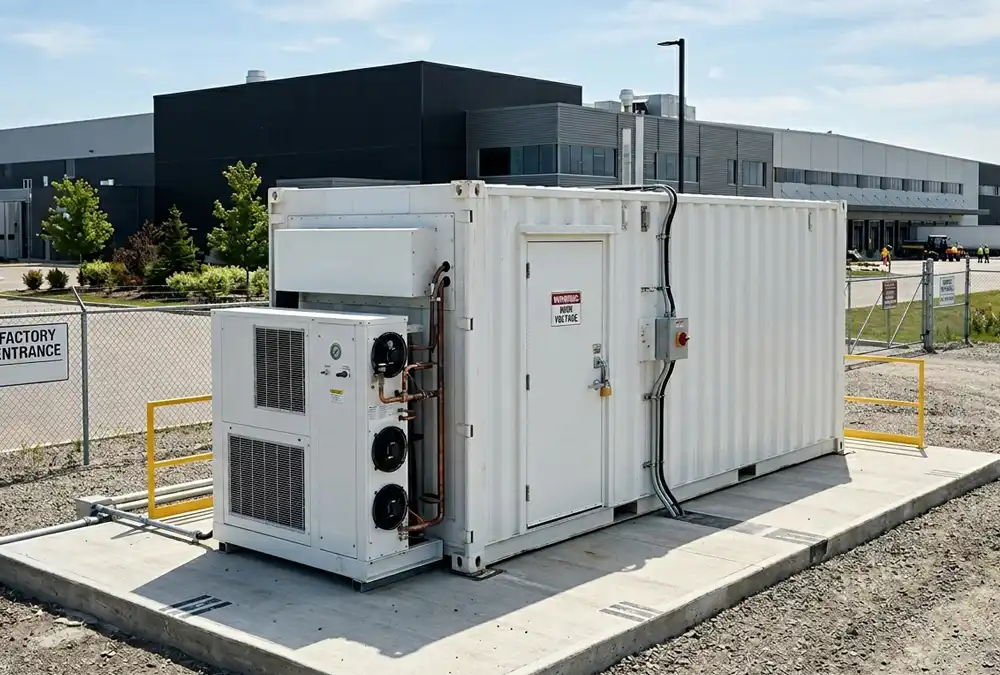
Traditional energy projects required building custom brick-and-mortar battery rooms on-site, a process that involved extensive structural design, complex local environmental permits, and prolonged field assembly times. A factory-tested Containerized Energy Storage System eliminates these issues. It centralizes all structural, environmental, and safety engineering inside an ISO-certified shipping container, protecting vital electronic systems from extreme weather conditions while streamlining logistics and local site permits.
Featured Snippet: What Is a Containerized 1MW Battery Storage Solution?
A containerized 1MW battery storage solution is a fully integrated Battery Energy Storage System (BESS) housed inside a standard container. It combines battery packs, PCS, BMS, EMS, HVAC, and fire protection systems into a plug-and-play unit, enabling faster deployment, lower installation costs, and scalable energy storage for commercial, industrial, and utility-scale applications.
Battery Energy Storage System (BESS) Components in a Containerized 1MW Solution
A commercial-grade containerized enclosure houses a carefully integrated balance of plant (BOP), with each subcomponent working together under tight tolerances:
Lithium-Ion Battery System
The main energy reservoir uses advanced Lithium-ion Battery Storage blocks, primarily relying on Lithium Iron Phosphate (LFP) cell configurations. LFP is chosen for stationary industrial applications because it offers better thermal stability, zero maintenance requirements, and an exceptional cycle life compared to older nickel-manganese chemistries.
Battery Management System (BMS)
The BMS serves as the primary technical guardian. Operating across cell, module, and rack levels, it continuously monitors real-time voltage profiles, surface temperatures, and states of charge, managing automated balancing currents to maximize long-term cell health.
Power Conversion System (PCS)
The PCS consists of high-capacity, bi-directional industrial inverters. It controls grid synchronization, voltage leveling, and precise phase matching, enabling high-speed power transitions during critical grid dropouts.
Energy Management System (EMS)
The EMS is the strategic software controller. It processes external market utility price points, tracks building power demands, and executes optimized dispatch profiles to achieve maximum economic efficiency.
HVAC Cooling and Thermal Management
High-capacity power cycling produces significant thermal loads. Modern builds use advanced liquid-cooling manifolds that cycle liquid coolant directly through internal battery chassis plates, keeping cell temperatures within a tight 2°C variation window to prevent uneven cell aging.
Fire Suppression and Safety Systems
To ensure full compliance with strict NFPA 855 guidelines, containers include multi-point gas monitoring, mechanical deflagration panels, and clean-agent gaseous fire suppression systems (such as Novec 1230) to mitigate thermal runaway risks.
Monitoring and Remote Control Platform
Engineers manage operations via secure cloud platforms, using real-time SCADA connections to review status trends, run remote diagnostics, and modify operating modes instantly without field technicians.
Containerized Energy Storage System Architecture and Design
Building an industrial container asset requires optimizing spatial, electrical, and thermal parameters inside a rigid metal frame:
- Standard Container Sizes (20ft vs 40ft): A 1MW system with a 2MWh energy capacity fits cleanly within a standard 20-foot container. High-capacity 4MWh setups or layouts requiring larger central switchgear arrays are built inside spacious 40-foot structures.
- Electrical System Layout: Design layouts place high-voltage DC battery lines along the rear walls, isolating them safely from sensitive low-voltage control circuits and high-power AC inverter connections.
- DC and AC Coupling Configurations: Designers use AC coupling for commercial projects to simplify integration with existing onsite solar setups. DC coupling is selected for brand-new solar-plus-storage projects to minimize round-trip conversion losses.
- Internal Battery Rack Arrangement: Racks face each other across a central service aisle, providing maintenance teams with direct physical access to all modules, fuse assemblies, and data line hubs.
- Thermal Management Design: Liquid chillers sit in separate, weather-isolated sections at the end of the container, keeping coolant lines close to battery racks while keeping moisture away from sensitive electronics.
- Safety and Compliance Standards: Enclosure structures feature blast-mitigation panels, robust earth grounding grids, and isolated electrical breakers to contain arc-flash incidents.
Modular Energy Storage Solution Benefits Compared to Traditional Battery Rooms
Shifting from custom on-site building construction to factory-assembled containers offers clear advantages for industrial developers:
Faster Deployment
Containers arrive completely assembled, wired, and factory-tested. Onsite installation simply requires pouring a flat concrete foundation, securing anchor bolts, and running final utility interconnect lines.
Lower Construction Costs
Moving assembly work from the field to a controlled factory floor eliminates expensive onsite technical labor, weather delays, and structural masonry costs.
Easier Transportation
Built to standard ISO shipping dimensions, these systems can be easily transported via standard ocean freight, rail lines, and low-boy semi trucks, simplifying project logistics worldwide.
Simplified Maintenance
With clear walkways, modular pull-out card configurations, and external connection panels, service teams can handle component inspections safely and quickly.
Flexible Expansion Capability
If a factory expands its production capacity, managers can easily add a second matching container block next to the original installation without re-engineering the existing setup.
Reduced Project Risk
Factory-certified integration ensures all safety controls and inverter components are fully tested before arrival, reducing common commissioning delays and unexpected site performance issues.
| Design Feature | Containerized BESS Architecture | Traditional Masonry Battery Room |
|---|---|---|
| Deployment Time | 2 to 4 weeks after site delivery | 4 to 6 months of active onsite construction |
| Civil Engineering Works | Minimal (Flat structural concrete pad) | Extensive (Foundations, firewalls, custom HVAC ducts) |
| System Mobility | High (Can be disconnected and relocated) | None (Permanent structural asset) |
| Scalability | Excellent (Modular container additions) | Difficult (Requires building expansions) |
| Upfront Installation Cost | Significantly lower due to factory assembly | Higher field labor and custom engineering costs |
1MW Battery Storage Capacity Options and System Configurations
The total energy runtime of the container dictates its suitability for different business applications. Evaluating configurations requires a clear technical understanding of operational specifications:
1MW/2MWh Containerized BESS
This layout delivers 1,000 kW of continuous output for exactly two hours. It is primarily used for commercial demand-charge reduction, fast power injections during machine startup spikes, and supporting short utility peak windows.
1MW/4MWh Containerized BESS
The current industry standard configuration provides 1,000 kW of output for four hours. This capacity easily handles deep daily solar shifting, long-duration industrial demand management, and multi-hour backup power security.
1MW/6MWh Containerized BESS
A high-capacity system built for deep-cycle applications. This version supports long-duration microgrid operations, heavy industrial processes, and overnight fleet charging infrastructure.
Choosing the Right Storage Duration
Selecting your system duration involves analyzing your facility’s 15-minute utility load data. If your peak demand spikes are short but high, a 2MWh configuration is the most cost-effective solution. If your facility faces prolonged high usage or requires extended backup power, a 4MWh or 6MWh asset is required.
Understanding MW vs MWh
In electrical engineering, **Megawatts (MW)** measure instantaneous mechanical power capacity—the size of the engine. **Megawatt-hours (MWh)** measure total stored energy volume—the capacity of the fuel tank. Balancing both metrics correctly is essential for proper system sizing.
| Technical Configuration | Power Rating (MW) | Energy Capacity (MWh) | Discharge Window | Primary Application Match |
|---|---|---|---|---|
| 1MW/2MWh Layout | 1.0 MW | 2.0 MWh | 2 Hours | Commercial Peak Shaving & Demand Charge Mitigation |
| 1MW/4MWh Layout | 1.0 MW | 4.0 MWh | 4 Hours | Solar Capacity Shifting & High-Throughput EV Hubs |
| 1MW/6MWh Layout | 1.0 MW | 6.0 MWh | 6 Hours | Heavy Fleet Depots & Islanded Microgrid Networks |
Commercial Energy Storage Applications for Containerized 1MW Battery Systems
Deploying a robust Commercial Energy Storage System protects diverse industrial sectors from grid volatility:
Manufacturing Facilities
Precision manufacturing operations use container systems to eliminate short voltage sags that can cause automated production lines to reset, preventing expensive scrap material losses and unscheduled downtime.
Industrial Parks
Large industrial developments use a shared container footprint to aggregate energy use across multiple tenants, lowering collective peak demands and cutting shared infrastructure costs.
Commercial Buildings
High-rise offices and commercial hubs use container systems to run high-efficiency HVAC equipment during peak afternoon rate hours without triggering expensive utility surcharges.
Data Centers
Data facilities integrate container systems alongside traditional backup generators, using the high-speed batteries to bridge power gaps cleanly during generator startup cycles.
Mining Operations
Remote mining sites use rugged Industrial Battery Storage containers to stabilize isolated power networks, absorbing the heavy voltage surges caused by massive crushing mills and rock hoists.
Agricultural Energy Projects
Large farming facilities combine battery storage with solar arrays to power irrigation pumps and cold-storage refrigeration units around the clock, dramatically reducing diesel fuel expenses.
Product Spotlight: Industrial 1MW/2MWh All-in-One Liquid-Cooled Containerized BESS
Engineered for harsh industrial environments, our factory-integrated 1MW containerized solution features Tier-1 LFP cells, advanced direct-to-plate liquid cooling, and a pre-configured smart EMS. This turnkey system provides high round-trip efficiency and simple utility interconnection, making it an ideal choice for manufacturing hubs and high-volume charging networks.
Containerized Battery Storage for Solar Energy Storage Projects
Integrating a Solar Battery Storage System turns variable solar generation into a reliable, dispatchable power resource:
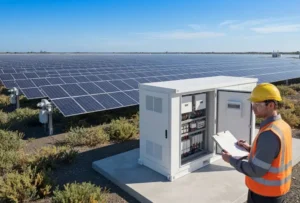
- Solar Plus Storage Architecture: Centralizing solar arrays and battery networks through a shared inverter layout simplifies utility interconnection permits and lowers balance of plant hardware costs.
- Reducing Renewable Energy Curtailment: When utilities limit solar export during midday overproduction windows, the container captures that excess energy instead of letting it go to waste.
- Maximizing Solar Self-Consumption: Facilities can store clear midday solar generation and use it to power heavy evening production shifts, minimizing expensive daytime power purchases.
- Grid Export Optimization: Smart automated controllers monitor wholesale power prices, discharging stored solar energy into the grid during peak pricing windows to maximize energy revenue.
- Solar Farm Applications: Large utility-scale solar farms deploy containerized systems to smooth out rapid production drops caused by passing clouds, ensuring stable grid injection profiles.
Containerized Battery Storage for EV Charging Stations
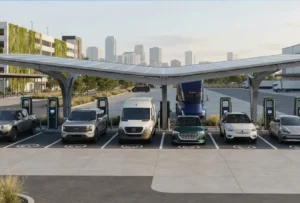
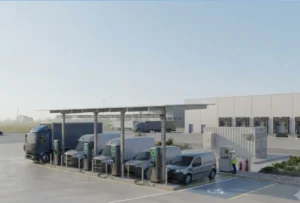
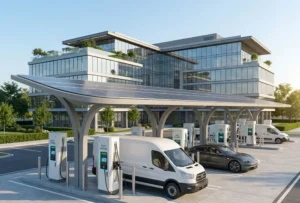
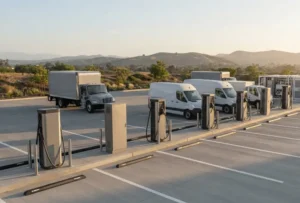
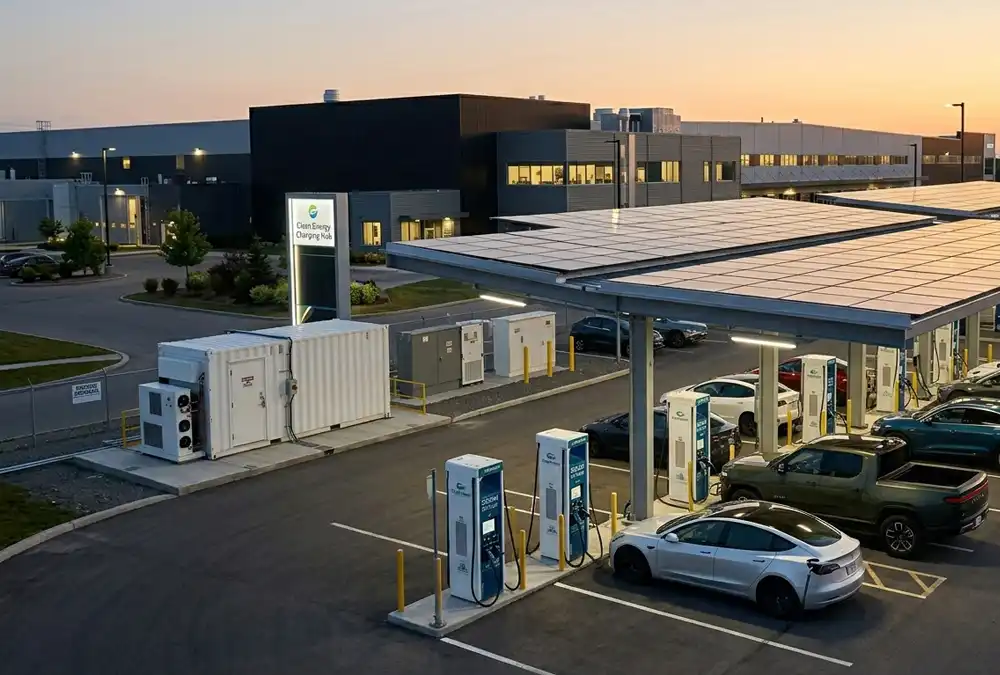
The rapid expansion of high-power highway charging depots and heavy commercial fleet yards creates massive, unpredictable electrical demands that challenge local grid infrastructure. Integrating a dedicated Battery Storage for EV Charging Stations platform allows developers to build high-volume charging sites on restricted utility lines.
When multiple vehicles connect to 180kW+ DC fast chargers simultaneously, local power demand can surge from zero to over a megawatt in seconds. A containerized battery system buffers these intense spikes by discharging stored power alongside the grid connection. This smart load management lowers expensive utility demand charges, prevents local voltage drops, and avoids the multi-year delays and high capital costs associated with ordering major utility transformer upgrades.
Grid-Connected Battery Storage and Utility-Scale Energy Storage Applications
At the substation level, deploying an asset as a Grid-Connected Battery Storage platform supports regional transmission network stability:
- Peak Load Management: Grid operators call on large container networks to discharge during intense heatwaves or winter demand peaks, easing strain on overbudended substations.
- Frequency Regulation Services: Modern systems respond within milliseconds to sub-cycle grid frequency shifts, providing rapid power modulation to keep grid networks balanced.
- Demand Response Programs: Industrial systems participate in automated utility programs, reducing facility grid draw on demand in exchange for lucrative incentive credits.
- Renewable Energy Integration: Aggregating multiple container units allows grid networks to safely integrate higher levels of variable wind and solar power.
- Grid Stability Enhancement: Providing localized voltage support and reactive power control helps transmission operators maintain stable power quality across regional lines.
1MW Containerized Battery Storage System Cost Breakdown
Developing a realistic budget requires evaluating a comprehensive 1MW Containerized Battery Storage System Cost breakdown across all core project subsystems.
According to clean energy capital indices from late 2025 and early 2026, a standard integrated 1MW/2MWh container installation ranges between **$630,000 and $890,000** for base hardware. Expanding the asset to a 4-hour 1MW/4MWh system increases total capital costs to a range of **$1,150,000 to $1,480,000**. The absolute financial investment scales based on cell density selection, localized civil foundation requirements, and specific utility connection parameters.
The battery cells and structural module racks represent roughly 45% of the total equipment invoice. The high-power bi-directional PCS inverters account for approximately 20% of the cost. The remaining budget covers internal BMS safety boards, localized liquid chiller lines, smart EMS controllers, structural ISO containers, and final onsite civil installation and utility commissioning work.
ROI and Payback Period of Containerized Battery Storage Solutions
Evaluating financial viability requires balancing upfront capital expenditures (CAPEX) against ongoing operational savings and market revenue streams:
- Revenue from Peak Shaving: Shaving down expensive utility monthly peak demand charges provides immediate, predictable savings for industrial facilities.
- Energy Arbitrage Opportunities: Charging the batteries during inexpensive overnight rate periods and discharging them during peak high-rate daytime hours lowers net energy costs.
- Demand Charge Reduction Savings: Eliminating unexpected power surges avoids steep utility demand penalties across your monthly billing cycles.
- Renewable Energy Optimization Benefits: Capturing on-site solar generation prevents power waste and shortens project payback timelines.
- Typical Payback Period Scenarios: Modern commercial projects typically achieve a full return on investment within 3 to 6 years, depending on local utility rates, operational profiles, and regional tax incentives.
| Industrial Application Type | Primary Revenue Generation Driver | Average Financial Payback Window |
|---|---|---|
| Industrial Production Facilities | Peak demand reduction & power quality protection | 3 to 6 Years |
| High-Power EV Charging Hubs | Mitigating charging surges & avoiding transformer upgrades | 2 to 5 Years |
| Commercial Solar Projects | Maximizing solar self-consumption & time-of-use arbitrage | 3 to 7 Years |
| Utility Grid Services | Frequency response & automated capacity market programs | 5 to 8 Years |
How to Choose the Right Containerized 1MW Battery Storage Solution
Project managers should follow a rigorous engineering review process when selecting a final equipment configuration:
- Evaluate Energy Demand Requirements: Run a detailed review of 12 months of 15-minute utility interval data to accurately chart your peak demand spikes and baseline energy usage.
- Select Appropriate Battery Capacity: Determine whether your facility needs a short power buffer (2MWh) or an extended energy duration layout (4MWh+) based on your typical load profiles.
- Assess PCS Specifications: Confirm the inverter is engineered to handle short-duration equipment startup surges and matches your facility’s operational line voltage.
- Review EMS Capabilities: Ensure the software supports standard communication protocols (like Modbus TCP or DNP3) to integrate smoothly with your existing facility controls or local solar arrays.
- Verify Safety Certifications: Only select equipment that carries full product safety certifications to simplify local building approvals and insurance underwriting.
- Compare Supplier Experience: Partner with an established manufacturer that has a proven track record in high-voltage system design and offers reliable long-term service agreements.
Containerized Battery Storage Safety Standards and Certifications
Meeting international electrical and safety standards is essential for project approvals and securing property insurance:
UL9540 and UL9540A
UL9540 is the overarching safety certification for integrated energy storage systems. UL9540A involves rigorous fire testing to measure thermal runaway characteristics, confirming that any localized cell failure remains contained within its individual module chassis.
IEC 62933 Standards
These international guidelines define the core operational performance, testing requirements, and basic safety parameters for all commercial grid-tied energy storage systems.
NFPA 855 Compliance
The National Fire Protection Association standard establishes strict installation criteria, including minimum clearance spacing between container walls, dedicated fire department access, and water supply requirements for energy storage sites.
Fire Protection Requirements
Enclosures incorporate multi-stage safety layers, including early-stage gas detection to sense cell off-gassing, automated electrical isolation relays, and gaseous clean-agent fire suppression systems.
Thermal Runaway Prevention
Using advanced direct-to-plate liquid cooling, continuous cell internal resistance monitoring, and insulated fire-barrier panels prevents thermal containment failures across adjacent modules.
Future Trends in Containerized Battery Energy Storage Systems
As clean energy infrastructure advances toward 2030, several key design trends are reshaping the industrial sector:
- Higher Energy Density Battery Technologies: The shift toward advanced 314Ah+ cells and solid-state architectures allows manufacturers to pack up to 5MWh of storage capacity into a standard 20-foot container, doubling the energy footprint of traditional systems.
- AI-Driven Energy Management Systems: Software platforms increasingly leverage predictive neural networks to analyze weather data and market price shifts, automatically optimizing battery trading and billing performance.
- Virtual Power Plant (VPP) Integration: Decentralized container networks are being linked via secure cloud platforms, allowing groups of independent commercial batteries to operate together as a single virtual power plant to support the regional utility grid.
- Second-Life Battery Applications: Re-manufacturing decommissioned electric vehicle battery packs into secondary stationary storage containers provides an eco-friendly, lower-cost option for budget-conscious projects.
- Long-Duration Energy Storage Development: Emerging flow battery chemistries and advanced iron-air systems are being integrated into container designs, offering extended multi-day discharge windows for utility grid backup storage.
Conclusion: Why Containerized 1MW Battery Storage Solutions Are the Preferred Choice for Modern Energy Projects
Key Technical Advantages
Deploying a Turnkey Containerized 1MW Battery Storage Solution provides comprehensive operational benefits. By integrating cell packs, advanced bi-directional inverters, automated safety controls, and smart liquid cooling inside a single pre-tested enclosure, developers minimize field labor risks and secure high system reliability.
Economic Benefits and ROI
Container systems deliver excellent financial value. Spreading project costs over a factory-assembled unit yields a highly efficient cost-per-kilowatt layout. This cost structure, paired with significant monthly peak demand savings and market arbitrage revenues, enables most industrial installations to achieve full capital payback within a 3 to 6-year window.
Best Application Scenarios
This scale of storage container is ideal for modern manufacturing facilities facing volatile energy rates, heavy commercial hubs integrating large solar arrays, and high-volume EV fast-charging depots looking to scale up operations without facing lengthy grid delays.
Next Steps for Project Developers and Energy Managers
For organizations looking to future-proof their energy infrastructure, the next step is conducting a detailed site load profile analysis. Partnering early with an experienced equipment manufacturer ensures your containerized system is perfectly sized, certified, and optimized to deliver maximum long-term energy resilience.