Looking for the best top 10 ev charging manufacturer partners for your commercial site deployment? Selecting the right top 10 ev charging manufacturer isn’t just about brand size. It requires finding an engineering partner who understands your power constraints. We built this B2B comparison matrix based on real manufacturing capacity, software open-protocols, field failure rates, and lifetime equipment support.
Quick Evaluation Framework Notice:
This editorial B2B benchmark evaluates equipment makers across ten operational vectors: Product Portfolio, Factory Capacity, Max Output Power, Compliance Certifications, OCPP Firmware Interoperability, OEM/ODM Customization, BESS Battery Integration, Field Project History, Global After-sales Support, and Total Lifecycle Cost. It is not an official global government ranking.
Global EV Charging Equipment Market Overview
Deploying public charging stations or commercial fleet depots requires direct visibility into hardware supply chains and grid infrastructure capabilities. Choosing a trusted EV charging equipment manufacturer ensures that your physical assets operate continuously without unexpected downtime or safety issues.
How Fast Is the Global EV Charging Market Growing?
Market expansion is accelerating rapidly across commercial real estate, logistics hubs, and highway corridors. According to data published in the IEA Global EV Outlook 2025 report, global electric car sales surpassed 17 million units in 2024, driving public charging deployment past 5 million active points worldwide. Furthermore, Precedence Research data for EV infrastructure forecasts the global electric vehicle charging infrastructure market size to expand from $59.94 billion in 2026 to nearly $492.59 billion by 2035. This explosive growth forces business owners to partner with robust electric vehicle charging suppliers capable of scaling factory output quickly.
Why EV Charging Infrastructure Is Becoming a Critical Investment
Deploying dedicated EV charging infrastructure is no longer just a green marketing perk for property owners. Commercial real estate developers, fleet operators, and retail plazas now treat charging hardware as a core revenue-generating utility asset. In addition, fleet operators electrifying light-duty delivery vans and heavy trucks require high-uptime equipment to meet rigid delivery schedules.
Why Fast and Ultra-Fast Charging Are Changing the Market
Slow overnight chargers are insufficient for highway hubs or fast-paced logistics centers. Data shows that 150 kW+ ultra-fast chargers saw over 50% year-over-year deployment growth globally. Sourcing from a specialized DC fast charging manufacturer allows commercial sites to turn over charging bays in under 30 minutes, preventing long queues and maximizing operator revenue per square meter.
Why Choosing the Right EV Charging Manufacturer Matters
Hardware is only thirty percent of the long-term operational equation. If your EV charger manufacturer utilizes closed, proprietary software protocols or unvetted power electronics, your hardware turns into an unserviceable brick the moment a component fails. Selecting an experienced electric vehicle charging company guarantees long-term supply chain access to spare parts, reliable software APIs, and compliance with dynamic electrical standards.
How We Selected the Top 10 EV Charging Manufacturers
We avoided generic brand recognition lists and focused strictly on technical capabilities, factory audits, and B2B flexibility. Every commercial EV charging station manufacturers profile below underwent testing against six critical engineering checkpoints.
Product Portfolio and Charging Power
We verified whether suppliers offer comprehensive product lines ranging from low-profile 7 kW–22 kW AC pedestals up to ultra-fast 240 kW–480 kW DC split-cabinet systems. Multi-standard support (CCS1, CCS2, NACS, GB/T) was mandatory for top consideration.
Manufacturing and R&D Capability
Tier-1 status requires dedicated production facilities, automated SMT board assembly lines, internal burn-in testing chambers, and proprietary power module development teams to guarantee structural quality control.
Certifications and Safety Standards
International deployments fail without verified safety compliance. We inspected active certification databases for UL 2202, CE, IEC 61851, TUV, FCC, and RoHS documentation across all rated equipment lines.
Software, OCPP and Smart Charging
Open Charge Point Protocol (OCPP 1.6J and OCPP 2.0.1) compliance is non-negotiable. Modern equipment must seamlessly connect with third-party Charge Point Management Systems (CPMS) for automated billing and dynamic load balancing.
OEM, ODM and Customization Capability
Commercial buyers often need custom housing colors, white-label branding, specialized cable lengths, or custom payment terminal integrations. High-ranking suppliers must support flexible EV charger OEM ODM capabilities.
Global Delivery and After-Sales Support
A global network for rapid spare-parts distribution, remote diagnostic firmware updates, and local field technician service protocols heavily weighted our scoring matrix.
Top 10 EV Charging Manufacturers in the World
The following analysis breaks down the leading top 10 ev charging manufacturer options available to global B2B procurement teams today.
1. ABB — Global Electrification and EV Charging Solutions
ABB is a Swiss-Swedish multinational pioneering industrial automation and electrification technology globally. Their dedicated charging division manufactures high-voltage commercial stations operating continuously across public CPO networks, commercial real estate complexes, and high-volume transportation corridors worldwide.
Product Portfolio
Terra AC wallboxes (7.4 kW–22 kW) for commercial parking, Terra DC fast chargers (50 kW–180 kW), and high-power split-cabinet systems delivering up to 360 kW with dynamic power sharing.
Target Applications
Public charging networks, commercial fleet depots, retail shopping centers, highway charging plazas, and heavy-duty electric bus depots.
Why B2B Buyers Choose ABB
Unrivaled global brand trust, active compliance with international grid codes, robust hardware casing durability, and extensive multi-national service networks for large public infrastructure tenders.
2. Siemens — Commercial and Infrastructure Charging
Siemens delivers comprehensive smart building electrification and industrial power distribution equipment. Their charging equipment seamlessly integrates with central microgrids, utility management systems, and intelligent building automation controllers for commercial sites.
Product Portfolio
VersiCharge AC commercial chargers (7.2 kW–22 kW) and Sicharge UC / Sicharge D high-power DC fast-charging terminals (50 kW–360 kW) engineered with active cooling technology.
Target Applications
Corporate office buildings, municipal transit hubs, industrial logistics parks, hospital parking garages, and microgrid installations.
Why B2B Buyers Choose Siemens
Seamless hardware-to-building software integration, exceptional power grid protection features, and proven ability to handle complex municipal transit electrification projects.
3. Delta Electronics — High-Efficiency EV Charging Technology
Delta Electronics leverages deep expertise in power conversion electronics to manufacture compact, thermally efficient commercial charging hardware. Their stations operate reliably across extreme temperature ranges in challenging outdoor industrial environments.
Product Portfolio
AC Max commercial chargers (7 kW–22 kW), Citycharger DC fast stations (50 kW–360 kW), and Ultra Fast Chargers delivering up to 200 kW in high-density power modules.
Target Applications
Commercial parking plazas, fleet parking bays, highway service stations, hotel chains, and retail commercial properties.
Why B2B Buyers Choose Delta
High electrical conversion efficiency ratings (up to 96%), compact enclosure footprints, low heat loss, and strong competitive pricing for hardware procurement.
4. Schneider Electric — EV Charging and Energy Management
Schneider Electric focuses heavily on smart energy management and sustainable facility electrification. Their commercial charging systems integrate directly with energy meters to balance charging loads against overall facility energy consumption.
Product Portfolio
EVlink Pro AC wallboxes and pedestals (7.4 kW–22 kW) featuring advanced security architecture, paired with compact EVlink DC fast chargers (24 kW–360 kW).
Target Applications
Commercial real estate complexes, corporate fleet facilities, residential multi-dwelling units, and smart commercial parking garages.
Why B2B Buyers Choose Schneider
Advanced load management algorithms that prevent facility electrical breaker trips, top-tier cyber-security design, and global field engineering support.
5. AnengJI — Factory-Direct EV Charging & Energy Integration Solutions
AnengJI is a specialized EV charger factory and technical supplier providing direct B2B manufacturing. Operating automated production lines, AnengJI eliminates middleman costs by supplying factory-direct hardware while solving local power grid constraints through integrated battery storage engineering.
Product Portfolio
AC Commercial Chargers (7 kW–22 kW), DC Fast Chargers (30 kW–360 kW), and Ultra-Fast Liquid-Cooled Cabinets (600 kW-900kw), alongside C&I Battery Storage systems (100kWh, 261kWh, 418kWh, 1MWh).
Target Applications
Commercial parking lots, logistics fleets, shopping centers, highway corridors, and commercial sites with limited grid transformer capacity.
Why B2B Buyers Choose AnengJI
Factory-direct wholesale pricing, deep EV charger OEM ODM customization options, full OCPP 2.0.1 compliance, and direct BESS battery integration to eliminate expensive utility transformer upgrades.
6. Alpitronic — High-Power DC Fast Charging
Alpitronic is a specialized European manufacturer known for its flagship Hypercharger brand. They focus exclusively on engineering modular, compact DC fast-charging terminals designed for fast turnover locations.
Product Portfolio
Hypercharger HY50 (50 kW), HY150 (150 kW), and HY300/HY400 ultra-fast modular DC charging terminals featuring liquid-cooled cable options.
Target Applications
Highway service plazas, high-traffic CPO networks, commercial fueling stations, and fast-turnover urban charging hubs.
Why B2B Buyers Choose Alpitronic
Extremely high power density, space-saving cabinet design, modular power stacks that allow easy power upgrades in the field, and exceptional field reliability.
7. Kempower — Dynamic Charging for Fleets and Heavy-Duty EVs
Kempower engineers user-friendly, dynamic DC charging systems tailored specifically for electric fleet depots, heavy transit buses, and public charging hubs requiring flexible power distribution.
Product Portfolio
C-Station power cabinets paired with slim C-Post and S-Post charging satellites, delivering dynamic power allocation from 50 kW to 400 kW across multiple vehicles.
Target Applications
Commercial truck depots, electric bus transit yards, logistics centers, commercial fleet depots, and public fast-charging sites.
Why B2B Buyers Choose Kempower
Dynamic power management that automatically routes kilowatts to vehicles needing it most, slim satellite footprint, and highly intuitive touch-screen interfaces.
8. StarCharge — Large-Scale EV Charging Equipment Manufacturer
StarCharge operates massive manufacturing operations producing high volumes of AC and DC charging stations. They serve automotive OEMs, utilities, and large global charging operators requiring high supply chain volume.
Product Portfolio
Commercial AC wallboxes (7 kW–22 kW), standalone DC fast chargers (30 kW–360 kW), and high-power split charging systems delivering up to 480 kW.
Target Applications
Large-scale CPO charging networks, automotive dealership groups, commercial real estate portfolios, and municipal charging projects.
Why B2B Buyers Choose StarCharge
Massive production capacity, competitive pricing structures, broad product options, and extensive OEM manufacturing experience.
9. Huawei Digital Power — Smart EV Charging and Energy Integration
Huawei Digital Power combines telecom ICT expertise with advanced power electronics to manufacture digital charging infrastructure. They focus heavily on high-voltage, quiet, liquid-cooled charging networks.
Product Portfolio
Fully liquid-cooled ultra-fast charging power units (360 kW–600 kW) and smart DC fast charging terminals designed for low operational noise.
Target Applications
Highway service hubs, urban ultra-fast charging plazas, commercial fleet hubs, and integrated solar-storage-charging sites.
Why B2B Buyers Choose Huawei
Liquid-cooling longevity, ultra-fast charge delivery, high system reliability, and advanced IoT digital remote management tools.
10. BYD — EV Ecosystem and High-Power Charging Technology
BYD engineers high-capacity commercial charging hardware designed to complement its extensive commercial electric bus, truck, and passenger vehicle ecosystem, as well as integrated energy storage solutions.
Product Portfolio
Heavy-duty AC commercial charging units and high-power DC fast stations (60 kW–300 kW+) tailored for heavy vehicle fleet cycles.
Target Applications
Public transit fleet depots, commercial logistics yards, heavy transport charging stations, and industrial enterprise sites.
Why B2B Buyers Choose BYD
Deep alignment between charging equipment and heavy-duty battery chemistry, exceptional hardware reliability, and complete vehicle-to-charging integration.
Top 10 EV Charging Manufacturers Comparison
To help procurement managers quickly compare structural capabilities, the matrix below details key manufacturing parameters across top equipment vendors.
| Manufacturer | Primary Region | AC Range | DC Fast | OEM/ODM | BESS Integration | Buyer Value Benefit |
|---|---|---|---|---|---|---|
| ABB | Europe / Global | 7–22 kW | 50–360 kW | Limited | Partner Based | Global brand trust for public utility tenders and municipal infrastructure projects. |
| Siemens | Europe / USA | 7–22 kW | 50–300 kW | No | Grid Level | Seamlessly links with complex smart building management software (BMS). |
| Delta | Asia / Global | 7–22 kW | 25–200 kW | Selective | PCS Level | High electrical efficiency minimizes heat waste in warm outdoor climates. |
| Schneider | Europe / Global | 7–22 kW | 24–180 kW | No | Microgrid | Protects corporate office electrical panels from overloading during office peak hours. |
| AnengJI | Asia / Global | 7–22 kW | 30–480 kW | Full Support | Native Direct | Eliminates middleman margins; prevents local transformer upgrades via built-in battery shaving. |
| Alpitronic | Europe | N/A | 75–400 kW | No | External | Ultra-compact footprint fits cramped highway fuel stations easily. |
| Kempower | Europe / USA | N/A | 50–400 kW | No | External | Dynamic cable allocation optimizes charging times for overnight bus depots. |
Which EV Charging Manufacturer Is Right for Your Business?
Stop asking who the largest supplier is. Instead, focus on technical alignment using our project matching matrix.
The EV Charger Manufacturer Fit Score™ Formula
Best Manufacturer for Commercial Parking Plazas
Target dual-socket 11 kW or 22 kW AC chargers featuring OCPP 1.6J integration, robust dynamic load management, and integrated credit card readers to maximize dwell-time revenue.
Best Manufacturer for DC Fast Charging Corridors
Select modular 120 kW to 240 kW DC fast chargers equipped with liquid-cooled cables, dual CCS2/NACS connectors, and high-efficiency power modules to turn over vehicles quickly.
Best Manufacturer for Commercial EV Fleets
Depot managers need high-reliability 60 kW to 180 kW DC terminals backed by automated backend energy scheduling software to ensure delivery vehicles charge during cheap off-peak hours.
Best Manufacturer for OEM/ODM Customization
When launching a regional charging network under your own brand, partner directly with an EV charger OEM manufacturer like AnengJI that supports custom exterior metalwork, custom software branding, and custom enclosure dimensions.
Best Manufacturer for Solar + Storage + EV Charging
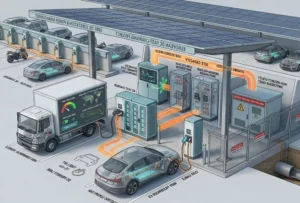
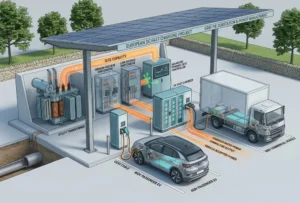
If local power utilities demand $200,000 for grid transformer upgrades, choose a supplier capable of linking chargers with local Photovoltaic (PV) solar panels and a 261kWh BESS energy cabinet. This allows site owners to charge cars directly from stored solar energy.
What Makes a Leading EV Charging Equipment Manufacturer?
Evaluating an EV charging equipment manufacturer requires looking inside their technical operations rather than relying on marketing brochures.
Technology and Product Range
A reliable supplier must design their own internal power conversion modules rather than sourcing off-the-shelf power supply units. Proprietary power electronics lead to better thermal management and longer operating life.
Safety Certifications and Global Compliance
Verify that your electric vehicle charging manufacturer holds legitimate, traceable test certificates from TUV, Intertek, or UL. Uncertified chargers can void commercial property insurance coverage in the event of an electrical fire.
Hardware and Software Integration
Hardware chargers must maintain continuous socket connection stability with central management software over cellular or Ethernet gateways without dropping communication packets.
Manufacturing Capacity and Delivery
Ensure the EV charger factory maintains an annual production capacity exceeding 50,000 units to guarantee uninterrupted shipment timelines during large-scale rollout phases.
Reliability, Warranty and After-Sales Support
Demand a standard 24-month or 36-month factory warranty backed by guaranteed spare-parts availability and rapid remote engineering diagnostics.
Total Cost of Ownership
Remember this simple truth: buying ultra-cheap hardware usually results in high field failure rates and excessive downtime losses. Look for balance between hardware price and operational longevity.
How Much Does the EV Charger Manufacturer Really Cost?
Smart procurement managers analyze total site expenditure rather than focusing strictly on the invoice price of the charging terminal.
Understanding 5-Year Total Cost of Ownership (TCO)
Your true hardware investment includes initial purchase cost, civil trenching, electrical panel upgrades, software platform license fees, routine maintenance, and potential revenue losses caused by broken equipment.
The Commercial EV Charger 5-Year TCO Framework
5-Year Real TCO = Initial Hardware Price + Trenching & Cabling + Grid Transformer Surcharges + CPMS Software SaaS Fees + Routine Maintenance – Energy Sales Revenue
20 Questions to Ask Any EV Charging Manufacturer Before You Buy
Use this technical evaluation checklist during your supplier screening calls to filter out unqualified brokers.
Manufacturing & Facility Standards
- Do you directly own and operate your manufacturing facility?
- What is your factory’s current monthly production capacity for DC fast chargers?
- Can our engineering team conduct an on-site or virtual factory inspection?
- What is your standard Minimum Order Quantity (MOQ) for custom exterior paint?
Certifications & Standards
- Are your CE and UL certificates issued by accredited third-party labs like TUV or Intertek?
- Do your commercial chargers comply with standard ISO 15118 Plug & Charge protocols?
- Can you provide certified seismic and ingress protection (IP55/IP65) test reports?
Software & Firmware Flexibility
- Is your firmware tested and certified against native OCPP 1.6J and OCPP 2.0.1 JSON?
- Do you lock hardware to a proprietary charging management platform?
- Can we access local API documentation to integrate chargers with our custom mobile app?
- How are Over-The-Air (OTA) firmware updates deployed to field units?
Reliability & Technical Support
- What is your verified Mean Time Between Failures (MTBF) rating for power modules?
- What specific warranty response time is guaranteed in your Service Level Agreement (SLA)?
- How quickly can replacement power modules be dispatched to our project site?
- Do you offer direct engineering assistance during local utility grid tie-in commissioning?
- Can your chargers integrate directly with paired battery energy storage cabinets?
7 Red Flags When Choosing an EV Charging Manufacturer
Watch out for these high-risk operational warning signs when reviewing prospective top 10 ev charging manufacturer bids.
- Red Flag #1 — Missing Factory Addresses: Brokers pretending to be an EV charger factory often refuse to provide exact facility locations or allow third-party audits.
- Red Flag #2 — Unverifiable Safety Certificates: Test reports containing forged certification numbers that fail online database verification checks.
- Red Flag #3 — Proprietary Software Lock-in: Hardware that restricts you to a single expensive software vendor with no native OCPP support.
- Red Flag #4 — Vague Warranty Terms: Warranties that require buyers to pay exorbitant international shipping costs for failed heavy power components.
- Red Flag #5 — Suspiciously Low Pricing: Low unit prices offset by hidden recurring software fees or low-grade internal components that overheat.
- Red Flag #6 — Lack of Local Technical Documentation: Missing electrical schematics, foundation drawings, or field installation manuals.
- Red Flag #7 — Zero Case Studies: Inability to provide reference contacts or proof photos of past commercial deployments.
EV Charging Industry Trends and Future Outlook
Planning a multi-year infrastructure rollout requires staying aligned with authoritative policy mandates and technological shifts transforming commercial mobility.
Global Policy Frameworks & Government Funding Programs
Government initiatives are driving fast-charging corridors worldwide. According to official guidelines from the U.S. Joint Office of Energy and Transportation (NEVI Program), national programs mandate 150 kW+ minimum DC fast chargers spaced every 50 miles along major highways. Furthermore, market data from Statzon Market Insights confirms commercial sites account for over 80% of public charging capital expenditure, reinforced by stringent European Union AFIR mandates requiring dedicated public fast-charging hubs.
Ultra-Fast Megawatt Charging for Heavy Fleets
As documented in the IEA Global EV Outlook 2025 report, 150 kW+ chargers grew over 50% year-over-year. Fleet operators are now expanding toward Megawatt Charging Systems (MCS) designed to recharge commercial electric semi-trucks and transit buses in under 45 minutes.
Smart Grid Interoperability and ISO 15118 Standardization
Electrical grids cannot sustain dozens of high-power chargers drawing maximum capacity simultaneously. Official grid integration frameworks from the National Renewable Energy Laboratory (NREL) emphasize that dynamic load balancing and ISO 15118 Plug & Charge protocols are critical to protect local transformer assets from severe power surges.
Solar + Battery Storage (BESS) + Charging Ecosystems
To avoid massive utility grid upgrade delays, commercial site hosts are increasingly adopting onsite solar paired with containerized battery storage. Implementing 100kWh, 261kWh, or 1MWh C&I energy storage cabinets allows commercial sites to charge vehicles during peak electricity tariff hours while avoiding expensive demand surcharges.
Why Choose AnengJI as Your EV Charging Equipment Partner?
When selecting a reliable top 10 ev charging manufacturer, business buyers need direct engineering support, flexible manufacturing, and predictable pricing.
Direct Factory Pricing
Eliminate distributor markups by working directly with our manufacturing facilities to maximize project profitability.
Complete Power Portfolio
From 7 kW AC commercial wallboxes to 480 kW ultra-fast DC split-cabinets, we cover all commercial charging requirements.
Full OEM/ODM Branding
Customized metal housing designs, branded client interfaces, and tailormade firmware built specifically for your network.
BESS Battery Integration
Avoid grid transformer upgrades by pairing chargers directly with our 100kWh to 1MWh C&I energy storage solutions.