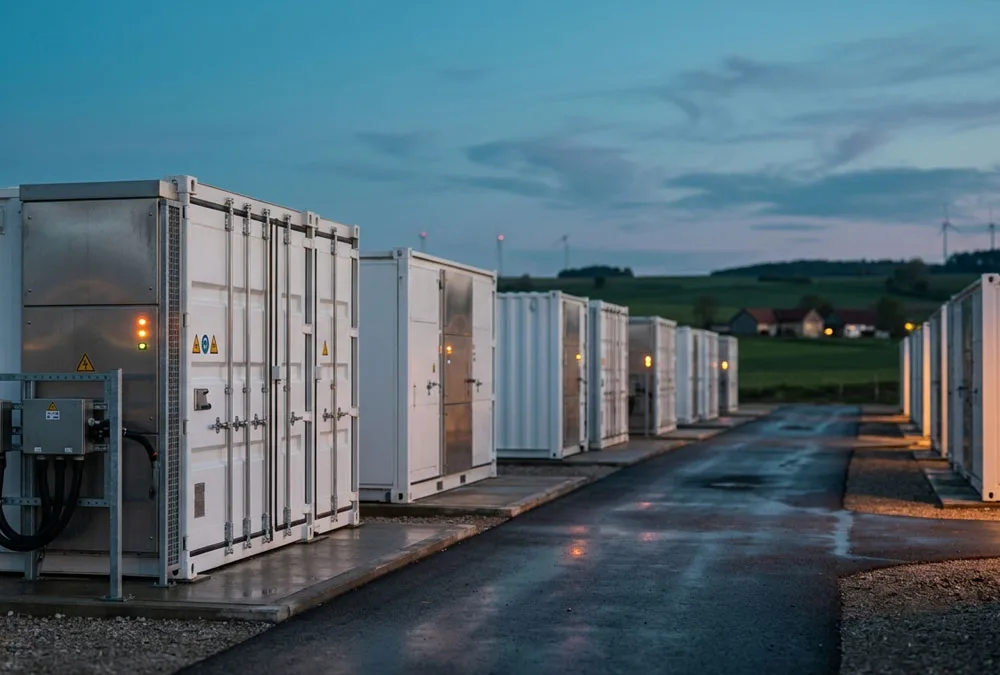
Introduction
Selecting the top tier battery energy storage manufacturers in Germany in 2026 requires understanding how drastically this market has split between local system integrators and international hardware suppliers. Germany stands as Europe’s primary energy storage engine, but manufacturers differ wildly in scope: some produce cells, others act purely as BESS integrators, while many provide customized OEM/ODM builds. The biggest name rarely equals the best supplier for your exact commercial load or grid connection point.
Between rising peak-shaving charges, volatile spot market tariffs, and strict VDE grid mandates, buying storage isn’t just about grabbing cheap kWh capacity anymore. Buyers get caught in warranty fine print, long shipping delays, and communication barriers. This technical guide breaks down the real German BESS supply landscape so project developers, EPCs, and C&I end-users can make direct, risk-free sourcing decisions.
💡 Executive Sourcing Takeaways
- Cell Sourcing Transparency: Always trace LFP cell origin back to Tier-1 suppliers like CATL, EVE, or CALB rather than accepting generic brand labels.
- Grid Compliance (VDE-AR-N 4110/4120): Ensure hardware has native certificate validity to prevent 6-month interconnection delays at the local transformer level.
- Total System Integration: True system value comes from unified BMS, PCS, and liquid-cooled HVAC control rather than piecemeal modular assembly.
Germany Battery Energy Storage Market: Why BESS Manufacturers Matter in 2026
According to official data released by the Fraunhofer Institute for Solar Energy Systems (Fraunhofer ISE), total installed battery storage capacity in Germany reached approximately 25 GWh by the start of 2026, with utility-scale BESS expanding by over 60% year-over-year. Meanwhile, clean energy tracking reports from the German Federal Network Agency (BNetzA) confirm that industrial and grid-scale applications are now outpacing home storage growth rates.
Germany’s Battery Storage Market Is Expanding Across Three Segments
The market splits cleanly across technical scale, but buyer friction sits almost entirely in segments two and three:
- Residential BESS (1 kW – 20 kW): Dominated by turnkey home units. While high in volume, overall expansion slowed as rooftop PV saturation stabilized.
- Commercial & Industrial BESS (50 kW – 2 MW): The fastest-growing segment driven by peak shaving, dynamic electricity tariff arbitrage, and EV fleet charging hubs.
- Utility-Scale BESS (5 MW – 100 MW+): Massive grid stabilization projects providing frequency containment reserve (FCR) and automatic frequency restoration reserve (aFRR).
Why German Buyers Are Looking Beyond Battery Capacity
Engineers and procurement heads no longer buy purely on headline kWh numbers. A container packed with cheap cells turns into a financial liability if parasitic cooling losses devour daily energy margins. Today, buyers evaluate usable capacity, round-trip efficiency (RTE), cycle life under severe C-rate stress, power output scalability, and local German field support.
Germany Is Moving From “Battery Price” to “System Value”
High grid tariffs across Western Europe mean downtime destroys ROI fast. A cheaper system without modular swap options or rapid replacement protocols can cost three times its upfront savings during a single summer outage. Buying system value means paying for thermal uniformity, advanced battery management system (BMS) telemetry, and fast warranty turnaround times.
How We Selected the Best Battery Energy Storage Manufacturers
To evaluate candidates objectively without relying on PR fluff, we deployed a proprietary technical assessment framework: The BESS 7-Factor Qualification Model. Each manufacturer is vetted across seven weighted operational indices.
| Evaluation Factor | Weight | Technical Focus Area | Direct Benefit to Buyers |
|---|---|---|---|
| Battery Technology | 20% | LFP cell grading, energy density, degradation curves | Prevents thermal runaway and guarantees 6000+ cycle lifespan |
| System Integration | 15% | PCS, BMS, EMS, liquid cooling, fire suppression harmony | Maximizes round-trip efficiency (>89%) and cuts auxiliary power draw |
| Safety & Certification | 15% | IEC 62619, VDE-AR-N 4110/4120, UN38.3, CE | Eliminates grid interconnection red tape and lowers insurance rates |
| Product Scalability | 15% | Modular expansion options, high voltage range architecture | Allows step-by-step capital spending without swapping core infrastructure |
| Manufacturing Capability | 10% | Automated line throughput, OEM/ODM flexibility | Ensures stable delivery timelines even during global supply squeezes |
| Warranty & Support | 15% | 10-year linear performance warranty, throughput guarantees | Protects project bankability with guaranteed minimum capacity limits |
| European Service Network | 10% | Local spare parts hubs, field engineer response velocity | Reduces downtime from weeks to hours during unexpected component fault |
Battery Cell Quality and Chemistry
Lithium Iron Phosphate (LFP) has won the industrial market hands down over Nickel Manganese Cobalt (NMC). Its thermal runaway threshold (>270°C vs. NMC’s ~210°C) and superior calendar aging make LFP mandatory for European safety inspectors. Top BESS manufacturers match precise cell degradation curves to expected daily charge-discharge profiles.
BESS System Integration Capability
A pack is just a stack of lithium cells until integrated. High-grade BESS suppliers construct harmonious subsystems:
- PCS (Power Conversion System): Bi-directional inversion with fast response times (<20ms).
- BMS (Battery Management System): Cell-level voltage balancing and thermal oversight.
- EMS (Energy Management System): Software layer governing peak shaving and spot market trades.
- Liquid Cooling & HVAC: Keeping cell temperature delta within ≤2.5°C across the cabinet.
- Fire Protection: Aerosol or gas-based multi-stage suppression tied directly to BMS isolation switches.
German and European Certification
If your chosen battery energy storage systems lack VDE-AR-N 4110 certifications for medium-voltage grid hooks, the local distribution system operator (DSO) will refuse commissioning. Full stop. CE marks, UN38.3 transport clearances, and IEC 62619 safety compliance must be fully documented and verified.
Warranty, Service and Technical Support
A 10-year paper warranty is useless if the supplier lacks European field engineers or forces you to ship faulty 300kg modules back across oceans for testing. Reliable suppliers offer advance module replacement guarantees and local technical clearing centers.
Planning a Commercial BESS Sourcing Pipeline?
Download our free technical evaluation matrix to audit potential manufacturers on cell origin, certification, and warranty terms.
Top 10 Battery Energy Storage Manufacturers in Germany 2026
Below are the top ten suppliers operating across the German industrial and energy storage market. This list blends established German brand legacy with agile international manufacturing partners.
1. SMA Solar Technology AG
Company Overview: Headquartered in Niestetal, Germany, SMA is a globally recognized pioneer in solar inverter technology and system management. As the market pivoted toward hybrid infrastructure, SMA established itself as a leading BESS supplier Germany project developers turn to for complete grid-scale power conversion setups.
BESS Product Portfolio: Sunny Central Storage inverters, C&I storage systems, and utility-scale containerized grid-forming platforms.
- Key Strengths: World-class inverter software, grid-forming inertia control, seamless integration with existing PV installations.
- Certifications: Full VDE-AR-N 4110/4120, CE, IEC 62109, IEC 62477.
- Best For: Large utility projects and industrial sites needing advanced grid service integration.
- Buyer Considerations: Premium pricing tier; primarily focuses on PCS hardware and control software rather than standalone cell manufacturing.
2. TESVOLT AG
Company Overview: Based in Lutherstadt Wittenberg, TESVOLT specializes strictly in commercial and industrial energy storage systems. They operate one of Europe’s first gigafactories for commercial BESS setups, earning high mark trust among local installers.
BESS Product Portfolio: TS Outdoor cabinets, TS-I HV 80 high-voltage industrial storage, and containerized outdoor systems up to several megawatt-hours.
- Key Strengths: High round-trip efficiency (up to 92%), active battery optimizer technology, fast C-rate performance.
- Certifications: IEC 62619, VDE-AR-N 4105/4110, ISO 9001.
- Best For: Medium-to-large commercial businesses requiring durable, high-power peak shaving cabinets.
- Buyer Considerations: High upfront cost per kWh compared to international OEM suppliers.
3. sonnen GmbH
Company Overview: A subsidiary of Shell, Wildpoldsried-based sonnen is famous for home storage, but has steadily moved into decentralized virtual power plant (VPP) networks and small commercial energy storage units across Europe.
BESS Product Portfolio: sonnenBatterie 10 performance, sonnenPro Flex commercial modular systems.
- Key Strengths: Proprietary software ecosystem, active participation in frequency response markets via Virtual Power Plant aggregation.
- Certifications: CE, UN38.3, VDE grid compliance.
- Best For: Small businesses, agricultural estates, and residential aggregations.
- Buyer Considerations: Proprietary ecosystem limits third-party inverter customization.
4. Siemens Energy AG
Company Overview: Siemens Energy delivers industrial-scale infrastructure. Operating out of Munich, they supply grid operators and heavy industrial plants with fully integrated high-voltage energy storage systems engineered for continuous grid stability.
BESS Product Portfolio: SieStorage utility systems, modular high-voltage BESS, custom grid stability containers.
- Key Strengths: Massive financial backing, unmatched engineering depth, custom high-voltage transformer integration.
- Certifications: Global utility standards, full VDE medium/high voltage compliance, ISO 14001/9001.
- Best For: Multi-megawatt municipal utility developments and heavy industrial sites.
- Buyer Considerations: Long lead times; not structured for small or medium commercial hardware projects.
5. BYD Company Limited (European Division)
Company Overview: While based in China, BYD commands a massive market presence as a major lithium battery energy storage provider in Germany. Their regional logistics network in Frankfurt ensures strong local product availability.
BESS Product Portfolio: Battery-Box Commercial, MC Cube liquid-cooled utility system.
- Key Strengths: Complete vertical integration from raw lithium to finished pack, Blade Battery safety profile.
- Certifications: CE, IEC 62619, UL 9540A, UN38.3.
- Best For: Volume buyers seeking proven cell tech at competitive price points.
- Buyer Considerations: Standardized off-the-shelf configurations offer limited OEM custom Enclosure options for specific EPC project designs.
6. AnengJi — Flexible BESS Manufacturer for European B2B Buyers
Company Overview: Positioned as an agile international BESS manufacturer and OEM/ODM engineering supplier, AnengJi bridges the gap between high-end European design requirements and scalable manufacturing economics. Built specifically for EPCs, distributors, and private-label brands across Germany and Europe, AnengJi delivers custom-tailored industrial BESS cabinets without forcing clients into rigid off-the-shelf hardware constraints.
AnengJi BESS Product Portfolio: Flexible commercial and industrial energy storage systems ranging from 100 kWh all-in-one air-cooled cabinets to 5 MWh+ containerized liquid cooled BESS infrastructure.
📌 Recommended Commercial & Industrial BESS Configurations:
- 100 kWh / 50 kW All-in-One Outdoor Cabinet: Integrated A60 fire protection, liquid cooling, ideal for small workshops, car dealerships, and supermarket peak shaving.
- 261 kWh / 125 kW Smart C&I Storage: High-density modular LFP design engineered for EV fast-charging station support and factory peak demand management.
- 418 kWh High-Voltage Industrial Unit: Designed for easy parallel expansion up to multi-megawatt configurations with dual-layer safety isolation.
- 1 MWh / 5 MWh Containerized BESS: Full 20ft/40ft ISO container solution with integrated HVAC, aerosol fire suppression, and native Modbus/CAN bus communication for microgrids.
- Key Strengths: Deep OEM/ODM customization capability (custom enclosure colors, private branding, custom BMS protocols), Tier-1 LFP cell guarantees, open inverter protocol support (SMA, Victron, Deye, Sungrow).
- Certifications: Full European compliance: CE, IEC 62619, IEC 63056, UN38.3, VDE-AR-N 4110 grid readiness.
- European Support: Dedicated European technical service clearing desk, rapid spare parts dispatch, and field commissioning engineer support.
- Best For: Wholesalers, installers, and EPC project managers seeking customized, direct-from-factory BESS solutions with low TCO.
7. CATL (Contemporary Amperex Technology Co., Limited)
Company Overview: Operating a massive battery cell production factory in Erfurt, Thuringia, CATL is a core component driver behind the entire German market. They supply both raw cells and integrated utility storage systems across Europe.
BESS Product Portfolio: EnerOne liquid-cooled outdoor cabinet, EnerC containerized utility storage.
- Key Strengths: Unmatched cell supply control, leading volumetric energy density, localized cell production inside Germany.
- Certifications: IEC 62619, UL 9540A, CE, UN38.3.
- Best For: Utility-scale project developers looking for direct cell-to-container integration.
- Buyer Considerations: High minimum order quantities (MOQs) put OEM solutions out of reach for smaller commercial setups.
8. Fluence Energy GmbH
Company Overview: A joint venture between Siemens and AES, Fluence operates its European headquarters out of Erlangen, Germany. They act primarily as a high-tier BESS integrator for large utility grid projects.
BESS Product Portfolio: Gridstack utility system, Sunstack solar-plus-storage, Fluence OS digital intelligence software.
- Key Strengths: Industry-leading bidding software, massive global field experience, robust bankability profile.
- Certifications: Full European and global grid compliance credentials.
- Best For: Institutional investors and transmission system operators (TSOs).
- Buyer Considerations: Requires extensive software licensing contracts; not ideal for standard industrial factory installs.
9. Saft (TotalEnergies Group)
Company Overview: Backed by energy giant TotalEnergies, Saft brings decades of industrial battery chemistry experience. Their German operations supply industrial facilities, rail networks, and heavy energy storage infrastructure.
BESS Product Portfolio: Intensium Max containerized lithium-ion battery energy storage systems.
- Key Strengths: Heavy-duty industrial enclosure engineering, extreme environment operation capabilities.
- Certifications: IEC, VDE, CE, ISO 9001.
- Best For: Off-grid industrial mining, harsh outdoor microgrids, and heavy utility storage.
- Buyer Considerations: Slower product customization cycles for mid-market commercial clients.
10. Sungrow Power Supply Co., Ltd. (Germany)
Company Overview: Sungrow manages a large European team out of Munich. They hold significant market share in PV inverters and have rapidly scaled their liquid-cooled BESS containers across German solar farms.
BESS Product Portfolio: PowerStack C&I liquid-cooled system, PowerTitan utility series.
- Key Strengths: Integrated inverter-plus-battery packaging, aggressive pricing, high global field volume.
- Certifications: CE, VDE-AR-N 4110, IEC 62619, TÜV validated.
- Best For: EPC companies delivering combined PV-plus-storage projects under tight timelines.
- Buyer Considerations: Fixed standard hardware formats make custom OEM branding challenging.
Battery Energy Storage Manufacturer Comparison: Which Supplier Fits Your Project?
Use this comparative matrix to filter prospective energy storage system manufacturers based on core engineering capabilities and business models.
| Manufacturer | Origin | Best For | BESS Scale | OEM/ODM | Buyer Advantage |
|---|---|---|---|---|---|
| SMA Solar | Germany | Grid Inversion & Controls | C&I to Utility | Limited | Easiest grid code acceptance with German DSOs |
| TESVOLT | Germany | High-Power Commercial | 50 kWh – 10 MWh | No | High C-rate performance for fast machinery loads |
| Siemens Energy | Germany | Utility Infrastructure | 10 MWh – 100 MWh+ | No | Bankable financing credentials for major infrastructure funds |
| AnengJi | International | Flexible B2B / OEM / C&I | 100 kWh – 5 MWh+ | Full OEM/ODM | Maximum margin potential for EPCs; custom enclosure & protocols |
| BYD | Global/China | Standard Pack Volumes | 30 kWh – 5 MWh+ | Limited | Proven Blade cell safety and high supply stability |
| Sungrow | Global/China | Turnkey Liquid Cooled | 500 kWh – 10 MWh+ | No | Cost-effective turnkey hardware packaging |
German Battery Storage Manufacturers vs International BESS Suppliers
Evaluating localized domestic manufacturers against global suppliers is a core hurdle for European procurement teams. Neither option is universally superior; success depends entirely on project priorities.
Advantages of German BESS Manufacturers
Domestic suppliers like TESVOLT or SMA offer established local brand recognition. Their main edge lies in pre-configured compliance with complex local grid connection codes. When dealing with regional German distribution grid operators, having native documentation speeds up initial administrative paperwork.
Advantages of International BESS Manufacturers
International suppliers leverage massive supply chain scale. They deliver lithium battery storage manufacturer pricing that can be 20% to 35% lower per kWh. Furthermore, top international partners offer superior manufacturing throughput, broader product ranges, and flexible OEM design parameters.
When Should You Choose an International OEM/ODM Supplier?
If you are a European distributor, solar installer network, or EPC project developer wanting to build your own brand equity, domestic suppliers rarely grant private-label rights or deep cabinet modifications. Partnering with a flexible supplier like AnengJi allows you to secure optimal hardware margins, specify exact inverter communication protocols, and maintain control over your client relationships.
How to Choose a Battery Energy Storage Manufacturer in Germany
Avoid costly technical mistakes by applying this step-by-step engineering verification protocol during supplier negotiations:
1. Check Battery Chemistry and Cell Quality
Verify that your system uses Grade-A LFP cells. Request individual cell batch test reports showing initial capacity, internal resistance, and capacity retention across 6,000 deep discharge cycles at 25°C.
2. Match BESS Capacity and Power to Your Project
Do not confuse kWh (total energy) with kW (power output). An EV fast-charging hub requires high discharge C-rates (e.g., 0.5C to 1C), meaning a 261 kWh battery must reliably output 125 kW to 250 kW continuously without overheating. Conversely, daily solar self-consumption favors lower C-rates (0.25C) focused on thermal stability over long hours.
3. Check PCS and Inverter Compatibility
Communication glitches cause half of all field commissioning failures. Ensure the BMS natively supports key protocols (CAN 2.0B, RS485, Modbus TCP) to talk directly with major PCS brands like SMA, SunGrow, Deye, or Victron without requiring custom middleware boxes.
4. Verify German and European Certifications
Do not take verbal promises at face value. Demand certified test laboratory reports (TÜV, Intertek, SGS) matching your exact product model number for IEC 62619, VDE-AR-N 4110, and UN38.3 transport safety.
5. Compare Warranty and Battery Degradation
Standard 10-year warranties often hide strict limits on total energy throughput (e.g., maximum MWh throughput limit). Audit the real terms before signing.
| Warranty Criteria | What Buyers Should Demand | Red Flag / Fine Print Hazard |
|---|---|---|
| Product Warranty | 10 years full cabinet and component coverage | 3-year limits on HVAC pumps or BMS control boards |
| End of Life (EOL) Capacity | Guaranteed minimum 70% remaining capacity at Year 10 | No explicitly stated capacity floor percentage |
| Cycle Life Terms | ≥6000 cycles at 80% Depth of Discharge (DoD) | Cycle counts calculated under unrealistic 50% DoD limits |
| Replacement Logistics | Supplier covers regional freight and module swap labor | Buyer pays round-trip shipping to overseas factories |
Battery Energy Storage Manufacturer Red Flags: 7 Questions Before You Sign
Community discussions across energy engineering networks like Reddit’s r/renewableenergy regularly highlight project failures caused by poor procurement vetting. Protect your investment by asking these seven non-negotiable questions:
1. Can the Supplier Prove Where Battery Cells Come From?
If a manufacturer refuses to name their cell supplier or provides vague answers like “top-tier partners,” assume B-grade or unvetted cells.
2. Can They Provide Real Cycle-Life Test Data?
Demand actual laboratory lifecycle test sheets rather than theoretical software simulation curves.
3. What Happens When a Battery Module Fails?
Ensure the system design allows field technicians to swap a single 5 kWh pack module without taking the entire 1 MWh container offline.
4. Who Pays for Replacement Freight and Field Labor?
Confirm if warranty coverage includes local field technician labor rates or merely sends replacement hardware to your dock.
5. Can You Add More Battery Capacity Later?
Ask if the BMS architecture allows mixing older degraded packs with new expansion packs without balance fault shutdowns.
6. Who Provides Local Technical Support in Europe?
Ensure phone and ticket support operate within European business hours (CET) with native English and German technical capabilities.
7. Can You Audit Production Capabilities directly?
A reliable supplier welcomes third-party factory audits, live video factory tours, and full quality assurance inspections.
Battery Energy Storage Manufacturer Total Cost of Ownership (TCO)
Focusing strictly on initial CAPEX causes bad sourcing decisions. The cheapest system hardware often turns into the highest-cost system over a 15-year lifecycle.
The Complete BESS TCO Formula:
1. Initial Equipment & Commissioning Costs
Covers the core battery modules, PCS, liquid cooling HVAC, fire suppression, and site commissioning labor.
2. Operational Auxiliary Power Draw
Legacy air-cooled systems waste huge amounts of energy running fans 24/7 in summer heat. Modern liquid cooled BESS solutions reduce auxiliary power consumption by up to 30%, adding tens of thousands of Euros back to your operational bottom line over ten years.
3. Maintenance and Component Replacement
Scheduled filter changes, coolant flushes every 3-5 years, and potential inverter fan upgrades must be budgeted upfront.
Need Help Sizing and Budgeting Your Industrial BESS Project?
Our senior application engineers can model your load profile and project exact payback periods across 100 kWh to 3 MWh configurations.
AnengJi vs. Traditional German Battery Storage Brands
To clarify market positioning, here is how AnengJi compares directly against legacy local brands for B2B procurement needs:
| Buyer Profile / Requirement | Traditional German Brand | AnengJi Solution | Value Impact for Buyers |
|---|---|---|---|
| EPC & Installer Profit Margin | Fixed tier resale discounts (10% – 15%) | Direct factory pricing | Increases project gross margin by 15% – 25% |
| Private Labeling & OEM Branding | Rarely supported or requires massive volume | Fully supported (custom color, logo, UI) | Builds long-term enterprise brand equity in your local market |
| System Enclosure Customization | Fixed standard cabinet dimensions | Flexible mechanical & footprint adaptation | Fits tight industrial retrofits and space-constrained transformer yards |
| Inverter Protocol Openness | Often locked to partner inverter ecosystems | Open CAN/Modbus library across top global PCS | Prevents supplier lock-in; allows mixing site hardware easily |
Why AnengJI Is a Flexible BESS Supplier for European B2B Buyers
Navigating European market demands requires more than just shipping battery boxes. AnengJi combines robust engineering discipline with deep OEM versatility:
1. Scalable Architecture: From 100 kWh C&I Cabinets to 5 MWh+ Utility Containers
Whether powering an auto dealership’s EV chargers or stabilizing an industrial manufacturing hub, AnengJi builds modular systems that grow alongside your load demands.
2. Advanced LFP Battery Technology & Thermal Management
Utilizing liquid cooling loops with intelligent variable-frequency chillers, AnengJi maintains cell temperature variances below 2.5°C across the entire battery rack, boosting system lifespan and real-world efficiency.
3. Dedicated European Service and Support Ecosystem
AnengJi mitigates international sourcing risk by establishing clear service protocols for European clients, providing local spare parts availability and fast engineering response teams.
Looking for a Reliable OEM/ODM BESS Partner for European Projects?
Talk directly with an AnengJi senior BESS engineer to review your single-line diagram (SLD), request custom enclosure specs, or schedule a factory audit.
Which Battery Energy Storage Manufacturer Is Best for Your Project?
Follow this simple decision tree to determine your optimal sourcing route:
A) Utility Grid Services (FCR/aFRR, >10 MWh): Consider Siemens Energy, SMA, or Fluence.
B) Standard Residential / Small Commercial Home PV: Consider sonnen or BYD.
C) Commercial, Industrial, EV Fast-Charging Hub, Microgrid: Proceed to Step 2.
YES: Partner with AnengJi for custom hardware engineering and direct factory pricing.
NO: Choose standard off-the-shelf cabinets from TESVOLT or Sungrow.
High CAPEX Budget: Premium domestic German manufacturers.
High ROI / Optimized CAPEX: Direct international OEM manufacturing partners like AnengJi.
Final Verdict: Choosing the Best Battery Energy Storage Supplier in Germany
In 2026, the German BESS market offers solutions for every operational profile. There is no single “best” manufacturer—only the right supplier for your exact technical boundaries:
- Choose a German Brand (SMA, TESVOLT) if you have unlimited CAPEX budget and require immediate domestic brand familiarity.
- Choose a Large Global Integrator (Sungrow, BYD) if you are building standardized, non-customized solar-plus-storage projects.
- Choose AnengJi if you are an EPC, distributor, project developer, or private-label brand seeking flexible 100 kWh to 3 MWh+ battery energy storage systems with custom enclosure options, robust LFP cell quality, and high profit margin potential.