
Introduction
The global transition toward clean power has pushed commercial solar solutions into a new era of growth. According to the BloombergNEF (BNEF) 1Q 2026 Global PV Market Outlook, global corporate procurement of renewable energy assets grew by 22% in 2025. This surge is driven by energy intensive industries seeking insulation from volatile utility tariffs. For enterprises deploying large scale infrastructure, choosing the right delivery model is critical. Adopting verified Turnkey Solar Solutions has emerged as a reliable method to optimize capital, eliminate execution friction, and protect asset yields. This comprehensive guide compares integrated project delivery against fragmented contracting models to help asset managers make informed procurement decisions.
What Are Turnkey Solar Solutions?
Featured Snippet Summary:
Turnkey Solar Solutions refer to an all inclusive project delivery framework where a single contract covers everything. One specialized partner handles engineering, procurement, construction, permitting, and final grid connection. The asset owner receives a fully operational solar plant ready to generate power immediately. This centralized approach removes execution risk, locks in budgeting, and guarantees system performance from day one.
Definition of Turnkey Solar Solutions
In a standard engineering model, an asset owner coordinates separate vendors. The turnkey framework replaces this complex setup with one unified contract. A Turnkey Solar EPC Contractor absorbs all design, hardware, and structural installation liabilities. This approach transforms complex infrastructure development into a predictable, bankable clean energy investment asset.
What Services Are Included in a Turnkey Solar Project?
A true turnkey delivery model ensures no capital or technical gaps exist during development. The full scope of services includes:
- Engineering Design: Generating electrical Single Line Diagrams (SLD), civil structural wind load analysis, and 3D shading simulations.
- Equipment Procurement: Sourcing tier-1 solar modules, smart inverters, mounting tracking systems, and medium voltage transformers.
- Construction and Installation: Executing site civil works, mechanical racking assembly, high voltage substation construction, and DC/AC cabling.
- Grid Connection: Managing utility interconnection studies, protection relay coordination, and securing formal energization approvals.
- Testing and Commissioning: Executing performance ratio (PR) testing, insulation checks, and thermal imaging scans.
- Operations and Maintenance Support: Activating 24/7 cloud monitoring, preventive servicing, and full system warranty management.
Key Features of Turnkey Solar Solutions
The core philosophy relies on complete risk migration. The model is built on four key operational strengths: a single point of responsibility for all milestones; a fixed project scope that prevents cost inflation; enforceable performance guarantees for energy yield; and simplified project management that reduces internal client labor costs.
What Is Traditional Solar Installation?
Traditional installation splits a project into multiple individual contracts. The asset owner manages each vendor separately, acting as the primary project coordinator.
How Traditional Solar Projects Are Typically Managed
The project owner retains independent engineering firms to draft preliminary blueprints. Next, they negotiate with multiple equipment suppliers to buy modules and inverters directly. They then hire separate construction contractors to perform field assembly. Finally, third party commissioning teams are brought in to test compliance before utility grid handover.
Advantages of Traditional Solar Installation
The primary benefit is maximum supplier flexibility. Owners can select specific equipment vendors and negotiate individual labor rates. This approach provides granular control over each component choice and allows internal procurement teams to manage exact supply chain margins.
Limitations of Traditional Solar Installation
The model introduces significant project management overhead. If a component fails to fit during field construction, the engineering firm, equipment vendor, and installer often trade blame. This fragmented approach leads to costly change orders, unclear legal accountability, and unexpected schedule delays.
Turnkey Solar Solutions vs Traditional Solar Installation
Choosing between these two structural frameworks requires evaluating how project execution, liability, and quality management change under different contracting structures.
Project Management Comparison
The turnkey model utilizes a unified workflow. Design engineers work directly alongside procurement and field construction crews. In contrast, the traditional model relies on a linear, fragmented process. This setup requires the owner to actively resolve conflicts between separate entities when design mismatches happen in the field.
Responsibility and Accountability Comparison
Under a turnkey framework, the Solar EPC Contractor holds 100% of the contractual risk. If the system underperforms, the single provider must fix it. In a traditional setup, liability is split across multiple vendors. This makes it difficult to pinpoint root causes when complex electrical or structural failures happen.
Quality Control Comparison
Turnkey delivery uses integrated quality management across the entire deployment. Components are selected for verified technical compatibility. Traditional delivery relies on decentralized quality control. Equipment arrives from different supply chains, which can introduce compatibility issues during system integration.
Project Flexibility Comparison
Turnkey solutions prioritize standardized delivery to ensure speed and predictable costs. Traditional installation offers greater customization in contractor selection, allowing owners to modify specific project segments. However, this flexibility increases the risk of interface errors during final field assembly.
Warranty and After-Sales Service Comparison
Turnkey projects offer a unified warranty asset. Owners make a single phone call to resolve field performance issues. Traditional projects require managing multiple vendor warranty claims. The asset owner must prove which specific component caused the problem before getting support.
Turnkey Solar Solutions vs Traditional Installation Cost Comparison
A thorough financial evaluation must look beyond the initial construction quotes to analyze the total cost of ownership (TCO).
Initial Investment Comparison
Traditional installation quotes may initially look lower because they exclude general contractor management fees. However, a turnkey solar project cost provides a fixed price that covers all contingencies. This model protects investors from unexpected cost increases during the construction phase.
Hidden Costs Often Overlooked in Traditional Installations
Fragmented projects frequently encounter hidden costs. These include internal staff hours spent managing vendors, legal fees for writing multiple contracts, and storage costs for delayed equipment. Additionally, field rework expenses can occur if structural attachments do not match factory module tolerances.
Total Cost of Ownership (TCO) Analysis
From a short term perspective, traditional contracting appears to save minor upfront capital. Over the long term, however, turnkey projects often deliver a lower TCO. Integrated engineering minimizes system down time and optimizes solar power plant installation quality, leading to better financial returns over 25 years.
| Financial Metric | Turnkey Solar Solutions Model | Traditional Installation Model |
|---|---|---|
| Upfront Price Predictability | Guaranteed Fixed CAPEX | Variable (Subject to change-orders) |
| Internal Management Overhead | Minimal (Single interface) | Very High (Multi-vendor tracking) |
| Risk of Overrun Costs | Absorbed by EPC Contractor | Borne by Project Owner |
| Long-term Asset Performance Wrap | Fully Enforceable (Single Guarantor) | Fragmented across individual components |
Turnkey Solar Solutions vs Traditional Installation Timeline Comparison
In clean energy infrastructure, a fast deployment directly improves project economics by accelerating the generation of electricity savings.
Typical Turnkey Solar Project Timeline
A commercial turnkey project (500 kW to 2 MW) typically finishes within 16 to 24 weeks. Because design and procurement happen within one team, hardware ordering can occur during the final permitting phase. This overlapping schedule accelerates field deployment.
Typical Traditional Solar Project Timeline
A traditional project often requires 28 to 40+ weeks. The owner must finish the engineering phase before bidding out procurement contracts, and then finalize those supply chains before hiring installation crews. This linear approach adds weeks of idle time to the schedule.
Factors That Cause Project Delays
Project schedules are vulnerable to regional permitting holdups, supply chain disruptions, and poor contractor coordination. Grid approval delays also occur if utility electrical integration paperwork contains errors from fragmented engineering teams.
Why Turnkey Solar Projects Are Often Delivered Faster
Turnkey delivery speeds up execution through centralized engineering and project management services. Engineering teams use standard material lists, which simplifies the municipal permitting process and accelerates field construction schedules.
Turnkey Solar Solutions vs Traditional Installation Risk Comparison
Managing execution, financial, and technical risks is essential when protecting capital deployments in renewable energy.
Procurement Risks
Buying hardware via multiple channels exposes owners to delivery delays and shipping damage liabilities. Turnkey providers manage all equipment logistics, absorbing any financial impacts from transit damage or component shortfalls.
Construction Risks
Onsite installation requires specialized electrical work. Traditional projects face risks from poor wiring or structural defects caused by inexperienced local crews. A turnkey solar EPC contractor uses trained installation teams to maintain strict build standards.
Budget Overrun Risks
Traditional infrastructure projects can experience cost increases from unexpected site conditions or connection challenges. Turnkey contracts use a fixed price structure, shifting budget risks away from the project owner.
Performance Risks
If a completed system falls short of its modeled energy yield, traditional owners must diagnose the issue themselves. Turnkey projects feature clear system performance guarantees, making the contractor financially responsible for meeting production targets.
Warranty and Liability Risks
When an inverter stops working in a traditional setup, the vendor may claim poor installation caused the issue. Turnkey delivery provides a single source of warranty support, avoiding complex multi-party liability disputes.
How Turnkey Solar Solutions Reduce Project Risks
Integrated delivery combines design, procurement, and execution under a single contract. This structural alignment eliminates interface errors and ensures the entire project meets strict safety and performance standards.
Solar Plus Storage Turnkey Solutions vs Traditional Energy Projects
Modern commercial energy strategies are shifting toward hybrid systems that combine generation with on-site storage assets.
What Is a Solar Plus Storage Solution?
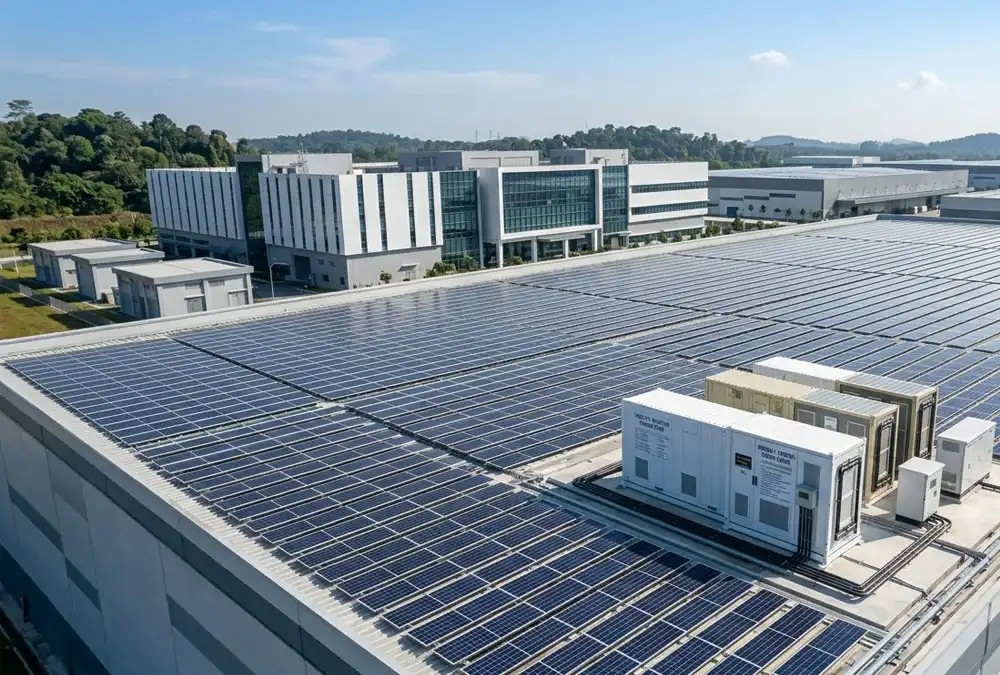
Standalone solar systems are limited by intermittent generation and cannot provide power at night or during grid outages. A Solar Plus Storage System integrates solar PV panels with an industrial battery storage installation to create a dispatchable clean energy asset.
Key Components of an Integrated Energy System
An optimized hybrid energy system relies on four core technologies:
- Battery Energy Storage System (BESS): The core hardware container utilizing advanced Lithium Iron Phosphate (LFP) cells for long cycle life. Alternative solutions include Flow Batteries for ultra-long durations or Flywheels for short power bursts. For most C&I sites, LFP offers the best balance of footprint, efficiency, and cost.
- Battery Management System (BMS): The micro-processor layer that monitors cell voltages and temperatures to ensure safe operation.
- Power Conversion System (PCS): The bi-directional inverter that converts DC battery power into stable AC power for the facility.
- Energy Management System (EMS): The software control platform that automates system charging and discharging schedules.
Benefits of Solar Plus Storage Turnkey Projects
These integrated systems provide peak shaving capabilities to lower high demand charges during peak operational windows. They offer reliable backup power during grid failures, optimize energy costs through time-of-use arbitrage, and support workplace EV charging infrastructure solutions without overloading local grid connections.
AnengJi Industrial Product Integration: Liquid-Cooled C&I BESS
To maximize financial returns on complex projects, AnengJi pairs high-yield solar arrays with our integrated Liquid-Cooled Commercial and Industrial Battery Energy Storage System (261kWh). This pre-engineered asset simplifies onsite integration.
- Thermal Management: Advanced closed-loop liquid cooling keeps cell temperature variations under 2°C, extending battery asset life by 20%.
- All-in-One Enclosure: Integrates LFP cells, a 100kW bi-directional PCS, an intelligent EMS, and fire suppression systems into a single cabinet, reducing construction labor.
Why Large-Scale Projects Prefer Turnkey Solar Solutions
As project scale increases, systemic complexity grows. This makes integrated project delivery the preferred model for large institutional developments.
Commercial and Industrial Solar Projects
Manufacturing facilities, distribution warehouses, and corporate business parks require fast execution that does not disrupt daily operations. Turnkey contracts streamline deployment, allowing management teams to focus on core business operations.
Utility-Scale Solar Farms
Large utility projects require extensive electrical engineering and grid matching. Institutional investors prefer turnkey models because the comprehensive cost control and clear performance warranties create a highly bankable project asset.
Solar Plus Storage and Microgrid Projects
Adding advanced electrochemical storage and microgrid software increases technical complexity. Turnkey delivery ensures all components work together seamlessly, avoiding the integration failures common in multi-contractor setups.
Real-World Applications of Turnkey Solar Solutions Across Industries
Integrated energy projects deliver measurable financial benefits across a wide range of industrial and commercial applications.
Industrial Manufacturing
Factories running multi-shift operations use turnkey solar to flatten peak daytime power demands, lowering fixed energy costs and improving operating margins.
Logistics and Warehousing
Logistics hubs feature large, flat roof spaces. Turnkey deployments convert these underutilized areas into generation assets, creating auxiliary revenue through net metering programs.
Commercial Buildings
Corporate headquarters and retail centers use turnkey systems to cut daytime air conditioning costs and satisfy sustainability reporting goals.
Agricultural Solar Projects
Farming enterprises and cold storage facilities utilize ground mount systems to secure reliable power, insulating operations from rural grid instabilities.
EV Charging Infrastructure
Logistics operators deploying electric delivery fleets combine solar arrays with BESS assets to support high power fast chargers without requiring expensive utility grid upgrades.
Utility-Scale Renewable Energy Projects
Independent Power Producers (IPPs) use large-scale turnkey installations to feed power into high-voltage transmission networks under long-term Power Purchase Agreements (PPAs).
How We Deliver Turnkey Solar Solutions Across Europe
AnengJi provides end-to-end clean energy engineering tailored for demanding commercial, industrial, and utility-scale developers.
Comprehensive EPC Project Management
We manage the complete lifecycle in house, from initial site feasibility mapping to final electrical installation. This internal coordination eliminates vendor friction and keeps projects on schedule.
Local Compliance and Grid Connection Expertise
Our engineering teams navigate complex European regulatory requirements. We manage all utility interconnection studies, ensuring full compliance with regional high-voltage injection codes.
Global Procurement Network
Through our direct manufacturing footprint, AnengJi eliminates supplier markups. This ensures project developers receive tier-1 equipment quality at competitive prices, optimizing initial project CAPEX.
Integrated Solar Plus Storage Capabilities
We specialize in building hybrid energy systems. By matching high-efficiency solar layouts with advanced BESS configurations and optimized EMS programming, we deliver reliable, dispatchable power assets.
Quality Assurance and Performance Guarantees
Every system matches strict quality benchmarks. All components carry verified CE markings and comply with international standards like IEC 61215 and IEC 62109, providing confidence to project financiers.
Long-Term Operations and Maintenance Support
Our dedicated operations team provides continuous performance tracking, predictive servicing, and rapid field support to ensure high system uptime over the life of the asset.
How to Decide Between Turnkey Solar Solutions and Traditional Installation
Review this clear framework to determine the most effective execution strategy for your organization’s energy goals.
Choose Turnkey Solar Solutions If:
- You require rapid project execution and fast grid interconnection.
- You want a fixed price contract with minimal risk of budget overruns.
- You prefer a single responsible partner holding full technical and legal liability.
- You are deploying a complex project, such as a solar plus storage microgrid.
Choose Traditional Installation If:
- You maintain a large, in house engineering and construction management team.
- You require maximum flexibility to mix distinct hardware component brands.
- Your organization can absorb the financial risks of potential project delays and field change orders.
Frequently Asked Questions About Turnkey Solar Solutions
What are turnkey solar solutions?
They represent an all-inclusive delivery model where a single contractor manages engineering, procurement, construction, and commissioning, handing over a fully operational energy asset to the owner.
Are turnkey solar projects more expensive?
While the initial contract price may include general management fees, they protect against the costly change orders and delay expenses common in traditional installations, often resulting in a lower total cost.
Which option offers a better ROI?
Turnkey projects typically deliver a better Return on Investment. Integrated engineering maximizes system performance and generation efficiency, which shortens the capital recovery timeline.
How much faster are turnkey solar projects?
By overlapping engineering and procurement phases, turnkey solutions often reduce total project schedules by 25% to 40% compared to fragmented, multi-vendor installation models.
Can battery storage be included in turnkey solar solutions?
Yes. Modern turnkey projects regularly integrate containerized BESS hardware, bi-directional inverters, and smart EMS platforms alongside the solar array to support advanced energy management.
Why do utility-scale projects prefer turnkey delivery?
Institutional investors require high financial predictability. Turnkey delivery provides fixed pricing and comprehensive performance guarantees, making the project highly eligible for non-recourse financing.
Final Thoughts: Choosing the Right Solar Project Delivery Model
Key Takeaways for Project Owners
Deploying large-scale energy infrastructure requires balancing cost, time, and execution risk. Turnkey solar solutions simplify project execution by replacing multi-contractor friction with a single point of responsibility. While traditional installation offers structural customization, it introduces high management complexity and financial risks that can hurt project economics.
Future-Proofing Renewable Energy Investments with Turnkey Solar Solutions
As solar PV, battery storage, smart EMS platforms, and fleet EV charging infrastructure become more integrated, development complexity will continue to rise. Partnering with a specialized Turnkey Solar EPC Contractor provides the most efficient pathway to deliver reliable, scalable, and financially optimized clean energy projects across Europe and global markets.