Introduction
EV charging station safety is not proven by a CE mark, an emergency-stop button or a list of protection features. A certified charger can still become unsafe if its upstream protection is poorly coordinated, its isolation point cannot be reached during an incident, its cable crosses a pedestrian route, or nobody is authorized to take a damaged connector out of service.
For a business owner, EPC contractor or charging operator, the decision is therefore bigger than “Which charger is safest?” The practical question is: Can the complete installation demonstrate a traceable safety chain from the exact equipment model to commissioning, routine inspection and return to service after a fault?
Those fears are not hypothetical. Official records have documented chargers with poor internal connections that could defeat protective earthing, terminal blocks capable of overheating, incorrect safety labels, component failures associated with shock or fire risk, and equipment that began charging during a ground-integrity test without the service ground connected. The important question is not whether a dramatic incident has appeared in a headline; it is whether the project can stop a small defect from becoming an electric-shock, fire or operational event.
This guide explains that chain for commercial AC and DC charging projects, with Europe as the primary market and comparisons for the United States, Southeast Asia and Central Asia. It also shows which documents to request, what must be tested on site, how AnengJi structures its manufacturing and testing controls, and what users should do when equipment looks unsafe.
The 30-second safety test
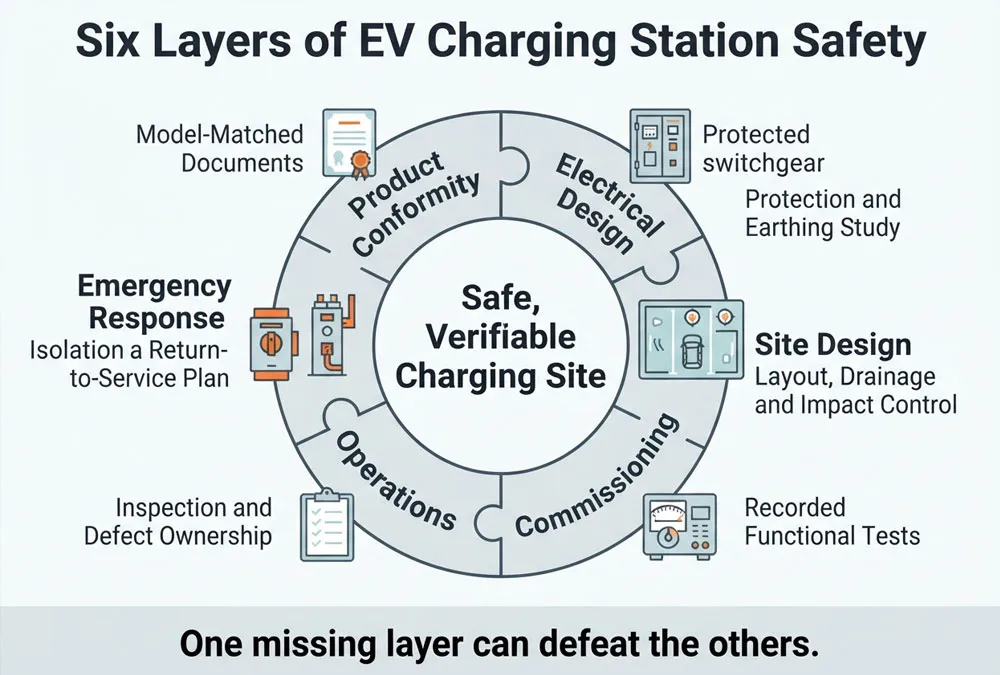
Before opening a charging site, verify all six layers:
- Product conformity for the exact ordered model and options
- Electrical protection and isolation designed as one system
- Safe placement, drainage, cable routing and vehicle-impact protection
- Recorded installation and commissioning tests
- Named inspection, maintenance and defect owners
- A practiced incident-isolation and return-to-service process
Real EV Charging Station Safety Incidents: What Buyers Should Learn First
The most useful official cases are not a collection of sensational EV-fire stories. They show how ordinary weaknesses—one loose conductor, one incorrect label, one unsuitable component or one market-certification mismatch—can remove a safety layer. The examples below are official recall, investigation or product-safety records. They are not global failure rates and do not imply that every product from a named brand or country is unsafe.
- United Kingdom, 2026—poor internal connections and loss of protective earth: the UK Office for Product Safety and Standards classified an imported portable EV charger as a serious electric-shock risk because poor internal connections could cause protective earthing to be lost and the product to become live. The import was rejected and destroyed. What the buyer should verify: protective-earth continuity, internal wiring, production consistency and whether the certification documents match the supplied unit. Read the OPSS safety report.
- United Kingdom, 2026—terminal-block overheating: another OPSS report identified a manufacturing defect in an internal output terminal block that could cause connections to overheat. A modification programme included software action, inspection and repair or replacement where necessary. What the buyer should verify: terminal inspection, thermal test evidence, batch traceability and the supplier’s corrective-action process after shipment. Read the OPSS terminal-block report.
- United Kingdom, 2026—incorrect terminal labeling: a backplate was marked “L3” where “PME” should have appeared. OPSS warned that the error could mislead installers and potentially bypass the built-in PEN-fault detection path. What the buyer should verify: labels, drawings, installer instructions, change control and serial-number traceability. Read the OPSS labeling report.
- United States, 2018—component failure and overheating: NHTSA recall campaign 18E-086 covered 4,528 EV charging systems because capacitors could fail, creating possible shock or fire hazards. What the buyer should verify: critical-component qualification, approved bill of materials, component-substitution control and recall support. Read the NHTSA recall acknowledgement.
- United States, 2024—arcing and thermal-event allegations: NHTSA opened preliminary evaluation PE24028 after receiving six complaints involving residential Level 2 chargers. The opening document identifies electrical arcing and thermal events as the subject under evaluation; opening an investigation is not a final defect determination. What the buyer should verify: event logs, complaint traceability, remote-support continuity and safe shutdown behavior. Read the NHTSA opening resume.
- Australia—local certification mismatch: an official Australian recall stated that a charging-socket wallbox did not meet local certification and labeling requirements, creating a potential electric-shock or fire risk. Affected units were replaced by a licensed electrician. What the buyer should verify: destination-market approval rather than assuming that acceptance in one country transfers to another. Read the Australian safety recall.
What Authoritative Testing Found Before and During Deployment
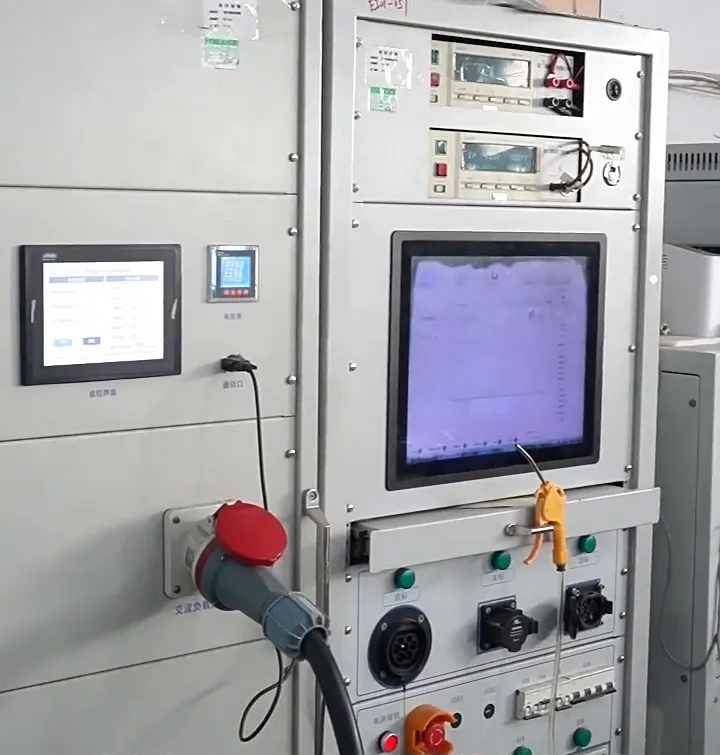
Official testing also shows why a certificate review and visual inspection are not enough. In the U.S. Department of Energy’s Irvine Smart Grid Demonstration final technical report, Southern California Edison evaluated EV supply equipment through functional, safety, grid-event, power-quality and ergonomic testing before field deployment.
Four findings from that specific historical project—not an industry failure rate
- A ground-integrity test found that the evaluated EVSE began charging without the service ground connected.
- Initial inspection found loose primary power cables at the terminal block, which could have caused arcing, short circuit, shock or fire if left uncorrected.
- The project resolved more than 20 software and hardware issues with the evaluated units by October 2014.
- Three different EVSE units developed excessive heat that damaged wires and terminal blocks; the project ultimately replaced the affected equipment.
The report is older and describes one demonstration project, so its counts cannot be generalized to today’s chargers. Its enduring lesson is procedural: ground-integrity tests, terminal inspection, thermal monitoring and post-update retesting can expose hazards that document review misses.
High-power DC sites add an emergency-response concern. The U.S. Fire Administration describes DC fast charging stations in a 400–1,000 V range and notes that responders need a quickly accessible means of disconnecting power. Its 2025 responder-safety guidance reinforces why isolation location, labeling and staff training must be designed before opening day.
The practical conclusion
Most of these events were not caused by “electric vehicles being unsafe.” They exposed a broken link between product design, component control, assembly, documentation, installation or field response. A buyer therefore needs an evidence chain—not a single safety logo.
What reduces a buyer’s real safety anxiety?
- Proof that the ordered model—not merely a product family—matches the certification documents.
- Evidence that high-current connections, protective functions and thermal behavior were tested.
- A site layout that prevents water exposure, vehicle impact, inaccessible controls and cable trip hazards.
- A named person who can isolate a fault and a defined process for returning equipment to service.
What Do EV Charging Station Safety Requirements Cover?
Commercial charging safety has several overlapping boundaries. Product standards address the charger and its interfaces. Electrical-installation rules address the circuit, earthing and protective devices. Building, fire and accessibility requirements address the site. Operating procedures determine what happens after the installer leaves.
This distinction matters because a buyer can receive a compliant product and still inherit an unsafe project. The following matrix makes the missing link visible.
| Safety layer | Failure the buyer may see | Evidence that closes the gap |
|---|---|---|
| Product | Certificate covers a different model or option | Model-matched declaration, certificate scope and technical documentation |
| Electrical design | Repeated trips, overheating or ineffective fault isolation | Single-line diagram, protection study, earthing design and settings schedule |
| Site design | Cable trip hazard, standing water or vehicle impact | Coordinated civil, drainage, traffic, access and fire layout |
| Commissioning | Safety feature exists on paper but does not operate correctly | Inspection, protection and functional-test records |
| Operations | Damaged connector remains available to users | Defect categories, response times, lockout process and asset history |
| Emergency response | Staff press an emergency stop but do not know what remains energized | Isolation matrix, labels, training and restoration authorization |
EV Charging Station Safety Codes by Market
Europe: Product Conformity and National Installation Rules
Europe does not have one certificate that approves an entire charging site. The product, electrical installation and building or fire-safety layers must be assessed separately.
IEC 61851-1:2017 covers general requirements and electrical safety for conductive EV supply equipment within a stated scope of up to 1,000 V AC or 1,500 V DC rated supply voltage, and up to 1,000 V AC or 1,500 V DC rated output voltage. Those figures define the standard’s equipment scope; they are not a recommended station operating voltage.
IEC 60364-7-722:2018 addresses low-voltage installation circuits supplying EVs and circuits feeding energy back from EVs. In practical terms, IEC 61851 evidence does not replace the site designer’s work on the supply circuit, earthing and protective measures.
For equipment placed on the EU market, applicable legislation can include the Low Voltage Directive 2014/35/EU and the EMC Directive 2014/30/EU. Chargers with intentional radio functions may also fall within the Radio Equipment Directive. The manufacturer must assess the actual configuration and applicable legislation.
Buyer warning: CE marking is not automatically proof that an independent laboratory approved the whole charger or the completed site. Ask for the EU Declaration of Conformity, exact model identification, listed legislation and standards, and supporting technical evidence.
United States: NEC, Listed Equipment and Local Approval
In the United States, EV power-transfer installations are addressed by NFPA 70, including NEC Article 625, but the adopted NEC edition and local amendments depend on the authority having jurisdiction. Product evaluation and installation approval are related, but they are not interchangeable.
UL Solutions’ EV charging standards overview identifies UL 2594 for EV supply equipment, UL 2202 for DC charging equipment, UL 2231-1 and UL 2231-2 for personnel-protection systems, and UL 2251 for plugs, receptacles and couplers. A procurement specification should identify which standard applies to the equipment being purchased and whether the certification covers the ordered model.
Southeast Asia and Central Asia: Do Not Assume One Regional Rule
Many projects use IEC-based technical references, but national registration, licensing, electrical and fire requirements still apply. Singapore provides a clear example: its Ministry of Transport states that Singapore Standard 722 replaced TR 25 on 1 April 2026, and chargers supplied there must meet the Land Transport Authority’s requirements and be certified and registered.
Central Asian rules also need country-level confirmation. Kazakhstan’s emergency authority reported 2024 amendments concerning EV charging in garages, parking areas and other locations. For Kazakhstan, Uzbekistan or another destination market, request a current compliance matrix from the project’s local designer or approval specialist instead of accepting a generic “international standard” statement.
Product Certification Is Not the Same as Installation Compliance
A useful procurement package should answer three different questions:
- Was the exact product configuration assessed? Match model number, rated input/output, connector option, communication module and production variant.
- Was the site designed for that equipment? Confirm supply, protection, earthing, isolation, environmental conditions, traffic and fire strategy.
- Was the installed system tested? Retain installation certificates where required, protective-device tests, functional checks, alarm tests and handover records.
A certificate for a charger family cannot prove that field cable terminations are tight, an upstream protective device is correctly selected, or an emergency isolator shuts down the intended chargers. These are site-verification tasks.
How AnengJi Builds a Verifiable EV Charger Safety Case
For a commercial buyer, manufacturing capability matters when it produces traceable evidence. AnengJi’s EV charger manufacturing and R&D system includes a 40,000 m² production base, more than 50 production and testing assets, enclosure-processing equipment, dedicated charger test systems and material-analysis capability.
International Conformity and Certification Portfolio—With Model-Level Verification
Company-supplied certification materials display CE, CB, UL, CCC, TÜV Rheinland and CQC marks, together with ISO 9001. Additional company records identify ISO 14001, ISO 45001 and IATF 16949 management-system certifications. These credentials demonstrate that AnengJi has worked with international conformity, laboratory and management-system frameworks.
Certification portfolio shown in company-supplied materials
CE • CB • UL • CCC • ISO 9001 • TÜV Rheinland • CQC
The professional way to present this strength is not to claim that every mark covers every charger. Certification scope may differ by model, rated power, connector, radio module and destination market. AnengJi can therefore support procurement by mapping the ordered configuration to the corresponding certificate, declaration or test report. Buyers should request certificate numbers and model appendices before tender approval.
Patents belong in a different evidence category. AnengJi reports more than 100 core patents, including 50+ invention patents and 50+ utility-model and design patents. They demonstrate R&D ownership in areas such as charging architecture, power conversion, thermal management, centralized power allocation, control, communication and enclosure protection. A patent does not replace a safety certificate, but it helps buyers evaluate whether the supplier controls its own engineering rather than only assembling a catalogue product.
How Manufacturing Controls Address the Risks Buyers Fear
| Buyer concern | AnengJi control described in company materials | Evidence to request for the order |
|---|---|---|
| Loose connections and heat damage | Dedicated AC/DC charger test equipment, multi-channel power analysis and a company-described 72-hour full-load aging process | Batch aging record, applicable thermal test and terminal inspection/torque control |
| Water, dust and corrosion | Sealed enclosure fabrication, corrosion-resistant coating and water-resistance verification against the model’s declared design | Exact-model IP test report, enclosure drawing and environmental limits |
| Material or component inconsistency | Energy-dispersive X-ray fluorescence analysis, electrical-life testing and controlled production equipment | Approved BOM, critical-component list and engineering change-control process |
| Protection exists in software but fails in practice | Charger test benches and functional test instruments for AC and DC equipment | Fault-injection or functional-test record for the exact protection sequence |
| Mechanical enclosure variation | TRUMPF automated laser cutting, Yawei intelligent bending and CNC enclosure processing | Dimensional inspection record and model-specific IK evidence where an IK rating is declared |
Safety Functions Buyers Can Verify on Specific AnengJi Configurations
AnengJi product documentation provides concrete examples of how those manufacturing controls become equipment-level protection. The listed functions are configuration-specific, so the purchase specification should name the model and require the corresponding manual, test record and certificate scope.
- 11 kW AC charger configuration: the published product specification lists charging-gun temperature detection, overvoltage, undervoltage, overload, short-circuit, grounding, overtemperature, low-temperature, insulation-monitoring and reverse-polarity protection. It also describes an emergency-stop control. Buyers can review the 11 kW AC charger configuration and then confirm which listed functions are included in the ordered regional variant.
- 20/30/40 kW DC charger configurations: the published product specification lists overcurrent, overload, short-circuit, overtemperature, grounding and overvoltage protection, together with an IP54 enclosure rating and a declared operating range of −20°C to +50°C. Buyers can use the 20/30/40 kW DC charger documentation as the starting point for model-level verification.
What the buyer should ask AnengJi to prove
For the exact quotation, request a one-page protection matrix showing the fault detected, detection method, charger response, reset condition, alarm or backend record, applicable test evidence and whether any upstream protection remains the EPC’s responsibility. This turns a long feature list into a checkable safety chain.
Electrical Safety Requirements for AC and DC EV Charging
AC and DC equipment share basic safety objectives—protection against electric shock, overcurrent, thermal damage and unintended energization—but they do not use identical architectures. Buyers should compare the protection chain, not simply count features in a brochure.
| Decision point | Commercial AC charging | DC fast charging | Buyer consequence |
|---|---|---|---|
| Power conversion | Main AC-to-DC conversion occurs in the vehicle | Charger converts site AC and delivers controlled DC | DC equipment adds high-voltage conversion, cooling and internal isolation considerations |
| Fault protection | Coordinate integral monitoring with upstream residual-current and overcurrent protection | Coordinate AC input protection, DC insulation/fault monitoring and internal DC switching | The specification must define both charger functions and site-provided protection |
| Thermal risk | Terminations, sockets, connectors and cables under sustained load | Power modules, buswork, contactors, connectors and cable-cooling system where fitted | Temperature alarms and derating behavior should be verified, not merely listed |
| Isolation | Define circuit and charger isolation | Define charger group, power cabinet, dispenser and auxiliary-supply isolation | Emergency-stop labels must match the actual isolation zone |
Why “Built-In RCD” Is Not a Complete Answer
A recurring field complaint is a charger that works for weeks and then begins tripping. Repeated resets can hide a deteriorating connection, water ingress, an upstream device mismatch or a genuine insulation fault. The correct response is not to increase the breaker rating or bypass protection.
The designer must identify what residual-current or ground-fault protection is integral to the charger, what protection is installed upstream, how DC residual current is addressed, and how selectivity and testing will be managed. The commissioning team should test the actual protective arrangement using equipment and procedures suitable for the installed device types.
This is the kind of requirement that should be resolved before selecting either AC charging equipment or DC fast charging equipment. The category and power level start the conversation; the exact model documentation and project design complete it.
EV Charging Site Safety: Placement, Cables and Vehicle Impact
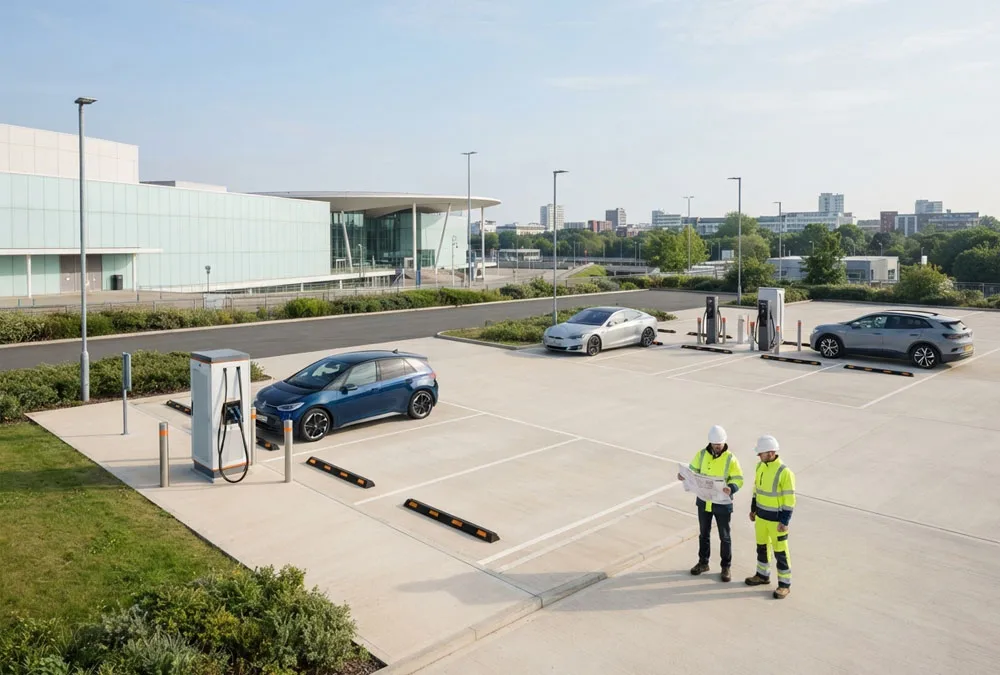
Many user injuries and equipment failures begin with layout, not electronics. A charger can be protected by bollards and still be difficult or dangerous to use. A cable can reach every vehicle inlet and still cross the walking route. A raised plinth can reduce minor water exposure but block wheelchair access.
The U.S. Access Board’s technical assistance recommends a clear floor or ground space of at least 30 × 48 inches. Operable parts should be no higher than 48 inches above the clear space and no farther than 10 inches away for an unobstructed side reach. These are U.S. technical recommendations, not universal global dimensions, but they show why charger position, bollards and controls must be designed together.
A coordinated site review should confirm:
- vehicle swept paths and likely charging-inlet positions;
- connector reach without stretching or crossing an accessible route;
- cable storage that prevents dragging, drive-over damage and trip hazards;
- bollard or curb positions that protect the cabinet without blocking controls;
- surface drainage, flood level and safe routing of underground services;
- lighting, visibility, emergency communication and secure access to switchgear;
- maintenance clearance and a safe technician working zone.
The U.S. Joint Office guidance on physical safety and security also highlights lighting, open sightlines, tamper resistance, secured electrical equipment and staff training. These controls reduce both user risk and the time a damaged asset remains unnoticed.
EV Charging Fire Safety for Outdoor and Covered Sites
Fire planning should distinguish an EVSE electrical fault from a damaged vehicle battery. Isolating the charger removes external charging energy; it does not remove energy already stored inside the traction battery.
The European Commission’s 2025 guidance for EVs and charging infrastructure in covered parking reports that available data indicate battery-electric vehicles have a lower fire risk than internal-combustion vehicles. The same guidance still calls for tailored prevention, detection, evacuation, propagation control and firefighting because thermal runaway, jet flames and possible reignition change the response challenge.
For an outdoor site, the fire strategy may focus on separation from combustible storage, emergency access, impact protection and safe isolation. For covered parking, the review also needs to consider detection, smoke control, compartmentation, evacuation, suppression strategy and coordination with local fire services. A universal spacing number or extinguisher rule should not be copied from another jurisdiction without a site-specific fire-risk assessment.
An Emergency Stop Is Not an Isolation Plan
Before commissioning, document what each emergency stop or isolator disconnects: one connector, one charger, one power cabinet, a floor or the complete charging distribution. Record whether control power, network equipment, lighting or other auxiliaries remain energized. Labels must match the single-line diagram, and only an authorized person should reset the system after the initiating condition has been investigated.
EV Charger Commissioning: Evidence Required Before Opening
Commissioning converts design intent into evidence. The exact tests depend on the jurisdiction, equipment and installation, but the handover package should make responsibility visible.
| Stage | Responsible party | Minimum evidence | Release question |
|---|---|---|---|
| Selection | Supplier + designer | Exact-model conformity documents and manuals | Does the evidence match the ordered configuration and market? |
| Design | Electrical designer / EPC | Load study, single-line diagram, protection and earthing design | Do the charger and site protections operate as one system? |
| Installation | Qualified contractor | Inspection records, cable/termination data and required certificates | Were substitutions and deviations approved? |
| Functional test | Commissioning team | Protection, alarm, isolation, communication and charging-session results | Does each tested fault produce the intended safe state? |
| Handover | EPC + owner/operator | Asset register, as-built drawings, training and maintenance plan | Can the operator isolate, report and manage a defect? |
Recommended project release gates—not universal legal thresholds
- 100% of energized connectors have a completed commissioning record.
- 0 unresolved critical safety defects at public opening.
- 100% of isolation labels match the approved drawings and tested isolation zone.
- 100% of nominated site responders have completed the handover briefing.
Commercial EV Charging Safety During Operation
A site remains safe only when defects are detected, classified and closed. Do not set one universal annual inspection interval. Combine local requirements, the manufacturer’s instructions, utilization, environmental exposure, fault history and the site risk assessment.
The operating plan should define:
- what the user or site team checks before use;
- which defects require immediate isolation;
- who may reset a protective device or emergency stop;
- how remote alarms create an on-site work order;
- who approves repair parts, firmware changes and configuration changes;
- what evidence is required before returning equipment to service.
What Should a User Do When a Charger Looks Unsafe?
- Cracked cable, exposed conductor, burned pin or loose connector: do not connect. Keep the equipment unavailable and report the exact connector number.
- Repeated breaker or RCD trip: do not repeatedly reset it. Record the fault indication and ask a qualified person to inspect both the charger and supply circuit.
- Standing water, flood exposure or water inside a connector: keep users away and isolate through trained staff. An outdoor rating does not mean flooded equipment can be re-energized without inspection.
- Vehicle impact: isolate before checking the cabinet, foundation, conduit and electrical integrity. A standing enclosure may still contain damaged internal connections.
- Smoke, hissing, unusual heat or a damaged vehicle battery: move away, warn others and call emergency services. Do not attempt an improvised repair or firefighting response.
EV Charging Station Safety Procurement Checklist
A strong request for quotation should ask suppliers and contractors to answer the following questions against the actual project—not a generic brochure.
- Which exact models, options and software/communication variants are covered by each conformity document?
- Which standards, directives and local codes apply in the destination market?
- Which protective functions are built into the charger, and what must be supplied upstream?
- What happens after loss of communication, control power, cooling or a thermal alarm?
- What does each emergency stop or isolator disconnect?
- Which factory and site tests are included, and which records will be handed over?
- Who owns remote alarms, on-site isolation, repair approval and safe return to service?
- Which connector, cable and critical spare parts are available for the operating region?
When comparing equipment, use the site’s dwell time, required energy delivery, electrical capacity and operating model to choose AC or DC first. Then request the exact compliance and protection package for the selected configuration. A long feature list without model-matched evidence is not a safety case.
Frequently Asked Questions About EV Charging Station Safety
Are EV charging stations safe in the rain?
Appropriately selected, installed and undamaged outdoor charging equipment is designed for its declared environmental conditions. Do not use equipment with broken seals, damaged connectors, standing-water exposure or suspected flood damage.
What is the most common EV charging hazard?
There is no single universal “most common” hazard across all site types. Frequently encountered operational risks include damaged cables/connectors, trip hazards, poor terminations, repeated protection trips and vehicle impact. The site risk assessment should rank them using local conditions and incident history.
Can a driver sit in an EV while it is charging?
Under normal operation, users may remain in the vehicle unless the vehicle, charger, site operator or local rules state otherwise. A user should leave the area if there is smoke, unusual heat, odor, noise, visible damage or an emergency warning.
Do all commercial EV chargers need an emergency-stop button?
Requirements depend on equipment design, power level, site configuration and local rules. Even where an emergency-stop function is provided, the project must document what it disconnects, how it is labeled and who may reset it.
How often should a commercial EV charger be inspected?
Use the manufacturer’s instructions, applicable regulations, local inspection rules and a risk-based schedule. High-utilization, public, coastal, flood-prone or vandalism-prone sites may need more frequent checks than a controlled private installation.
What safety documents should a charger supplier provide?
Request model-matched declarations and certificates, technical datasheets, installation and operating manuals, protective-function information, environmental ratings, maintenance instructions, warranty terms and available factory-test evidence. The EPC and installer must add site design, inspection, test and as-built records.
Buy an Evidence Chain, Not a Safety Feature List
A safe charging project connects the exact product to the exact market, site, protective design, commissioning result and operating owner. If one link is missing, the risk does not disappear—it moves to the business that owns or operates the site.
Before requesting equipment, prepare the destination market, required charging power, site layout, available electrical capacity, parking or vehicle-flow model and expected operating hours. That information allows the supplier and project team to discuss the correct charger configuration and documentation instead of relying on a generic compliance claim.