Introduction
If you are asking for an EV charger MOQ, you probably need three numbers before approving a private-label programme: the minimum quantity for one exact configuration, the cash required beyond the unit price, and the date the first saleable batch can reach your warehouse. A single “MOQ: 100” or “lead time: 30 days” does not answer any of those questions unless the supplier defines the SKU, customization scope, starting event and delivery boundary.
This guide puts those commercial answers first. It compares supplier-published 2026 planning examples, calculates the non-unit cost of two illustrative AC charger launches, and shows how a one-SKU launch differs from a three-SKU product line or a small DC project. The competitor figures below are not AnengJi quotations or universal industry averages. AnengJi’s separate fast-track terms for eligible validation orders are identified clearly so buyers can distinguish a one-set custom sample from a production MOQ.
2026 quick answer
- AC chargers: public supplier examples range from the low hundreds for white label to 50–200 or 300+ for ODM. The disagreement is why a model-specific quotation matters.
- DC fast chargers: public examples often start with one unit or a small project batch because the unit value and project configuration differ from stocked AC wallboxes.
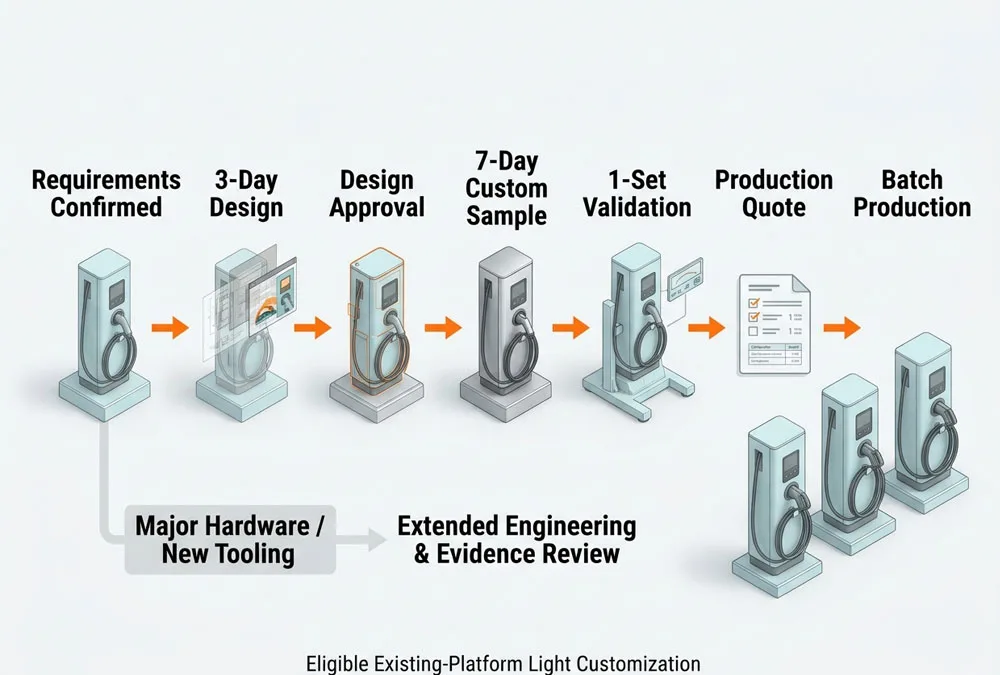
- AnengJi validation route: eligible existing-platform projects can start from one set, with design customization targeted within 3 days and a custom sample targeted within 7 days after the required inputs and design are confirmed.
- First-order cost: calculate units plus NRE, tooling, samples, compliance work, inspection, freight, import charges, spares and software—not units alone.
- Lead time: distinguish ex-factory production from landed delivery. Public 2026 examples range from roughly 4–8 weeks ex-factory for a simple white-label programme to 14–22 weeks for new-tooling ODM, before destination risk is considered.
2026 EV Charger MOQ Examples: Compare the Source, Not Just the Number
There is no neutral, audited database of EV charger factory MOQs. The most transparent available numbers are supplier-published planning examples, and they do not agree. That does not make them useless. It shows that MOQ changes with platform, supplier economics, engineering scope and the unit used for counting.
| Public source | AC white label | AC ODM | DC charger | What the buyer should learn |
|---|---|---|---|---|
| Supplier example A, June 2026 | 300 units per SKU | 50–200 units for a first order, depending on change depth | Starts from 1 unit for project-driven orders | The per-SKU rule can multiply the real commitment. |
| Supplier example B, August 2026 | Low hundreds | Commonly 300+ units | Single-digit white-label or 2+ ODM units may be possible | A different platform or supplier can produce a materially different minimum. |
| Supplier example C, October 2026 | No fixed quantity published | No fixed quantity published | No fixed quantity published | It ranks changes from standard label through new electronics by their MOQ impact. |
Source note: figures were checked on 2 November 2026 in public guides from JointCharging, ULandPower and VULTAE. These are supplier-published examples, not independent market statistics and not AnengJi programme terms.
AnengJi fast-track customization for a lower-risk market test
AnengJi offers a faster entry route for buyers that want to validate a model or market before committing to a large production batch. The route is intended for eligible projects based on an existing charger platform with light OEM customization. It should not be confused with a new enclosure, new electronics, a separate firmware architecture or fresh certification programme.
| AnengJi programme point | Target or starting point | Suitable use | Boundary to confirm |
|---|---|---|---|
| Design customization | Targeted within 3 days | Logo, artwork and agreed light specification changes on an existing platform | Clock starts after the requirements, source files and selected base model are confirmed. |
| Custom sample | Targeted within 7 days | Physical and functional review before a larger order | Timing begins after design approval and depends on platform and material availability. |
| Low validation MOQ | From 1 set | Testing a lower-risk model, specification or target market | This is a sample or validation starting point, not a blanket mass-production MOQ. |
| OEM light customization | Small-batch support | Brand customization and selected specification changes | Exact batch size changes with the model, option, component and document scope. |
| Agile supply support | Procurement aligned with the launch plan | Pilot, initial release and forecast-based replenishment | Production slots and component purchasing require an agreed forecast and current availability check. |
Commercial note: the 3-day design target, 7-day custom-sample target and one-set starting point are AnengJi programme information supplied for this article. The model-specific quotation should confirm scope, start event, included deliverables, sample price, freight, destination-market evidence and the separate MOQ for mass production.
The number is meaningless until the quotation defines “per what?”
Ask whether the minimum applies per purchase order, product family, model, power level, connector, colour, firmware branch, packaging language or complete SKU. Consider a buyer ordering 300 AC chargers split across 7 kW, 11 kW and 22 kW versions. If the factory minimum is 300 units per SKU, the buyer has not met the minimum; the commercial commitment is 900 units. If two colours are added, it may become six SKUs and 1,800 units. This is the inventory trap hidden behind a seemingly acceptable headline MOQ.
RFQ wording: “Please state MOQ for this exact configuration and identify whether it is counted per model, power level, connector, colour, firmware, packaging language or total order. Also quote the standard-platform minimum separately from every custom option.”
How Much Does a First EV Charger ODM Order Cost?
Unit price is only the repeatable hardware line. A buyer can have enough cash for the units and still fail to launch because the budget excludes engineering, evidence, freight or the replacement stock needed to support the first customers.
Worked example 1: one European AC SKU, 200 units
The following calculation uses a June 2026 supplier-published “basic ODM” example—not an AnengJi quote. The programme includes logo, colour and firmware work for 200 AC chargers. The unit price is deliberately left as U because power, cable, meter, protection, connectivity and commercial terms are unknown.
| Cost line | Public planning example | Buyer interpretation |
|---|---|---|
| Production units | 200 × U | Request one frozen configuration and Incoterm. |
| NRE / tooling | USD 3,000–5,000 | Link payment to drawings, firmware or tooling deliverables. |
| Published certificate-path allowance | USD 1,500–3,000 | Do not assume a transfer is available; verify the exact model, brand and technical change first. |
| LCL sea freight to EU | USD 3,000–6,000 | Obtain a dated forwarder quote for the real volume, weight, port and Incoterm. |
| Customs and handling | USD 800–1,500 | Confirm HS classification, duty, VAT treatment and inland delivery with a broker. |
| Non-unit subtotal | USD 8,300–15,500 | USD 41.50–77.50 per charger before unit price, spares and contingency. |
That last line is the useful decision. A purchasing team comparing only U will understate the launch cost by the non-unit allocation. It should also add sample freight, initial replacement parts, third-party inspection and a clearly governed contingency if they are not already included.
Worked example 2: new enclosure and app, 100 units
The same public guide shows a more extensive 100-unit programme with a new enclosure, branded app and packaging. Its non-unit example is USD 22,500–40,000, equal to USD 225–400 per charger before the hardware price. The smaller order does not necessarily reduce cash exposure because new tooling and additional technical review dominate the first batch. For a market test, an existing enclosure with controlled branding can therefore be financially safer than a visually unique product.
How Long Does EV Charger ODM Take in 2026?
“Thirty days” often means factory production after deposit, frozen specifications and material release. It usually does not mean thirty days from first email to a compliant, sellable charger in a European warehouse. Compare schedules only after separating ex-factory readiness from sea transit, customs and inland delivery.
| Programme | Published ex-factory example | Published landed-Europe example | Main schedule risk |
|---|---|---|---|
| White label Logo and colour only | 4–8 weeks | 9–15 weeks | Artwork approval, packaging and available finished platform. |
| Firmware ODM No new enclosure | 8–14 weeks | 13–21 weeks | Requirements, CSMS integration, regression testing and sample approval. |
| New-tooling ODM | 14–22 weeks | 19–29 weeks | Tooling iterations, hardware change, evidence review and rework. |
These are supplier-published examples from the cited June 2026 guide, not guaranteed delivery windows. A separate August 2026 supplier guide gives roughly 4–6 weeks for production and QC of a standard existing-platform product. VULTAE’s October 2026 guide gives roughly 4–6 weeks port-to-port from northern China to northern Europe and tells buyers to add clearance and inland delivery. A live freight quotation and model-specific production plan remain necessary.
The date that starts the clock must be written down
A factory may count from the later of deposit, specification freeze, artwork approval, compliance-path confirmation and sample acceptance. A buyer may count from the purchase-order date. Both parties can then believe the project is on schedule while the launch slips. The quotation should state: “Lead time begins only after [named event] and ends at [ex-factory / named port / delivered location].”
Treat every post-freeze change as a schedule event. A new connector, cable length, meter, language, OCPP setting or enclosure opening may affect materials, drawings, firmware, documentation or test scope. Require a written change notice showing cost, old dispatch date, new dispatch date and any evidence that must be repeated before work resumes.
Three EV Charger MOQ Scenarios Buyers Can Use
Scenario A: launch one 11 kW AC charger in Europe
A distributor wants one Type 2 configuration, one colour and one packaging language. The lowest-risk route is usually an existing platform with controlled logo, label and documentation changes. The buyer can use AnengJi’s one-set validation route to review an eligible custom sample before negotiating the production batch, helping avoid dividing stock among 7, 11 and 22 kW variants before sales data exists. AnengJi’s published AC wallbox platform can serve as a configuration discussion point; production MOQ, evidence and landed lead time still require a written quote for the destination market.
Scenario B: build a three-SKU private-label range
The brand wants 7, 11 and 22 kW products, but its forecast only supports 300 units total. If the quoted minimum is 300 per SKU, the desired range requires 900 units before colours, cables or packaging versions are added. The practical solution is not to pressure the factory into an unclear blended MOQ. Launch the configuration with the strongest vehicle and electrical fit, use common packaging where legally and technically appropriate, and put later variants into a volume-triggered framework agreement.
Scenario C: buy four DC chargers for a site project
A four-unit order may be commercially feasible because DC chargers are commonly project configured, but “MOQ 1” does not mean plug-and-play. The quote must freeze rated output, input supply, connector arrangement, cable reach, payment, meter, modem, CSMS workflow, spare modules, commissioning support and site acceptance. AnengJi’s 60–160 kW DC charger family offers a product starting point, not permission to assume every option or certificate is available in every combination.
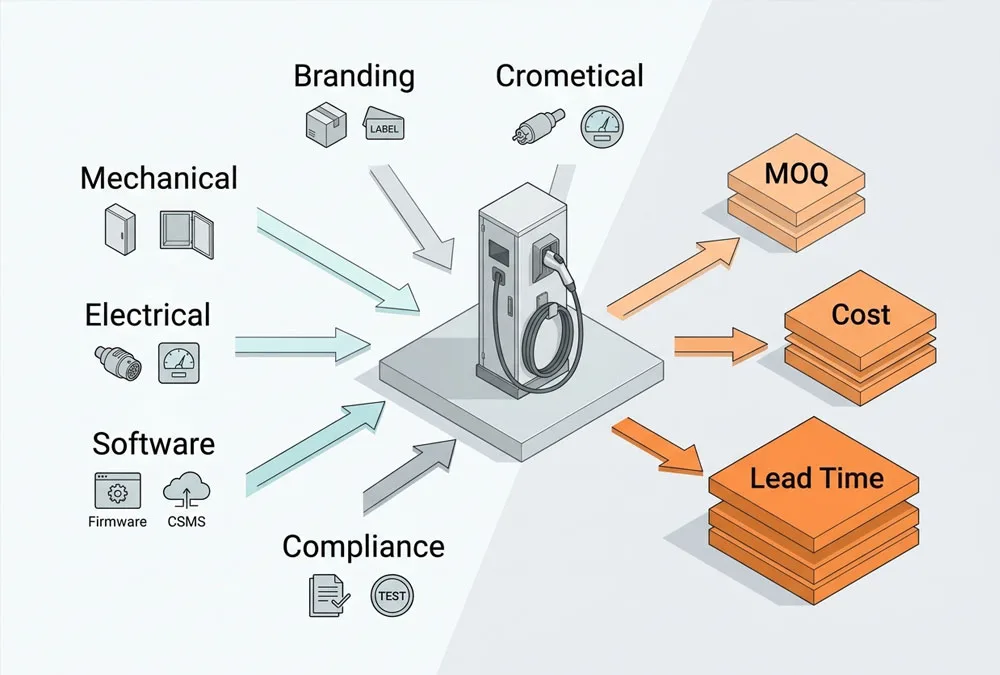
What Changes MOQ and Resets the ODM Schedule?
| Change layer | Examples | Why MOQ or time changes | Buyer control |
|---|---|---|---|
| Branding | Logo, label, carton, manual | Print setup, controlled artwork and packaging batches | Approve one artwork pack before material release. |
| Mechanical | Colour, faceplate, pedestal, new housing | Paint batch, fixtures, mould or sheet-metal tooling | Use an existing enclosure for the pilot unless form is commercially essential. |
| Electrical | Cable, connector, meter, RFID, modem | Component batch, wiring update and validation | Freeze the BOM option code, not a marketing description. |
| Software | UI, language, app, OCPP defaults, CSMS | New firmware branch and regression testing | Define messages, workflows, licence rights and recovery tests. |
| Market evidence | New brand, destination or technical variation | Evidence review, lab work or new documentation | Complete a compliance-delta review before paying NRE. |
The industry detail that protects repeat orders is the production baseline: approved golden sample, BOM revision, firmware version, configuration file, labels, manuals and packaging. A sample that “works” is not enough. Mass production must reproduce an identified version, and component substitutions or firmware updates must follow written change control.
How to Reduce EV Charger MOQ Without Buying the Wrong Product
- Start with one saleable SKU. Reduce power, connector, colour and language variants before negotiating quality controls away.
- Use the existing enclosure. Branding and UI changes usually expose less cash than a new mould or new sheet-metal architecture.
- Separate pilot from production. Buy samples for technical validation, then a controlled pilot batch, then release the commercial MOQ after acceptance.
- Offer a credible forecast, not an inflated promise. A framework can define future volume triggers without forcing the buyer to hold every unit on day one.
- Keep shared components across variants. Common enclosures, controllers, packaging dimensions and service parts can reduce variant overhead when the technical design allows it.
- Accept transparent small-batch pricing. A higher first-batch unit price may cost less than unsold stock, but the quality plan, evidence and warranty scope should remain intact.
Be cautious when a supplier offers a very low MOQ but cannot identify the factory, controlled BOM, serial traceability or evidence for the exact model. The stock may be a legitimate standard batch, but it may also be leftover inventory or mixed configurations. Ask for model identity, manufacturing records and a sample from the same proposed build before treating the low quantity as a benefit.
Check Compliance and OCPP Before Paying NRE
For EU sales, branding is not just a carton decision. The European Commission’s General Product Compliance guidance defines a manufacturer as a party that makes, or has a product designed or made, and places it on the market under its own name or trademark. The same guidance lists conformity assessment, technical documentation, the EU Declaration of Conformity, instructions and traceability among manufacturer responsibilities. Confirm the applicable rules and economic-operator roles for the exact product and country; a logo change does not automatically make existing documents usable under a new commercial arrangement.
OCPP evidence also follows a defined product. The Open Charge Alliance’s White Label Certification requirements state that the rebranded product must remain internally identical in hardware and firmware to the certified original, with written confirmations and original-vendor consent. If your ODM request creates another firmware branch, do not assume the original certificate follows it. Test the exact charger, firmware and CSMS workflow. AnengJi’s OCPP procurement guide provides a practical starting point for that integration review.
For North America, the route is different. UL Solutions lists product-specific standards including ANSI/UL 2594 for EVSE and ANSI/UL 2202 for DC charging equipment. The applicable pathway depends on the product, installation, jurisdiction and programme; do not copy a European cost or schedule assumption into a US launch.
What AnengJi Needs to Quote MOQ, Cost and Lead Time
A useful quotation should be built from a controlled configuration, not from the phrase “custom EV charger.” For the fast-track route, a complete brief is also what makes the 3-day design and 7-day sample targets measurable. Send the following inputs in one brief:
| Input | Minimum detail | Why it changes the quote |
|---|---|---|
| Market and role | Destination countries, your brand, importer/distributor structure | Defines evidence, labels, language and responsibilities. |
| Product baseline | AC/DC, power, connector, cable, mounting and quantity per exact SKU | Establishes platform fit and production batch. |
| Customization | Logo, colour, enclosure, UI, app, OCPP, CSMS, payment and documents | Separates branding from engineering and tooling. |
| Programme volume | Samples, first batch, 12-month forecast and reorder pattern | Supports pilot, batch and framework alternatives. |
| Schedule boundary | Required ex-factory date, delivery location and Incoterm | Prevents production time being mistaken for landed time. |
| Acceptance and support | Sample tests, FAT, spares, training, warranty and firmware support | Makes the first batch serviceable after delivery. |
Use the same brief for every shortlisted manufacturer. AnengJi’s commercial charger buying checklist can help normalize hardware, software, evidence and service scope before comparing quotations.
Start with one custom validation set
Send your market, selected platform, customization files and target date. AnengJi can first confirm whether the project qualifies for the 3-day design and 7-day sample route, then quote the separate production MOQ and landed schedule.
EV Charger MOQ and ODM FAQ
What is a typical EV charger MOQ?
There is no reliable universal figure. Supplier-published 2026 examples range from low hundreds for AC white label, 50–200 or 300+ for AC ODM, and one or small project quantities for DC. Request the minimum for one exact SKU and customization scope.
Does the MOQ apply to the total order?
Not always. It may apply per model, power level, connector, colour, firmware branch or packaging language. Put the counting unit into the quotation and purchase order.
Can I buy samples before meeting the production MOQ?
Yes, for eligible AnengJi existing-platform projects, the validation order can start from one set and a custom sample is targeted within 7 days after design approval and availability confirmation. Sample price, freight, destination-market evidence and whether the charge is credited to production remain model-specific. Confirm that the sample represents the proposed production BOM and firmware, then define the tests required before mass release.
How long does a private-label EV charger order take?
Public 2026 examples range from about 4–8 weeks ex-factory for simple white label to 14–22 weeks for new-tooling ODM, with transport and clearance added. Your quotation must define the starting event, included stages and delivery endpoint.
What is the best way to lower the first-order MOQ?
Reduce the number of SKUs and use an existing platform before cutting validation, traceability or support. A one-SKU pilot with a credible reorder forecast usually creates less risk than launching several lightly stocked variants.
Final Decision: Buy One Controlled SKU Before a Broad Product Line
The most useful EV charger MOQ is not the lowest number a salesperson will type into an email. It is the smallest controlled batch that can be sold in the target market, supported after installation and reordered without changing the product underneath your brand. Put the exact SKU, non-unit costs, schedule start, delivery boundary and production baseline into the commercial agreement.
For many first-time ODM buyers, the strongest 2026 strategy is simple: validate one existing-platform configuration, calculate its fully landed first-program cost, test the exact firmware and documentation, and add variants only after demand supports their individual MOQ. That creates a launch plan the finance, product, compliance and service teams can all understand.