Introduction
The same current-limited charging cable can offer roughly 140 kW to a vehicle at 400 V and 280 kW at 800 V. That difference is why a charger marked “350 kW” can feel fast to one vehicle and unexpectedly ordinary to another. For an EPC, charging operator or site owner, 400V vs 800V EV charging is therefore a purchasing question: will the selected equipment deliver useful power to the vehicles that will actually visit the site?
This guide turns that question into a practical selection method. You will see the voltage-and-current math, how 800V vehicles use lower-voltage infrastructure, which charger data matter, and how to match the equipment to a workplace, fleet depot or high-turnover charging hub.
Start with the parking pattern
- Long-dwell parking: choose AC power around dwell time and the vehicle’s onboard charger. The 400V/800V battery badge is rarely the deciding factor.
- Mixed commercial fleet: prioritise a wide DC output range, useful current at lower voltage and intelligent power allocation between ports.
- High-turnover charging hub: high-voltage output and sustained connector current become central because every minute of dwell affects bay turnover.
The buyer’s shortcut
Compare three numbers together: the vehicle’s operating-voltage window, the charger’s continuous output current and the power available to each port during simultaneous charging. Those three values reveal more than the headline kW alone.
400V vs 800V EV Charging in One Comparison Table
| Decision factor | 400V-class EV | 800V-class EV | What the charger buyer should compare |
|---|---|---|---|
| Battery voltage | A voltage class, not a constant 400 V | A voltage class, not a constant 800 V | Minimum and maximum vehicle voltage across the charging window |
| Current for the same power | Higher current is required | Approximately half the current at twice the voltage | Continuous and temporary current by connector and cable option |
| DC fast-charging potential | Can still charge quickly, but high power requires more current | Makes very high power easier to deliver within a current ceiling | Power available at representative 400V and 800V operating points |
| Lower-voltage station | Normally a direct voltage match within the station’s range | May require vehicle-side boosting or pack reconfiguration | Whether charging starts, and the vehicle-specific conversion-power limit |
| AC destination charging | Limited primarily by AC supply and onboard charger | Limited primarily by AC supply and onboard charger | Vehicle onboard AC rating, phase support and site capacity—not the battery badge |
The useful conclusion is not “800V always wins.” A well-engineered 400V vehicle can maintain a strong charging curve, while an 800V vehicle can be slow on an unsuitable station, with a cold battery or at high SOC. For a commercial buyer, architecture indicates what may be possible; the vehicle–charger operating envelope determines what can be delivered.
400V and 800V Are Voltage Classes, Not Fixed Battery Voltages
A battery described as “400V” does not sit at exactly 400 V throughout a session. Pack voltage changes with cell configuration, SOC, temperature and operating condition. The same applies to an “800V” pack. This matters because the DC charger must raise its output to the voltage requested by the vehicle and stay within both its own voltage/current limits and the vehicle’s allowable curve.
CharIN’s published DC CCS Power Classes, Table 1 treats voltage range, peak current, derated current and reference power as separate requirements. Its HPC class calls for a minimum supported voltage of no more than 200 V, a maximum of at least 920 V and peak current of at least 500 A. This gives commercial buyers a better comparison format: an operating area rather than one headline kW value.
A useful quotation therefore shows power at several operating voltages. “350 kW, CCS2” becomes meaningful when it is accompanied by the DC range, continuous current and per-port allocation.
Why 800V Can Deliver More Power Without Doubling Current
For a first screening calculation:
Power (kW) ≈ Voltage (V) × Current (A) ÷ 1,000
| Illustrative DC operating voltage | Current required for 200 kW | Power at a 350 A ceiling | Buyer interpretation |
|---|---|---|---|
| 400 V | 500 A | 140 kW | A current-limited charger cannot reach 200 kW at this voltage |
| 800 V | 250 A | 280 kW | Higher voltage provides more power headroom at the same current |
Illustrative DC-side arithmetic: actual session power follows the lowest applicable limit across the charger, cable, vehicle request, SOC, battery temperature, power sharing and site allocation.
The International Energy Agency’s Ultra-fast charging batteries analysis states that doubling pack voltage can double delivered power at the same current when system limits allow. At the same power, doubling voltage halves current and reduces resistive heat loss by 75%. That creates more power headroom, but charging time still depends on cell C-rate, cooling, SOC and the vehicle’s charging curve.
Does 400V vs 800V Affect AC EV Charging?
Usually not in the way buyers expect. During AC charging, the vehicle’s onboard charger converts AC supply into DC for the battery. A 7, 11 or 22 kW wallbox cannot become faster merely because the vehicle uses an 800V traction architecture. Available AC supply, phase configuration and the vehicle’s onboard AC limit control the result.
This distinction prevents a common specification error. “400 V” on a European wallbox or DC charger input table often means approximately 400 V three-phase AC from the building. It does not mean the equipment can output only 400 V DC to the vehicle. AC input and adjustable DC output are opposite sides of the power converter and must occupy separate rows in the datasheet.
Do not let one “400 V” entry hide three different questions
- Site input: what AC voltage and phase arrangement feeds the charger?
- Charger output: what adjustable DC voltage and current can each connector deliver?
- Vehicle battery: what voltage does the vehicle request across the planned SOC window?
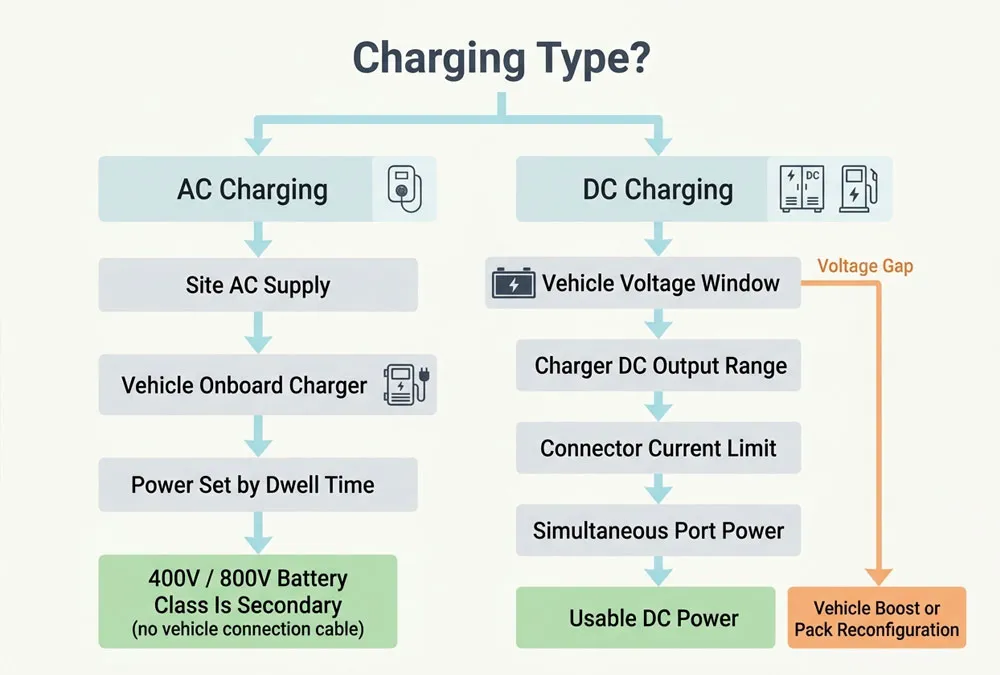
Can an 800V EV Charge on a 400V DC Charger?
It depends on both the charging station and the vehicle. When the station’s maximum DC output is below the voltage requested by an 800V-class battery, a conversion or battery-reconfiguration path is required. Its available power then becomes part of the charging limit.
Dedicated onboard DC/DC boost conversion
A dedicated converter raises the station’s lower DC voltage to the level required by the pack. It adds hardware, cost, mass and thermal constraints. Its maximum conversion power may be lower than either the charger’s nameplate or the vehicle’s native high-voltage peak, so “session started” does not mean “full advertised speed.”
Motor-and-inverter boost charging
A 2024 peer-reviewed IEEE conference study listed by the Khalifa University research portal demonstrates this principle by using the motor winding and inverter as a boost converter between a 400V charging source and an 800V battery system. For buyers, the important question is the conversion-power limit of the actual vehicle platform.
Reconfigurable or split-pack charging
Some vehicle designs can reconfigure battery sections so a lower-voltage source charges parallel pack sections before they return to the higher-voltage driving arrangement. This is why the actual vehicle model belongs in the compatibility matrix; connector type alone does not describe the conversion path.
Why the Same 350 kW Charger Delivers Different Power
Four checks are separate:
- Connector: does the physical interface match the vehicle and destination market?
- Communication: can the charger and vehicle negotiate a DC session using the supported protocol?
- Voltage and current: can the charger reach the requested operating point?
- Available power: is enough module, cable and site capacity assigned to that connector?
The US Department of Energy’s Vehicle Technologies Office Electrification Annual Progress Report describes Idaho National Laboratory testing of a 350 kW extreme-fast charger at 300, 400, 650, 750 and 850 VDC, across output currents from 50 to 500 A. This test matrix shows why a buyer should compare performance across the voltage–current operating area instead of treating 350 kW as one universally available output.
The IEA’s 2026 analysis adds the market context: fewer than 5% of the electric-car stock in 2025 could use charging above 250 kW. High-power infrastructure may support future vehicles and faster bay turnover, but today’s utilisation case still depends on the vehicles that visit the site, their SOC on arrival and the power each vehicle can accept.
When a Charging Map Shows kW but Not Voltage
Drivers often see only a 150 kW or 350 kW marker in a charging app. That number describes a station ceiling, not the power every car will receive. The missing pieces are the charger’s output-voltage range, connector current limit, power sharing and the vehicle’s own charging curve.
A more useful message for drivers
Instead of promising “up to 350 kW,” publish the charger model, total site power, whether power is shared and the vehicles or voltage ranges the site is designed to serve. Fleet operators can then maintain an approved-station list based on tested vehicle–charger pairs, reducing failed stops and unexpectedly slow sessions.
How to Specify Chargers for a Mixed 400V and 800V Fleet
Start with vehicle duty, not a charger catalogue. For every target vehicle or voltage group, record the arrival SOC, target SOC, required energy, departure deadline, battery-voltage window, maximum requested current and expected charging curve. A fleet with eight-hour dwell time may gain little from paying for maximum high-voltage power. A public hub serving short-stay high-voltage vehicles may lose utilisation if its equipment is current-limited at the voltages those vehicles request.
| Design input | What to record | What goes wrong when omitted | Practical verification |
|---|---|---|---|
| Vehicle voltage window | Minimum/maximum requested DC voltage across usable SOC | A connector fits but the station cannot reach a useful operating point | Vehicle data plus simulator or representative-vehicle test |
| Charger V–I–P envelope | Available power by voltage, continuous current and temporary boost | Headline kW exists only at the high end of the voltage range | Order-code datasheet and factory test points |
| Simultaneous output | Per-port voltage, current and power when two or more vehicles charge | Cabinet power is mistaken for connector power | Test mixed-voltage vehicles at the same time |
| Thermal duty | Ambient range, cable cooling and derating behaviour | Short peak tests pass but sustained sessions fall below the plan | Sustained FAT/SAT test at defined ambient conditions |
| Departure requirement | Required kWh and time available by vehicle group | The system stays within site capacity but vehicles leave short of energy | Validate delivered energy, not only peak kW |
Where Load Management EV Charging Fits—and Where It Does Not
Load management EV charging controls how much of the site’s available electrical capacity is assigned to charging. It can protect a grid connection, transformer, panel, feeder, power cabinet or charger group. A multi-output charger may also share its installed DC power modules between ports.
Neither function repairs a voltage mismatch. If a station cannot produce the voltage requested by an 800V-class vehicle and the vehicle has no supported boost path, assigning more site power will not start a useful session. If a 400V-class vehicle is already at the connector’s current ceiling, allocating more cabinet kW may also change nothing.
This is where equal sharing can disappoint drivers. Imagine a 300 kW DC allocation serving one 400V-class vehicle and one 800V-class vehicle. Dividing 150 kW equally may be reasonable only if both can use it and have similar departure needs. A better controller uses vehicle-requested limits, required energy and departure priority while still respecting the site boundary.
The National Renewable Energy Laboratory’s Impact of Electric Vehicle Charging report notes that EVSE does not operate continuously at rated output and that power sharing can reduce charging speed when more ports are occupied. That makes a two-vehicle simultaneous test more informative than a single-port peak-power demonstration. For a deeper procurement check, use the commercial EV charger buying checklist before comparing quotations.
What to Put in a 400V and 800V EV Charger RFQ
| RFQ field | Required supplier response | Acceptance evidence |
|---|---|---|
| DC output range | Minimum and maximum voltage for the exact ordered configuration | Factory test at agreed low, middle and high voltage points |
| Current capability | Continuous, boost and derated current for each cable/connector | Temperature and current log over the specified duty cycle |
| Power envelope | Maximum available kW as a function of DC voltage | V–I–P curve for the quoted module and cable configuration |
| Simultaneous charging | Per-port limits and module-allocation rules with mixed-voltage vehicles | Two-vehicle or simulator test with requested power and measured output |
| Software and controls | Exact firmware, OCPP functions, local controller and backend scope | Command, read-back, fallback and recovery logs |
| Destination-market evidence | Applicable standards, certificates and model/order-code scope | Documents matched to the exact supplied configuration |
Match AnengJi Charger Power to the Site and Dwell Time
The right charger is the smallest configuration that can deliver the required energy before the vehicle leaves—without creating avoidable grid, cable or utilisation costs. The following planning profiles make the choice more concrete.
| Site profile | Typical dwell pattern | Practical starting point | What drives the final choice |
|---|---|---|---|
| Hotel, office or employee parking | 4–10 hours | Managed AC charging for most bays; limited DC only where rapid turnaround is a real service need | Overnight energy, onboard AC limit and parking policy |
| Urban commercial site or fleet depot | 30–120 minutes or scheduled return-to-base windows | 60–160 kW commercial DC charging | Required kWh per visit, lower-voltage current demand and simultaneous sessions |
| Highway hub or high-turnover charging plaza | 10–40 minutes | 320–480 kW DC charging options with a published 200–1000 VDC output range | Vehicle mix, sustained current, bay turnover and site power allocation |
For a mixed 400V and 800V fleet, a 60–160 kW system can suit depots and commercial sites where dwell time provides enough energy-delivery margin. A 320–480 kW system is better aligned with short-stop hubs where high-voltage vehicles, connector utilisation and queue time justify the additional site capacity.
Turn your operating plan into a charger configuration
Share the target vehicles, required connectors, battery-voltage groups, arrival and departure windows, site power limit, simultaneous sessions and destination country. These inputs allow the power modules, cables, connectors and load-control strategy to be sized around the site’s real duty rather than a catalogue maximum.
400V vs 800V EV Charging FAQ
Is an 800V EV always faster to charge than a 400V EV?
No. An 800V architecture makes high power easier to deliver within a current and thermal limit, but charging time still depends on usable battery capacity, charging curve, SOC, temperature, charger voltage/current capability, power sharing and site allocation. Compare average power over the required SOC window, not the voltage label alone.
Can an 800V EV use a 400V fast charger?
Only when the station can reach a supported operating point or the vehicle has an approved method to raise or reconfigure the incoming voltage. The method and maximum power are vehicle-specific. Verify the exact model rather than assuming every 800V vehicle behaves like another.
Does an 800V EV charge faster on an AC wallbox?
Not simply because it uses an 800V traction system. AC charging is normally limited by the wallbox supply and the vehicle’s onboard AC charger. Check single- or three-phase support and the onboard charger rating.
Does a 350 kW charging station automatically support 800V vehicles?
No. The station must provide the required DC voltage range, current and communication support. Even when the session is compatible, full power may be unavailable because of module configuration, cable limits, power sharing or the vehicle’s request.
What is the most important charger specification for a mixed-voltage fleet?
Do not select one field. Request the combined DC voltage–current–power envelope, per-port simultaneous-output rules and derating conditions, then test representative vehicle voltage points. Those data reveal whether headline power is usable across the actual fleet.
Choose the Voltage–Current Envelope Before the Headline kW
The practical lesson from 400V vs 800V EV charging is not that every project should buy the highest-voltage vehicle or the largest charger. It is that power must be evaluated at the vehicle’s real operating voltage. Connector type, charger nameplate, vehicle architecture and site capacity are four different constraints.
For a credible commercial design, match the vehicle-voltage matrix to the charger’s V–I–P envelope, model required energy by departure, test simultaneous sessions and verify the control system under normal and fallback conditions. That process prevents a charger that looks powerful in a catalogue from becoming current-limited, voltage-incompatible or operationally ineffective onsite.