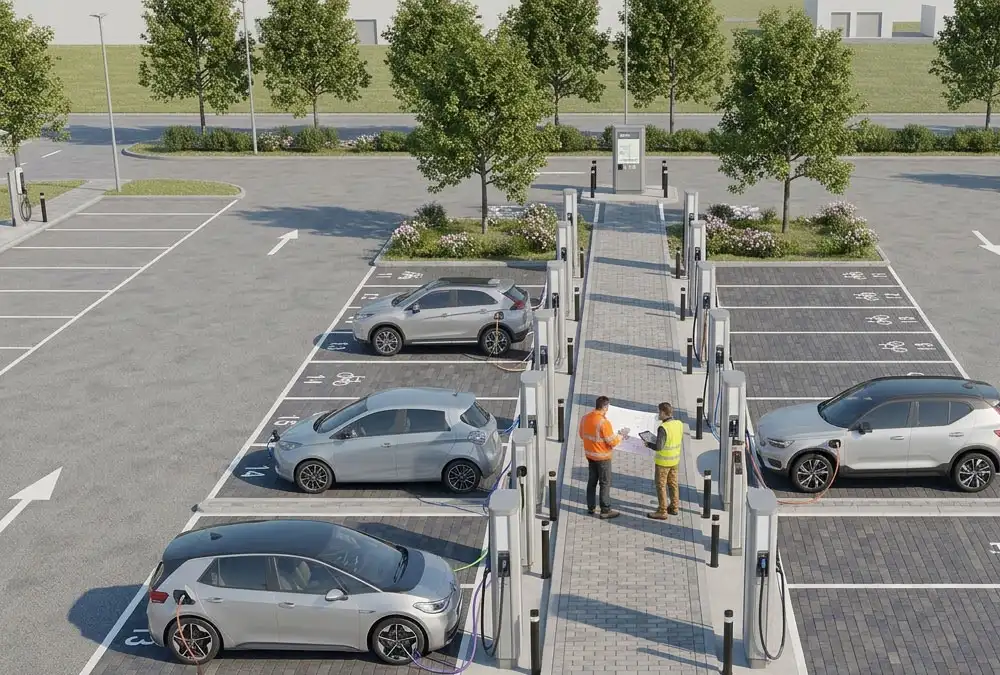
Introduction
A useful commercial EV charger buying checklist should do more than compare kilowatts, connectors and prices. Picture the decision most buyers actually face: three quotations carry the same nominal power, yet one covers only the charger, another adds a payment terminal and backend licence, and the third includes commissioning, spare parts and on-site support. The prices cannot be compared until those missing boundaries are visible. The cheapest quotation may simply contain the most exclusions.
For an EPC contractor or commercial project buyer, the real purchasing decision is whether the complete charging system can deliver the required energy before vehicles leave, stay within the site power limit, complete the required access and payment workflows, and recover predictably when something fails. This guide provides three practical tools: a 60-second screening table, the original BUY SAFE procurement framework and a factory/site acceptance checklist.
Short answer: define the charging job and site boundary before comparing products. Then require every supplier to answer the same technical, commercial and acceptance questions. A specification is only complete when the promised function has a named owner, model-specific evidence and a test method.
Commercial EV Charger Buying Checklist: The 60-Second Screen
Use this table before spending time comparing individual models. A paused decision is cheaper than discovering an unresolved interface after equipment arrives.
| Compare first | Pause the purchase when | Evidence to request | Buyer consequence |
|---|---|---|---|
| Charging task | The supplier recommends power before asking who charges or how long vehicles park. | Approved use-case statement and demand inputs | Prevents an expensive charger from solving the wrong parking problem. |
| Energy and departure | Only vehicle battery size or charger nameplate is provided. | Required kWh, usable dwell window, concurrency and reserve | Connects equipment power to the actual service outcome. |
| Site power | Voltage, phase, spare capacity or existing peak load is unknown. | Site electrical boundary and load data | Exposes grid, transformer and switchgear work before award. |
| Simultaneous output | A dual-port charger is described only by one headline power number. | Cabinet, connector and concurrent power-allocation matrix | Avoids assuming that both vehicles receive the advertised maximum. |
| Compliance | The evidence is a logo sheet with no model or certificate scope. | Model-specific declarations, certificates and test references | Reduces market-entry, inspection and tender risk. |
| Software and payment | “OCPP supported” is the only interoperability statement. | Version, profile, firmware, CSMS and workflow test record | Prevents connected hardware from becoming an unusable service. |
| Service and lifecycle | “Warranty included” has no response, parts or labour boundary. | SLA, exclusions, spare-parts plan and software-support period | Turns a marketing promise into an operating commitment. |
Define the Charging Job Before Comparing EV Chargers
A workplace, hotel, supermarket, fleet depot and motorway charging hub do not need the same product simply because each is a “commercial site.” Start with the operating task. Who may use the chargers? How long do vehicles remain parked? How much energy must they receive? What happens if a vehicle leaves undercharged? Is access private, semi-public or open to the public?
This is where many buying projects drift. A property owner may ask for a DC fast charger because “faster is better,” while most vehicles remain for six hours. A depot may buy broad AC coverage even though several vans return late and must leave again within a short recovery window. The solution is not a generic power recommendation; it is a one-page use-case statement that every bidder must accept before proposing hardware.
If you do not know whom to contact first: do not begin by asking a charger supplier for its “best model.” Give the site owner, electrical designer/EPC and intended operator the same one-page brief. The site team confirms the physical and electrical boundary; the operator defines access, billing and support; the charger supplier responds to the resulting specification. This prevents a hardware quotation from silently deciding responsibilities that belong to other parties.
Build a one-page project brief
- Market: destination country, public/private status and planned commissioning date.
- Users: employees, guests, tenants, fleet drivers, customers or general public.
- Vehicles: models or vehicle classes, connector types, AC limits and DC acceptance information.
- Demand: required energy, arrival/departure windows, simultaneous sessions and future growth.
- Operating model: free service, internal allocation, paid public charging or mixed access.
- Ownership: who buys, installs, operates, maintains, bills and approves acceptance.
The Welsh Government’s procurement guidance makes the same project-level point: charging infrastructure should be considered with fleet context, energy consumption, available downtime and wider site electrification, rather than as a stand-alone equipment purchase. Its sections on grid upgrades, physical placement, back-office management, maintenance and data provision are directly relevant to a commercial specification, although its legal context is Welsh public-sector fleet procurement. Review the Welsh Government procurement guidance.
Calculate Required Energy, Ports and Simultaneous Output
Do not size a commercial charging project from vehicle count or battery capacity alone. The first screening calculation is:
Minimum average charging power = required energy before departure ÷ usable charging time
If a vehicle needs 30 kWh during a six-hour usable window, the idealised average is 5 kW. That is a screening result, not a final charger rating. The design must still account for charging losses, operational reserve, late arrivals, interruptions, the vehicle’s charging limit and power shared with other vehicles.
Separate four different power values
- Cabinet rated output: the maximum total output the power cabinet may provide under stated conditions.
- Connector maximum: the upper limit available at one cable or outlet.
- Guaranteed simultaneous allocation: what multiple active outputs can receive together.
- Vehicle-accepted power: what the vehicle can take at its present voltage, state of charge and temperature.
This distinction catches a common commercial surprise. A dual-connector DC charger may advertise two high-power outputs while both connectors share one smaller cabinet total. Ask for a matrix showing both vehicles at maximum request, one vehicle tapering, one session stopping, one power module unavailable and a reduced site limit. If the supplier cannot show how power moves between outputs, the quotation is not ready for comparison.
“We only plan to buy one or two chargers—should they be AC or DC?” The number of cabinets is not enough to answer. Put each vehicle or user group into a row with arrival time, departure deadline, required kWh and charging limit. Test the busiest credible day. If the energy can be delivered during the available parking window with managed AC, DC may add cost without solving another constraint. If a short-window vehicle still misses departure, that shortfall is the case for a DC layer.
Check EV Charger Power Requirements Before Final Pricing
A final equipment price is premature until the electrical boundary is known. Record the utility service voltage and phase, transformer rating and loading, switchgear capacity, existing demand profile, available spare capacity, protection and earthing design boundary, proposed cable route and expansion allowance. The qualified local designer remains responsible for final electrical design and compliance.
Dynamic load management can cap the charging system and redistribute available power as building demand changes. It cannot create the daily energy the vehicles require, repair an inadequate dwell window or make a vehicle accept a higher rate. The procurement question is therefore not only “Does the charger support load management?” Ask where the control decision is made, how limits reach the charger, how quickly they update and what safe local limit applies when the controller or communications path fails.
Survey communications and civil works at the same time
A charger can arrive fully functional and still miss its commissioning date because the SIM/APN, Ethernet route, firewall, drainage, foundations, bollards or cable path were outside the hardware order. Confirm cellular signal where the charger will stand—not from an office nearby. Check flood exposure, vehicle impact, lighting, accessible routes, cable reach, parking direction and whether vans or trailers require pull-through bays.
The equipment budget is approved, but the project price is still unknown. This usually means the quotation arrived before the cable route, switchboard work, communications, foundations and grid boundary were surveyed. Require an inclusion/exclusion drawing and responsibility matrix before award. It should name who designs and supplies every item from the point of connection to the charger, including civil reinstatement and network commissioning.
Choose AC or DC EV Chargers From Dwell Time and Turnover
| Operating pattern | Likely starting architecture | Buyer test |
|---|---|---|
| Vehicles remain for several hours | Managed AC coverage | Can the available time deliver the required energy at the vehicle’s AC limit? |
| Most users stay, but some need recovery charging | AC coverage plus a limited DC layer | Does the DC asset avoid a measurable delay or missed departure? |
| Short dwell and high turnover | DC-focused architecture | Can the vehicles, grid and traffic flow use the extra power productively? |
| Fleet with fixed departures | Managed AC/DC mix by priority | Does the control system protect route-critical vehicles rather than divide power blindly? |
Do not select a universal AC/DC ratio from site size. A 20-vehicle multi-shift depot may need more peak power than a 100-space office car park. If this decision still needs modelling, compare AC and DC charging against your actual parking window before fixing the equipment schedule.
AnengJi publishes AC charging options for long-dwell applications and commercial DC charger categories. Use these as configuration starting points, not as proof that every model carries the same connector, software or certification scope. Confirm each requirement against the selected model and destination market.
Use Published AnengJi EV Charger Data for Initial Shortlisting
The following figures are taken from AnengJi product pages checked on 26 October 2026. They are useful for an initial technical conversation, but they are not a quotation, certificate schedule or confirmation that every listed option can be combined. Ask AnengJi to identify the exact order code, connector, firmware, access method and destination-market evidence in writing.
| Published product reference | Published electrical data | Useful starting scenario | What the buyer must still verify |
|---|---|---|---|
| Q6-EH07S4 AC wallbox | 7 kW; 230 V; single-phase L+N+PE; 32 A | Long-dwell bays where the vehicle can remain connected for several hours | Connector/cable format, access control, communications, protection arrangement and local installation requirements |
| Q6-EH11S4 AC wallbox | 11 kW; 400 V; three-phase L1+L2+L3+N+PE; 16 A | European workplaces, hotels or fleet parking where vehicles support three-phase AC charging | Vehicle onboard-charger limit, phase availability, load-management method and model-specific software scope |
| Q6-EH22S4 AC wallbox | 22 kW; 400 V; three-phase L1+L2+L3+N+PE; 32 A | Long- or medium-dwell sites where enough vehicles can accept more than 11 kW AC | Whether the vehicle fleet can use 22 kW; otherwise the extra site allocation may not shorten sessions |
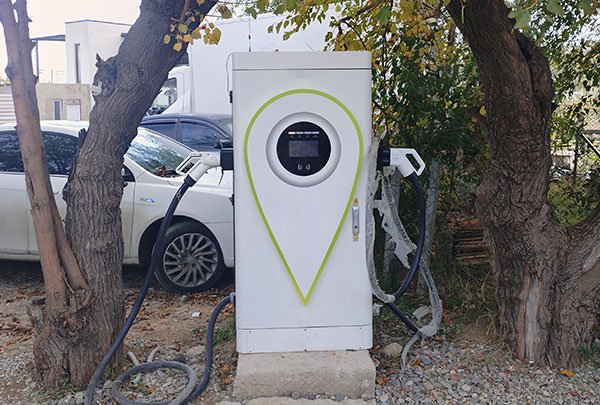
| 30/40 kW DC charger family | 380 VAC ±15% input; published 200–(750)1000 VDC output range; 0–100 A / 0–133 A; 5 m cable; Ethernet/4G | A limited DC recovery layer where 7–22 kW AC cannot meet a short departure window | Exact voltage/current curve, connector configuration, simultaneous split, access workflow, grid capacity and certificate scope |
| 60/80/120/160 kW commercial DC family | 380 VAC ±15% input; published 200–(750)1000 VDC output range; 0–200 A; 5 m cable; Ethernet/4G; card/QR/password initiation listed | Higher-turnover public, fleet or mixed-use sites after demand and grid studies | Power available at the target vehicle voltage, dual-output allocation, payment integration, derating, maintainability and destination-market documents |
Translate charger power into a realistic energy reference
For screening only, rated power multiplied by active charging time gives idealised energy. The table below does not predict battery energy, driving range or a full-charge time. Real delivery is reduced or constrained by the vehicle, state of charge, temperature, conversion losses, power sharing, site limits and interruptions.
| Rated power used for screening | Example active time | Idealised energy | How to use the number |
|---|---|---|---|
| 7 kW AC | 6 hours | 42 kWh | Compare with the vehicle’s required energy and AC acceptance limit. |
| 11 kW AC | 6 hours | 66 kWh | Useful only when the vehicle and three-phase supply can sustain the rate. |
| 22 kW AC | 2 hours | 44 kWh | Do not assume a passenger car accepts the full 22 kW. |
| 30 kW DC | 30 minutes | 15 kWh | A recovery-energy reference, not a promise of constant battery-side power. |
| 60 kW DC | 30 minutes | 30 kWh | Check voltage/current limits and whether another connector shares the cabinet. |
| 120 kW DC | 30 minutes | 60 kWh | Use only after checking the vehicle charging curve and site demand limit. |
This is the practical value of product data: it lets a buyer reject an impossible shortlist early. It does not replace the energy-and-departure model. A 22 kW AC unit attached to a vehicle limited to 11 kW behaves as an 11 kW charging path; a 120 kW DC unit attached to a tapering vehicle or power-limited site will not deliver a constant 120 kW.
Verify Vehicle, Connector and Cable Compatibility
For European projects, Type 2 and CCS2 are common planning references, but the actual specification must follow the target vehicles, country and operating model. In the United States, J1772, CCS1 and J3400/NACS decisions must be aligned with the vehicle population and deployment timing. Do not copy one regional bill of materials into another market.
Compatibility is also physical. Map the inlet location of representative vehicles, normal parking direction, cable length, cable weight and bend path. A connector can be electrically correct and still be impractical if the cable crosses a pedestrian route, cannot reach a front-corner inlet or forces a delivery vehicle to occupy two bays.
Check EV Charger Compliance With Model-Specific Evidence
A row of certification logos is not a market-access file. Ask for the legal manufacturer or certificate holder, exact model and configuration, applicable declaration, certificate or report reference, issuing body, scope, date and validity. If the delivered controller, payment terminal, modem or power module differs from the tested configuration, require the supplier to explain whether the evidence still applies.
Separate EU and UK public charging rules
For publicly accessible charging in the European Union, Article 5 of Regulation (EU) 2023/1804 establishes ad hoc charging and payment requirements, with provisions that depend on power and deployment date. It does not mean that every private workplace charger needs the same payment hardware. Confirm the public/private status and national implementation details for the actual site. Read Regulation (EU) 2023/1804 on EUR-Lex.
The United Kingdom has its own Public Charge Point Regulations. The government guidance addresses price transparency, contactless payment for defined public charge points, rapid-network reliability, helplines, open data and roaming. These requirements should be added only when the site falls within their scope; they should not be described as EU rules. Check the current GOV.UK public charge point guidance.
Metering, accessibility, electrical installation, permitting and grid-connection requirements can also vary by country and project type. Treat “Europe compliant” as an incomplete statement until the destination country and application are named.
Compare OCPP, CSMS, Access and Payment as Workflows
Open Charge Point Protocol (OCPP) standardises communication between a charging station and a charging station management system (CSMS). It does not supply the mobile network, payment acquiring, driver app, roaming contract, site-energy logic or customer-support team. More importantly, a charger connecting to a test server does not prove that your required business workflow succeeds.
The Open Charge Alliance states that buyers can verify independently tested OCPP products through its official certificate list. Check the certification number, product identity and OCPP version rather than accepting a certificate image without traceability. Certification supports conformance evidence; the procurement conclusion is still to test the exact charger model, firmware and intended CSMS together. Verify OCPP certificates with the Open Charge Alliance.
Specify normal, offline and recovery behaviour
- Which RFID credentials work, and what happens when the network is unavailable?
- Can a public user start and pay without a pre-existing contract where required?
- How are interrupted sessions, buffered transactions and timestamps reconciled?
- Who owns the endpoint, administrator credentials, SIM/APN and security certificates?
- Can the owner export data and migrate to another CSMS without replacing hardware?
For a deeper test schedule, use AnengJi’s guide to verify OCPP functions before procurement. The key principle is simple: implemented, certified and tested with your backend are three different statements.
The site may collect less charging revenue than it spends on software. This is a real risk for a lightly used workplace, private car park or small visitor installation. Before adding paid charging, compare the annual CSMS, SIM, payment-terminal, acquiring, transaction, roaming and support charges with expected paid sessions. A simpler free or internally allocated service may be more economical for low utilisation; public or mixed-use sites may still need a compliant ad-hoc payment route. The decision belongs in the operating model, not in a hardware feature list.
Inspect Serviceability, Thermal Design and Spare-Part Support
Outdoor rating and operating temperature are screening specifications, not proof of full output in every condition. Ask for the applicable output/derating information, cooling architecture, filter or coolant maintenance, module replacement method and diagnostic access for the destination climate. For a multi-module DC system, ask what output remains when one module is isolated and whether repair can occur without taking the entire site offline.
“After-sales support” should become a contract table. Define remote response, on-site attendance, working hours, parts and labour, travel, consumables, software updates, payment-terminal responsibility, spare-part lead time and end-of-life notice. A warranty that replaces a part in several weeks may be legally valid while still failing the site’s availability objective.
Also map shared failure points. One payment terminal may serve several chargers; one router, controller or power cabinet may support multiple outlets. The price per connector looks attractive until a single failure removes every paid or high-priority charging path.
When a charger stops, buyers often enter a supplier–installer–network blame loop. Prevent it before purchase. Give each alarm category a first responder, diagnostic-data owner and escalation path. The handover pack should state who checks incoming power, charger hardware, SIM/APN, firewall, CSMS, payment and vehicle-side faults—and who has the credentials and tools to do so. Then test the escalation path during site acceptance instead of discovering it during the first customer complaint.
Compare Commercial EV Charger TCO, Not Only Purchase Price
A defensible comparison uses the same time horizon and boundary for every bidder. Five years is a useful internal comparison period, but it is not a universal asset life or payback claim. Use the period that matches your organisation’s procurement and finance rules.
| Cost layer | Include | Why it changes the decision |
|---|---|---|
| Equipment | Charger, options, cables, payment, modem, pedestal and protection supplied with the unit | Prevents an incomplete base model from looking cheaper. |
| Site works | Design, utility, transformer, switchgear, cabling, trenching, foundations, drainage and markings | These works can control budget and schedule even when hardware is available. |
| Digital operations | CSMS, SIM/data, APIs, payment, roaming, settlement and cybersecurity operations | A low-use site may not justify a complex recurring software stack. |
| Service | Preventive maintenance, response, travel, parts, consumables, training and inspections | Availability depends on the service chain, not only hardware quality. |
| Energy and capacity | Electricity, losses, demand/capacity exposure and idle auxiliary use where material | High power can create costs even when utilisation is modest. |
| Exit and change | Data export, credential handover, backend migration, recertification and decommissioning | A cheap closed system can make the next procurement unnecessarily expensive. |
Use BUY SAFE to Compare EV Charger Quotations
BUY SAFE converts this commercial EV charger buying checklist into seven approval gates. Do not score a charger as “compliant” when an answer is blank; mark it as unresolved.
| Gate | Decision | Required deliverable |
|---|---|---|
| B — Business task | Who charges, for how long and for what outcome? | Approved use-case statement |
| U — Utility and site | What power, communications and physical infrastructure exist? | Site boundary sheet |
| Y — Yield by deadline | Can required energy reach priority vehicles on time? | Energy-and-departure model |
| S — Standards and market | Which product, installation, payment and market rules apply? | Compliance schedule |
| A — Access and software | Can users, operators and systems complete required workflows? | Integration matrix |
| F — Failure and acceptance | What happens during faults, and how will recovery be proven? | FAT/SAT test script |
| E — Economics, service and exit | What will ownership, support and change cost? | Normalised TCO and exit schedule |
Use the same quotation columns for every bidder
At minimum, use: Requirement | Supplier response | Exact model/firmware | Evidence reference | Included price | Recurring price | Exclusion or assumption | Responsible party | Acceptance test | Status. This forces the comparison away from polished brochures and toward auditable delivery.
Run Factory and Site Acceptance Tests Before Final Approval
Factory acceptance testing (FAT) should verify the ordered model, controller and firmware; physical ports; regional connector configuration; payment/RFID options; power allocation; alarms; emergency stop; logs; remote functions and documentation. Record defects and define which items block shipment.
Site acceptance testing (SAT) must repeat the highest-risk workflows using the production electricity supply, network, SIM/APN, firewall, CSMS, payment route and representative vehicles. A laboratory pass cannot prove that the live certificate chain, DNS, settlement account or site controller is correct.
Verify four layers for every important command
- Requested state: what the operator or CSMS asked the charger to do.
- System response: accepted, rejected, scheduled, unsupported or timed out.
- Observed charger state: connector status, configuration read-back, energy flow or local alarm.
- Business outcome: correct access, energy delivery, billing record, power limit, recovery or maintenance ticket.
The United States Joint Office infrastructure playbook likewise treats procurement, ownership and operation as connected decisions and provides resources for RFPs, maintenance and contract provisions. Use it for US project planning, not as a substitute for European requirements. See the Joint Office procurement and operations resources.
What Information Should You Send an EV Charger Supplier?
A supplier cannot responsibly select equipment from “four chargers for a shopping centre.” Send a structured input pack:
- Market and project: country, public/private access, site type, programme and target date.
- Vehicles and task: vehicle list/classes, connectors, required energy, arrival/departure and priority.
- Electrical boundary: supply, transformer, switchgear, measured load, controlled site limit and future expansion.
- Physical boundary: layout, foundations, trenching, environment, cable reach, accessibility and impact protection.
- Digital operation: CSMS, OCPP, RFID, payment, load management, connectivity, data and offline rules.
- Commercial delivery: quantity, Incoterms if applicable, commissioning, training, spares, warranty and service.
- Evidence and acceptance: destination-market documents, deviations, FAT, SAT and handover records.
How AnengJi Can Support Commercial EV Charger Selection
AnengJi’s verified website presents AC and DC equipment categories for commercial, fleet and public-infrastructure projects. The correct next step is not to match a project to a category name alone. Submit the BUY SAFE inputs so the proposed power, connector, access method, software scope, destination-market evidence and delivery boundary can be reviewed for the selected configuration.
Exact OCPP version, firmware, certification, payment workflow, simultaneous output and service terms should be confirmed in the model-specific quotation and evidence pack. That qualification protects both the buyer and the supplier from an assumption becoming an acceptance dispute.
Commercial EV Charger Buying FAQ
What should I check before buying a commercial EV charger?
Check the use case, energy required by departure, available site power, vehicle compatibility, simultaneous output, destination-market evidence, access/payment workflow, software integration, service boundary, total cost and acceptance tests. Do not compare price until bidders answer the same scope.
How do I know whether my site needs AC or DC charging?
Use parking time and required energy. Managed AC commonly fits long dwell; DC becomes valuable when turnover, short recovery windows or missed departures have measurable value. Confirm the vehicles and site capacity before choosing power.
Does an OCPP-compatible charger work with every backend?
Not automatically. Verify the exact OCPP version, functions, profiles, certificate scope, charger model, firmware and target CSMS. Then test the required normal, offline and recovery workflows.
How should I compare two EV charger quotations?
Normalise hardware options, site works, software, payment, commissioning, spares, warranty, recurring charges, exclusions and acceptance. Require each bidder to identify the responsible party and evidence for every requirement.
What documents should an EV charger supplier provide?
Request model-specific datasheets, drawings, installation requirements, declarations/certificates applicable to the destination market, software and protocol scope, configuration records, test reports where required, warranty/SLA terms, spare-parts information and FAT/SAT documentation.
What should an EV charger warranty and SLA define?
Define coverage period, excluded parts and conditions, remote and on-site response, labour, travel, shipping, consumables, software updates, spare availability, escalation, restoration targets and evidence required to make a claim.
Which tests should be completed before accepting the chargers?
Test configuration identity, connector operation, power allocation, protections, emergency stop, user authorization, payment where applicable, OCPP/CSMS functions, load limits, network loss, transaction recovery, alarms, remote support and handover records. Repeat the highest-risk tests on the live site.
Approve the Charging System, Not Just the Charger
The best answer to a buy EV charger checklist is not a universal model. It is the lowest-risk system that reliably completes the site’s charging task and can be supported, tested and changed throughout its operating life. Define the job, apply BUY SAFE, normalise every quotation and make acceptance evidence part of the purchase order.
When every supplier receives the same project brief and returns the same evidence schedule, a lower price becomes meaningful. Until then, it may simply be the cost of a smaller promise.