Introduction
Every commercial energy storage solutions project shares a single, painful point of failure: getting the scale wrong. In my years running engineering teams, I have seen brilliant EPC designs ruined by a Battery Storage System that was either an overpriced, oversized paperweight or an undersized box that tripped every time the facility hit peak load. Sizing a Battery Storage System is not a guessing game of matching your monthly electricity bill to a random datasheet. It requires deep load profiling, clear operational goals, and an understanding of how power and energy interact. If you get it wrong, you either burn capital on inactive capacity or drop critical backup loops when you need them most.
Buyers often ask me if they can just copy a competitor’s system size. The short answer is absolutely not. Your load curve, your facility’s peak spikes, and your local utility tariff structures are unique. This guide breaks down the math, the operational realities, and the field-tested strategies required to size your Battery Storage System for maximum ROI and long-term grid stability.
How to Size a Battery Storage System: Quick Answer (Featured Snippet)
To accurately size a Battery Storage System, your capacity is determined by your highest 15-minute peak power demand (kW) and the total energy duration (kWh) needed to sustain that load. You must calculate three non-negotiable parameters: peak operational load, daily discharge depth, and total round-trip efficiency losses. Never look at energy capacity (kWh) alone; a system with massive storage is useless if its power conversion system (PCS) lacks the kW capacity to handle your facility’s instantaneous surge currents.
The Five Key Inputs for Battery Storage System Sizing
- Daily Energy Consumption: The total kilowatt-hours (kWh) your facility consumes or intends to shift throughout a standard 24-hour operational cycle.
- Peak Power Demand: The absolute maximum power spike (measured in kW) your system must support or suppress during operation.
- Backup Duration: The exact number of consecutive hours the storage system must run independently during a grid outage.
- Battery Depth of Discharge (DoD): The usable percentage of the total capacity; discharging a battery to absolute zero drastically shortens its lifespan.
- Round-Trip Efficiency: The total energy lost as heat during the charge and discharge cycle, typically ranging between 85% and 92% in high-quality systems.
What Is Battery Storage System Sizing and Why Does It Matter?
In industrial energy management, Battery Storage System Sizing is the precise calibration of power rating (kW) and energy rating (kWh) to match a specific application. It dictates your initial CapEx, your long-term OpEx, and whether your system can successfully execute advanced functions like grid battery storage support or local microgrid stabilization.
What Does Battery Storage System Sizing Mean?
Think of sizing as building a custom reservoir. The power rating (kW) is the size of the pipe leaving the reservoir—it determines how much water can rush out at any single second. The battery storage capacity (kWh) is the volume of the actual tank—it determines how long that water will flow before running dry. Sizing is the engineering process that ensures the pipe handles your biggest surges while the tank holds enough volume to complete the job.
Why Oversizing and Undersizing Are Costly Mistakes
When engineering teams rely on guesswork rather than clean data, they fall into two highly expensive traps:
Oversized Systems: Many buyers believe “bigger is better” to safeguard against outages. The result? Excessive initial CapEx on lithium-iron-phosphate blocks that sit completely idle. This unutilized capacity never generates a return, dragging down your overall project ROI and artificially inflating your balance-of-system (BOS) costs.
Undersized Systems: Cutting corners on capacity leads to immediate operational failure. An undersized system cannot handle the harsh step-loads of heavy machinery, resulting in poor peak shaving performance. Even worse, overworking a small battery bank forces rapid cycling, accelerating battery degradation and shortening your asset’s lifespan.
Battery Storage System Applications and Typical Capacity Requirements
Different industries interact with the grid in completely unique ways. A manufacturing plant requires massive surge protection, while a microgrid requires long, sustained energy dispatch. The table below outlines these structural variations:
| Application | Typical Power (kW) | Typical Energy (kWh/MWh) | Common Duration | Value to User / Operational Benefit |
|---|---|---|---|---|
| Residential | 3–15 kW | 5–30 kWh | 2–10 h | Protects critical home appliances; maximizes local solar self-consumption during evening peak rates. |
| Commercial Buildings | 50–500 kW | 100–1,000 kWh | 2–4 h | Lowers demand charges drastically; provides smooth backup for data centers and life-safety systems. |
| Manufacturing Plants | 500–5,000 kW | 1–20 MWh | 2–6 h | Saves millions by smoothing huge inductive motor startup spikes; prevents costly assembly line downtime. |
| EV Charging Stations | 100–2,000 kW | 200 kWh–10 MWh | 1–4 h | Allows ultra-fast megawatt-level charging without triggering massive utility grid upgrades. |
| Microgrids | Custom | Custom | 4–24 h | Enables 100% true off-grid autonomy; balances intermittent solar and wind assets smoothly. |
| Utility Scale | Multi-MW | 10–500+ MWh | 2–8 h | Provides lucrative grid frequency regulation, spinning reserves, and wholesale energy arbitrage. |
Residential Battery Storage
At the household level, systems are compact and focus mostly on backup duration and maximizing solar self-consumption. Sizing is straightforward, typically designed to cover baseline lighting, refrigeration, and basic cooling loops through the night without drawing from the utility grid.
Commercial & Industrial Battery Storage
This is where complexity spikes. Industrial battery storage demands precise, high-speed energy management system (EMS) integration. Sizing for industrial facilities centers on clipping sharp, short demand spikes rather than long, slow energy discharge. It requires an intimate knowledge of your facility’s daily load profile.
Utility-Scale Battery Storage
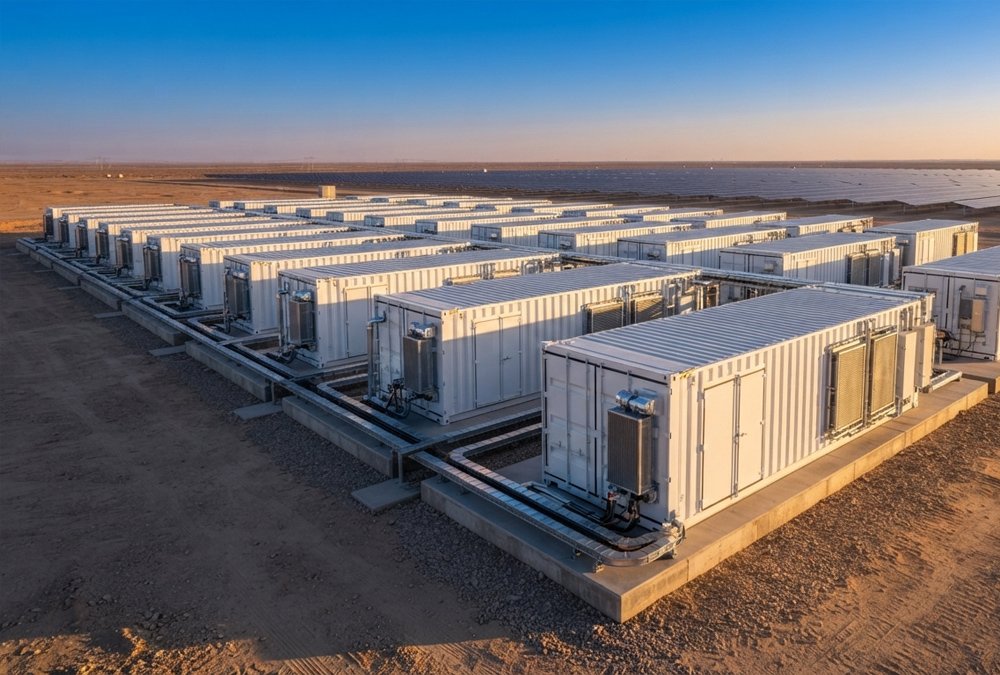
Sizing for utility scale battery storage sizing projects involves massive multi-megawatt containers. These installations are driven entirely by financial models centered on wholesale power markets, grid ancillary services, and wide-scale renewable energy integration. They are built for extreme durability and long-term thermal management.
EV Charging + Battery Storage
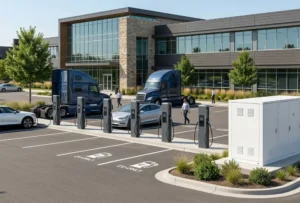
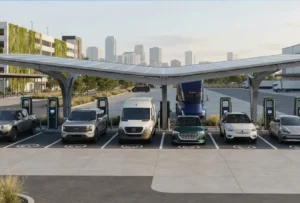
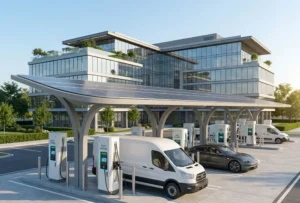
When multiple high-power DC fast chargers trigger simultaneously, they create a massive, instantaneous load on the local distribution transformer. Integrating a dedicated Battery Storage System creates a structural buffer, absorbing the high-current vehicle demand and slowly recharging from the grid during off-peak periods.
Solar + BESS Projects
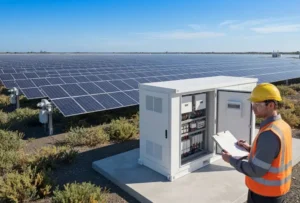
Adding energy storage to a commercial solar asset converts an intermittent, unpredictable generation source into a highly reliable, dispatchable power asset. Sizing here relies on calculating your exact over-generation curve during peak daylight hours so that energy can be deployed strategically when sun conditions drop.
Battery Storage System Sizing Fundamentals: Understanding kW vs kWh
If you take away nothing else from this guide, remember this: kilowatts (kW) and kilowatt-hours (kWh) are entirely different engineering metrics. Mixing them up will lead to catastrophic design errors during equipment sourcing.
What Is kW?
Kilowatts represent the metric of electrical power rating. It represents the instantaneous rate at which a system can either deliver or absorb electricity. In any BESS design guide, the kW rating is limited by the size of your Power Conversion System (PCS)—the inverters that transform DC battery power into clean, usable AC utility power.
What Is kWh?
Kilowatt-hours represent total electrical energy storage capacity. This tells you exactly how much work the system can perform over an extended period. If a battery delivers 100 kW of power continuously for exactly two hours, it has discharged 200 kWh of total energy capacity.
kW vs kWh Comparison Table
To help visualize how these two metrics impact your project budget and hardware sizing, here is a breakdown of their primary differences:
| Metric | What It Measures | Hardware Limiter | Impact on System Performance |
|---|---|---|---|
| kW (Power) | Instantaneous output rate | Inverter / PCS Size | Determines how many heavy machines or fast chargers can run simultaneously without shutting down. |
| kWh (Energy) | Total stored reserve capacity | Battery Cells / Module Count | Determines how many hours your facility can run off-grid before the system drains completely. |
Battery Storage Sizing Formula
When we sit down to draft a preliminary system layout, we use a foundational formula to establish the raw battery capacity calculation before factoring in ambient thermal adjustments:
$$Battery\ Capacity\ (kWh) = \frac{Load\ (kW) \times Backup\ Time\ (h)}{DoD \times Efficiency}$$
Worked Example
Let’s run through a realistic industrial sizing project. Imagine we are designing a battery backup system for a precision manufacturing plant with the following engineering requirements:
- Peak Critical Backup Load: 500 kW
- Required Autonomy Backup Time: 2 Hours
- Target Depth of Discharge (DoD): 95% (0.95)
- System Round-Trip Efficiency: 90% (0.90)
First, we multiply our peak load by our desired runtime to get our net operational energy requirement: 500 kW × 2 hours = 1,000 kWh.
Next, we divide that number by our depth of discharge to account for the un-dischargable energy safety floor: 1,000 kWh ÷ 0.95 = 1,052.6 kWh.
Finally, we divide that result by our system’s round-trip efficiency to offset the inevitable heat losses through the power electronics: 1,052.6 kWh ÷ 0.90 = 1,169.5 kWh.
Therefore, your facility requires a nominal battery storage capacity of at least 1,170 kWh coupled with a minimum 500 kW PCS to meet its operational goals safely.
Define the Purpose of Your Battery Storage System Before Sizing
The economic value of energy storage comes from different operational profiles. You must define your primary financial or engineering lever before choosing your hardware footprint.
Backup Power
When sizing strictly for backup power applications, your system must hold enough raw kWh capacity to keep essential processes running smoothly throughout the duration of local grid failures. Sizing is dictated entirely by your critical load list and worst-case outage windows.
Peak Shaving
If your main goal is peak demand reduction, your focus shifts entirely to speed and power. You need an energy management system that spots rapid load spikes within milliseconds and deploys high-current bursts. This clips your peak demand charges without needing a massive, long-duration battery bank.
Load Shifting
For standard load shifting, you store cheap, off-peak electricity and discharge it during high-tariff periods. Sizing requires mapping your local utility’s exact time-of-use schedule to ensure you have enough capacity to cover the entire high-rate block.
Solar Energy Storage
When sizing a battery storage system for commercial buildings with large rooftop solar arrays, the goal is capturing clean energy that would otherwise be wasted or exported to the utility at low net-metering rates. Sizing is built directly around your daytime over-generation profile.
Renewable Energy Integration
Large-scale solar and wind projects use storage to stabilize generation drops caused by clouds or wind changes. This requires a balanced, highly responsive power conversion system that can cycle rapidly throughout the day without overheating.
Energy Arbitrage
Arbitrage relies on buying power at rock-bottom prices and selling it back to the grid when market prices surge. Sizing is driven by financial modeling software, balancing market price volatility against the degradation costs of cycling your battery cells.
Key Factors That Determine Battery Storage System Size
Beyond basic formulas, several real-world variables will directly impact your actual physical system footprint on-site:
Daily Energy Consumption
Analyzing a full year of 15-minute interval utility data allows us to chart your exact energy patterns. This prevents seasonal surprises, ensuring your system handles both winter heating surges and summer cooling spikes efficiently.
Peak Demand
Your absolute highest demand spike determines the size of your power conversion system (PCS). If your plant pulls a sudden 1,000 kW surge when heavy motors start up, your inverters must be rated to handle that peak load safely, regardless of your total battery capacity.
Depth of Discharge (DoD)
Modern lithium-iron-phosphate (LFP) chemistries offer excellent stability, allowing a high depth of discharge—often up to 95%—without rapid degradation. Older or cheaper chemistries often require a lower discharge limit, forcing you to buy a larger overall system to get the same usable capacity.
Required Backup Duration
There is a direct relationship between runtime and system footprint. Moving from a simple 2-hour peak shaving asset to a comprehensive 4-hour critical backup asset doubles your required battery cells, instantly expanding your project’s physical and financial scale.
Charging Method and Charging Speed
Choosing an AC-coupled, DC-coupled, or hybrid topology changes how power flows through your facility. AC-coupled systems offer great flexibility for retrofits, while DC-coupled setups deliver superior efficiency when charging directly from a solar array.
Battery Efficiency
No storage system is perfectly efficient. High-end systems deliver an excellent round-trip efficiency of around 92%, meaning you lose very little power to heat. Cheaper alternatives with lower efficiency force you to buy more starting capacity to offset those ongoing operational losses.
Future Expansion Requirements
Your facility’s energy needs will likely grow. I always advise clients to design their concrete foundation pads and main switchgear with 20% to 30% extra capacity. This allows you to scale up modularly with simple plug-and-play rack expansions later on, saving massive civil costs down the road.
Battery Storage System Sizing Examples for Different Industries
Let’s look at how these principles translate into actual real-world projects across different commercial sectors:
Manufacturing Plant
- Project Goal: BESS sizing for peak shaving and protection against voltage sags.
- Load Profile: Heavy, unpredictable 1,200 kW spikes from large inductive motor startups.
- Recommended Power Rating: 1,000 kW
- Recommended Energy Capacity: 2,000 kWh (2 MWh)
- Expected ROI: High utility demand charge reductions yield a full capital payback within 3.8 years.
Commercial Building
- Project Goal: Time-of-use tariff optimization and critical data center backup.
- Load Profile: Predictable, steady daytime air conditioning and server loads.
Recommended Power Rating: 250 kW
- Recommended Energy Capacity: 500 kWh
- Expected ROI: Combining load shifting with demand charge reduction delivers steady financial payback within 4.5 years.
Solar + Battery Project
- Project Goal: Smooth out intermittent generation and eliminate evening grid demand completely.
- Load Profile: Massive mid-day solar generation with a heavy load shift to evening operations.
- Recommended Power Rating: 500 kW
- Recommended Energy Capacity: 1,500 kWh
- Expected ROI: Maximizing clean energy consumption cuts utility dependency, delivering full project payback within 5.2 years.
EV Charging Station
- Project Goal: Buffer the grid against simultaneous high-power fast charging events.
- Load Profile: Sharp, erratic megawatt-level power draws throughout the day.
- Recommended Power Rating: 500 kW
- Recommended Energy Capacity: 1,000 kWh
- Expected ROI: Avoids expensive substation upgrades, protecting operating margins with an expected payback within 4.1 years.
Microgrid Project
- Project Goal: Achieve true off-grid operational autonomy for a remote facility.
- Load Profile: Continuous 24-hour baseline load paired with intermittent local wind and solar generation.
- Recommended Power Rating: 300 kW
- Recommended Energy Capacity: 2,400 kWh
- Expected ROI: Eliminates diesel generator fuel and maintenance costs, achieving full payback within 6.0 years.
When Accurate Battery Storage System Sizing Is Most Critical
Precise sizing shifts from a simple financial preference to an absolute engineering requirement in several high-stakes scenarios:
Peak Demand Charge Reduction
In many commercial utility territories, demand charges make up over 50% of your total monthly electric bill. If your system is sized too small or reacts too slowly, even a single 15-minute peak slip will lock in high utility charges for the entire billing cycle.
Time-of-Use Tariff Optimization
As utilities widen the price gap between peak and off-peak power, your storage capacity must be precisely sized to carry your entire facility through the expensive peak windows without drawing a single kilowatt from the grid.
Off-Grid Solar Systems
When there is no utility grid to act as a safety net, an undersized battery bank means a total blackout. Sizing for off-grid systems must account for consecutive cloudy days to ensure continuous operational autonomy.
Critical Backup Applications
For hospitals, laboratories, and continuous-process manufacturing plants, a power interruption can cause catastrophic financial losses or safety hazards. Sizing must guarantee your critical load loop is fully supported until backup generators line up.
Utility Grid Support
Systems participating in utility frequency response programs must match strict power injection and absorption targets. Sizing ensures your system can deliver these rapid bursts without drifting out of thermal compliance limits.
Battery Storage System Cost Based on System Size
Project pricing is determined by your total capacity requirements and layout complexity. According to leading 2025/2026 clean energy index reports, utility scale battery storage sizing projects average between $180 and $240 per kWh at the system level, while commercial battery storage system sizing configurations typically range from $280 to $420 per kWh due to customized balance-of-system engineering and advanced fire suppression integration.
Cost Factors
Your total installation cost is driven by three main areas: the core battery cells, the power conversion system (PCS) inverters, and the civil on-site works. Complex site prep, extended trenching, and custom grid interconnections will quickly increase your baseline budget.
ROI Considerations
To accurately calculate your true financial returns, look beyond upfront CapEx. Factory warranties, long-term degradation rates, and local clean energy tax incentives all play a huge role in determining your final project payback window.
How Long Does a Properly Sized Battery Storage System Last?
A standard industrial-grade LFP battery system is engineered to deliver an operational lifetime of 15 to 20 years, or roughly 6,000 to 8,000 complete charge-discharge cycles, before its maximum capacity drops to 80% of its original factory rating.
How Proper Sizing Extends Battery Life
When a system is sized correctly, it operates within its ideal thermal and electrical comfort zones. An oversized or properly optimized battery bank avoids the rapid, deep cycling that generates excessive internal heat. Keeping operating temperatures low stabilizes the internal cell chemistry, drastically slowing down battery degradation and extending your asset’s working life.
How to Choose the Right Battery Storage System for Your Project
Do not buy hardware based on a generic online calculator. Follow this structured engineering process to ensure an optimized deployment:
Analyze Your Energy Consumption
Pull 12 full months of 15-minute interval data (8760 data files) from your utility provider. This allows you to map your exact load profile, identifying hidden consumption spikes that basic monthly bills completely hide.
Clarify Project Objectives
Decide what your primary financial or operational lever is. Sizing a system for maximum peak shaving requires a completely different hardware configuration than designing a system for long-duration critical backup power.
Work with an Experienced Battery Storage System Supplier
Partner with an integrated tier-1 manufacturer that provides complete, turnkey engineering support. A truly qualified partner doesn’t just sell you battery cabinets—they handle your complete load analysis, run advanced software simulations, optimize your EMS control loops, and guide you through the entire local utility grid interconnection process.
Scalable Battery Storage Solutions for Industrial Projects
If you are looking for field-proven, industrial-grade reliability, we engineer scalable, liquid-cooled energy storage systems designed for seamless modular expansion:
- All-in-One Outdoor Cabinets (100kW / 215kWh & 261kWh): Perfect for small-to-medium commercial buildings and EV charging stations. These pre-engineered systems deliver compact footprints, simplified transport, and straightforward local installation.
- High-Capacity Industrial Storage (418kWh): Built for heavy manufacturing facilities and mid-sized commercial projects looking to maximize peak shaving returns.
- Containerized Utility Systems (1MWh to 5MWh+): Engineered into rugged 20ft and 40ft form factors, these systems offer liquid-cooled efficiency and advanced fire protection for large-scale utility grid support and independent microgrid installations.
Frequently Asked Questions About Battery Storage System Sizing
How do I calculate battery storage size?
Multiply your total critical load (kW) by your required runtime hours, then divide that by your target depth of discharge and system round-trip efficiency to determine your minimum nominal capacity (kWh).
How many kWh battery do I need?
Your required capacity depends entirely on your operational goals. A commercial facility focused on peak shaving might only need a 215kWh system, while an off-grid manufacturing plant could easily require several megawatt-hours of storage.
What is the difference between kW and kWh?
kW measures instantaneous power delivery capacity (the inverter’s output speed), while kWh measures total stored energy capacity (the total amount of electricity available in the battery cells over time).
How much battery storage is enough for my business?
The ideal capacity matches your specific utility tariff structure and load profile. It must hold enough energy to maximize demand charge reductions or sustain critical operations through a standard outage window.
What affects battery storage capacity?
Total capacity is heavily influenced by operating temperatures, your chosen chemistry’s depth of discharge limits, system-level efficiency losses, and natural cell degradation over the life of the asset.
How long does a BESS last?
High-quality lithium-iron-phosphate systems typically last between 15 and 20 years, executing 6,000 to 8,000 complete cycles before maximum capacity drops to 80% of its initial factory rating.
Can I expand a battery storage system later?
Yes, provided you choose a modular, scalable architecture. Designing your initial layout with expandable racks, flexible cabinets, or containerized connections allows you to easily scale up capacity as your business grows.
Get Expert Help Sizing Your Battery Storage System
Stop guessing your system capacity and risking costly design errors. Our dedicated engineering team is here to help you design a precise, optimized energy storage configuration tailored to your actual operational needs.