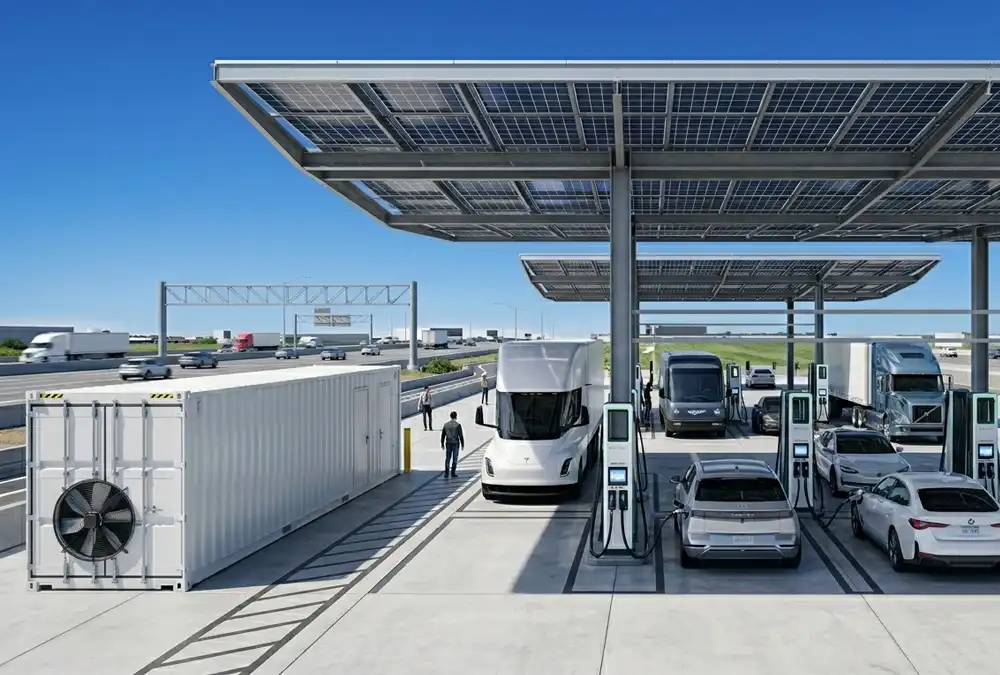
Introduction: The Scalability Dilemma of High-Power Charging Assets
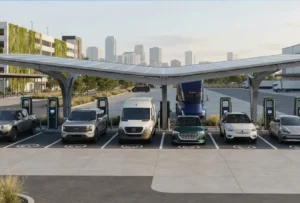
The global transition to electrified transport has introduced significant localized technical challenges for electrical distribution grids. For charge point operators (CPOs), heavy-duty fleet managers, and engineering, procurement, and construction (EPC) contractors, performing a detailed evaluation of 1MW vs 2MW Battery Storage for EV Charging has transitioned from a progressive design choice to a critical requirement for infrastructure financial viability. As modern passenger vehicles and commercial fleets adopt high-voltage direct current (DC) architectures, vehicle power demands create massive, unpredictable load profiles that standard distribution substations cannot easily support. Deploying multiple high-power dispensers without on-site electrochemical buffering frequently leads to excessive utility peak demand fees, long utility grid upgrade delays, and systemic voltage drop issues. Incorporating a utility-scale Battery Energy Storage System (BESS) acts as a flexible buffer, decoupling immediate high-current charging dispenser activity from the physical limits of the utility grid connection. This comprehensive engineering and economic guide analyzes sizing dynamics, total cost of ownership (TCO), and investment returns to optimize your next energy storage asset deployment strategy.
The main difference between 1MW and 2MW battery storage systems for EV charging is power output and charging capacity. A 1MW BESS is ideal for small to medium fast-charging stations, while a 2MW BESS supports larger charging hubs with higher simultaneous charging demand. The best choice depends on charger quantity, peak load requirements, grid capacity, and future expansion plans.
Understanding Battery Energy Storage Systems (BESS) for EV Charging
Deploying a robust EV Charging Station Energy Storage asset involves integrating an advanced, active electrochemical and power electronics facility into your local infrastructure layout, rather than just installing passive backup cells.
What Is a Battery Energy Storage System?
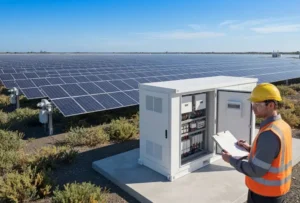
A stationary Battery Energy Storage System (BESS) is an integrated industrial asset designed to manage bidirectional power flows. It combines high-density battery cell matrices, multi-tiered protection systems, bidirectional power inversion hardware, and sub-millisecond digital controller software into a weather-proof, utility-grade containerized enclosure.
How BESS Supports EV Charging Infrastructure
The system operates through automated state-of-charge (SoC) balance management. During off-peak periods when the facility is under-utilized, the BESS draws a controlled, continuous baseline current from the utility feed. When a vehicle or fleet plugs into a high-capacity dispenser, the storage asset discharges its capacity to support the load, preventing sudden, massive spikes from hitting the upstream distribution network.
Why EV Charging Stations Need Energy Storage
High-capacity vehicle charging is naturally volatile, characterized by sudden, severe consumption spikes separated by extended idle periods. Localized storage stabilizes local grid voltage, guarantees uninterrupted backup power during utility distribution outages, eliminates expensive commercial demand fees, and enables the deployment of ultra-fast dispensers at properties with constrained utility grid feeds.
The Relationship Between MW and MWh
In power systems engineering, Megawatts (MW) quantify the instantaneous power capability of the power conversion system’s (PCS) inverters, determining how many high-power chargers can run concurrently. Megawatt-hours (MWh) measure the total energy capacity of the system, indicating how many hours that specific power output can be continuously sustained before the system requires a recharge.
Typical BESS Architectures for Charging Stations
Commercial stations typically deploy either AC-coupled or DC-coupled integration configurations. AC-coupled architectures link components on a common alternating current distribution panel, offering exceptional flexibility for expanding modular sites. DC-coupled layouts connect localized solar arrays, stationary battery cells, and high-voltage dispensers directly onto a shared high-voltage direct current busway. This design eliminates multiple inefficient AC-to-DC conversion stages, boosting overall system round-trip efficiency by 5% to 8%.
1MW Battery Storage for EV Charging Applications
A standard 1MW Battery Storage System represents an agile, highly versatile asset class engineered to provide effective peak-load buffering for localized commercial and public travel centers.
What Is a 1MW Battery Storage System?
This configuration delivers up to 1,000 kW of continuous instantaneous power output. It serves as an active, compact energy asset that resolves moderate electrical capacity shortfalls without requiring extensive civil modifications to existing local distribution boards.
Typical 1MW/2MWh and 1MW/4MWh Configurations
A 1MW system configured with a 2-hour duration (1MW/2MWh) provides 1,000 kW for two hours, optimized for standard peak shaving. A 4-hour duration system (1MW/4MWh) yields deep, long-duration energy shift capabilities, supporting continuous operation through prolonged peak pricing windows.
Number of Chargers Supported by a 1MW BESS
A standard 1MW power bloc effectively buffers up to eight 120kW chargers or four 180kW chargers operating under normal load sharing conditions. It can also support up to two 350kW ultra-fast dispensers during simultaneous peak charging sessions without exceeding common commercial grid thresholds.
Best Use Cases for 1MW Battery Storage
- Urban Fast Charging Stations: City parking structures and retail commercial areas with strict grid power limitations.
- Retail Charging Sites: Shopping malls and hypermarkets optimizing solar plus storage EV charging during daytime retail hours.
- Commercial Parking Facilities: Corporate office centers providing fleet and employee daytime charging options.
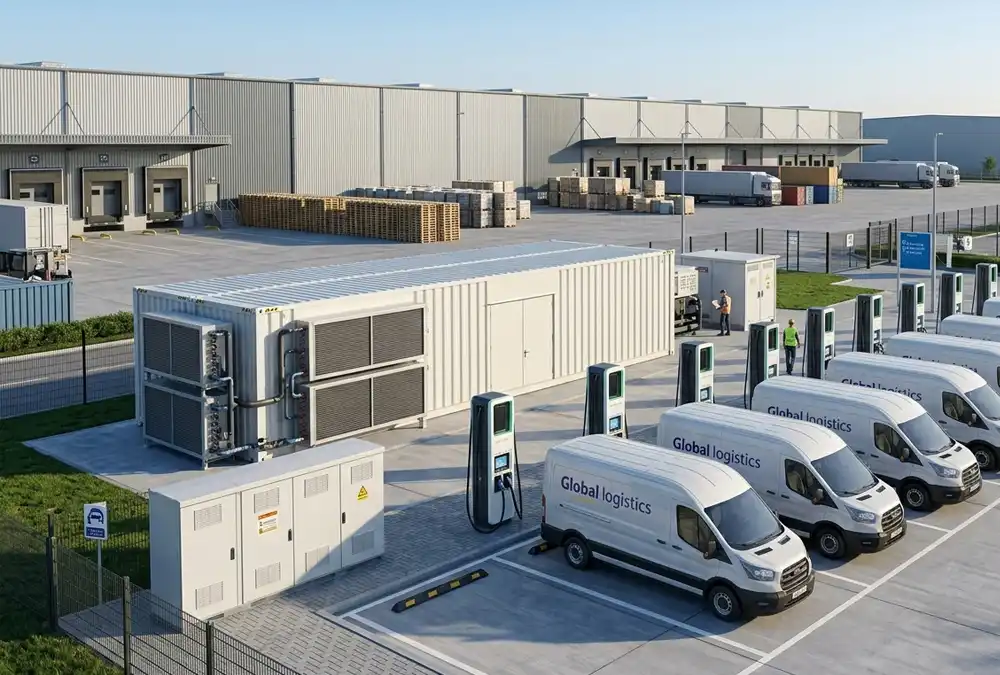
- Small Fleet Depots: Municipal or private logistics facilities operating a controlled number of delivery vans or service vehicles.
Advantages and Limitations of a 1MW BESS
The primary benefit of a 1MW system lies in its low upfront capital requirement and compact 20-foot containerized footprint, easing civil site permitting. However, its ultimate output capacity can bottleneck facilities planning to scale up to massive multi-dispenser heavy-vehicle ultra-fast charging setups.
2MW Battery Storage for EV Charging Applications
For large public hubs and industrial fleet operations, a 2MW Battery Storage System provides the robust power capacity required to support heavy continuous usage.
What Is a 2MW Battery Storage System?
This system delivers up to 2,000 kW of continuous bidirectional power capability. It is engineered to handle heavy, sustained simultaneous inductive and electrochemical loads across high-throughput travel corridors and massive public transit depots.
Typical 2MW/4MWh and 2MW/8MWh Configurations
The 2MW/4MWh configuration is the industry standard for large-scale industrial load management. For facilities integrating extensive multi-megawatt solar arrays or requiring long-duration backup protection, the high-capacity 2MW/8MWh configuration provides durable energy support through extended grid outages.
Number of Chargers Supported by a 2MW BESS
A single 2MW power asset can comfortably support a large charging plaza containing sixteen 120kW chargers, ten 180kW units, or four to six 350kW ultra-fast liquid-cooled charging systems operating at maximum simultaneous output profiles.
Best Use Cases for 2MW Battery Storage
- Highway Charging Hubs: High-throughput interstate rest stops experiencing concentrated waves of passenger and commercial EV traffic.
- Large Public Charging Networks: Multi-megawatt municipal travel centers requiring ultra-fast vehicle turnover.
- Bus Charging Depots: Public transit hubs where large bus fleets return simultaneously and require high-current overnight charging.
- Logistics Fleet Charging Centers: Distribution hubs operating heavy-duty electric trucks with class-leading battery capacities.
Advantages and Limitations of a 2MW BESS
A 2MW system delivers exceptional cost-per-kWh value due to manufacturing economies of scale, and provides robust capabilities for utility-scale grid interaction. The trade-off involves a larger physical equipment footprint (often requiring a 40-foot enclosure or multiple concrete pads) and more complex grid interconnection approvals.
1MW vs 2MW Battery Storage for EV Charging: Side-by-Side Comparison
Choosing the correct asset capacity requires careful analysis of physical, financial, and electrical integration factors to ensure alignment with long-term infrastructure goals.
Side-by-Side BESS Specification Comparison Table
The following technical table provides a side-by-side engineering comparison of 1MW and 2MW systems:
| Technical & Economic Feature | 1MW Battery Storage System | 2MW Battery Storage System |
|---|---|---|
| Continuous Power Output | 1,000 kW (1 Megawatt) | 2,000 kW (2 Megawatts) |
| Typical Energy Capacity | 2.0 MWh to 4.0 MWh usable | 4.0 MWh to 8.0 MWh usable |
| 350kW Ultra-Fast Chargers Supported | 1 to 2 units simultaneously | 4 to 6 units simultaneously |
| Physical Footprint Needed | Standard 20-foot ISO container footprint | Expanded 40-foot container or dual-pad layout |
| Per-kWh Capacity Unit Cost | Higher baseline unit cost | Optimized; 15%–22% lower per-kWh cost |
| Grid Interconnection Complexity | Moderate; maps to existing medium-voltage | High; requires upgraded transformer substations |
| Expansion Potential | Moderate; scalable by adding blocks | Exceptional; highly modular internal busway |
Power, Capacity, and Scalability Engineering Analysis
While a 1MW system can effectively manage standard commercial peak loads, it can become a bottleneck if a station needs to add multiple ultra-fast dispensers later. A 2MW installation provides the deeper energy reserve necessary to maintain continuous high-speed charging capacity across dozens of bays simultaneously, significantly reducing long-term scalability concerns.
EV Fast Charging Infrastructure Requirements and Battery Storage Sizing
Determining the right system size requires an accurate assessment of localized consumption habits and vehicle charging characteristics.
Understanding Charging Station Load Profiles & Peak Demands
Sizing begins by analyzing the facility’s load profile—a chart of electricity consumption mapped over a 24-hour period. Commercial stations experience sharp power peaks in the morning and late afternoon, separated by long intervals of low consumption.
Sizing Battery Storage Based on Charger Types
The total power rating of your charging equipment dictates your BESS requirements. Standard 60kW and 120kW chargers create manageable demand profiles that are easily buffered by an agile 1MW system. However, modern highway travel plazas deploying multiple 180kW chargers and 350kW ultra-fast liquid-cooled dispensers generate severe, high-current load spikes that necessitate a high-capacity 2MW storage asset to maintain operational stability.
Grid Connection Capacity and Battery Storage Integration
Integrating a stationary battery allows developers to execute a virtual grid upgrade, bypassing the physical constraints of localized utility lines.
Why Grid Capacity Limits Charging Station Growth
Local utility distribution grids are frequently bottlenecked by localized transformer capacity limits. If your facility’s physical grid connection is capped at 300 kW, you cannot operate a 500 kW fast-charging network without facing grid overloads or multi-year utility upgrade timelines.
Using BESS as a Virtual Grid Upgrade
A BESS acts as a reliable power buffer, charging slowly from the grid’s available baseline capacity during low-occupancy periods. When an EV plugs in and demands high current, the battery supplements the grid feed, allowing the station to deliver full-speed charging without exceeding its physical grid connection limit.
When a 1MW System Is Enough vs. When a 2MW System Is Required
A 1MW storage configuration provides ample power for sites with up to 500 kW of available grid capacity looking to run a standard commercial charging plaza. However, when the available grid connection is exceptionally weak (under 200 kW) and the site must support heavy truck charging or multi-dispenser ultra-fast networks, a 2MW system becomes mandatory to maintain reliable, long-duration operational buffering.
Peak Shaving and Demand Charge Reduction for EV Charging Stations
Managing utility demand charges is a primary factor determining the long-term profitability of commercial charging operations.
What Is Peak Shaving?
Peak shaving is the process of actively capping the maximum amount of power drawn from the utility grid during short-duration consumption spikes. The BESS monitors real-time building demand and instantly discharges to handle any load exceeding a predefined threshold.
How Demand Charges Affect Charging Profitability
Commercial electricity bills include high fees based on the single highest 15-minute consumption spike recorded during the month. Unbuffered fast-charging sessions create large, volatile demand spikes that can trigger thousands of dollars in monthly utility penalties, wiping out the operator’s profit margins.
Industrial Product Recommendation: AnengJi BESS-EV HyperSeries
For high-throughput commercial travel hubs and fleet depots evaluating 1MW vs 2MW infrastructure, we recommend the AnengJi BESS-EV HyperSeries. This fully integrated containerized storage system features an advanced Energy Management System (EMS) and high-efficiency bidirectional inverters optimized for demanding EV fast-charging environments. Equipped with long-life liquid-cooled LFP modules, the HyperSeries maintains exceptional thermal uniformity within a tight 2.5°C variance. Fully certified to UL 9540 and NFPA 855 standards, it provides seamless plug-and-play load management and rapid power discharge, allowing charging operators to eliminate demand charge penalties and scale up fast-charging infrastructure without waiting for expensive grid connection upgrades.
Battery Storage Technologies Used in EV Charging Applications
Selecting the optimal electrochemical technology requires balancing technical safety metrics against long-term asset life cycles.
Evaluating Battery Alternatives for EV Sites
For sites with extreme high-power, short-duration needs, supercapacitors or flywheel kinetic systems can serve as alternatives or supplements to traditional chemical batteries. While flywheels provide millions of cycles and instant high-current discharge without thermal risk, their high cost and low energy density mean they generally serve as short-term voltage stabilizers rather than deep-duration energy buffers.
Energy Management System (EMS) Optimization for EV Charging and BESS
The operational efficiency and economic return of an integrated charging hub depend heavily on the control software driving its Energy Management System.
Dynamic Load Management and Smart Charging Control
The EMS acts as the central coordinator for the entire site. It monitors real-time building consumption, battery state of charge, and active vehicle demands. If multiple cars plug in simultaneously, the EMS executes dynamic load management, balancing power distribution between the grid, storage modules, and dispensers to maximize charging speeds without overloading the facility’s infrastructure.
AI-Based Energy Scheduling
Next-generation EMS platforms use advanced AI algorithms to optimize site performance. By processing historical charging patterns, weather forecasts, and shifting real-time utility pricing, the AI automatically determines the most economical times to charge the internal batteries and the most profitable moments to discharge them, significantly reducing ongoing operational expenses.
Battery Storage Cost Comparison for EV Charging Projects
A comprehensive 1MW vs 2MW battery storage system cost for EV charging stations evaluation requires analyzing both upfront procurement costs and ongoing lifecycle expenses.
Total Cost of Ownership (TCO) Analysis
While a 1MW turnkey BESS project requires a lower initial investment, it faces higher levelized per-kWh component costs. A 2MW installation maximizes asset efficiency by spreading fixed project engineering, permitting, and grid connection expenses across double the storage capacity, resulting in lower unit costs and improved long-term operating margins.
ROI and Payback Period of 1MW vs 2MW Battery Storage for EV Charging
Financial returns are driven by a combination of reduced demand charges, time-of-use energy arbitrage, and increased vehicle throughput capacity.
ROI Comparison and Typical Payback Period Scenarios
A standard 1MW installation focused on basic peak shaving typically achieves a full return on investment within 4 to 6 years. Thanks to lower per-kWh procurement costs and the ability to participate in profitable utility grid-stabilization markets, a high-capacity 2MW configuration can shorten the site’s payback window to 2.5 to 4 years, delivering substantially higher cumulative profitability over its 15-year operational lifespan.
| Deployment Scenario | Typical Payback Period (1MW BESS) | Typical Payback Period (2MW BESS) |
|---|---|---|
| Urban Charging Station | 4.0 to 5.5 Years | 3.5 to 4.5 Years (Highly optimized) |
| Logistics Fleet Depot | 3.5 to 4.5 Years | 2.0 to 3.5 Years (Maximum utilization) |
| Highway Fast Charging Hub | 4.5 to 6.0 Years | 3.0 to 4.5 Years (High throughput) |
Solar Plus Storage for EV Charging Infrastructure
Combining rooftop or canopy solar generation with a stationary BESS creates a highly efficient, self-sustaining energy ecosystem for modern fast-charging infrastructure.
Self-Consumption Optimization and Carbon Reduction
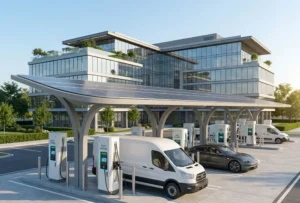
A solar plus storage EV charging configuration prevents clean renewable energy from being wasted. The EMS captures excess daytime solar generation and stores it in the battery modules instead of exporting it to the grid for low feed-in tariffs. This clean energy is then deployed during busy evening charging periods, maximizing renewable utilization, protecting the site against utility rate hikes, and ensuring true zero-emission corporate mobility.
Real-World EV Charging Station Scenarios: 1MW vs 2MW BESS
Analyzing real-world deployment profiles demonstrates how system sizing choices depend on specific facility environments and operational goals.
Urban Commercial Hub vs. Highway Transit Depot Cases
A major commercial parking structure in a dense urban area deployed a 1MW/2MWh liquid-cooled BESS to support four 120kW fast chargers. The compact system successfully flattened evening charging peaks, keeping the facility safely within its tight 200 kW grid allocation and eliminating local voltage drops.
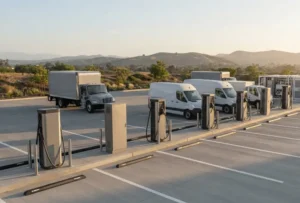
Conversely, a heavy-duty highway logistics depot operating twenty 180kW delivery truck chargers required a comprehensive 2MW/4MWh system. The larger power capacity was essential to handle massive, simultaneous truck-charging loads when the fleet returned to the depot in the evening, providing reliable peak shaving and preventing catastrophic grid overloads.
How to Choose the Right Battery Storage Size for EV Charging
Selecting the ideal system scale requires a structured engineering review of your facility’s operational profile. CPOs should begin by gathering 12 months of detailed utility interval data to identify historical peak consumption levels and determine exact grid capacity constraints. Calculate your expected daily vehicle turnover and project future expansion needs over a 5-year window; if your site plans to add high-capacity 350kW ultra-fast dispensers to support growing commercial or heavy-vehicle traffic, investing in a modular 2MW system from day one prevents future infrastructure bottlenecks. Evaluate your available physical site space and project budget against clear return-on-investment targets. Finally, consult an experienced, certified BESS manufacturer who provides advanced EMS integration, regulatory permitting support, and comprehensive long-term maintenance warranties to ensure your infrastructure investment delivers maximum financial and operational value.
Frequently Asked Questions About 1MW vs 2MW Battery Storage for EV Charging
How Many EV Chargers Can a 1MW Battery Support?
A standard 1MW BESS can comfortably buffer up to eight 120kW chargers or four 180kW fast chargers under normal load sharing conditions. It can also support up to two 350kW ultra-fast dispensers during simultaneous peak charging sessions without exceeding common commercial grid thresholds.
Is a 2MW BESS Worth the Extra Investment?
Yes, for high-throughput hubs and heavy-duty fleet depots, a 2MW system is highly cost-effective. It delivers a 15% to 22% reduction in per-kWh procurement costs due to manufacturing economies of scale, handles massive simultaneous charging loads, and shortens overall payback periods by unlocking access to profitable utility grid-stabilization markets.
What Battery Capacity Should Be Paired with a 1MW System?
A 1MW power output rating is most commonly paired with either a 2MWh capacity configuration for standard 2-hour peak shaving applications, or a 4MWh capacity layout for long-duration energy shifting and extended backup power requirements.
Can Battery Storage Eliminate Grid Upgrades?
Yes. By using an internal battery buffer to supply high-current charging peaks, developers can completely bypass the need for expensive, time-consuming utility transformer and substation overhauls, accelerating station deployment timelines by several months or years.
What Is the Typical Lifespan of a BESS?
A premium utility-grade BESS utilizing high-quality Lithium Iron Phosphate (LFP) cells combined with advanced liquid cooling systems typically delivers an operational lifespan of 12 to 15 years, sustaining over 6,000 complete charging cycles before reaching end-of-life capacity thresholds.
Which System Has a Better ROI?
While a 1MW system features a lower initial purchase price, a 2MW configuration regularly delivers a superior return on investment for busy charging plazas and commercial fleet hubs by maximizing capital efficiency and providing deeper demand charge savings.
Future Trends in Battery Energy Storage for EV Charging
The electric vehicle charging landscape is evolving rapidly, driven by continuous advancements in high-power electronics and smart data processing software.
Megawatt Charging Systems (MCS) and Next-Gen Technologies
The imminent rollout of Megawatt Charging Systems (MCS) for heavy commercial trucking will demand unprecedented power levels, requiring high-output 2MW and larger stationary battery buffers to protect regional grids. Additionally, the expansion of Vehicle-to-Grid (V2G) capabilities and AI-driven Virtual Power Panels (VPPs) will allow station operators to aggregate their collective battery networks and sell power back to utility companies during periods of extreme grid stress, turning charging facilities into active, multi-stream revenue centers.
Conclusion: Should You Choose a 1MW or 2MW Battery Storage System for EV Charging?
Selecting between a 1MW and 2MW storage asset is a strategic decision that directly shapes the long-term scalability and financial viability of your charging network. For localized urban hubs, retail locations, and mid-sized commercial properties focused on basic peak shaving, a standard 1MW configuration provides a highly reliable, cost-effective solution with minimal site permitting hurdles. However, if your business manages heavy industrial applications, operates high-throughput highway rest stops, or runs large logistics fleets requiring ultra-fast turnaround times, investing in a high-efficiency 2MW modular system delivers the superior power capacity, capital efficiency, and future-proof flexibility required to maximize your infrastructure returns and dominate the electrified transportation landscape.