Introduction
A wholesale DC fast charger quotation may show the right connector, an attractive price and a familiar power rating. That still does not make the equipment ready for a European rollout. The real product is a working chain: charger hardware, vehicle interoperability, site power, payment, metering, charging-management software, compliance evidence and a service system capable of restoring failed units.
That distinction is where bulk buyers either protect or lose margin. Importers, distributors, charge point operators (CPOs), EPC contractors and fleet developers should compare deployable outcomes—not cabinet prices. This guide introduces the EU-FAST supplier scorecard, a six-gate method for deciding whether a quotation can become a supportable charging asset.
What Should You Specify Before Requesting a Wholesale DC Fast Charger Quote?
A useful request for quotation begins with an operating problem. “We need ten 180 kW chargers” is a quantity request, not a technical brief. It tells the supplier nothing about the vehicles, simultaneous demand, available electrical capacity, public access or the software environment.
Separate Charger Power, Vehicle Acceptance and Site Capacity
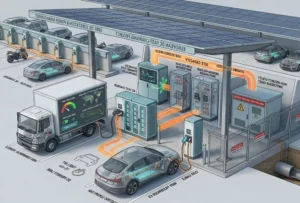
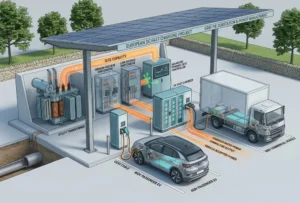
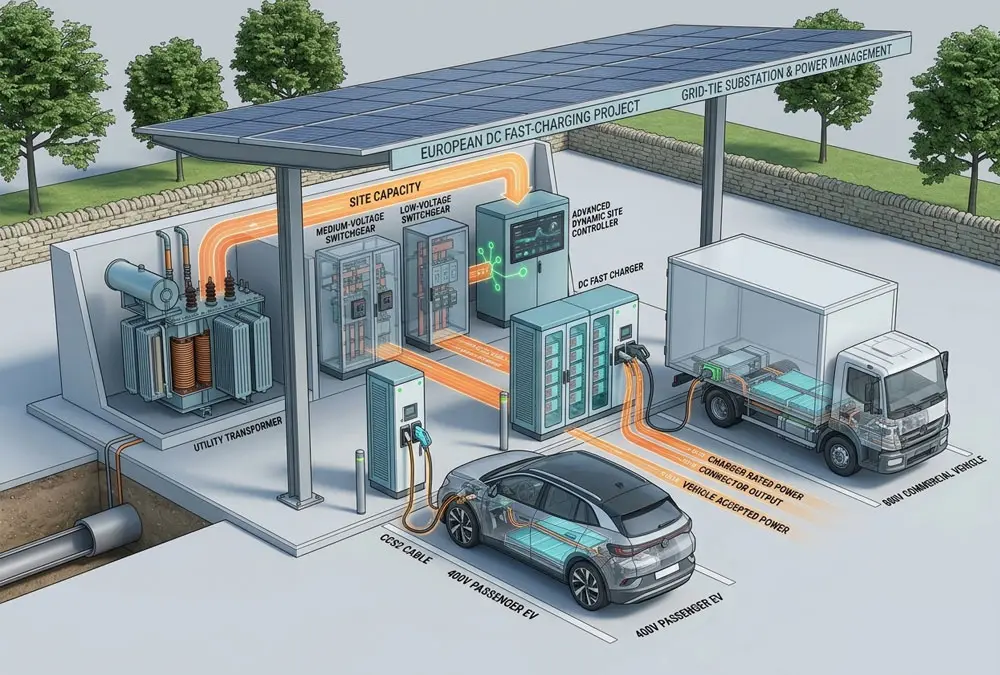
Four power limits matter during a DC session: the charger’s nameplate rating, the maximum output of the active connector, the power requested by the vehicle, and the power available from the site. The lowest active limit controls the session. A 240 kW cabinet cannot force a vehicle to accept 240 kW, and a constrained grid connection cannot continuously supply every charger at full output.
The same rule applies to dual- and multi-connector chargers. Ask whether the advertised rating belongs to the complete cabinet or to each outlet. Request the actual allocation states—for example, how power is divided when two vehicles connect at once—and confirm whether a failed module reduces output gracefully or removes the entire unit.
Build a Project Data Sheet Suppliers Can Actually Quote
| RFQ input | Minimum data | Risk if omitted | Buyer benefit |
|---|---|---|---|
| Vehicles | Models, battery voltage, DC acceptance, inlet location and charging curve | A connector fits, but useful power or cable reach does not | Confirms real compatibility before shipment |
| Operations | Arrivals, dwell window, daily energy, concurrency and missed-charge contingency | Queues or overspecified hardware | Matches outlets and power sharing to demand |
| Electrical site | Grid connection, transformer headroom, voltage, protection and other major loads | Late transformer, switchgear or connection changes | Exposes infrastructure cost early |
| Digital system | CSMS, OCPP version, network, authentication, tariff and payment route | Hardware arrives before integration responsibility is defined | Creates a testable end-to-end workflow |
| Commercial scope | Destination, quantity, sample plan, Incoterm, branding, spares and support | Quotes appear comparable but include different obligations | Produces a normalized bid |
Which DC Fast Charger Power Rating Fits Each European Site?
Power bands are useful for shortlisting, but they are not universal design rules. The ranges below are procurement starting points. Final selection still depends on the vehicle mix, dwell time, charging curve, site capacity, utilization target and redundancy strategy.
60–80 kW for Longer-Dwell Commercial Sites
This range can suit dealerships, hospitality, municipal parking, workplace sites and smaller fleets where vehicles remain parked long enough to obtain useful energy without a high-power session. It may also reduce the electrical upgrade compared with a larger charger. Buyers should still model overlapping sessions: two outlets do not automatically mean two vehicles each receive the cabinet rating.
120–180 kW for Retail, Urban Hubs and Mixed Fleets
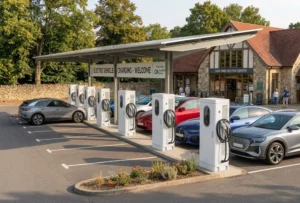
This band is often evaluated where turnover matters but the project does not require the highest available power. A dual-connector unit can improve utilization when demand is staggered. The decisive questions are maximum current per cable, power-sharing logic, vehicle acceptance at different states of charge and the site’s coincident-load limit.
240–480 kW for High-Throughput Sites and Heavy-Duty Vehicles
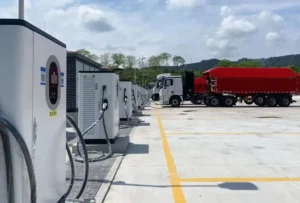
Highway sites, large charging hubs and commercial-vehicle fleets may evaluate this range, especially for vehicles using higher-voltage platforms. However, the charger’s maximum rating is not sustained vehicle power. Battery temperature, state of charge, current limits and the vehicle’s control strategy can all reduce delivery. Heavy-duty projects must also consider bay geometry, cable handling, trailer movement, redundancy and whether one power cabinet creates a common failure point.
Which EU Compliance Documents Should a Charger Supplier Provide?
“CE,” “CCS2” and “OCPP” are not interchangeable proof statements. They concern different parts of the product and operating chain. The procurement file should show exactly what was assessed, which model and software version were involved, and who is legally responsible for placing the finished product on the market.
Confirm CCS2 and Fixed-Cable Requirements Under AFIR
For EU public charging, Annex II, section 1.2 of Regulation (EU) 2023/1804—the Alternative Fuels Infrastructure Regulation (AFIR)—requires publicly accessible DC high-power points to provide at least the Combo 2 connector described in EN 62196-3:2014. AFIR Article 5(10) also requires all publicly accessible DC points to have a fixed cable. Read the exact provisions in the official EUR-Lex text.
CCS2 hardware is only the baseline. A factory acceptance test should run representative European vehicles through cable lock, authorization, current ramp, normal stop, emergency stop and recovery after communication loss. For 800 V vehicles, verify usable output across the actual voltage range rather than accepting “up to 1000 V” as a complete answer.
Audit the CE Evidence Pack for the Exact Model
The European Commission’s CE guidance says the manufacturer must identify applicable legislation and harmonised standards, complete the conformity assessment, establish technical documentation, issue the EU Declaration of Conformity and affix the marking. More than one legal act may apply. The Commission explains the process in its six-step guidance for manufacturers.
Ask for the signed Declaration of Conformity for the exact ordered configuration, the technical-file index, relevant reports, nameplate artwork, installation manual and the identities of the manufacturer, importer and authorised representative where applicable. Match model numbers and standard editions across all documents. A certificate image on a website is not a substitute for this model-level review.
Test OCPP, Payment and Metering as One Operating Chain
OCPP connects the charger to its charging-station management system (CSMS); it is not the CCS vehicle communication protocol. The Open Charge Alliance states that its certification program uses approved independent laboratories to assess conformance. For OCPP 2.0.1, Core is mandatory and other profiles have separate scope. Buyers can verify product designation, software version and profile in the OCA certification program and certified-products register.
Certification narrows risk; it does not replace integration testing with the buyer’s backend. Test authorization, transactions, meter values, availability, remote reset, charging profiles, fault codes, offline operation, firmware updates and network recovery. For public EU charging, AFIR Article 5 also covers ad hoc payment and price presentation. Metering, tax, accessibility and implementation details must be confirmed in the destination country.
How Should Buyers Compare Wholesale DC Fast Charger Prices?
Normalize the Scope Before Comparing Unit Prices
A wholesale DC fast charger price can exclude payment hardware, cables, branding, commissioning, backend work or essential spares. Build one bid sheet and force every supplier to respond to the same scope:
Comparable landed offer = configured equipment + options + conformity/document scope + freight and insurance + duties/taxes + site interfaces + software/integration + commissioning + spares and training
Keep grid connection, transformer, switchgear, civil works and local installation as separate project lines. These may exceed the price difference between two chargers, but they are not usually controlled by the factory. State the Incoterm, packaging method, unloading responsibility and damage-claim process so logistics risk is visible.
Add Downtime and Spare-Parts Exposure to Lifecycle Cost
A cheaper charger can become expensive when the operator cannot diagnose it, a replacement contactor takes weeks, or a software issue requires a factory engineer in another time zone. Model downtime with project-specific assumptions: lost charging margin, alternative outlet capacity, service labor, travel, part lead time and any contractual availability penalties.
Request a recommended two-year spare-parts list, replacement procedures, remote-diagnostic access, escalation contacts and target response times. Ask which repairs local technicians may perform without voiding the warranty. These answers reveal more about lifecycle value than a generic warranty duration.
Want a comparable quotation? Prepare the project data sheet above, then send the same scope to every shortlisted supplier.
How Do You Audit a DC Fast Charger Supplier? Use the EU-FAST Scorecard
EU-FAST converts broad supplier promises into six evidence gates. A supplier should not receive a high commercial score simply because its quotation is complete. It must demonstrate that the offered configuration can be documented, integrated, produced consistently and supported.
| Gate | Evidence to request | Fail signal | Buyer benefit |
|---|---|---|---|
| E — Evidence | Exact-model DoC, reports, manuals, labels and document ownership | Generic certificates or mismatched model numbers | Reduces import and acceptance uncertainty |
| U — Use-case fit | Vehicle, power, cable, environment and allocation review | Recommendation based only on maximum kW | Prevents oversizing and compatibility gaps |
| F — Functional interoperability | Vehicle sessions, CSMS script, payment and recovery tests | “Supported” without a test plan | Turns feature claims into acceptance evidence |
| A — After-sales recovery | Diagnostic tools, spares, training, escalation and response commitments | Warranty exists, but no recovery workflow | Shortens avoidable outages |
| S — Supply consistency | BOM control, traceability, end-of-line tests and change notification | Sample components can change without approval | Keeps volume units aligned with the approved sample |
| T — Total landed value | Normalized installed and lifecycle scope | Decision rests on ex-works unit price | Selects the most commercially complete offer |
What Is the Safest Path From Sample to European Rollout?
Engineering Sample and Documentation Review
Start with a sample configured for the destination market and intended CSMS. Inspect enclosure construction, component accessibility, labels, cable reach, manuals and the evidence pack. Record the bill of materials or controlled component list that defines the approved unit.
Pilot Site and Acceptance Tests
The pilot should use representative vehicles, network conditions, authentication and payment. Measure session success, power allocation, thermal behavior, remote visibility and recovery from realistic faults. Agree which failures stop acceptance and which can be corrected before the bulk release.
Controlled Bulk Release and Change Management
Release volume only after pilot findings are closed. The purchase contract should require notice and approval before changes to power modules, contactors, meters, payment terminals, modems, cables, controllers or firmware. Repeat critical end-of-line and integration tests after a material change. This prevents an approved sample from quietly becoming a different production product.
Why Consider ANENGJI for a DC Fast Charger Wholesale Project?
ANENGJI presents itself as a manufacturer of EV charging equipment and battery energy storage systems, with product development, manufacturing, customization and project-support capabilities. Its corporate pages describe R&D, production and customer-support systems. These are supplier-reported facts and should be validated during buyer due diligence. See the ANENGJI company profile and its manufacturing and service overview.
DC Charger Options Across Commercial and Fleet Power Bands
The ANENGJI portfolio page lists DC charging products across several formats. For European buyer evaluation, relevant routes include 60–160 kW commercial units with CCS2 options, 160–320 kW multi-output configurations and 320–480 kW products intended for higher-power fleet applications. These ranges are a shortlist, not a site design. Buyers should verify connector current, output voltage, power sharing, OCPP feature scope and compliance evidence for the exact model.
Review the ANENGJI DC fast charger range, the 60–160 kW commercial platform and the 320–480 kW heavy-duty platform.
Customization, Manufacturing and Project Support
ANENGJI states that it supports customized power, connector configuration, appearance, interface and project delivery. Wholesale buyers can use the EU-FAST scorecard to turn those capabilities into a model-specific offer: request the controlled configuration, evidence pack, backend test, production inspection plan, spare-parts proposal and service responsibilities rather than relying on portfolio-level statements.
Information ANENGJI Needs for an Accurate Proposal
Provide the destination country, site type, vehicle models, battery-voltage range, energy required per visit, dwell time, available grid capacity, number of simultaneous vehicles, connector quantity, CSMS and OCPP requirement, public-payment method, cable length, environmental conditions, order quantity, branding scope and desired delivery terms.
Request an ANENGJI Europe-Ready Project Review
Send the project inputs above and ask for a model-specific configuration, document list, sample plan and commercial quotation. Final compliance and installation requirements should be validated for the destination country and site.
Wholesale DC Fast Charger FAQ
What Is a Typical MOQ for DC Fast Chargers?
There is no universal minimum order quantity. It depends on the model, customization, tooling and commercial terms. Ask separately for an engineering sample, pilot quantity and volume-order MOQ.
Does OCPP Support Guarantee CSMS Compatibility?
No. Confirm the protocol version and feature scope, check independent certification where available, and run an integration script with the intended CSMS and charger software version.
Is CE Marking Enough to Sell a Charger in Europe?
CE marking is part of product conformity in the EU/EEA, but the responsible economic operator must identify all applicable legislation and maintain supporting evidence. Public operation, payment, metering, accessibility, installation and grid rules can add EU-level or national obligations.
How Do Buyers Compare 120 kW and 180 kW Chargers?
Compare the vehicle’s accepted power, dwell-time objective, connector current, simultaneous allocation, site capacity, thermal derating and expected utilization. The higher nameplate rating is valuable only when the rest of the system can use it.
What Should Be Included in a Wholesale RFQ?
Include destination, vehicles, operating schedule, site supply, connector and cable requirements, CSMS/OCPP, payment, environment, documentation, acceptance tests, quantity, branding, spares, support, Incoterm and rollout schedule. That information gives suppliers enough context to quote a deployable solution rather than a generic cabinet.