
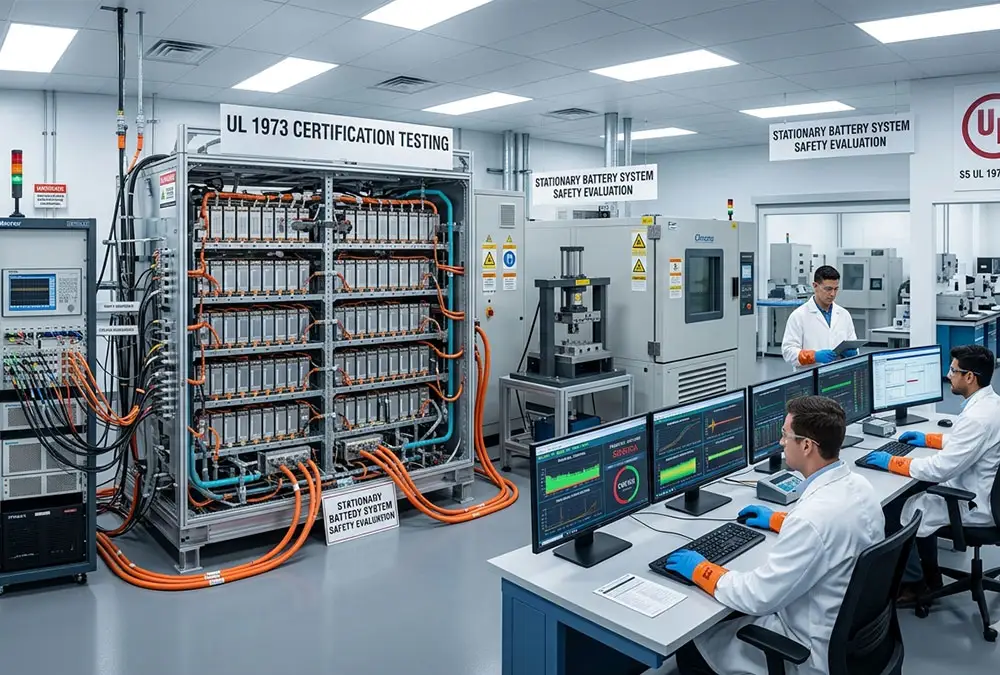
As the global transition to renewable energy accelerates, the demand for UL 1973 certification for battery energy storage systems has reached an all-time high. Ensuring that stationary battery systems meet rigorous electrical and thermal safety standards is no longer just a technical preference—it is a non-negotiable requirement for commercial success and public safety.
Introduction: Why UL 1973 Has Become the Gold Standard for Battery Energy Storage Safety
Rapid Growth of Global Battery Energy Storage Systems (BESS)
According to the 2026 Global Energy Storage Outlook, the total installed capacity of Battery Energy Storage Systems (BESS) is projected to grow by over 35% annually. From utility-scale grid stabilization to integrated EV charging energy storage applications, these systems are the backbone of the modern grid. However, with massive scale comes massive responsibility.
Increasing Safety Concerns and Thermal Runaway Risks
The industry has seen a rise in high-profile fire safety incidents. Thermal runaway protection is now a top priority for EPCs and project developers. Without a standardized safety framework, the integration of high-density lithium battery systems poses significant risks to property and personnel. This is precisely where UL 1973 requirements for commercial energy storage play a pivotal role, setting the benchmark for lithium battery safety standards in North America and beyond.
Common Customer Concerns About UL 1973
- Is UL 1973 mandatory? In most North American jurisdictions, the AHJ (Authority Having Jurisdiction) will not approve an installation without it.
- Can a BESS project operate without it? Operation might be possible in unregulated regions, but insurance providers will likely reject the policy, and financing will be nearly impossible to secure.
- What are the risks? Using uncertified systems leads to higher liability, potential grid interconnection delays, and catastrophic fire risks.
Featured Snippet: UL 1973 is a key safety certification standard for stationary battery energy storage systems, ensuring electrical, thermal, and mechanical safety for commercial and industrial applications. It is the fundamental building block for achieving broader UL 9540 system-level compliance.
What Is UL 1973 Certification for Battery Energy Storage Systems?
To understand what does UL 1973 mean for energy storage systems, one must look at its scope. Unlike standards that focus on portable electronics, UL 1973 specifically targets stationary battery certification. It evaluates the ability of a battery system to safely withstand simulated abuse conditions.
The Difference Between Component and System Certification
A common misconception is that if the individual cells are safe, the whole system is safe. UL 1973 bridges this gap by testing the “battery system,” which includes the battery management system safety logic, the enclosure, and the electrical interconnections. While UL 1973 vs UL 9540 for BESS is a frequent debate, the simplest explanation is that UL 1973 certifies the battery, whereas UL 9540 certifies the entire system (including the inverter/PCS).
What Systems Need This?
- Commercial Battery Storage Systems: Used in peak-shaving and backup power for factories.
- Utility-Scale Battery Storage: Large-scale installations supporting the power grid.
- Data Center Backup: Replacing traditional lead-acid with lithium-ion battery compliance-ready solutions.
- Solar + Storage: Integrated residential and commercial renewable projects.
Why UL 1973 Certification Is Important for Energy Storage Systems
The UL 1973 certification for battery energy storage systems is not just a sticker on a cabinet; it is a rigorous validation of engineering integrity.
1. Enhancing Operational Safety
Through thermal runaway protection and energy storage compliance testing, UL 1973 ensures that a single cell failure does not lead to a multi-cabinet conflagration. This involves complex propagation and fire protection testing.
2. Market Access and Regulatory Alignment
For the North American market, UL 1973 aligns with NFPA 855 (Standard for the Installation of Stationary Energy Storage Systems). Most commercial battery storage certification paths require this alignment to satisfy fire marshals and local utilities.
3. Investor and Stakeholder Trust
In 2025, a report from BloombergNEF highlighted that BESS projects using UL certified battery storage systems received 20% more favorable financing terms compared to uncertified peers. It minimizes “bankability” risks for developers.
Technical Deep Dive: Key Components and Requirements
Achieving UL 1973 certification for battery energy storage systems requires an integrated approach to power electronics. As engineers, we focus on three core pillars:
| Category | Testing Focus | Requirement (2025/2026 Standards) |
|---|---|---|
| Electrical | Short Circuit / Overcharge | No fire, explosion, or leakage. |
| Mechanical | Vibration, Crush, Impact | Maintain structural and isolation integrity. |
| Thermal | Thermal Abuse / Propagation | Prevent cell-to-cell fire spread. |
| Software (BMS) | Functional Safety | Fail-safe logic for temperature/voltage faults. |
Battery Management System (BMS) Logic
The BMS is the “brain” that prevents thermal runaway. Under UL 1973, we evaluate the battery management system safety by simulating sensor failures. The system must demonstrate that it can shut down the power conversion system (PCS) before a hazard occurs.
Lithium Iron Phosphate (LFP) vs. NMC
Does UL 1973 apply to LFP? Absolutely. While Lithium Iron Phosphate (LFP) is inherently more stable than NMC, UL 1973 requirements for commercial energy storage still mandate testing for internal short circuits and utility-scale battery safety standards compliance.
The Compliance Evaluation Process: How to get UL 1973 Certification
For manufacturers asking how to get UL 1973 certification for lithium battery systems, the journey is divided into four critical steps:
- Product Design Review: Initial assessment of the North America ESS standards alignment.
- Laboratory Safety Testing: Destructive testing including crush, thermal abuse, and electrical fault simulation.
- Manufacturing Inspection: Ensuring the production line in the factory maintains energy storage testing requirements consistently.
- Ongoing Audits: Quarterly inspections to ensure lithium-ion battery compliance never wavers.
Industrial BESS Recommendations: Pro-Grade Solutions
If you are developing a project in 2026, we recommend the following UL 1973 certified energy storage systems:
- Liquid-Cooled Industrial BESS (215kWh+): Ideal for high-duty cycle EV charging energy storage applications.
- Containerized Utility-Scale ESS: Fully integrated BESS fire safety certification units for grid-tie projects.
Note: These products feature UL 9540A tested modules for superior safety.
Comparison: UL 1973 vs. Other Standards
Navigating North America ESS standards can be confusing. Here is a quick breakdown of how UL 1973 interacts with other energy storage compliance rules:
- UL 1973: The battery pack/rack level safety.
- UL 9540: The total system level safety (Battery + Inverter).
- UL 9540A: A testing method for fire propagation (data used to satisfy UL 9540).
- IEC 62619: The international equivalent, though often less stringent than UL 1973 certification for battery energy storage systems regarding mechanical abuse.
FAQs About UL 1973 Certification
Is UL 1973 mandatory for battery energy storage systems?
Legally, it depends on local building codes, but practically, yes. Insurance companies and AHJs in the US and Canada almost universally demand it for commercial battery storage certification.
What is the biggest risk of non-compliance?
Aside from fire, the biggest risk is project rejection. An uncertified system can be ordered to stop operation immediately by a fire marshal, leading to millions in lost revenue.
Does it cover Energy Management Systems (EMS)?
UL 1973 focuses on the safety interaction between the BMS and the battery cells. While EMS logic is reviewed, its primary focus is preventing hazardous outcomes from software or hardware failures.