Introduction
The global energy landscape is currently undergoing a structural transformation that demands more than just capacity—it requires duration. As we navigate the complexities of a grid increasingly powered by intermittent renewables, liquid air energy storage for grid scale applications has emerged as a cornerstone technology. While lithium-ion batteries have dominated the short-duration market, the industry’s focus is shifting toward long duration energy storage (LDES) to ensure 24/7 grid reliability. As power systems evolve, understanding the technical nuances, thermodynamic cycles, and economic viability of cryogenic solutions is essential for any stakeholder looking to lead in the 2026 energy market.
What Is Liquid Air Energy Storage (LAES) and How Does It Enable Grid-Scale Energy Storage?
LAES Definition: Cryogenic Air Liquefaction and Expansion
Liquid Air Energy Storage (LAES) is a sophisticated cryogenic technology that stores electricity by cooling ambient air until it liquefies. This process involves compressing air and cooling it to approximately -196°C (-320°F). In its liquid state, air is over 700 times more energy-dense than in its gaseous state at ambient pressure. When the grid requires power, this liquid air is pumped to high pressure, heated, and expanded through a turbine to generate electricity.
Position in Modern Energy Systems
In the 2025-2026 energy framework, LAES occupies a unique niche. It bridges the gap between the rapid-response, short-duration capabilities of Battery Energy Storage Systems (BESS) and the massive, geographically dependent capacity of Pumped Hydro Storage (PHS). Unlike chemical batteries, LAES relies on mature industrial components—pumps, compressors, and turbines—that have been used in the oil, gas, and liquid oxygen industries for decades.
Why it Matters for Grid-Scale Storage
The primary advantage of LAES is its ability to scale. While lithium-ion costs scale linearly with energy capacity (more hours = more expensive cells), LAES scales by simply increasing the size of insulated storage tanks. This makes it a leading grid scale liquid air energy storage project candidate for stabilizing national grids and supporting high-voltage transmission networks.
Featured Snippet:
Liquid air energy storage (LAES) is a cryogenic energy storage technology that stores electricity by liquefying air and releasing it to generate power, making it suitable for large-scale and long duration energy storage applications.
The Role of Liquid Air Energy Storage in Long Duration Energy Storage (LDES)
What is LDES and Why it Matters
Long Duration Energy Storage (LDES) refers to systems capable of discharging power at their rated capacity for periods ranging from 8 to over 100 hours. As coal and gas plants are retired, the grid loses “inertia” and firm capacity. Renewables like wind and solar are intermittent; LDES acts as the “buffer” that prevents blackouts during multi-day periods of low wind or solar radiation (often referred to as Dunkelflaute).
Limitations of Short-Duration Storage
Lithium-ion batteries are excellent for frequency regulation and 1-4 hour peak shaving. However, a LAES long duration energy storage system cost analysis reveals that as duration increases beyond 6 hours, the “Levelized Cost of Storage” (LCOS) for lithium becomes prohibitively high. Furthermore, chemical batteries suffer from degradation and thermal runaway risks—concerns that do not apply to liquid air.
Why LAES Fits Multi-Hour to Multi-Day Storage
LAES provides a sustainable, long-life alternative. Because it uses no rare-earth minerals or toxic chemicals, it is a truly green renewable energy storage solution. It provides “synchronous inertia”—the physical spinning mass of the turbine—which is critical for grid frequency stability, something inverter-based battery systems struggle to replicate at scale.
Thermodynamic Process of Liquid Air Energy Storage (Cryogenic Energy Storage Cycle)
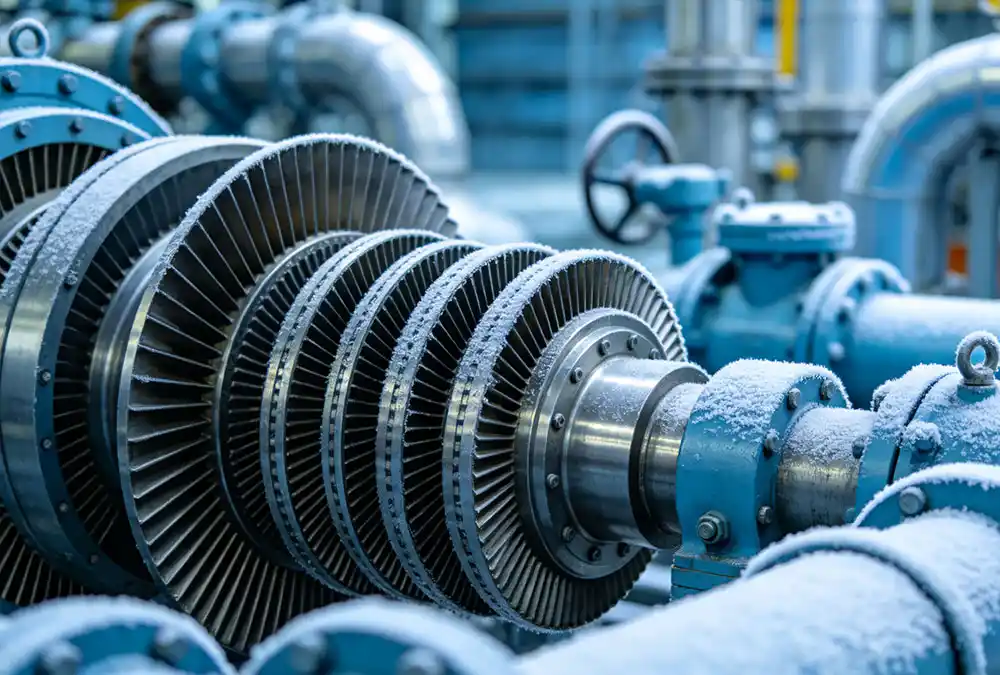
To grasp how liquid air energy storage works step by step, one must analyze the three distinct phases of its thermodynamic cycle.
1. Charging Phase: Air Compression and Liquefaction
Electricity from the grid (or surplus renewable sources) drives a series of compressors. As air is compressed, it generates significant heat. In high-efficiency systems, this “heat of compression” is captured and stored in a thermal storage medium (like molten salt or specialized oils). The compressed air is then passed through a “Cold Box” (heat exchanger), where it is cooled using the “cold energy” recovered from the discharge phase. Finally, a Joule-Thomson expansion valve or a cryogenic expander drops the temperature further until the air liquefies.
2. Storage Phase: Cryogenic Tank (-196°C)
The liquid air is stored in large, double-walled, vacuum-insulated tanks at low pressure. These tanks are similar to those used in the LNG (Liquefied Natural Gas) industry. The energy remains stored with very low “boil-off” losses, making it ideal for multi-day storage.
3. Discharge Phase: Expansion and Turbine Generation
When power is needed, the liquid air is pumped to high pressure (often over 60 bar). It is then passed through the heat exchangers, where it absorbs the “heat of compression” stored during the charging phase. This rapid heating causes the liquid to flash-boil and expand massively. This high-pressure gas is fed into a multi-stage turbine connected to an electrical generator.
Heat Recovery and Efficiency Optimization
Efficiency is the primary engineering challenge for cryogenic energy storage systems for renewable energy grids. Modern plants utilize “Cold Recovery” (storing the cold during evaporation) and “Waste Heat Integration” (using heat from nearby industrial plants). According to a 2025 ScienceDirect report, integrating waste heat can boost round-trip efficiency by 15-20%.
Thermodynamic Efficiency Formula (Plain Text):
Round-Trip Efficiency (RTE) = (Electrical Energy Output / Electrical Energy Input) x 100
In optimized systems, this can be expressed as:
RTE = (W_turbine – W_pump) / (W_compressor – Q_recovered)
Efficiency and Performance of Liquid Air Energy Storage Systems
Round-Trip Efficiency (25–50% vs 60-80% Hybrid)
Standalone LAES typically has a round-trip efficiency (RTE) of 25% to 50%. While this is lower than the 85-90% found in lithium-ion systems, the comparison is often misleading. In an LDES context, the goal is not just efficiency but cost-per-stored-MWh.
Impact of Thermal Integration
The performance of large scale energy storage systems like LAES increases dramatically when paired with industrial processes. For example, if an LAES plant is built next to an LNG regasification terminal, it can utilize the “waste cold” from the LNG, reducing the energy needed for liquefaction.
Performance vs System Scale
LAES exhibits significant economies of scale. A 5MW/20MWh pilot plant will always have lower efficiency than a 50MW/400MWh commercial installation. The 2025 research from MIT suggests that utility-scale systems are approaching the 60% RTE threshold through advanced multi-stage compression and high-temperature thermal storage integration.
Liquid Air Energy Storage vs Other Power Storage Systems: A Strategic Comparison
A liquid air energy storage vs lithium ion battery storage analysis is vital for grid operators choosing a 20-year technology roadmap.
| Feature | LAES (Cryogenic) | Lithium-ion (BESS) | Pumped Hydro (PHS) | CAES (Compressed Air) |
| Duration | 8 – 100+ Hours | 1 – 4 Hours | 8 – 24 Hours | 8 – 48 Hours |
| Energy Density | High | Very High | Low | Low-Medium |
| Lifespan | 30+ Years | 10 – 15 Years | 50+ Years | 30+ Years |
| Geographic Need | None (Anywhere) | Minimal | High (Mountains/Water) | High (Salt Caverns) |
| Safety | High (Non-toxic) | Risk of Fire | High | Moderate |
| Typical RTE | 40 – 60% | 85 – 90% | 75 – 80% | 50 – 70% |
Strategic Takeaway
While Lithium-ion is the king of “power” (fast response), LAES is the king of “energy” (long duration). Compared to Pumped Hydro, LAES is far easier to permit and build because it does not require flooding valleys or specific geology.
Cost Analysis of Liquid Air Energy Storage: LCOS and Economic Viability
Capital Expenditure (CAPEX)
For large scale storage solutions, the CAPEX of LAES is dominated by the power block (turbines and compressors). However, the marginal cost of adding more “hours” of storage is very low—essentially the cost of an extra insulated tank.
Levelized Cost of Storage (LCOS)
LCOS is the most accurate metric for comparing technologies. It accounts for CAPEX, O&M (Operation & Maintenance), depth of discharge, and lifespan.
LCOS Formula (Plain Text):
LCOS = (Total Capital Cost + Total O&M Costs) / (Total Energy Discharged over Lifespan)
In 2026, the LAES long duration energy storage system cost analysis shows that for a 10-hour duration, LAES is competitive with lithium. At 24+ hours, LAES is significantly cheaper.
Cost Reduction with Scale
As more grid scale liquid air energy storage projects and suppliers enter the market, we are seeing the “learning curve” in effect. Standardized modular “cold boxes” are reducing installation times and soft costs, much like the modularization of the LNG industry.
How Liquid Air Energy Storage Supports Renewable Energy and Grid Stability
Wind and Solar Intermittency Solution
Solar power peaks at noon, but demand peaks in the evening. Wind can be absent for days. Energy storage for wind and solar requires LDES to “time-shift” energy across days, not just hours. LAES allows a utility to capture excess spring wind energy and use it during a summer heatwave.
Frequency Regulation and Peak Balancing
While slower than batteries, the rotating mass of an LAES turbine provides instantaneous physical inertia. This is a vital “ancillary service” that helps the grid maintain a steady 50Hz or 60Hz frequency when large loads are switched on or off.
Backup for Grid Resilience
In the event of a total grid failure (Black Start), LAES can provide the initial power to restart other plants. Its ability to store energy for weeks without significant loss makes it a superior grid stability energy storage choice for national security.
Grid-Scale Applications of Liquid Air Energy Storage Systems
Utility-Scale Energy Storage
The most common application is a large-scale plant (50MW/400MWh) located at a strategic substation. It absorbs surplus renewable energy and provides wholesale market services.
Industrial Energy Backup: Recommended Product
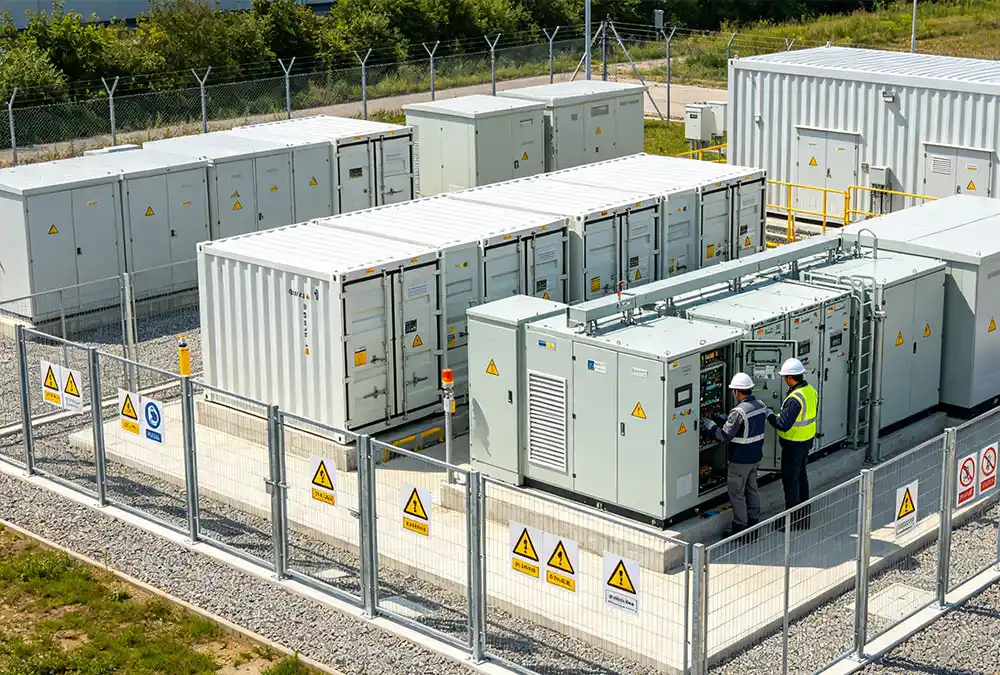
For heavy industry—such as steel mills or chemical plants—the AnengJi Industrial Cryo-Block Series offers a modular LAES solution. Unlike chemical batteries, these units can withstand the harsh thermal environments of heavy industry while providing the multi-hour backup required for critical processes.
Remote and Off-Grid Systems
For island grids or remote mining operations, LAES offers an alternative to lithium battery storage that is easier to maintain. Mechanical engineers can repair a turbine or a pump; specialized chemical engineers are rarely available in remote areas to fix failed battery modules.
Key Challenges of Liquid Air Energy Storage Technology
1. Efficiency Limitations
The thermodynamic loss during the liquefaction-evaporation cycle is the technology’s biggest weakness. Engineers must focus on thermal energy storage systems integration to capture every possible joule of heat and cold.
2. High Initial Infrastructure Cost
Building a “mini LNG plant” for energy storage requires a significant upfront investment. This makes it difficult for smaller developers to enter the market without government subsidies or long-term utility contracts.
3. Early-Stage Commercialization
While the components are mature, the integrated system is still in the early-commercialization phase. However, projects like the Highview Power 50MW plant in the UK are proving that the technology is ready for prime time.
The Future of Liquid Air Energy Storage in the LDES Market
Growth of LDES Demand
The Long Duration Energy Storage Council predicts a trillion-dollar market by 2040. As carbon prices rise and “firming” requirements for renewables become law, LAES will see exponential growth.
Integration with Green Hydrogen
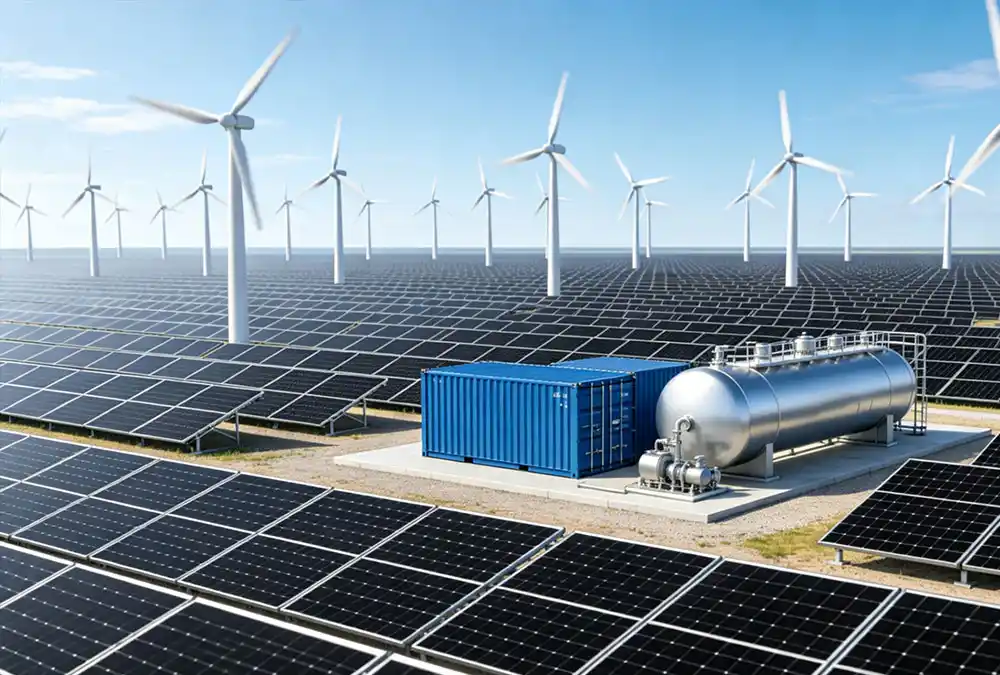
A future trend is the co-location of LAES with Green Hydrogen production. The oxygen by-product of electrolysis can be liquefied and stored using LAES technology, creating a high-value industrial gas stream alongside energy storage.
When Is Liquid Air Energy Storage the Best Choice?
Choosing between LAES vs BESS vs Liquid Cooling depends on your project’s specific goals.
- Choose LAES if: You need >8 hours of storage, have a project scale >20MW, and require a 30-year asset life with no fire risk.
- Choose BESS if: You need <4 hours of storage, millisecond response times, and have a smaller footprint.
- Hybrid Strategy: Many 2026 projects are using a Hybrid Storage Strategy. A small lithium-ion battery handles the “fast” signals, while a large LAES system handles the “bulk” energy shifting.
Featured Snippet:
Liquid air energy storage is best suited for large-scale, long duration applications where cost and scalability are more important than efficiency.
FAQs About Liquid Air Energy Storage (LAES)
What is LAES mainly used for?
It is primarily used for grid-scale and long duration energy storage, renewable energy integration, and providing synchronous inertia to the power grid.
Is LAES commercially available?
Yes, it is in the early commercialization stage. Several utility-scale projects are currently operational or under construction in Europe and the United States.
What are the main advantages of LAES?
No geographic constraints, long lifespan (30+ years), no degradation over time, and a lower LCOS for long-duration applications.
Liquid Air Energy Storage Key Takeaways
| Metric | Detail |
| What is it? | A cryogenic grid-scale energy storage technology. |
| Core Advantage | Long duration storage without location limits or fire risk. |
| Main Limitation | Lower standalone round-trip efficiency than lithium. |
| Best Application | Multi-day renewable energy shifting and grid firming. |
| Strategic Role | A leading candidate for the 2026 LDES market. |
How to Evaluate Liquid Air Energy Storage for Your Energy Project
Assess Storage Duration Needs: If your requirement is >6 hours, LAES should be on your shortlist.
Analyze Local Industry: Is there waste heat or cold nearby? This will dictate your RTE.
Perform an LCOS Analysis: Compare the 30-year lifecycle cost of LAES against the replacement costs of multiple battery cycles.
Consult Energy Storage Experts: Engage with engineers who understand both the electrical grid and the cryogenic cycle.
Ready to stabilize your grid? Contact our technical team today for a comprehensive load-profile analysis and see if a cryogenic solution is the right fit for your renewable energy roadmap.