Introduction
Renewable energy is reshaping our electricity grids faster than old transmission lines can handle. Sun and wind generate massive clean power, but they do so unpredictably. That sudden gap between generation spikes and peak evening demand destabilizes regional grids. This exact challenge is where Grid Scale Battery Storage steps in as an indispensable infrastructure asset. Modern utility installations store excess megawatt-hours during low-demand periods and discharge them when the grid needs power most. Understanding how a grid scale battery storage system operates allows developers, engineers, and power producers to build resilient, profitable assets.
Buyer Insight: Overcoming Initial Capital & Risk Hesitation
Many infrastructure buyers worry about battery cell degradation, fire risks, and lengthy grid connection queues. You aren’t just buying static lithium racks. You are investing in a software-controlled power plant. Addressing fire suppression standards, thermal liquid cooling, and revenue bidding software during early design completely transforms project bankability.
What Is Grid Scale Battery Storage and Why Does the Grid Need It?
Power networks require split-second balance between supply and consumption. A sudden surge in factory load drops system frequency. Conversely, a solar flood at noon spikes voltage. A grid battery storage system acts as a high-speed energy reservoir, absorbing or injecting electricity in milliseconds to maintain strict voltage stability.
Recent industry data from Wood Mackenzie shows global energy storage additions topped 106 GW in 2025 alone. Utility-scale projects captured over 82% of these worldwide installations. According to market analysis from BNEF, annual build rates are projected to hit 123 GW in 2026. This massive deployment proves that large scale battery storage solutions have moved from experimental concepts to core grid infrastructure assets.
The Growing Challenge of Renewable Energy Integration
Traditional transmission grids were designed for centralized fossil fuel generators. Coal and gas turbines provided constant spinning inertia. Renewables broke that old operational pattern completely:
- Solar power fluctuation: Rapid cloud cover drops regional solar output by hundreds of megawatts in seconds.
- Wind power intermittency: Strong gusts generate unexpected power surges, followed by sudden calm periods.
- Grid congestion: Local power lines overheat when crowded with midday clean power.
- Renewable curtailment: Grid operators intentionally disconnect solar farms to protect substation transformers from overloads.
Gas peaker plants take 15 to 30 minutes to fire up. They emit heavy carbon and run on expensive natural gas. Modern networks need faster, cleaner, flexible backup power.
How Large-Scale Battery Storage Supports Modern Power Grids
A utility scale battery energy storage system provides five essential grid-support capabilities:
- Energy shifting: Storing cheap midday solar electricity to supply peak evening loads.
- Peak shaving: Discharging power during peak demand hours to reduce expensive grid capacity tariffs.
- Frequency regulation battery storage: Injecting or absorbing power within milliseconds to keep grid frequency at 50Hz or 60Hz.
- Grid balancing: Supplying reactive power support to maintain local transmission voltage levels.
- Renewable energy storage solution: Capturing clean electricity that would otherwise be curtailed and wasted.
Grid Scale Battery Storage vs Traditional Energy Storage Methods
Older grid storage options exist, but geographic restrictions limit their expansion. Compare traditional generation against modern grid connected battery energy storage system installations below.
| Storage Technology | Response Time | Geographic Limits | Build Timeline | Buyer & User Strategic Benefit |
|---|---|---|---|---|
| Gas Peaker Plants | 15–30 Minutes | High (Air permits & gas pipelines) | 3 to 5 Years | High operational expenses. Exposed to volatile fossil fuel fuel prices. |
| Pumped Hydro Storage | Minutes to Hours | Extreme (Requires dual water reservoirs) | 7 to 10 Years | Massive long-term capacity, but limited by terrain, water, and environmental permitting. |
| Grid Scale Battery Storage | <200 Milliseconds | Very Low (Modular containerized footprint) | 6 to 18 Months | Rapid deployment near substations. Unlocks instant frequency market revenue stacking. |
How Does Grid Scale Battery Storage Work? Understanding the Three-Layer System Architecture
People frequently ask: how does grid scale battery storage work under demanding field conditions? It is not just a cluster of batteries stacked in a warehouse. A professional utility scale battery storage plant functions through three integrated engineering layers.
Layer 1: Physical System — Battery Chemistry and Hardware Components
The physical layer handles chemical energy storage, structural protection, and high-voltage electrical conversion. Key hardware elements include:
- Battery Cells and Modules: Individual Lithium Iron Phosphate (LiFePO4) cells compiled into rigid, battery modules.
- Battery Racks: Vertical metal frames housing multiple modules, complete with cell balance wiring and local fuses.
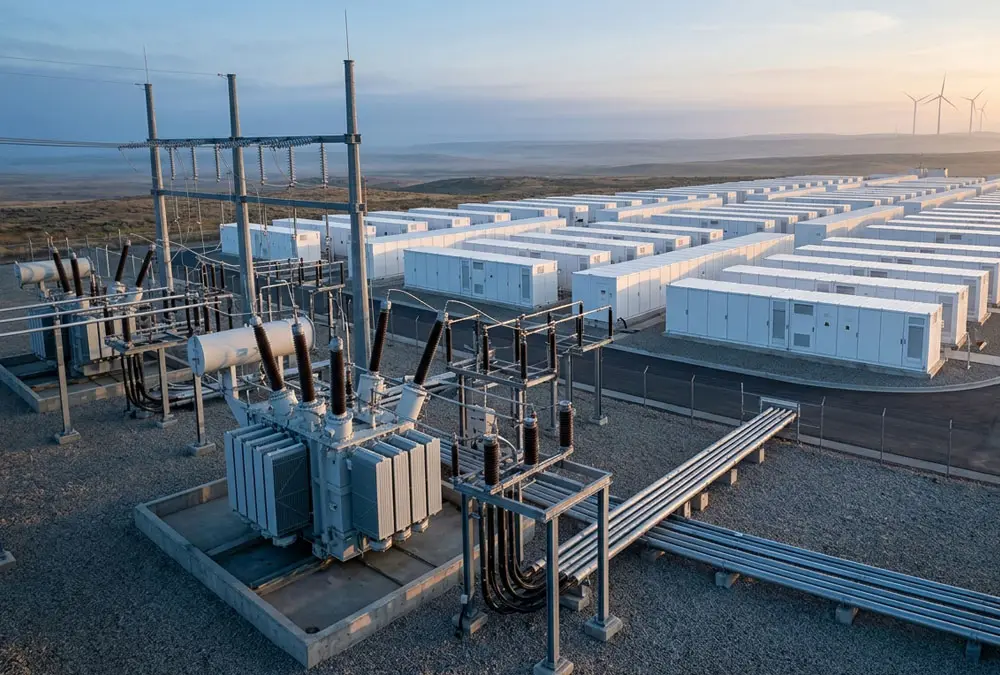
- Containerized Battery Storage System: Heavy-duty, insulated ISO enclosures fitted with liquid cooling loops, HVAC, and automatic Novec 1230 fire suppression.
The Power Conversion System (PCS) serves as the bidirectional electrical bridge. Batteries store Direct Current (DC). The utility grid operates on Alternating Current (AC). During charging, the PCS rectifies AC grid power to DC. During discharging, it converts DC back to precise AC grid voltage.
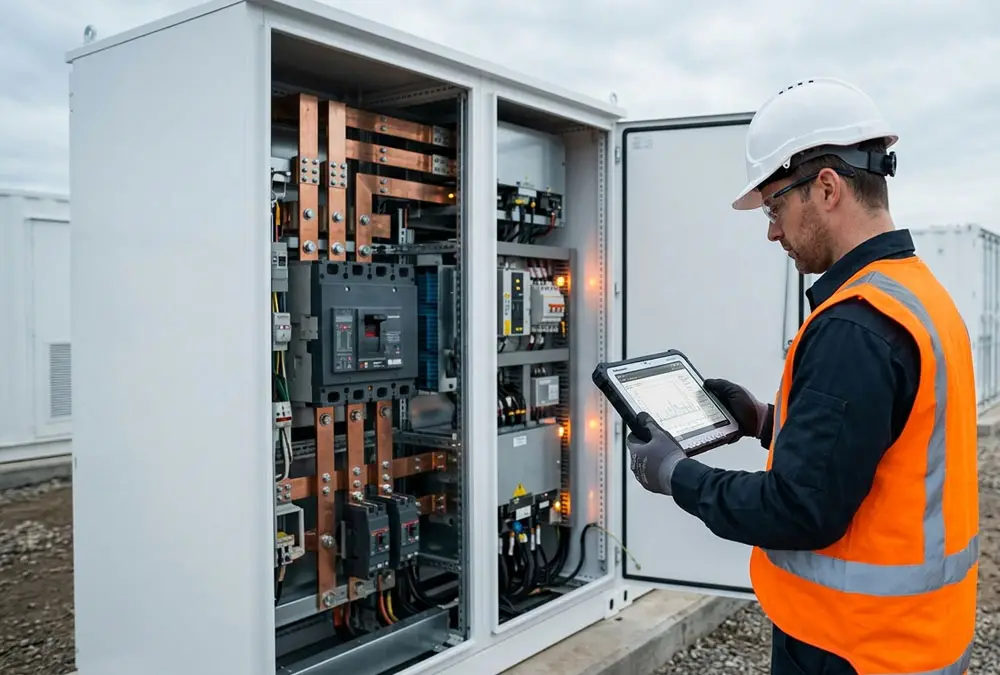
The Battery Management System (BMS) monitors cell voltages, internal temperatures, State of Charge (SOC), and State of Health (SOH) continuously. It prevents thermal stress, individual cell overcharging, and deep voltage drops.
The Energy Management System (EMS) acts as the central software brain. It receives external dispatch orders from grid operators, balancing charging schedules with economic market price signals.
Commercial & Industrial Energy Storage Solutions
Pre-Engineered Liquid-Cooled BESS Cabinets & Containers
Need scalable energy storage system integration before committing to multi-gigawatt transmission projects? Our modular liquid-cooled storage systems deliver plug-and-play reliability:
- 100kWh / 261kWh Industrial Cabinets: Engineered for commercial factory peak shaving, solar integration, and EV fast-charging demand charge reduction. Features built-in liquid cooling and smart BMS control.
- 418kWh / 1MWh Modular Containers: High-density outdoor energy storage designed for solar farm battery storage, wind farms, and utility feeder substations.
Key Value Advantages: Tier-1 LiFePO4 cells, <3°C cell-to-cell thermal variance, IP55 rating, pre-installed fire suppression, and full UL 9540A certification compliance.
Layer 2: Control System — Software Optimization and Intelligent Energy Management
Hardware alone cannot generate high financial returns. Advanced utility battery storage technology relies on intelligent control software:
- Real-Time Telemetry: Sampling local substation voltage, feeder line load, and ambient temperature every millisecond.
- AI-Based Energy Optimization: Predictive algorithms analyze day-ahead market pricing and weather forecasts to build dynamic charging models.
- Grid Interaction Control: Executing automated generation control (AGC) commands to stabilize local power grids instantly.
Layer 3: Economic System — Energy Markets and Revenue Streams
Utility operators monetize grid scale battery storage through three main revenue streams:
- Energy Arbitrage: Charging when power prices hit bottom or turn negative. Discharging during high-priced evening peak hours.
- Ancillary Services: Earning steady service fees for frequency response, spinning reserves, and black-start grid restoration.
- Capacity Market Revenue: Receiving guaranteed monthly availability payments for keeping power reserves ready on demand.
MW vs MWh in Grid Scale Battery Storage: Why Both Ratings Matter
Investors and site developers often confuse Megawatts (MW) and Megawatt-hours (MWh). Both technical metrics dictate how a system operates and earns money.
Understanding Power Rating (MW)
Megawatts measure instantaneous discharge power output. Think of MW as the width of a water pipe. A 100MW BESS can deliver up to 100 Megawatts of power in an instant, making it ideal for rapid frequency regulation battery storage.
Understanding Energy Capacity (MWh)
Megawatt-hours measure total stored energy volume. Think of MWh as the overall size of the water tank. A system rated at 100MW / 400MWh can discharge its maximum 100MW output continuously for four hours ($100 \text{ MW} \times 4 \text{ Hours} = 400 \text{ MWh}$).
How Storage Duration Changes Project Economics
System duration determines which electricity markets a project can target profitably.
| Storage Duration | Primary Operational Focus | Dominant Revenue Engine | Buyer & User Strategic Benefit |
|---|---|---|---|
| 1 to 2 Hours | Frequency regulation, synthetic inertia | Ancillary service payments | Lower initial capital expenditure. High cycling speed unlocks quick cash flow. |
| 4 Hours (Industry Benchmark) | Solar energy shifting, peak shaving | Wholesale arbitrage + capacity market | Optimal economic balance between equipment CAPEX and multi-hour power arbitrage income. |
| 8+ Hours (LDES) | Multi-day renewable smoothing, outage backup | Long-duration capacity contracts | Replaces base-load fossil generators during extended dark or low-wind weather events. |
How Does Grid Scale Battery Storage Operate During a Full Charge and Discharge Cycle?
A grid scale battery storage project follows a strict three-phase operational cycle every day. This process maximizes market revenues while extending battery cycle life.
Cycle Sequence: Surplus Solar/Wind → PCS Rectification (AC to DC) → Liquid-Cooled LFP Rack Storage → Peak Market Inversion (DC to AC) → Substation Grid Dispatch
Charging Phase: Capturing Excess Renewable Energy
Midday solar output spikes, causing wholesale electricity prices to drop. The EMS software detects low electricity prices and signals the PCS to start charging. The PCS pulls AC power from the substation, converts it to DC, and fills the battery racks. This process absorbs excess clean power and prevents costly renewable curtailment.
Idle Phase: Maintaining Grid Readiness
Once fully charged, the system sits in standby mode. Liquid thermal management pumps circulate coolant to keep individual cells at an ideal 25°C. BMS safety sensors check voltage balance and insulation resistance across every module, keeping the asset ready for instant dispatch commands.
Discharging Phase: Supplying Power During Peak Demand
Evening sets in. Solar output drops just as household power usage peaks. Wholesale power prices climb sharply. The grid operator sends an automated dispatch command. The BESS switches to discharge mode in under 200 milliseconds. DC power flows out through the PCS, converts to AC, steps up through local transformers, and flows directly into transmission lines.
Why Lithium-Ion Batteries Dominate Grid Scale Battery Storage Projects
Lithium-ion chemistries account for over 90% of all newly installed utility scale battery storage projects worldwide. High energy efficiency and mature manufacturing supply chains keep lithium at the top of the market.
Lithium-Ion Battery Market Leadership in Utility Storage
Lithium systems deliver excellent Round-Trip Efficiency (RTE), typically between 85% and 92%. Low energy conversion losses mean more stored electricity gets sold back to the grid. Global manufacturing scale has pushed fully installed 4-hour utility-scale system costs down to roughly $117–$125 per kWh according to 2025/2026 reports from Ember and BNEF.
Why LiFePO4 Is Preferred for Large-Scale BESS
Lithium Iron Phosphate (LiFePO4 or LFP) has replaced Nickel Manganese Cobalt (NMC) as the preferred chemistry for utility storage installations:
- Superior Safety: LiFePO4 thermal runaway breakdown occurs above 270°C, offering far better thermal stability than NMC.
- Extended Cycle Life: Provides 6,000 to 10,000 full charge-discharge cycles before reaching 70% residual capacity.
- Lower Raw Material Costs: Eliminates expensive, supply-constrained cobalt and nickel.
Emerging Alternatives Beyond Lithium-Ion Batteries
While lithium leads today, alternative grid energy storage technology options are gaining ground for specific use cases:
- Sodium-ion batteries: Uses low-cost, abundant sodium materials. Performs exceptionally well in extreme cold, though energy density remains lower than lithium.
- Vanadium Redox Flow batteries: Stores energy in liquid electrolyte tanks. Offers zero cell degradation over 20+ years, making it ideal for 8 to 12-hour duration needs.
- Solid-state batteries: Uses solid electrolytes to eliminate fire risks while increasing energy density, though manufacturing costs remain high.
Second-Life EV Batteries for Grid Storage Applications
Retired Electric Vehicle battery packs retain roughly 70% to 80% of their original storage capacity. Repurposing these packs into stationary grid storage cuts initial hardware costs. However, testing, sorting mixed cell health, and integrating inconsistent battery modules remain technical challenges for integrators.
Grid Scale Battery Storage Challenges: Why Deployment Is Not Plug and Play
Building a utility scale battery energy storage system involves complex engineering, regulatory approvals, and safety compliance. Experienced developers address these challenges early in the planning process.
Grid Interconnection Challenges
Connecting a 100MW BESS to high-voltage transmission lines requires detailed system impact studies. In major power markets, interconnection queues can take 2 to 4 years due to utility review backlogs and local transformer supply shortages.
Complex Energy Market Participation
Wholesale electricity market rules change between transmission regions. Software bidding algorithms must adapt dynamically to local capacity auctions, real-time dispatch signals, and changing tariff rules to maintain profitability.
Safety and Compliance Requirements
Managing thermal safety requires strict adherence to international equipment and installation standards:
- UL 9540 / UL 9540A: Evaluates complete energy storage system safety and measures thermal runaway fire propagation risks.
- NFPA 855: Outlines fire protection, mandatory safety clearances, and explosion control for stationary storage facilities.
- IEC 62619: Mandates safety testing for secondary lithium cells used in industrial and utility applications.
Buyer Insight: Navigating Local Permitting & Fire Safety
Local fire marshals frequently block BESS projects over thermal runaway fears. Developers who share certified UL 9540A unit-level test reports early and incorporate blast relief venting and isolated liquid cooling loops pass local planning reviews far faster.
Can Grid Scale Battery Storage Really Make Money? Understanding Project Economics
Financiers evaluate grid scale battery storage investments by balancing capital costs (CAPEX) and operational expenditures (OPEX) against multi-stream revenue models.
Main Costs of Grid Scale Battery Storage Projects
Project capital costs fall into three main categories:
- Equipment CAPEX (60–70%): Battery enclosures, PCS inverters, step-up transformers, and switchgear.
- Balance of System (BOS): Site concrete pads, high-voltage trenching, security fencing, and grid connection hardware.
- Soft Costs: Environmental impact studies, land leases, legal contracts, and interconnection study fees.
Operating Costs and Battery Degradation
OPEX includes HVAC cooling electricity, regular equipment inspections, site insurance, and land leases. Lithium cells degrade slightly with every charge cycle (typically 1.5% to 2.5% annually). Project financial models must include mid-life cell augmentation—adding fresh battery racks around Year 10—to maintain contracted energy capacity over a 20-year project lifespan.
Revenue Opportunities for Grid Battery Storage
Recent analysis from Ember shows that all-in 4-hour BESS projects achieve a Levelized Cost of Storage (LCOS) of roughly $65 per MWh. Combining wholesale price arbitrage with frequency response and capacity market payments allows well-sited assets to generate strong internal rates of return (IRR).
The Future of Grid Scale Battery Storage: Beyond the 4-Hour Storage Limit
As fossil fuel power plants continue to retire globally, energy grids will rely on longer storage durations to handle multi-day weather fluctuations.
Why Four-Hour Battery Storage Became the Industry Benchmark
Four-hour battery systems match evening peak demand periods perfectly. They deliver high economic returns relative to current lithium equipment costs.
The Rise of Long Duration Energy Storage (LDES)
Future clean energy grids require 8 to 24-hour energy storage capacity. Emerging technologies like flow batteries, compressed air energy storage (CAES), and thermal storage will complement lithium systems to sustain multi-day power reserves.
Next-Generation Trends Reshaping Grid Battery Storage
- AI Energy Optimization: Automated trading algorithms that bid storage assets into real-time electricity markets automatically.
- Virtual Power Plants (VPP): Software platforms that aggregate hundreds of distributed industrial batteries into a unified dispatchable asset.
- Hybrid Renewable Plants: Co-locating solar, wind, and storage behind a single substation connection to cut land and grid connection costs.
How to Choose the Right Grid Scale Battery Storage Solution for Your Project
Partnering with the right equipment manufacturer and system integrator determines whether your storage asset achieves its target financial returns.
Evaluate Battery Technology and System Performance
Verify cell Round-Trip Efficiency (RTE) under hot summer operating conditions. Demand clear cell degradation curves under daily 100% Depth of Discharge (DOD) usage profiles.
Check BESS Supplier Engineering Capability
Choose equipment suppliers with proven system integration experience. Ensure they provide local field service teams, fast spare parts availability, and 24/7 remote monitoring support.
Design a Scalable Energy Storage System for Future Expansion
Select modular containerized storage architectures. Modular designs allow seamless capacity expansion when local feeder load grows or when performing future battery cell augmentation.
Frequently Asked Questions About Grid Scale Battery Storage
What is grid scale battery storage?
Grid scale battery storage refers to large-scale energy storage systems connected directly to electric transmission networks or substations. These installations store excess electricity during low-demand periods and discharge it back during peak demand hours to maintain grid stability.
How long can grid scale batteries store energy?
Most commercial utility installations are engineered to discharge energy for 2 to 4 hours. Modern long-duration energy storage systems can store and discharge energy for 8 to 12 hours or longer using flow batteries or specialized chemical setups.
What batteries are used in utility scale storage?
Lithium Iron Phosphate (LiFePO4) batteries dominate utility storage projects due to high safety, long cycle life, and excellent thermal stability. Other emerging options include sodium-ion and vanadium redox flow batteries.
How does battery storage help renewable energy?
Battery storage captures surplus clean electricity generated by solar farms and wind turbines during off-peak hours. It releases that clean energy back to the grid during peak evening hours, preventing clean energy curtailment and reducing reliance on fossil peaker plants.
Is grid scale battery storage profitable?
Yes. Grid battery projects generate revenue by stacking multiple value streams. These include energy price arbitrage (buying cheap power, selling high), frequency regulation payments, and guaranteed capacity market reserve contracts.