Introduction
A 150 kW charger can be online, fault-free and still deliver only a fraction of its rated power to a cold-soaked vehicle. While the driver waits, the queue grows, payment complaints begin, and the operator may send a technician to equipment that is not broken. That is the commercial risk behind an electric car in cold weather: the vehicle, charger and site can each become the limiting factor, and buying more nameplate kW does not reveal which one is responsible.
If you are specifying a workplace, fleet depot, shopping-centre or public charging site, this guide helps answer the decisions that affect winter uptime: how many connectors the site really needs, when AC is more useful than DC, which equipment evidence belongs in the tender, and how to test the complete system before the first cold snap. The goal is not simply to find a charger that “works below zero.” It is to keep vehicles moving when battery acceptance, grid capacity, snow, payment and maintenance pressures arrive together.
What a commercial buyer needs to know in 60 seconds
- Cold-weather charging performance depends on ambient temperature, battery temperature and the complete EVSE system—not charger nameplate power alone.
- A cold-soaked vehicle can remain on a high-power bay while accepting much less than the charger’s rating, reducing winter throughput.
- Reliable projects combine suitable equipment with drainage, snow management, remote recovery, load control and cold-weather acceptance tests.
What Electric Car Cold Weather Really Changes at a Charging Site
A cold battery, a cold charger and a cold site are different problems
When a driver connects to a DC charger, the vehicle’s battery management system controls how much voltage and current the battery will accept. If the pack is cold, the vehicle may request a low current while it warms. Replacing that charger with a higher-rated unit will not force the battery to accept more power.
The charger has its own temperature limits. In its Impact of Electric Vehicle Charging report, the U.S. National Renewable Energy Laboratory (NREL) notes that published DC fast-charger operating ranges are typically around −30°F to 130°F (approximately −34°C to 54°C), while also warning that peak performance can be difficult to achieve at temperature extremes. An operating-temperature range is therefore an eligibility check, not a promise of full rated output in every condition.
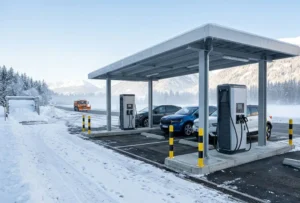
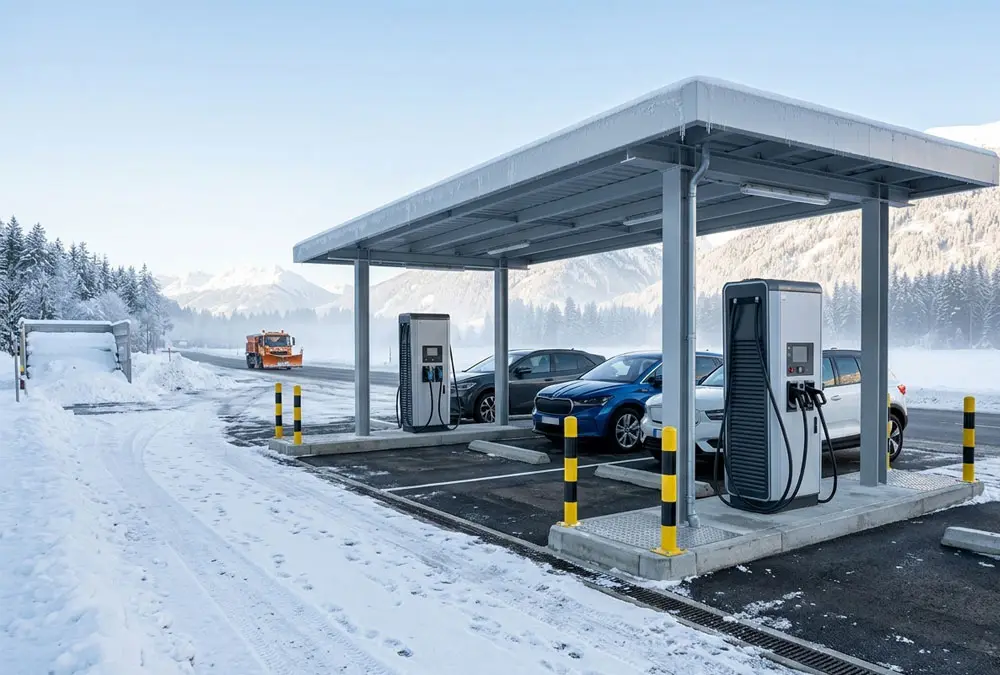
The site creates a third boundary. A charger can be online but unavailable because a ploughed snow bank blocks the bay, an iced holster will not release the connector, or a payment terminal cannot complete authorization. This is why winter availability must be measured at the connector—not only by a green icon in the management platform.
Why charger power does not predict winter session time
A 2025 Canadian Automobile Association test, published by the FIA, drove 13 vehicles to depletion at temperatures between −7°C and −15°C and tested charging on 14 vehicles. The measured range differences versus Natural Resources Canada ratings varied from −14% to −39%. Charging results also varied widely even though the non-Tesla vehicles used 350 kW chargers. That spread is the practical lesson: vehicle design, thermal management, battery condition and charging curve can dominate a winter session.
| Selected vehicle from the same test | Measured range | Difference from official range | 10%–80% charge time | Average charging power |
|---|---|---|---|---|
| Chevrolet Equinox EV | 337 km | −34% | 42 min | 100 kW |
| Kia EV9 | 349 km | −20% | 33 min | 139 kW |
| Kia Niro EV | 285 km | −30% | 77 min | 36 kW |
| Polestar 2 | 384 km | −14% | 40 min | 94 kW |
| Toyota bZ4X | 255 km | −37% | 92 min | 33 kW |
| Volvo XC40 Recharge | 248 km | −39% | 40 min | 87 kW |
Test boundary: selected examples from the CAA/FIA 2025 winter test; ambient temperature was −7°C to −15°C. These are vehicle-specific field results, not a universal winter derating factor or a product ranking.
For site operators, the best diagnostic is to compare four timestamps and values: connection time, charge start, requested power and delivered power. On DC equipment, the charger may record the vehicle’s requested voltage/current locally or expose it through vendor telemetry; availability through OCPP depends on the implementation. If the vehicle requests little current, the charger is not necessarily defective. If requested power is high but delivered power remains low, investigate the charger, shared power cabinet, site limit and thermal condition.
Use the COLD-SITE Framework Before Selecting EV Chargers
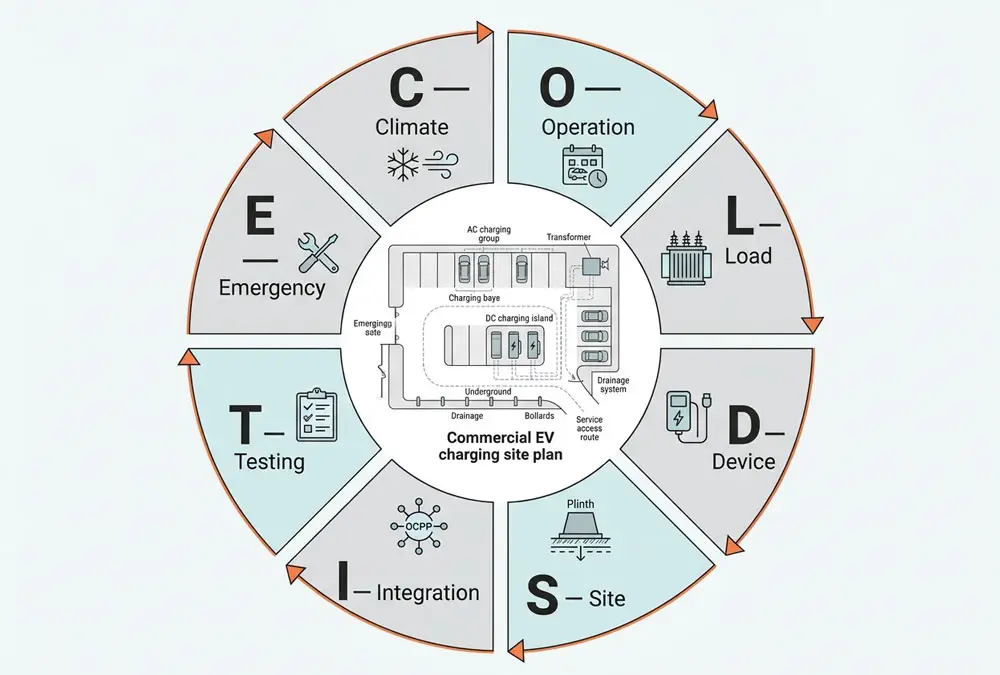
A cold-region tender becomes easier to evaluate when every supplier receives the same project inputs. The COLD-SITE framework keeps the vehicle, charger, electrical system and civil works in one decision chain.
- C — Climate design basis: minimum temperature, duration, wind, snow, ice, freeze–thaw and summer maximum.
- O — Operating demand: vehicle list, route energy, cold-soak duration, arrival SOC, dwell and departure deadline.
- L — Load and power path: transformer capacity, building demand, charging allocation, auxiliary loads, redundancy and expansion.
- D — Device qualification: the cabinet, cable, connector, screen, payment terminal, communications and enclosure—not just one internal component.
- S — Site civil works: plinth, drainage, canopy, bollards, lighting, bay geometry, accessible route and snow storage.
- I — Integration and controls: CSMS, OCPP scope, access/payment, offline operation, remote recovery and load management.
- T — Testing and commissioning: cold start, cold-soak session, power sharing, connection loss, fault recovery and repeated operation.
- E — Emergency and maintenance: inspection triggers, de-icing method, spare parts, response ownership and restoration verification.
How Cold Weather Changes Site Energy and Charging Capacity
A common procurement mistake is to calculate only installed power: four 120 kW chargers equal 480 kW, therefore the site can serve four vehicles at 120 kW. That conclusion ignores the grid allocation, power sharing and vehicle acceptance. It also says nothing about whether the vehicles receive the required energy before departure.
For a fleet or long-dwell commercial site, begin with energy:
Consider an illustrative fleet of 12 cars travelling 70 km per day. If the planning consumption is 0.20 kWh/km, baseline traction energy is 168 kWh per day. Assume the operator’s own winter telemetry shows a 25% energy uplift and the engineering team uses a 90% wall-to-battery planning efficiency:
| Calculation step | Illustrative input | Result | What it does—and does not—prove |
|---|---|---|---|
| Baseline traction energy | 12 × 70 km × 0.20 kWh/km | 168 kWh/day | Estimates vehicle energy before winter uplift and charging losses |
| Winter traction allowance | 168 × 1.25 | 210 kWh/day | Uses a project assumption that must be replaced by local telemetry |
| Meter energy | 210 ÷ 0.90 | About 233 kWh/day | Estimates daily site energy; it does not determine connector quantity |
| Average over a 10-hour window | 233 ÷ 10 | 23.3 kW average | Does not capture simultaneous arrival, short dwell, cold-soak ramp or outages |
The example shows why energy and power must stay separate. A 30 kW allocation may cover the average daily energy, yet still fail if most cars arrive together, two leave early or one connector is blocked. Model a time series with arrival, departure, required kWh and vehicle limits. Then test a charger-outage case. Where the building supply is constrained, a properly commissioned commercial EV charging load-management system can distribute an approved charging budget; it cannot create missing energy or shorten an inadequate parking window.
AC vs DC Charging in Cold Weather: Which Mix Fits the Site?
The right choice follows dwell and required energy, not the assumption that winter automatically requires DC fast charging. Long parking gives managed AC time to deliver energy and support scheduled preconditioning. DC is valuable where turnover or an urgent departure matters, but a cold battery can still limit the first part of the session.
| Architecture | Best-fit parking pattern | Cold-weather constraint | Design response | Buyer benefit |
|---|---|---|---|---|
| Managed AC | Workplace, hotel, overnight depot | Vehicle onboard-charger limit; some power may support battery/cabin heating | Schedule by departure and model net kWh, not connected hours alone | More connectors with lower peak demand |
| DC fast charging | Public corridor, turnaround fleet, priority vehicles | Cold-soaked battery may request low current | Route/precondition where supported; model winter session distributions | Faster recovery when vehicle and charger conditions align |
| Mixed AC/DC | Mixed dwell or critical fleet operations | More complex allocation, access and fault recovery | Shared site limit, priority policy and tested fallback | Routine energy plus a controlled path for urgent charging |
For long-dwell projects, AnengJi’s published AC charging range includes power classes suitable for overnight and workplace planning. Sites needing faster turnaround can review the DC charging range. Select the power class from required kWh and dwell first; then place the exact model, cable assembly, operating temperature, connector and control behavior into the project submittal.
How Cold-Weather Requirements Change by Region
Once the site has defined its energy and charging architecture, geography sharpens the specification. “Cold climate” is not one design condition. World Bank climate profiles report average national winter temperatures of roughly −9°C to −12°C in Kazakhstan, with much colder northern conditions, while Uzbekistan’s December-to-February monthly averages are around −1°C to −3°C with substantial regional variation. Copernicus data also show that European frost, ice and snow conditions vary greatly by region and year. Country names are therefore context—not equipment specifications.
| Editorial planning band | Illustrative condition | Possible examples | Design priority | Buyer consequence |
|---|---|---|---|---|
| Freeze-prone | 0°C to −10°C | Parts of central/western Europe; some Uzbek urban winters | Wet snow, icing, drainage and freeze–thaw | Usability and civil works may matter more than extreme-temperature hardware |
| Severe cold | Below −10°C to about −25°C | Northern/eastern Europe; parts of Kazakhstan and European Russia | Cold-soak, cable handling and winter throughput | Port count and queue capacity must reflect slower sessions |
| Extreme cold | Below about −25°C | Northern Kazakhstan, continental/northern Russia and Arctic locations | Full-system qualification, redundancy and recovery | A cabinet temperature label alone is insufficient procurement evidence |
Important: these bands organize the buying discussion; they are not an engineering standard. Use local design temperatures, duration below each threshold, wind exposure, snow depth and freeze–thaw data. See the World Bank Kazakhstan profile, the Uzbekistan profile and Copernicus European temperature data for regional context.
Winter-Ready Charger Hardware and Civil Works Checklist
One of the most expensive winter mistakes is specifying the enclosure and forgetting everything the user touches. Ask for evidence covering the complete delivered configuration:
- Operating and storage temperatures: confirm whether derating applies and whether the range covers the display, meter, payment unit, communication hardware, connector and cable.
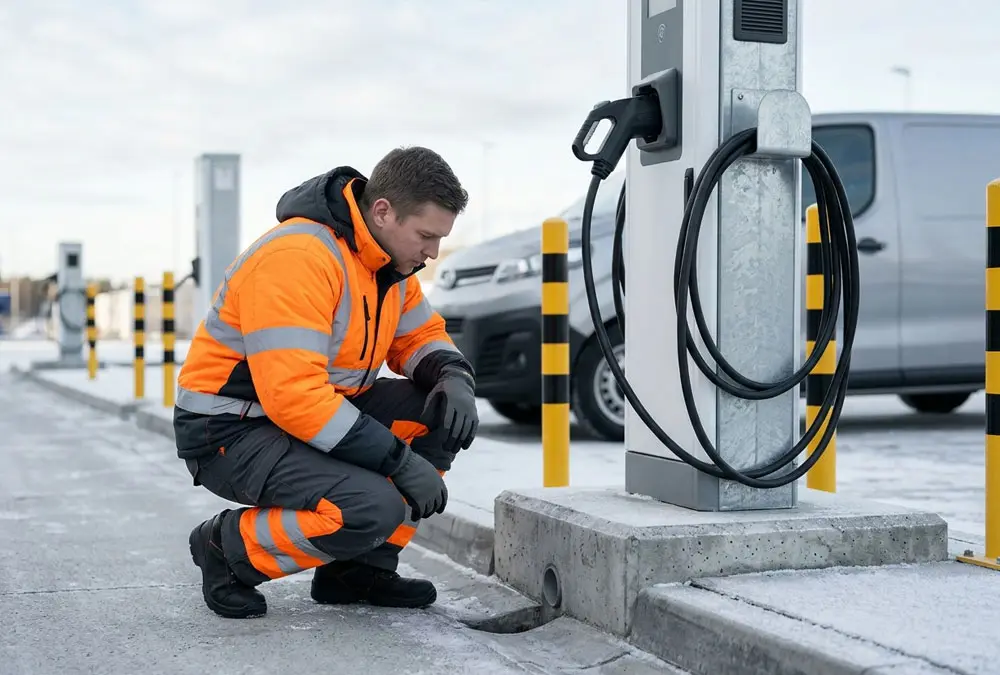
- Cable and connector handling: verify cold flexibility, bend radius, holster drainage, locking behavior and replacement method. A frozen or brittle cable can close a connector even when the charger electronics remain healthy.
- Condensation and freeze–thaw: review enclosure sealing, drainage, approved anti-condensation measures and the effect of bringing service parts between warm and cold environments.
- Human interface: test the screen, RFID reader, payment flow and emergency stop with gloves and under winter glare.
- Plinth and drainage: raise vulnerable openings above expected snow/slush and route water away from the cabinet and pedestrian path. Do not leave exposed temporary cables across a plough route.
- Canopy and ventilation: protect the user and connector without trapping exhaust heat or blocking service clearance.
- Impact protection: design bollards and snow storage so clearing equipment can work without approaching the charger blindly.
NREL’s Overview of Potential Hazards in Electric Vehicle Charging Infrastructure identifies snow-removal vehicle impacts, de-icing chemical corrosion and frozen charging cables as cold-climate hazards. These are not cosmetic concerns: they belong in the civil drawings, maintenance method and handover documentation.
Connectivity, Payment and Remote Recovery Matter More in Winter
A driver arriving with a low state of charge in sub-zero weather has less tolerance for an app failure, locked connector or unavailable card reader. The project should define what happens when the mobile network or CSMS is unreachable: who may start, whether credentials are cached, how session data is stored, and how transactions reconcile after reconnection.
Do not accept “OCPP supported” as the full answer. Record the charger model, firmware, CSMS, network path and required workflows, then witness them together. The OCPP procurement and interoperability guide provides a practical test structure for authorization, transactions, remote commands, offline recovery and smart-charging functions.
An operator also needs diagnostic separation. A slow session can result from the vehicle request, a shared cabinet limit, site load management, charger derating or a hardware fault. The CSMS should show enough evidence to route the case correctly; otherwise every winter complaint becomes an unnecessary field visit.
Cold-Weather Commissioning Tests for EPC Handover
A factory test at room temperature cannot prove winter operation. Add cold-weather scenarios to the site acceptance plan and define the evidence to retain:
- Cold-soaked vehicle session: record ambient temperature, vehicle model, initial SOC, connection time, requested and delivered power, ramp behavior and stop reason.
- Repeated operation: complete several start/stop cycles and inspect connector locking, cable handling and HMI response.
- Shared-power test: connect multiple vehicles, impose the site limit and verify allocation, minimum power and recovery after one vehicle leaves.
- Network-loss test: confirm authorization policy, active-session behavior, local records and reconciliation.
- Fault recovery: simulate a recoverable alarm, remote reset and field escalation; verify the final physical state rather than relying only on an accepted command.
- Winter access inspection: walk the snowplow route, drainage path, accessible route, lighting, bollards, canopy and snow-storage areas.
- Reduced-capacity case: take one charger or module group out of service and confirm that priority vehicles can still meet their departure requirement.
NREL’s Electric Vehicle and Charging assessment reports that three Tesla vehicles were used at temperatures as low as −40°C; the small case sample experienced longer charging and cable-use challenges but no failure that prevented the intended trips. The same report found better efficiency for the vehicle stored in a heated garage than for the two stored outdoors. The finding supports cold-soak testing and sheltered parking, but it should not be converted into a universal performance percentage for every vehicle.
Winter Maintenance: Keep a Small Fault from Closing the Site
A useful winter maintenance plan assigns an owner, trigger, response time and proof of restoration. “Inspect regularly” is too vague. Define who checks cable jackets and holsters after a freeze–thaw event, who clears snow without pushing it into accessible bays, and who approves de-icing products near electrical equipment.
- Inspect cable flexibility, abrasion, connector seals and holster drainage after severe cold or ice.
- Keep charger fronts, accessible aisles, emergency stops and ventilation openings clear.
- Review failed starts, low-power sessions and offline periods by cause—not as one “charger unavailable” total.
- Stock site-specific wear parts and the tools needed to release or replace a damaged connector safely.
- After repair, complete a real authorization and charging session; a restored network heartbeat alone is not proof of service.
Natural Resources Canada’s Green Fleet Best Practices Guide highlights canopies, clear charger access and snowplow damage as practical fleet-site issues. This supports a simple operational rule: the winter maintenance contractor must be part of the charging-site responsibility matrix, not treated as an unrelated facilities supplier.
Cold-Climate EV Charger Procurement Checklist
Before issuing a purchase order, request a submittal that connects the exact equipment to the exact site. The following evidence is more useful than a generic “winter-ready” statement:
- Exact model, order code, firmware and connector configuration.
- Operating and storage temperature limits for the delivered system, including any derating.
- Cable and connector temperature data, not only cabinet electronics.
- Destination-market certificates and test reports tied to the product identity.
- Input/output range, connector count, simultaneous-output rules and minimum controllable power.
- Local and remote behavior during network, meter, CSMS or temperature-related faults.
- Factory and site acceptance procedures, including cold-weather scenarios.
- Spare-parts package, warranty boundary, firmware change control and winter response SLA.
Use the broader commercial EV charger buying checklist to add grid, payment, compliance and lifecycle-cost questions. For a useful configuration review, prepare the site’s location, design minimum temperature, vehicle list, required daily kWh, dwell times, available electrical capacity, planned connector count and operating model.
Electric Car Cold Weather FAQ
Do electric cars charge more slowly in cold weather?
Often, especially when the traction battery is cold-soaked. The vehicle may limit charge current until the battery warms. Charger temperature, shared site power and equipment condition can also reduce delivered power, so diagnose requested and delivered power separately.
Can an electric car battery freeze?
An EV can become too cold to accept normal charging, and model-specific limits vary. Modern battery-management and thermal systems are designed to protect the pack by restricting operation when necessary. Follow the vehicle manufacturer’s temperature and storage instructions rather than relying on one universal threshold.
Should an EV remain plugged in during severe cold?
Many vehicles can use grid energy for scheduled cabin or battery conditioning while connected, but behavior and recommended SOC limits are model-specific. Fleet policy should follow the vehicle manual and confirm that the AC supply can deliver both conditioning and the required departure energy.
Does battery preconditioning improve DC fast charging?
It can improve charge acceptance when the vehicle supports it and the battery reaches the intended temperature. Some vehicles trigger preconditioning only when a compatible charger is selected in navigation; others provide manual controls or no active preconditioning. Charging-site signage should not promise a feature the vehicle may not have.
Do public EV chargers work in snow?
Correctly rated and installed chargers can operate in snowy climates, but operational availability also depends on clear bays, usable connectors, drainage, payment/connectivity and safe snow removal. Winter readiness is a site property, not only a charger property.
Is Level 2 AC or DC fast charging better for a cold-climate fleet?
Use managed AC when vehicles park long enough to receive their required energy and precondition before departure. Add DC where short dwell, operational recovery or priority vehicles justify it. Many fleets benefit from a mixed system rather than making every bay high power.
Design for the Coldest Credible Operating Day
Cold-weather reliability comes from coordinated decisions: realistic vehicle demand, an AC/DC architecture matched to dwell, equipment qualified as a complete assembly, winter-aware civil design, observable controls and a tested recovery plan. The most useful specification is not “works at −30°C.” It is a documented answer to what the site must deliver, under which conditions, after which failure, and how the operator proves service has been restored.
Prepare these inputs for a cold-climate charging review
Site location, local design temperatures, snow/ice exposure, vehicle models, daily kWh, arrival and departure times, available electrical capacity, proposed connector count, CSMS/payment requirements and winter maintenance responsibility.