Introduction
Navigating the complexities of industrial energy management starts with a clear understanding of fundamental units. For facility managers, fleet operators, and grid developers, the difference between kW and kWh with examples is the baseline for making informed procurement and operational decisions. In a world rapidly shifting toward electrification, mistaking power (kW) for energy (kWh) can lead to massive sizing errors in Battery Energy Storage Systems (BESS) or unexpected spikes in utility demand charges. As we look toward the 2026 energy landscape, where decentralized power and smart grids dominate, mastering these definitions is essential for optimizing ROI and ensuring system reliability.
What is kW and kWh? (Power vs Energy Explained)
In the electrical world, terms are often used interchangeably by the public, but for an engineer, they represent two distinct physical dimensions.
What is kW (Kilowatt)?
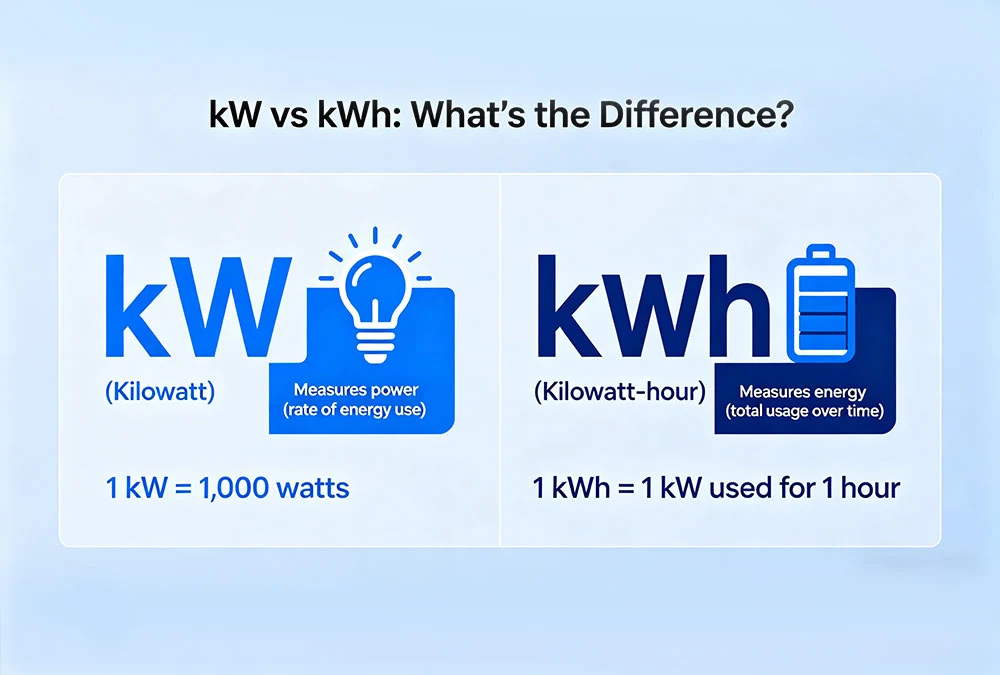
A kilowatt (kW) is a unit of power. It represents the instantaneous rate at which electricity is being generated or consumed. Think of it as the “capacity” or the “size” of the electrical flow. In technical terms, 1 kW is equal to 1,000 watts. When you look at the nameplate of an EV charger or an industrial motor, the kW rating tells you the maximum demand that device will place on your electrical infrastructure at any single moment.
What is kWh (Kilowatt-hour)?
A kilowatt-hour (kWh) is a unit of energy. It represents the total amount of work done over a specific period. If kW is the “speed,” kWh is the “odometer.” It is the primary unit found on your electricity bill and tells you how much fuel (electricity) you have actually consumed.
Why kW and kWh Are Often Confused
The confusion stems from their similar naming and the fact that they are mathematically linked. Because “kW” is tucked inside the term “kWh,” people often assume they are the same. However, one is a rate (kW), and the other is a quantity (kWh). Understanding this distinction is the first step in kW vs kWh explained for electricity bills.
Key Difference Between kW and kWh (kW vs kWh Explained Clearly)
To master energy management, you must separate the “potential” from the “consumption.”
kW = Power (Instant Usage)
Power (kW) describes the load. If you turn on ten 100W light bulbs, you are instantly drawing 1 kW of power from the grid. If you turn on a 350 kW ultra-fast EV charger, you are placing a massive instantaneous load on the transformer. This is why what is kW in electricity is so critical for infrastructure planning.
kWh = Energy (Usage Over Time)
Energy (kWh) describes the total volume. If those ten bulbs stay on for 10 hours, you have used 10 kWh of energy. The kilowatt vs kilowatt hour debate is essentially a debate between “Size” and “Volume.”
Simple Analogy (Speed vs Distance)
The most effective way to internalize this is the car analogy:
- kW is Speed (MPH): It tells you how fast you are going at this exact second.
- kWh is Distance (Miles): It tells you how far you have traveled after an hour of driving.
| Feature | Kilowatt (kW) | Kilowatt-hour (kWh) |
| Physical Quantity | Power (Rate) | Energy (Quantity) |
| What it measures | Instantaneous demand | Total consumption over time |
| Analogy | Speedometer (MPH) | Odometer (Miles) |
| Impact on Bill | Peak demand charges | Total energy usage charges |
| System Sizing | Determines inverter/cable size | Determines battery/fuel tank size |
kW to kWh Formula (Energy Calculation Made Simple)
Knowing how to calculate kWh from kW and time is a basic yet powerful skill for any project manager.
Basic Formula
The relationship is linear and straightforward:
Energy (kWh) = Power (kW) x Time (hours)
To find the energy, simply multiply the power rating of the device by the number of hours it operates.
Step-by-Step Calculation Examples
- Standard Office Load: A 1 kW server rack running for 1 hour consumes 1 kWh.
- Industrial Heater: A 15 kW industrial heater running for 4 hours consumes 60 kWh (15 x 4).
- EV Charging: A 7 kW home charger running for 10 hours delivers 70 kWh to the vehicle battery.
Common Mistakes in kW and kWh Calculation
The most frequent error is dividing instead of multiplying. Remember: You don’t “per” a kilowatt-hour; it is a product of time, not a ratio of it. Another mistake is forgetting to convert minutes to hours. If a 100 kW machine runs for 15 minutes, the calculation is:
100 kW x 0.25 hours = 25 kWh.

Real-World Examples of kW vs kWh (Electricity Usage Scenarios)
Household Appliances Example
A high-performance air conditioner might be rated at 3 kW. If it cycles on and off throughout a hot afternoon for a total of 5 hours of “run time,” it has consumed 15 kWh. Your bill reflects the 15 kWh, but your electrical panel had to be sized to handle the 3 kW “surge” when the compressor started.
Electric Vehicle Charging Example
In the world of EVs, EV charging kW vs kWh is the most discussed topic.
- kW (Charging Speed): A DC Fast Charger might provide 150 kW.
- kWh (Battery Capacity): A Tesla Model 3 has roughly a 75 kWh battery.
- The Result: At a perfect 150 kW rate, it would take 0.5 hours (30 minutes) to fill the 75 kWh battery (75 / 150 = 0.5).
Industrial Equipment Example
In factories, motors often have high kW ratings for startup (torque) but might not run constantly. However, if a 500 kW motor runs for a full 8-hour shift, the electricity unit explanation becomes expensive: 4,000 kWh per shift.
kW vs kWh in Electricity Bills (Understanding Energy Costs)
Why Electricity Bills Use kWh
Utilities charge residential customers primarily for “Total Energy Consumed.” This is measured in kWh because it directly reflects the amount of fuel (coal, gas, or solar electrons) the utility had to provide.
How Utility Companies Measure Energy Usage
Smart meters log your kWh meaning in electricity bill data every 15 to 30 minutes. This allows utilities to see not just how much you used, but when you used it, leading to “Time of Use” (TOU) pricing.
How kW Affects Peak Demand Charges
For industrial users, the kW is just as important as the kWh. Most commercial bills include a “Demand Charge.” This is a fee based on the highest kW peak you hit during the month. If all your machines start at 8:00 AM and hit a 1,000 kW spike for just 15 minutes, you will pay a massive premium for that capacity, even if your total kWh for the month is low.
Expert Quote (Michael Liebreich, BloombergNEF): “The transition to a net-zero grid is not just about generating kWh; it’s about managing the kW peaks through flexible storage and demand response.”
kW and kWh in Battery Energy Storage Systems (BESS Explained)
In the energy storage sector, the kW and kWh for battery energy storage systems defines the system’s “C-rate” and its application.
kW in Battery Storage Systems
The kW rating of a BESS is determined by the Inverter. It dictates how much power the battery can push out at any given moment. A high kW rating is essential for “Power Quality” and “Fast Frequency Response.”
kWh in Battery Storage Systems
The kWh rating is determined by the Battery Cells. It dictates how long the battery can sustain its output. This is the battery storage kWh capacity.
Example: Battery Storage System Sizing
- Power Application (100 kW / 120 kWh): This is a “1-hour” battery. It is used for smoothing out short solar spikes.
- Energy Application (100 kW / 400 kWh): This is a “4-hour” battery. It is used for “Energy Shifting”—storing solar at noon and using it for 4 hours at night.
Why kW and kWh Are Critical in Energy Storage Design
If you get the what size battery do I need kW vs kWh calculation wrong, you either spend too much money on excess capacity or fail to support your critical loads during a blackout.

Recommended Product: AnengJi Industrial Liquid-Cooled BESS
When dealing with industrial loads, we recommend the AnengJi Modular Liquid-Cooled BESS Series. These systems are specifically designed to address both peak demand (kW) and long-duration storage (kWh).
- Technology: Uses high-density Lithium Iron Phosphate (LFP) cells.
- Configuration: Scalable from 215 kWh to multi-MWh arrays.
- Efficiency: Liquid cooling ensures that the cells stay at an optimal temperature, maximizing the kWh output over the life of the system (15+ years).
- Application: Ideal for industrial power vs energy explained scenarios where peak shaving is required to lower demand charges.
Battery Technologies: LFP, Sodium-Ion, and Beyond
To understand battery capacity kWh, we must look at the chemistry inside.
LFP (Lithium Iron Phosphate)
The industry standard for 2026. It offers the best balance of safety, cost, and cycle life. Most industrial BESS like AnengJi use LFP because it can handle thousands of charge/discharge cycles without significant kWh degradation.
Sodium-Ion (Emerging Alternative)
As we move into 2025-2026, Sodium-Ion is gaining traction. It is cheaper and more sustainable than Lithium, making it a great candidate for massive kWh storage where weight isn’t an issue.
Flow Batteries
Unlike solid-state batteries, flow batteries store energy in liquid tanks. They are the ultimate “long-duration” solution, where you can increase the kWh capacity simply by building a larger tank.
How to Choose the Right kW and kWh (Energy Storage & Solar System Sizing)
Matching Power (kW) to Load Demand
Start by listing your largest equipment. If your facility peaks at 500 kW, your BESS inverter (kW) should be sized to handle that peak if you plan to go off-grid.
Matching Capacity (kWh) to Usage Time
How long is your typical outage? If you need to run that 500 kW load for 2 hours, you need at least a 1,000 kWh (1 MWh) battery.
Common Sizing Mistakes to Avoid
Most buyers focus only on the kW to kWh conversion and forget about “Depth of Discharge” (DoD). You should never drain an LFP battery to 0%. Always add a 10-20% buffer to your battery storage kWh capacity calculations.
kW vs kWh in Solar Energy Systems (Solar + Storage Applications)
Solar System Capacity (kW)
A solar array is rated in kWp (Kilowatt-peak). This is the maximum power it can produce under perfect “Standard Test Conditions” (STC). A 100 kW solar system might only produce 80 kW on a hazy day.
Energy Production (kWh)
The solar system kW vs kWh relationship is determined by “Sun Hours.” A 100 kW system in Arizona might produce 600 kWh per day, while the same system in Seattle might only produce 300 kWh.
Solar + Battery Storage Integration
By pairing a solar system with an AnengJi BESS, you can “time-shift” your kWh. You store the kW generated at 12:00 PM and discharge the kWh at 7:00 PM when electricity prices are highest.
Quick Summary of kW vs kWh (Power vs Energy Cheat Sheet)
| Question | Short Answer | Unit |
| What is it? | How fast energy moves | kW |
| What is it? | How much energy moved | kWh |
| Analogy? | Speed | kWh |
| Equation? | P = V x I | kWh = kW x h |
| BESS focus? | Inverter Size | Battery Size |
Why Understanding kW and kWh Matters (Energy Efficiency & Cost Optimization)
Reduce Energy Costs
By understanding the difference between kW and kWh with examples, you can implement Peak Shaving. This involves using a battery to provide power during your highest kW spikes, keeping your “Demand Charge” low.
Optimize Energy Usage
Knowledge of kWh usage allows you to identify “vampire loads”—equipment that draws low kW but runs 24/7, leading to massive kWh totals.
Improve Energy Storage ROI
The highest ROI in energy storage today comes from “Arbitrage”—buying kWh when they are cheap (night) and using them when they are expensive (peak day). This requires a deep understanding of your kW to kWh conversion needs.
Conclusion: kW vs kWh Explained for Everyday and Industrial Use
As the energy sector moves toward a “storage-first” mentality, the distinction between power and energy has never been more critical. Whether you are an engineer designing a microgrid or a homeowner looking at solar, remember that kW is your capacity to do work, while kWh is the work actually accomplished. By mastering the kW vs kWh explained for electricity bills and system sizing, you position yourself to save money and increase resilience.
The future of energy is modular and intelligent. Systems like the AnengJi Industrial BESS are bridging the gap, providing the high kW output needed for heavy machinery and the deep kWh capacity required for long-term sustainability.
FAQ – Difference Between kW and kWh (Featured Snippet Optimized)
What is the difference between kW and kWh?
kW (Kilowatt) measures power, which is the instantaneous rate of energy flow. kWh (Kilowatt-hour) measures energy, which is the total quantity of electricity consumed over a period of time.
How do you convert kW to kWh?
To convert kW to kWh, multiply the power in kilowatts by the time in hours. For example, a 2 kW appliance running for 3 hours uses 6 kWh (2 kW x 3 hours = 6 kWh).
Why is electricity billed in kWh instead of kW?
Utilities bill in kWh because it represents the actual volume of electricity consumed. However, many commercial bills also include a kW demand charge for the highest power spike recorded.
What does kW mean in appliances?
The kW rating on an appliance indicates its “Power Demand.” It tells you how much electrical capacity your home or factory must provide to run that device at full power.
What does kWh mean in battery storage?
In battery storage, kWh indicates the “Storage Capacity.” It tells you how much energy the battery can hold and how long it can power your loads before needing a recharge.