How to Choose the Best EV Fleet Charging Solution
The best ev fleet charging solutions are not necessarily the fastest or cheapest options. When transition managers buy hardware without a long-term strategy, operational bottlenecks pop up fast. To build a reliable system, you need hardware and software that can meet vehicle energy needs, departure schedules, site power limits, and future fleet growth at an acceptable total cost. Electrifying commercial vehicles isn’t just swapping diesel pumps for cable plugs—it requires a complete rethink of depot energy distribution, grid connections, and route scheduling.
This practical guide breaks down the core technical and financial elements of deploying enterprise-grade ev fleet charging solutions, covering key operational questions:
- How many chargers do you actually need for daily operations?
- Should you deploy AC Level 2 chargers, DC fast chargers, or a hybrid strategy?
- How much power will your fleet draw, and how do you calculate peak loads?
- How can you manage limited local grid capacity without paying millions for utility upgrades?
- What are the true hidden costs in the 5-year Total Cost of Ownership (TCO)?
- When does adding a Battery Energy Storage System (BESS) make financial sense?
- How do you evaluate and select the right turnkey solution provider?
Why Choosing the Right EV Fleet Charging Solution Matters
Deploying ev fleet charging infrastructure without an operational roadmap leads to high demand charges, uncharged vehicles, and expensive retrofits. Getting the foundation right protects daily operational uptime.
a
Keep Fleet Vehicles Ready for Scheduled Departure
The core metric for fleet management is Vehicle Readiness. If a delivery van or heavy-duty truck leaves the depot with an incomplete charge, routes fail, deliveries delay, and revenue drops. A proper commercial ev fleet charging solution pairs vehicle departure schedules directly with automated charging queues, making sure every battery reaches target State-of-Charge (SoC) before shift starts.
Avoid Overspending on Chargers and Electrical Infrastructure
Buying excessive high-power DC chargers often wastes capital. If vehicles sit idle for 10 hours overnight, installing 180kW DC fast chargers for every bay is an expensive mistake. Over-specifying hardware drives up equipment costs and forces unnecessary transformer upgrades. Right-sizing charging hardware based on dwell time keeps capital expenditure under control.
Reduce Charging Downtime and Operational Risk
Hardware breaks down, cables wear out, and network connections drop. According to national reliability metrics, unmonitored commercial charging setups often face 10% to 15% downtime without automated alerts. A robust system uses automated self-healing firmware, remote diagnostics, and modular hardware components to ensure uninterrupted fleet operations.
Build a Scalable Fleet Charging Infrastructure
Most fleet electrification projects start small—typically 5 to 10 pilot vehicles—before scaling to 50 or 100+ units. Designing site power, conduit routing, and switchgear solely for Phase 1 forces site operators to dig up concrete twice. Scalable infrastructure plans for final site power capacity from day one, adding charging dispensers as the fleet grows.
What Is an EV Fleet Charging Solution?
An enterprise fleet electric vehicle charging solution is an integrated ecosystem made of four core layers: hardware, software, physical electrical infrastructure, and dynamic energy management systems.
EV Fleet Charging Hardware
AC EV Chargers (Level 2): Delivering between 7kW and 22kW, AC chargers work best for light-duty vans and passenger fleets resting during long overnight dwell times (8 to 12 hours).
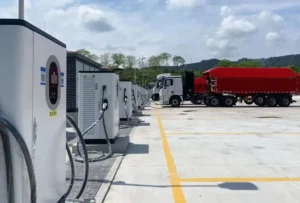
DC Fast Chargers (DCFC): Ranging from 60kW up to 360kW+, DC chargers convert grid AC power directly into high-voltage DC current inside the cabinet, supplying rapid power for mid-shift top-ups or short dwell windows.
Power Conversion Modules: High-efficiency internal AC/DC rectifier modules (typically 30kW or 40kW blocks) allow modular field upgrades and internal redundancy inside DC fast charging cabinets.
Fleet Charging Software
The Charge Point Management System (CSMS) acts as the operational brain. Utilizing the Open Charge Point Protocol (OCPP 1.6J or OCPP 2.0.1), the software connects charging stations with fleet telematics, orchestrating vehicle queues, tracking energy use per asset, and running remote diagnostics.
Electrical Infrastructure
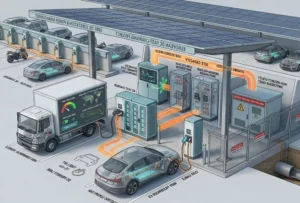
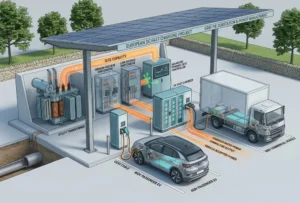
Behind the chargers lies the core power distribution network: step-down transformers, medium-voltage switchgear, isolation panels, sub-metering, trenching, and industrial-grade cabling designed to handle continuous heavy electrical loads.
Smart Charging and Energy Management
Energy Controllers running Energy Management Systems (EMS) automatically throttle power during peak utility tariff hours. When paired with stationary energy storage (BESS) or solar, smart charging software prevents expensive peak demand penalties.
The Fleet Charging Readiness Model™: What Should You Evaluate First?
Before requesting quotes or ordering hardware, engineering teams should evaluate site feasibility using The Fleet Charging Readiness Model™. Gathering these core operational variables upfront prevents costly design changes mid-project.
1. Fleet Energy Demand: Total daily kilowatt-hours (kWh) required across all vehicles based on route length, cargo weight, and weather impact.
2. Vehicle Dwell Time: The exact window of hours vehicles sit parked at the depot during off-shift periods.
3. Departure & Route Schedules: Fixed vs. staggered dispatch times, route criticalities, and emergency backup buffer needs.
4. Available Site Power: Headroom on the site’s main electrical breaker minus existing facility baseload.
5. Future Expansion Timeline: Expected growth in fleet size over 3-year, 5-year, and 10-year horizons.
Buyer’s Perspective & Reality Check: “Will installing 180kW fast chargers everywhere damage my EV battery life over time?”
Answer: Modern EV battery packs with active liquid cooling handle DC fast charging safely, provided the Battery Management System (BMS) controls thermal limits. However, using high-power DC fast charging constantly when vehicles have an 8-hour overnight dwell time wastes capital and increases utility demand charges. High-power DC fast charging should be reserved for tight turnaround windows, while controlled AC or mid-power DC handles longer overnight dwell times.
How Many EV Chargers Does Your Fleet Actually Need?
Determining charger counts requires balancing total daily energy demand against available charging windows, rather than simply matching one charger to every vehicle.
Step-by-Step Capacity Calculation
1. Calculate Daily Fleet Energy Consumption: Multiply total daily mileage per vehicle by its energy consumption rate (kWh/mile), then multiply by total vehicles.
Example: 20 Class 6 delivery trucks × 100 miles/day × 1.2 kWh/mile = 2,400 kWh required daily.
2. Determine Available Charging Window: Identify total idle time parked at the depot overnight or between shifts.
Example: Fleet returns at 7:00 PM and departs at 5:00 AM = 10-hour charging window.
3. Estimate Required Charging Power: Divide total energy by dwell hours, applying an 85% system efficiency factor for thermal losses.
Calculation: (2,400 kWh / 10 hours) / 0.85 = 282 kW continuous power required.
4. Plan for Vehicle Overlap: If all 20 vehicles park simultaneously, deploying 20 dual-port 19.2kW AC chargers or 5 dual-dispenser 60kW DC chargers with dynamic load management satisfies this load profile easily.
Fleet Charger Sizing Matrix
| Fleet Vehicle Category | Daily Mileage Range | Dwell Time Window | Recommended Hardware | Buyer Advantage & Operational Benefit |
|---|---|---|---|---|
| Light-Duty Passenger / Sedans | 40 – 80 miles | 10 – 12 Hours | 7kW – 11kW AC Level 2 | Lowest hardware costs; gentle on facility electrical panels. |
| Last-Mile Delivery Vans (Class 2-3) | 70 – 130 miles | 8 – 10 Hours | 19.2kW AC / 30kW-60kW DC | Balances fast top-ups with low installation cost per bay. |
| Regional Freight Trucks (Class 6-7) | 120 – 220 miles | 4 – 6 Hours | 120kW – 180kW DC Fast Charger | Guarantees full recharge during brief shift turnovers. |
| Heavy drayage / Electric Trucks (Class 8) | 150 – 300+ miles | 1 – 3 Hours | 240kW – 360kW+ / MCS Ready | Maximizes vehicle uptime for multi-shift continuous operations. |
AC vs DC EV Charging: Which Is Best for Your Fleet?
Choosing between AC chargers and DC fast chargers depends on daily duty cycles, vehicle battery sizes, and turnaround time constraints.
When AC EV Charging Is the Better Choice
AC charging utilizes the vehicle’s onboard charger to convert AC current from the grid into DC power for the battery. AC charging works best for long overnight parking scenarios. Hardware purchase costs are lower, installation is simpler, and continuous power draw puts less stress on local transformers.
When DC Fast Charging Makes More Sense
DC fast chargers bypass the vehicle’s onboard converter, supplying high-voltage power directly to the battery. **ev fleet charging solutions for electric trucks** and heavy-duty vehicles require DC fast charging due to their large battery sizes (300kWh to 600kWh+), which would take over 24 hours to charge on a standard AC charger.
Hybrid Fleet Charging Architecture
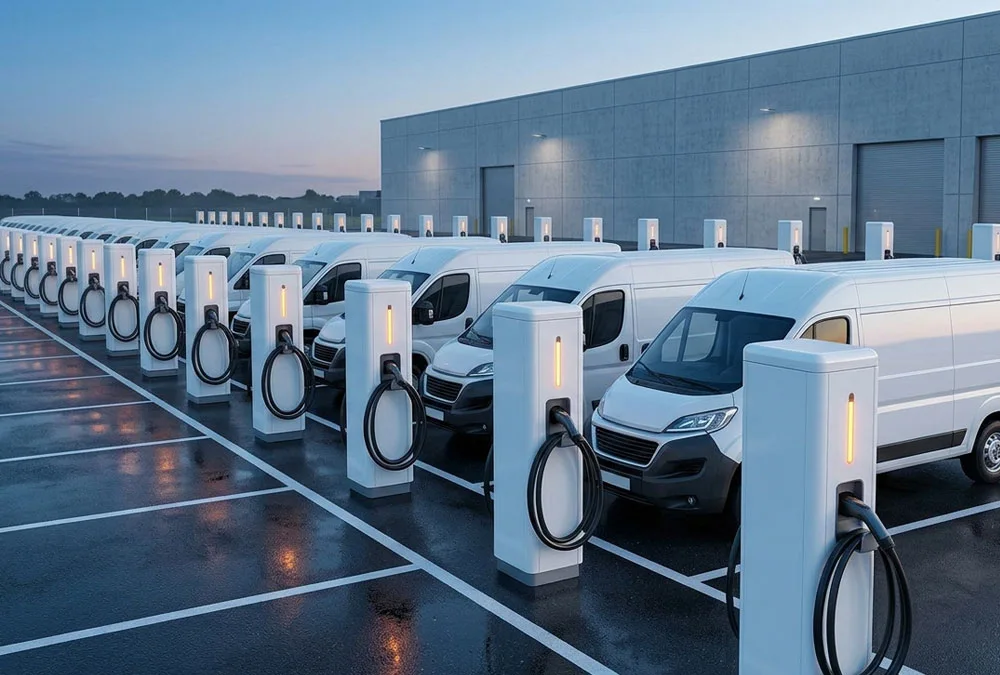
Most commercial logistics depots deploy a Hybrid Fleet Charging Architecture. In this setup, 80% of parking bays feature low-cost AC chargers for standard overnight dwell windows, while 20% feature high-power DC fast chargers for rapid mid-shift top-ups or delayed vehicles needing quick recovery.
How to Manage EV Fleet Charging When Grid Capacity Is Limited
Grid infrastructure upgrades from regional utilities can take 12 to 36 months, threatening fleet rollout schedules. Intelligent load control solves these capacity bottlenecks in software.
Why Unmanaged Simultaneous Charging Overloads Depots
When 30 delivery vans plug in simultaneously at 6:00 PM following shift end, unmanaged chargers immediately draw peak power. This creates massive utility demand spikes that can trip main facility breakers and incur expensive monthly peak demand charges.
Dynamic Load Management (DLM) and Smart Scheduling
EV charging load management controllers dynamically balance available power across active dispensers in real time. If total available power is limited to 300kW, DLM distributes 10kW to 30 vehicles early in the evening, automatically increasing output to 30kW per bay as individual vehicles finish charging.
Real-World Impact: Managed vs. Unmanaged Grid Load
In a 2026 commercial depot analysis by BloombergNEF, implementing software-driven dynamic load management reduced peak power demand by up to 45% without impacting vehicle dispatch schedules. This allowed site operators to double their active fleet size on existing grid connections without paying for utility transformer upgrades.
How to Control the Total Cost of EV Fleet Charging
Hardware purchase costs represent less than 35% of the total cost of ownership over a 5-year operating window. Evaluating project economics requires a full capital and operational expenditure analysis.
The Fleet Charging TCO Model™ (5-Year Projection)
| Cost Category | Unmanaged Setup (20 Bays) | Optimized System with DLM + BESS | Strategic Savings & Operational Advantage |
|---|---|---|---|
| Charger Hardware (CAPEX) | $180,000 (DC Fast Chargers) | $95,000 (Hybrid AC + DC) | Lower initial equipment investment. |
| Grid Upgrade & Civil Works | $250,000 (New Transformer) | $40,000 (Existing Connection) | Avoids major utility upgrade delays and costs. |
| 5-Yr Energy & Demand Charges | $420,000 (Uncontrolled Peak) | $260,000 (Peak Shaved) | Significantly reduces peak utility charges. |
| Software & O&M Maintenance | $45,000 (Reactive repairs) | $30,000 (SLA Cloud management) | Improves uptime while lowering repair costs. |
| Total 5-Year Estimated TCO | $895,000 | $425,000 | Over 50% Reduction in Total Lifetime Cost |
How EV Fleet Charging Software Improves Operations
Modern ev fleet charging management solutions integrate directly with fleet telematics platforms like Samsara, Geotab, and Webfleet to pass real-time State-of-Charge (SoC) data directly into the charging controller.
OCPP Compatibility & Vendor Interoperability
Selecting hardware compatible with open protocols (OCPP 1.6J or OCPP 2.0.1) prevents proprietary software lock-in. If a software provider raises subscription prices or shuts down cloud service, open OCPP hardware allows site operators to point chargers to a new management platform without replacing physical hardware.
Automated Vehicle Prioritization & Remote Diagnostics
When a delivery truck arrives at the depot with only 10% battery remaining and is scheduled for an early 5:00 AM dispatch, intelligent software prioritizes power allocation to that bay over a vehicle arriving with 50% battery scheduled for a 9:00 AM dispatch. Meanwhile, automated diagnostic alarms monitor internal temperatures and electrical noise, flagging potential hardware faults before they cause site outages.
How to Improve Charging Efficiency and Battery Life
Operating a commercial fleet efficiently requires minimizing energy conversion losses and managing battery thermal health over time.
Match Charging Profiles to Shifts: Avoid high-power charging for vehicles resting longer than 6 hours.
Automate Pre-Conditioning: Program the software to heat or cool vehicle cabins while still connected to grid power, protecting battery range before the vehicle hits the road.
Limit High SoC Hold Times: Avoid holding batteries at 100% State-of-Charge for hours in hot ambient conditions; schedule full charges to complete just prior to departure.
Maintain Cabinet Power Efficiency: Select DC chargers with modern Silicon Carbide (SiC) power modules that deliver overall system efficiency above 96%.
When Should You Add BESS to an EV Fleet Charging Solution?
Integrating ev fleet charging solutions with energy storage creates a microgrid that reduces dependency on local electrical grid capacity.
Core Technical Use Cases for BESS Integration
Adding a Battery Energy Storage System makes financial sense in three main depot scenarios:
- Severe Grid Connection Limits: Local grid capacity is capped at 200kW, but peak fleet charging demands reach 800kW.
- High Utility Demand Charges: Local utility demand charges exceed $20/kW/month, making peak shaving highly profitable.
- On-Site Solar Integration: The depot has roof-mounted or canopy solar PV, requiring stationary storage to capture daytime solar energy for evening fleet charging.
Recommended Commercial BESS Product Configurations for Fleet Depots
Depending on depot size, integrating outdoor cabinet-style or containerized BESS units stabilizes site power delivery:
• 100kWh / 261kWh Commercial BESS Cabinets: Compact liquid-cooled outdoor cabinets designed for small delivery depots (5–15 vans). Core benefit: Shaves short demand spikes and fits into standard parking spaces easily.
• 418kWh / 1MWh Containerized BESS Systems: High-density modular enclosures engineered for heavy transport hubs and electric bus depots. Core benefit: Supplies megawatt-level burst power for fast charging while enabling grid demand-response monetization.
How to Plan and Deploy a Commercial EV Fleet Charging Station
Deploying a commercial depot requires careful execution across four main deployment phases:
Phase 1: Site Assessment & Layout Design: Analyze turning radiuses, vehicle parking maneuvers, cable reach, and safety clearance zones around high-voltage equipment.
Phase 2: Civil Works & Electrical Distribution: Complete ground trenching, conduit laying, concrete pad pouring, and utility transformer connections.
Phase 3: Network & Communication Provisioning: Install redundant cellular (4G/5G) or hardwired ethernet communication lines to link chargers back to cloud management servers reliable.
Phase 4: Commissioning & Pilot Deployment: Execute full electrical insulation testing, OCPP cloud handshakes, and run a 30-day pilot test before full operational rollout.
How to Choose the Best EV Fleet Charging Solution for Your Business
Follow The 10-Step Fleet Charging Decision Path™ to select hardware and software aligned with your operational requirements:
- Define Vehicle Duty Cycle: Calculate average daily distance and cargo weight.
- Map Daily kWh Energy Needs: Convert route demands into required battery charging energy.
- Identify True Dwell Windows: Log exact vehicle arrival and departure times.
- Select Topology (AC, DC, or Hybrid): Choose hardware configurations that match dwell times.
- Audit Site Electrical Capacity: Check available amp capacity on main panels with an electrician.
- Evaluate Software Load Controls: Confirm the software supports Dynamic Load Management (DLM).
- Verify OCPP & Software Protocols: Ensure hardware supports open standards (OCPP 1.6J / 2.0.1).
- Calculate 5-Year Operating TCO: Factor equipment costs alongside utility demand charges.
- Design Phase 2 Expansion Space: Underground conduit and switchgear space should accommodate future fleet growth from day one.
- Select a Qualified Turnkey Partner: Choose an experienced OEM/EPC partner with proven fleet deployment experience.
How to Choose an EV Fleet Charging Solution Provider
Not all equipment suppliers offer turnkey support. Use this scorecard to rate potential manufacturing and EPC partners during procurement:
Fleet Solution Partner Scorecard™
| Evaluation Factor | Weight | Selection Criteria & Technical Requirements | Strategic Buyer Advantage |
|---|---|---|---|
| Product Portfolio | 15% | Complete range of AC Level 2 and high-power DC fast chargers. | Single-vendor hardware sourcing simplifies support. |
| Software & OCPP Support | 15% | Full compliance with OCPP 1.6J/2.0.1; native dynamic load management. | Prevents lock-in to proprietary software platforms. |
| Hardware Reliability | 15% | Modular power conversion design with high IP/IK weatherproofing ratings. | Reduces vehicle downtime caused by charger failure. |
| Safety Certifications | 10% | UL, CE, IEC, and local grid safety compliance certifications. | Ensures smooth municipal permitting and utility approval. |
| Engineering Support | 10% | Provides pre-sales site evaluations, single-line diagrams (SLD), and design assistance. | Prevents costly electrical design mistakes early on. |
| OEM / ODM Capability | 10% | Custom enclosure branding, tailored firmware development, and custom UI options. | Supports enterprise branding and custom software integration. |
| Manufacturing Capacity | 10% | Established factory production lines and clear hardware lead times. | Protects project timelines from supply chain delays. |
| Warranty & Spare Parts | 10% | Clear spare parts supply chains with strict SLA response times. | Ensures quick repairs and long-term equipment operation. |
Common EV Fleet Charging Mistakes to Avoid
Steer clear of these common pitfalls when deploying fleet electrification projects:
1. Buying Chargers Based Solely on Rated Power: Selecting 180kW chargers when 22kW AC units satisfy overnight dwell times wastes capital.
2. Ignoring Utility Peak Demand Charges: Unmanaged simultaneous charging drives up monthly utility bills unexpectedly.
3. Designing Only for Phase 1 Vehicle Counts: Laying conduit sized strictly for 5 pilot vehicles forces expensive ground trenching when scaling to 30 units.
4. Skipping Full-Load Pilot Testing: Rolling out hardware site-wide without testing OCPP handshakes causes unexpected operational downtime.
Frequently Asked Questions
Q: What is the best EV fleet charging solution?
A: The best solution balances hardware power output, vehicle dwell times, and site power limits using dynamic load management software to minimize total operational costs.
Q: Should an EV fleet use AC or DC charging?
A: Use AC Level 2 chargers for long overnight parking windows (6-12 hours). Use DC fast chargers for heavy trucks with large battery packs or tight shift turnaround windows.
Q: How does dynamic load management help fleet charging?
A: Dynamic load management shifts power output across plugged-in vehicles based on real-time capacity. This prevents transformer overloads and avoids expensive utility demand charges.
Q: Can a Battery Energy Storage System (BESS) reduce fleet charging costs?
A: Yes. A BESS charges during off-peak hours and discharges during peak charging windows, supplying extra power without triggering utility grid demand penalties or transformer upgrades.
Get the Right EV Fleet Charging Solution for Your Project
Ready to electrify your commercial fleet without overspending on grid upgrades or wrong-sized hardware? Work directly with our application engineers to model site power requirements, size hardware correctly, and calculate your 5-year operating TCO.
Plan Your Commercial EV Fleet Charging Infrastructure Today
Get a customized site evaluation, single-line electrical layout, and commercial quote tailored to your specific vehicle fleet and power constraints.
Related Article
- Top 10 EV Charging Manufacturers in the World: 2026 Guide for Business Buyers
- The 10 Biggest Electric Vehicle Charging Companies in the World
- Electric Car Charging Stations Cost: 2026 Commercial Installation Guide
- Level 1 vs. Level 2 vs. Level 3 Charging: Which EV Charger Do You Need?
- Commercial DC Fast Charging Solutions: Complete Guide for Business