Introduction
The modern power grid is undergoing a significant transformation, moving from centralized generation toward localized, intelligent distribution. At the absolute center of this structural change is the adoption of behind the meter energy storage, a technology that allows commercial and industrial enterprises to intercept their power flow, gain energy independence, and drastically optimize their overhead costs. In an era marked by dynamic utility tariffs and continuous sustainability mandates, relying entirely on a utility provider introduces substantial financial vulnerabilities. By deploying localized distributed energy resources (DER), forward-thinking organizations are transforming themselves from passive consumers into proactive participants in the modern power network.
What Is Behind the Meter (BTM) in Energy Storage?
Definition of Behind the Meter
To properly understand the practical application of this technology, one must define the boundary lines of physical electricity delivery. Behind the meter refers to any localized energy generation or storage system that is physically installed on the customer’s side of the utility’s electric meter.
Location in the Energy System
The utility meter acts as both a physical and legal boundary. All electricity drawn from the central grid passes through the meter, where consumption is recorded for billing.
By placing battery systems, solar arrays, or microgrids on the facility side of this operational boundary, businesses can manage their localized consumption directly. The localized system can meet the facility’s instantaneous electrical needs before drawing from the utility grid, or it can store grid power when prices are low and discharge it later when utility prices peak.
System Components: Hardware and Software Integration
An industrial-grade localized storage system operates through the coordination of four primary building blocks:
- Battery System: Typically comprised of safe, high-cycle Lithium Iron Phosphate (LFP) cells. These cells offer superior thermal stability and over 6,000 charge cycles before reaching critical degradation levels.
- Power Conversion System (PCS): A bi-directional inverter that converts DC power from the battery modules into usable AC power for the building’s machinery, or converts incoming AC grid power into DC for charging.
- Battery Management System (BMS): A hardwired safety interface that continuously tracks current, individual cell voltages, and thermal conditions to prevent electrical overstress or thermal runaway.
- Energy Management System (EMS): The high-level digital intelligence that runs algorithms to automate charging and discharging cycles based on local facility demand, weather forecasts, and utility tariff changes.
Featured Snippet:
Behind the meter (BTM) refers to energy generation or storage systems installed on the customer side of the electricity meter, allowing businesses to manage their own energy usage, reduce costs, and improve reliability.
Behind the Meter vs Front of the Meter: Key Differences in Energy Storage
For commercial operations planning capital investments, a clear behind the meter vs front of the meter energy storage comparison is essential.
| Feature | Behind the Meter (BTM) | Front of the Meter (FTM) |
| Physical Placement | On the customer side of the utility meter | On the grid/utility side of the meter |
| Typical Target User | Factories, commercial sites, data centers | Grid operators, wholesale energy investors |
| Core Economic Driver | On-site bill reduction and continuous power backup | Ancillary market revenue and large-scale arbitrage |
| Storage Capacity Scale | 30 kW to 10 MW (Highly modular) | 10 MW to over 500 MW (Grid-scale) |
| Key Advantage | Protects against dynamic local demand charges | Stabilizes broad transmission networks |
Physical Placement
BTM energy assets are permanently sited within the commercial customer’s property line, connected directly to their primary switchgear. Front of the meter (FTM) systems are connected directly to distribution substations or high-voltage transmission lines.
Ownership Models and Operational Goals
FTM systems are typically owned by electric utilities or institutional investors who participate directly in wholesale power trading. Conversely, BTM systems are typically purchased by businesses to serve as local financial and operational tools. This helps facilities manage their own utility bills, run localized microgrids, and secure reliable backup power.
Revenue and Savings Mechanisms
FTM projects capture value by selling bulk capacity, frequency response, or reactive power directly to regional grid operators. BTM applications generate value primarily through cost avoidance—lowering demand charges, maximizing time-of-use (ToU) arbitrage, and preventing financial losses caused by brief power outages.
Featured Snippet:
The main difference between behind-the-meter and front-of-the-meter systems is that BTM operates on the customer side for cost savings, while FTM systems operate on the grid side for large-scale energy management.
How Behind the Meter Energy Storage Reduces Electricity Costs
Direct savings on electricity bills are the primary financial driver for the installation of behind the meter storage systems. These savings are achieved through a few key operational strategies.
Total Monthly Energy Bill = (Total Energy Consumed in kWh x Tariff Rate) + (Peak Demand in kW x Demand Tariff)
Peak Shaving and Demand Charge Reduction
Industrial users do not just pay for the volume of electricity they use. A large part of their monthly bill is determined by the “Demand Charge.” This fee is calculated based on the single highest 15-minute window of peak usage within the billing cycle.
Using high-power machinery, automated assembly lines, or large compressors can cause brief but intense spikes in power draw. A localized battery system smooths out these peaks by discharging stored energy directly to the facility. This keeps the utility meter from registering a spike and significantly lowers the facility’s demand charges.
BTM Shaved Peak in kW = Original Facility Peak Load in kW - Battery Discharge Power in kW
Time-of-Use (ToU) Tariff Optimization
Many utility companies use dynamic time-of-use tariffs, where energy costs rise significantly during specific peak windows. BTM installations capture energy from the grid at night or during off-peak periods when electricity prices are lowest. This stored energy is then discharged to run the facility during expensive peak hours, reducing the amount of high-priced power purchased from the utility.
Energy Arbitrage
In regions with highly dynamic energy markets, the EMS can automate power purchases. This allows the system to buy and store electricity when prices are extremely low or negative, and then use it to offset localized operations when prices spike. This strategy provides predictable and stable energy costs for the business.
Featured Snippet:
Behind-the-meter energy storage reduces electricity costs by storing energy during low-cost periods and using it during peak demand, lowering both energy and demand charges.
Behind the Meter Energy Storage for Commercial and Industrial Applications
Industrial and commercial sites require tailored configurations to match their specific operational patterns. Utilizing behind the meter energy storage solutions for industrial facilities ensures operations run smoothly and efficiently.
Manufacturing and Production Plants
Factories have high continuous loads combined with sudden spikes from heavy electric motors and thermal systems. BTM systems act as an on-site power buffer. They absorb sudden surges from large machinery to prevent voltage sags and eliminate localized peak spikes that can lead to costly demand charges.
Additionally, should the central grid experience a total blackout, a localized battery system can quickly isolate the factory’s network. This keeps the most critical automated production lines running and prevents costly production delays.
Commercial Office Buildings and Retail Centers
For corporate real estate, the primary challenge is managing high daytime usage driven by HVAC systems, lighting, and computing needs. Deploying localized energy storage for buildings lowers peak usage during office hours, reduces the property’s overall carbon footprint, and helps owners achieve higher LEED green building certifications.
Behind the Meter Data Centers
Data centers require absolute uptime and continuous power. Transitioning from traditional, passive backup infrastructure to active behind-the-meter storage allows these facilities to turn their emergency backup assets into active financial tools. The BTM battery system provides seamless backup power while simultaneously performing peak shaving and participating in local grid demand response programs to generate additional revenue.
Behind the Meter Solar and Battery Storage Systems
Pairing distributed solar panels with localized energy storage creates a robust, highly optimized on-site energy network.
Increasing On-Site Solar Utilization
Without battery storage, any solar power generated that exceeds the building’s instantaneous load is exported back to the central utility grid. In regions without favorable net metering programs, exporting solar power offers poor returns. Behind the meter solar and battery storage system benefits solve this problem by capturing surplus daytime solar generation and using it to run the facility during high-rate evening hours.
Solar Self-Consumption Rate (%) = [(Direct Solar Consumption + Discharged Solar Storage) / Total Solar Generation] x 100
Reducing Grid Dependency
When combined with solar panels, a localized energy system creates a highly resilient power loop. In the event of a major grid failure, the on-site solar array recharges the BTM batteries during the day, which then power the facility’s critical loads through the night. This allows businesses to operate independently for long periods during a utility blackout.
Behind the Meter Energy Storage for EV Charging Stations
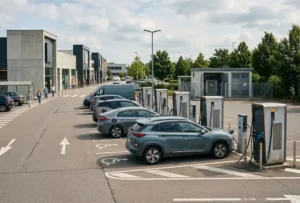
As logistics fleets transition to electric vehicles, depots and fleet operators face immense power demands that existing local grids are often unable to supply immediately.
Avoiding Expensive Distribution Grid Upgrades
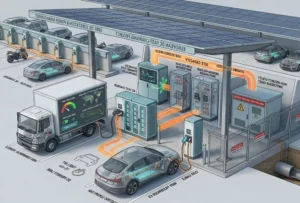
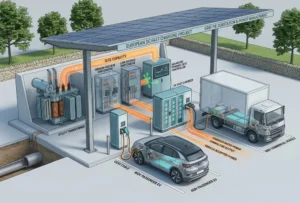
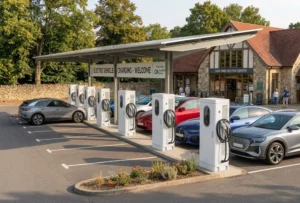
Installing ultra-fast chargers (e.g., 180 kW to 360 kW dual-gun systems) can easily push a commercial site’s total load past the capacity of the local utility transformer. Upgrading these high-voltage lines or replacing the transformer is expensive and often takes 12 to 24 months to permit. Behind the meter energy storage for EV charging stations provides immediate relief. The battery system charges slowly from a lower-capacity grid connection during off-peak hours and discharges rapidly to support high-speed charging sessions.
EV Charger Support Formula:
Peak Load Met by Grid = Charger Output in kW - BTM Battery Discharge in kW
Controlling Charging Demand Costs
Fast charging events are high-intensity and intermittent. Using localized energy storage to discharge batteries during charging prevents massive demand charge spikes that would otherwise make the charging station unprofitable. This localized power management ensures fleet charging is both fast and cost-effective.
The Role of EMS in Behind the Meter Energy Storage Systems
While battery cells physically store energy, the software layer is what unlocks the economic value of the system.
AI-Driven Forecasts and Load Optimization
A modern EMS uses predictive algorithms to analyze upcoming power requirements. By scanning local facility usage trends, current weather forecasts, and dynamic tariff changes, the system predicts peak usage events before they occur. It then automates charging and discharging cycles to maximize savings.
Dispatch Logic:
If Expected Load > Demand Target -> Discharge BTM Battery
If Grid Price < Off-Peak Threshold -> Charge BTM Battery
Real-Time Monitoring and Safety Management
Cloud-based EMS platforms allow facility managers to track battery health (SoH), individual cell temperatures, and real-time cost savings through a central dashboard. This ongoing oversight ensures the battery system operates safely, extends its operational life, and maximizes return on investment.
Economic Benefits of Behind the Meter Energy Storage Systems
Evaluating the true financial impact of an installation requires shifting from simple upfront equipment costs to a comprehensive lifetime ROI framework.
Energy Bill Savings
Commercial and industrial users who install a localized behind the meter storage system typically see their total electricity costs drop by 20% to 40%. These savings come primarily from a significant reduction in peak demand charges and moving energy consumption to lower-cost, off-peak hours.
Payback Period and ROI
Driven by a continuous drop in the cost of high-density Lithium Iron Phosphate (LFP) cells, the initial capital expenditure for localized commercial storage has dropped significantly. In 2026, the payback period for a typical industrial BTM system is 3 to 6 years, depending on local utility tariffs and any applicable clean energy tax credits.
Levelized Cost of Storage (LCOS)
To evaluate the true value of a BTM asset over its 10- to 15-year operational lifespan, engineers use the Levelized Cost of Storage (LCOS).
LCOS Formula (Plain Text):
LCOS = (Initial CAPEX + Total Lifetime O&M Costs) / Total Energy Discharged over Lifespan in MWh
Featured Snippet:
Behind-the-meter energy storage systems typically deliver a payback period of 3 to 6 years by reducing electricity costs and optimizing energy usage.
Key Components of Behind the Meter Energy Storage Systems
Effective behind-the-meter installations rely on high-quality hardware and software that work together seamlessly.
- High-Cycle Battery Modules: Built primarily with safe, thermally stable Lithium Iron Phosphate (LFP) cells.
- Power Electronics: Multi-stage bi-directional inverters that convert power efficiently.
- Control Systems: Hardwired BMS safety layers combined with advanced EMS software that manages system performance in real-time.
Battery Chemistries & Alternatives
While lithium-ion batteries dominate the market due to their energy density, alternative technologies are available for specialized needs. For example, Vanadium Redox Flow Batteries are an excellent choice for sites requiring long discharge cycles (>8 hours), as they do not suffer from capacity degradation over time. Additionally, Sodium-ion technologies are emerging as a cost-effective alternative for stationary applications where physical space is less restricted.
Challenges of Behind the Meter Energy Storage Systems
To build a reliable and economically sound system, it is important to understand the practical challenges involved in deployment:
Upfront Capital Investment
Despite declining battery costs, installing a large commercial storage system remains a notable capital commitment. To address this, many companies choose third-party financing or Energy-as-a-Service (EaaS) models to install systems without significant upfront costs.
System Integration Complexity
Connecting a localized storage system into an existing electrical panel—especially one with older transformers or sensitive automated equipment—requires careful engineering to ensure the system integrates smoothly with on-site machinery.
Regulatory Approvals and Safety Standards
Permitting large localized lithium-ion battery systems requires strict adherence to fire safety protocols, such as NFPA 855 codes, and explicit approval from the local electrical utility. Working with experienced providers who understand these local codes prevents costly installation delays.
When Should You Choose Behind the Meter Energy Storage?
Businesses should consider a behind-the-meter energy storage system if their operations meet specific conditions:
- High Demand Charges: Sites where utility demand charges exceed $15/kW.
- Solar Integration Needs: Facilities looking to maximize the value of their on-site solar systems.
- High Uptime Requirements: Businesses that require high power quality and immediate backup power to prevent production stops.
- Limited Grid Capacity: Facilities looking to add EV fast chargers without facing expensive transformer upgrades from the utility.
Recommended Product for Industrial Use:
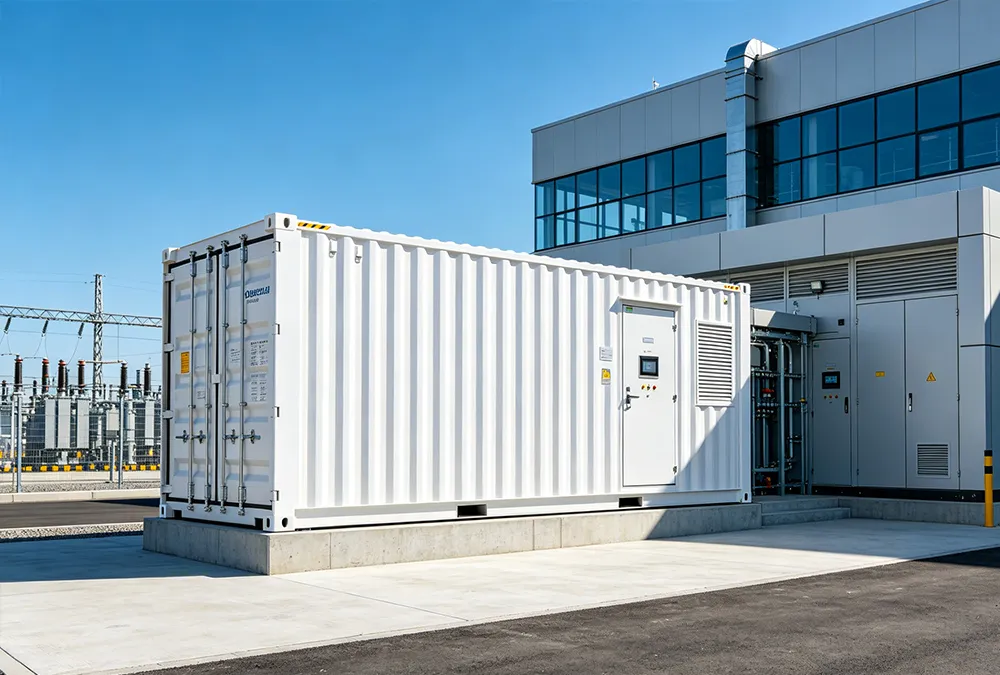
For large-scale industrial sites, the AnengJi Power-Core 500kW/1.2MWh Liquid-Cooled Container is highly recommended. It utilizes high-density LFP cells and an advanced integrated liquid-cooling system to maximize cycle life. This solution is purpose-built for the demands of industrial energy management, featuring an integrated EMS that connects seamlessly with building management systems.
FAQs About Behind the Meter Energy Storage
What does behind the meter mean?
It refers to energy systems—such as battery storage or solar panels—that are physically installed on the customer’s side of the utility meter, allowing the facility to use or store that energy directly on-site.
Is behind-the-meter storage worth it?
Yes. For commercial and industrial facilities with significant peak demand spikes or time-of-use tariffs, the system frequently pays for itself in under 6 years.
What is the main benefit of BTM systems?
The primary benefit is cost reduction—specifically by capping high demand charges and moving energy consumption to lower-cost, off-peak hours.
Behind the Meter Energy Storage: Key Takeaways and Summary
- Definition: Energy systems installed on the customer side of the meter.
- Main Benefit: Lower electricity costs via peak shaving and time-of-use load shifting.
- Key Difference from FTM: Focuses directly on localized user savings rather than bulk utility services.
- Best Application: Commercial and industrial facilities, EV charging hubs, and localized data centers.
- Strategic Role: A key component in building distributed energy resources (DER) for the modern grid.
How to Implement a Behind the Meter Energy Storage System
Building a high-performing on-site storage system follows a clear development path:
- Analyze Energy Usage: Review your facility’s 15-minute interval data to identify your peak demand events.
- Define System Goals: Focus on your primary objectives, such as lowering peak demand charges, securing reliable backup power, or supporting EV fast charging.
- Select the Right Technology: Work with experienced professionals to select high-density LFP cells and an EMS platform that matches your facility’s power profile.
- Partner with Experienced Providers: Collaborate with a deployment partner who can manage the technical integration, fire code compliance, and utility approvals smoothly.
Ready to optimize your energy strategy? Contact our engineering team today for a comprehensive load-profile analysis to see how a behind-the-meter energy storage system can improve your operational economics and energy resilience.