
Introduction
Selecting an optimal project delivery model remains a foundational challenge for global developers. Evaluating EPC vs EPCM vs PMC frameworks shapes the financial trajectory of modern capital investments. According to the International Energy Agency (IEA) 2025 Renewables Report, utility scale installations face mounting supply chain pressures. Volatile raw material index prices alter baseline engineering estimations daily. Because of these dynamics, fixed price contracting styles grow highly attractive. Misaligning your organizational risk profile with execution frameworks invites severe budget overruns. Navigating contractual interfaces requires technical acumen and strategic foresight. This technical guide analyzes structural differences across major project execution strategies. Learn to secure execution milestones and safeguard long term asset performance.
EPC vs EPCM vs PMC Explained: Understanding the Three Major Project Delivery Models
Modern renewable infrastructure demands tailored administrative control methods. Industry stakeholders balance budget boundaries against fast track commercial operations dates. Selecting a framework dictates legal liabilities and daily operational tracking structures.
Featured Snippet Summary:
EPC, EPCM, and PMC are three widely used project delivery models in renewable energy, infrastructure, and industrial projects. EPC provides a turnkey solution with a single contractor responsible for engineering, procurement, and construction. EPCM offers engineering and management services while the owner retains control of procurement and contracts. PMC acts as the owner’s representative, overseeing project execution and coordination.
Why Choosing the Right Project Delivery Model Matters
Impact on Project Cost
Your contract design dictates how market price changes affect total capital expenditure. Standard turnkey templates insulate owners from volatile component shipping rates. Service models leave baseline hardware procurement exposed to open market price swings.
Impact on Schedule
Parallel processing models allow long lead procurement to advance during final permitting. Linear execution paths freeze hardware ordering until engineers complete final site master drawings.
Impact on Risk Allocation
Shifting engineering flaws onto specialized market executors protects corporate investor balances. Retaining interface accountability means you absorb costs for field layout rework.
Impact on ROI
Early asset energization captures early seasonal energy generation revenues. Prolonged grid connection disputes delay projected payback timelines, lowering total asset yields.
What Is an EPC Contract? Understanding Turnkey Project Delivery
An epc contract represents an integrated, single responsibility approach to large scale infrastructure procurement.
What Does EPC Stand For?
Engineering
Specialized technicians draft detailed structural designs, high voltage schematics, and structural cabling blueprints.
Procurement
Sourcing major hardware, managing cross border customs logistics, and absorbing physical asset transport damage.
Construction
Executing civil grading, physical racking deployment, high voltage substation construction, and final testing parameters.
EPC Contracts: Turnkey Project Delivery for Maximum Certainty
Single Point of Responsibility
The chosen renewable energy EPC company carries absolute liability for all field development milestones. If a structural interface error emerges, the general contractor repairs it independently.
Performance Guarantees
Contractual terms secure specific energy generation targets under formal asset performance wraps. Underperformance triggers liquidated damages to offset lost operational cash flows.
Fixed Completion Commitments
The prime contractor legally binds their business to an agreed commercial operations date. Delays spark severe daily financial penalties to insulate owner revenue expectations.
Simplified Project Management
The asset owner operates a lean internal staff to oversee macro milestones. Daily site subcontractor coordination remains entirely with the prime general contractor.
The Fixed-Price Principle in EPC Contracts
Lump-Sum Turnkey (LSTK)
The executor delivers a locked, total execution price before physical work begins on site. Subsequent field labor cost spikes fall exclusively onto the general contractor’s margins.
Guaranteed Maximum Price (GMP)
This model establishes an absolute contract cost ceiling for project execution workflows. Shared savings mechanisms reward the contractor if final costs drop below the cap.
Cost Certainty Benefits
Lump-sum turnkey options satisfy strict investment fund allocation guidelines by eliminating variable costs. Predictable development expenses allow developers to structure accurate power purchase agreements.
Why Choose the EPC Model? Advantages and Disadvantages of EPC Contracts
Evaluating turnkey structures requires weighing extreme price predictability against reduced owner technical input.
Advantages of EPC Contracts
Predictable Costs
Locked capital expenditures shield institutional infrastructure funds from unexpected market inflation cycles.
Reduced Owner Risk
Engineering mistakes and construction supply delays transfer fully to the executing market contractor.
Faster Project Execution
Internal design and buying coordination eliminates operational dead time between project delivery phases.
Easier Financing Approval
International debt lenders favor integrated turnkey configurations due to predictable debt service coverage ratios.
Simplified Contract Administration
Managing one single legal agreement lowers internal corporate legal and auditing resource requirements.
Disadvantages of EPC Contracts
Higher Initial Pricing
Contractors add high contingency premiums to absorb potential material and labor price variations.
Limited Design Flexibility
Altering system technical parameters after contract signing causes expensive, time consuming change orders.
Less Procurement Control
The contractor selects specific component sub-vendors to maximize their internal project margins.
Change Orders Can Be Expensive
Scope adjustments during physical deployment carry severe pricing penalties from the prime contractor.

Best Applications for EPC Projects
Solar Farms
Utility scale solar projects utilize standardized, repeatable tracking and electrical layout configurations.
Battery Energy Storage Systems (BESS)
Deploying specialized battery equipment requires deep power electronics and automated high voltage security management.
EV Charging Infrastructure
High output electric fleet charging hubs demand highly integrated, rapid utility grid connection workflows.
Utility-Scale Renewable Energy Projects
Multi-megawatt energy installations demand guaranteed financial caps to satisfy non recourse project finance criteria.
What Is an EPCM Contract? Engineering, Procurement and Construction Management Explained
An epcm contract shifts the executor’s role from a general contractor to a professional management consultant.
What Does EPCM Stand For?
Engineering
The consultant delivers rigorous site layouts, hardware requirements, and localized electrical engineering services.
Procurement Management
Evaluating global vendor proposals and managing hardware shipping logistics on behalf of the client.
Construction Management Services
Supervising onsite builders, tracking execution milestones, and enforcing strict field safety compliance audits.
How EPCM Differs from EPC
Owner Holds Contracts
The client signs direct individual agreements with every hardware vendor and construction labor crew. The epcm consulting services firm never assumes direct multi vendor contractual liability.
EPCM Contractor Provides Management Services
The consultant acts as an administrative supervisor to align diverse parallel task paths. They do not issue overarching system performance guarantees or final completion wraps.
Increased Client Involvement
The owner’s internal team must process individual supplier invoices and resolve field coordination conflicts. This layout demands substantial technical sophistication from the developer’s internal project management team.
Service-Based and Cost-Reimbursable EPCM Model
Management Fee Structure
The developer pays the advisor via hourly professional fees or fixed monthly management milestones.
Cost Reimbursement Mechanism
All physical project execution costs are passed directly back to the project owner’s balance sheet.
Procurement Transparency
The owner views direct factory component invoices, avoiding hidden markup fees from general contractors.
When Is the EPCM Model Appropriate? Advantages and Disadvantages of EPCM Contracts
Using service based delivery suits complex deployments where scope definition remains fluid during initial planning.
Advantages of EPCM Contracts
Greater Procurement Flexibility
Owners can purchase preferred tier-1 hardware components to optimize multi site asset portfolio consistency.
Better Cost Transparency
Direct exposure to open market equipment pricing structures eliminates generic contractor margin additions.
More Control Over Design
Engineering teams adjust system technical specifications smoothly as localized grid interconnection parameters shift.
Easier Scope Changes
Revising physical plant layouts does not trigger punitive financial penalties from a prime contractor.
Disadvantages of EPCM Contracts
Increased Owner Responsibility
The developer absorbs total financial liability for matching distinct hardware and building contractor interfaces.
Greater Cost Overrun Risks
Sudden global module market price hikes or local labor shortages impact your budget directly.
More Contract Management Requirements
Administering dozens of separate suppliers strains internal corporate accounting and corporate legal structures.
Potential Schedule Delays
A shipping delay from one rack vendor can stall multiple subsequent onsite assembly teams.
Ideal Applications for EPCM Projects
Large Industrial Facilities
Complex factories require continuous technical integration with deep, existing on site infrastructure networks.
Complex Renewable Energy Projects
Hybrid configurations mixing diverse asset classes benefit from tailored, non-standard engineering design changes.
Multi-Phase Developments
Long term projects deployed in sequential annual tranches allow buyers to adjust procurement dynamically.
International Infrastructure Projects
Cross border developments require flexible, localized contracting across diverse national and regional jurisdictions.
What Is PMC? The Role of a Project Management Consultant
A professional project management consultant provides high level oversight to shield owners from developer execution blind spots.
What Does PMC Stand For?
PMC stands for Project Management Consultant, meaning an independent advisor representing the client’s interests.
PMC Responsibilities Throughout the Project Lifecycle
Planning
Structuring master development schedules, auditing initial feasibility data, and defining clear procurement strategies.
Procurement Oversight
Drafting complex request for proposal documents and vetting major general contractor balance sheets.
Construction Monitoring
Conducting field quality assurance audits and checking that physical progress matches contractor invoicing.
Quality Assurance
Reviewing factory component testing certifications and verifying that field assembly matches strict specifications.
Stakeholder Coordination
Directing communication paths between financial investors, local utility operators, and environmental permitting offices.
Advantages and Limitations of PMC Services
Strategic Oversight
Provides deep technical resources to protect the client’s long term financial capital allocations.
Independent Advice
Delivers unbiased evaluations of construction quality without hardware manufacturing or direct building conflicts.
No Direct Construction Responsibility
A contractor pmc handles managerial process auditing. They do not supply physical construction labor forces.
When PMC Is Most Valuable
Mega Projects
Multi hundred megawatt infrastructure builds demand extra layers of structured, professional administrative oversight.
Multi-Contractor Environments
Coordinating separate individual building packages requires centralized, authoritative project risk management frameworks.
Owner-Led Developments
Asset owners lacking deep technical engineering teams use pmc consulting to audit external contractors.
EPC vs EPCM vs PMC: Key Differences Comparison Table
Analyzing these options requires checking how liability, cost certainty, and administrative burdens change under different models.
Project Responsibility Comparison
Turnkey partners assume complete execution risk. EPCM entities manage field schedules without taking balance sheet liability. PMC teams act as expert client representatives across all project delivery model options.
Cost Structure Comparison
Turnkey deals lock total pricing upfront. EPCM works via cost reimbursable contract models for professional services. PMC uses fixed monthly retainer structures.
Quick Comparison Matrix
| Criteria | EPC Model | EPCM Model | PMC Model |
|---|---|---|---|
| Cost Certainty | High (Fixed Lump-Sum) | Low (Cost Reimbursable) | Medium (Fixed Service Fees) |
| Risk Allocation | Transferred to Contractor | Retained by Project Owner | Retained by Project Owner |
| Owner Control | Low (Turnkey Delegation) | High (Direct Contracting) | High (Through Consultant) |
| Schedule Predictability | High (Guaranteed COD) | Variable (Multi-Contract) | High (Oversight Focus) |
| Flexibility | Low (Rigid Scope) | High (Fluid Adaptation) | Medium (Strategic Adjustments) |
| Financing Acceptance | Excellent (Bankable Wrap) | Moderate (Requires Strong Owner) | Excellent (Enhances Oversight) |
EPC vs EPCM Cost and Risk Comparison for Renewable Energy Projects
Balancing cost structures against long term asset security remains crucial when evaluating epc vs epcm vs pmc pathways.
Capital Cost Comparison
Solar Projects
Turnkey solar projects incorporate risk premiums to counter unexpected weather interruptions or local labor inflation. EPCM setups eliminate this markup but expose the owner to sudden steel racking price fluctuations.
Battery Energy Storage Projects
Sourcing large battery containers via EPCM saves upfront fees. However, matching distinct battery cells with power conversion systems requires rigorous technical interface coordination.
Hybrid Energy Systems
Co-locating generation arrays and storage assets increases field connection risks. Turnkey models unify these elements under a single operational performance guarantee.
Project Risk Allocation Comparison
Design Risk
Turnkey suppliers absorb costs if engineering errors require physical layout alterations during field assembly. Under EPCM, the owner pays for modifications if baseline assumptions prove inaccurate.
Procurement Risk
EPC frameworks isolate owners from hardware supply disruptions. EPCM leaves all international transport damage liabilities on the developer’s balance sheet.
Construction Risk
Physical wiring assembly errors are repaired solely at the turnkey contractor’s expense. EPCM developers must pursue individual building crews to repair deficient field work.
Performance Risk
Turnkey contracts guarantee plant performance using strict net efficiency metrics. EPCM warranties are split across separate suppliers, which can leave major coverage gaps.
Warranty Risk
Resolving component field breakdowns requires one point of contact under turnkey frameworks. EPCM demands that owners prove which specific contractor caused the fault.
Which Model Delivers Better ROI?
The choice between EPC vs EPCM vs PMC directly dictates your long term asset bankability metrics. BloombergNEF (BNEF) 2026 energy transition market reports indicate that institutional lenders favor structured risk minimization. Eliminating multi contractor interface disputes ensures predictable commercial operations timelines. For asset owners without deep technical engineering teams, turnkey EPC structures deliver the most reliable financial returns.
How EPC, EPCM and PMC Apply to Solar and BESS Projects
As generation systems grow more sophisticated, delivery structures must adjust to match the unique physical hardware configuration.
Utility-Scale Solar Farms
Multi-megawatt utility scale solar projects demand massive procurement scale. Large developers use PMCs to run international bidding, then deploy turnkey EPC packages for rapid field tracking assembly.
Commercial & Industrial Solar Projects
Onsite industrial solar EPC projects require minimal disruption to daily factory output. Fixed price contracts isolate corporate capital allocations from volatile local installation labor markets.
Battery Energy Storage Systems (BESS)
Battery Systems
Industrial installations favor Lithium Iron Phosphate (LFP) chemistry for its long lifecycle and thermal safety. Flow Batteries provide excellent multi hour discharge profiles but demand large structural footprints. Flywheel alternatives deliver instant short duration power bursts but lack dense bulk capacity storage capabilities.
PCS Integration
The Power Conversion System (PCS) functions as a heavy duty bi-directional inverter. It manages continuous power translation between battery direct current and grid alternating current networks.
BMS Coordination
The Battery Management System (BMS) continuously monitors internal cell level voltages and ambient temperatures. This processing layer maintains cell balance to prevent localized thermal runaway events.
EMS Optimization
The Energy Management System (EMS) acts as the intelligent software brain of the plant. It runs complex algorithms to execute automated charging and discharging schedules for maximum market arbitrage.
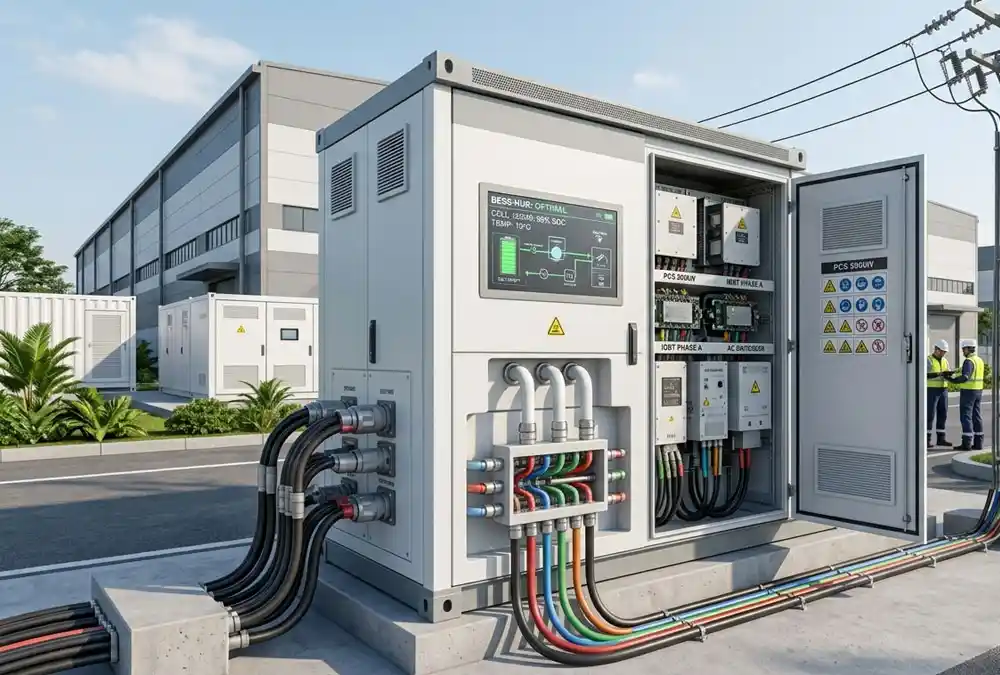
Industrial Asset Highlight: Liquid-Cooled C&I BESS
Complex hybrid energy projects require highly reliable, factory integrated hardware solutions. Deploying pre-engineered systems reduces field installation complexity and protects project timelines.
- Thermal Balancing: Advanced closed-loop liquid cooling keeps cell temperature variations under 2°C, extending total asset operational life by 20%.
- All-in-One Enclosure: Integrates premium LFP cells, a 100kW bi-directional PCS, an intelligent EMS, and fire suppression into one cabinet to eliminate on site interface errors.
Solar Plus Storage Projects
Co-locating generation arrays and electrochemical storage requires unified software control mapping. Turnkey solar plus storage EPC providers pre-test communication protocols before shipping hardware components to the field.
Microgrid Projects
Islanded power microgrid EPC services demand advanced automated load shedding configurations. Appointing a project management consultant protects developers during specialized protection relay programming stages.
Choosing Between EPC and EPCM: Critical Decision Factors
Selecting an execution framework requires checking asset design status, organizational skill levels, and financing requirements.
1. Evaluate Project Maturity and Complexity
Concept Stage Projects
Early stage assets with evolving interconnection parameters benefit from the open, adaptive nature of EPCM structures.
Fully Developed Projects
Finalized engineering specifications allow developers to secure highly competitive, fixed price turnkey bids.
2. Assess Internal Resources and Risk Tolerance
Experienced Project Teams
Developers possessing deep technical engineering staff can leverage EPCM frameworks to capture direct supply chain savings.
Limited Internal Expertise
Corporate energy buyers focusing on core business activities utilize EPC to delegate complex execution liabilities.
3. Consider the Lender’s Perspective
Bankability Requirements
International project financing banks require rigid cost caps to safeguard debt coverage performance metrics.
Financing Risk Assessment
Turnkey delivery structures compress field execution risks, matching non recourse investment criteria perfectly.
4. Questions to Ask Before Making a Decision
- Which organization will actively manage daily onsite builder coordination tasks?
- Who will absorb financial losses if the plant encounters physical building delays?
- What specific level of upfront cost certainty does your corporate board demand?
- How much direct influence over component manufacturer selection do you need to retain?
Beyond the Acronyms: Contract Details That Shape Project Success
Deep contractual clauses dictate project success far more than basic delivery model names.
Contract Clauses Unique to EPC Contracts
Liquidated Damages (LDs)
Financial penalties charged to the contractor if they miss completion deadlines or fail system output criteria.
Performance Guarantees
Enforceable technical commitments ensuring the completed power asset maintains baseline generation targets.
Completion Milestones
Binding operational deadlines tracking engineering submittals, mechanical assembly, and final utility grid energization.
Contract Clauses Unique to EPCM Contracts
Management Responsibilities
Detailed performance parameters specifying the advisor’s oversight, auditing, and reporting obligations.
Cost-Reimbursable Terms
Auditable hourly rate schedules regulating engineering services, site travel, and managerial overhead billing.
Procurement Governance
Strict structural transparency guidelines governing how the consultant evaluates external material manufacturing proposals.
The Importance of International Standards
FIDIC Contracts
The International Federation of Consulting Engineers produces standard templates for global infrastructure contracting. The FIDIC Silver Book serves as the global benchmark for turnkey EPC energy project execution.
NEC Contracts
The New Engineering Contract model prioritizes collaborative risk sharing and real time cost adjustments between partners.
ISO Standards
Enforcing ISO 9001 and ISO 14001 ensures strict quality tracking and environmental protection compliance on site.
IEC Standards
Solar modules and inverters must hold verified IEC 61215 and IEC 62109 certifications to guarantee electrical safety.
EPC or EPCM: A Strategic Choice That Determines Project Success
Aligning your execution framework with your organizational goals protects your long term energy infrastructure investment.
Choose EPC If:
- Absolute cost certainty is a non-negotiable requirement for internal project approval.
- You want to shift technical, logistical, and construction risks to an external party.
- External project debt financing requires a comprehensive, single source bankable performance wrap.
- Your internal staff lacks the technical capacity to manage multiple individual contractor groups.
Choose EPCM If:
- Complete design customization and direct component brand selection control are vital.
- Your firm possesses deep, experienced internal engineering and procurement management capabilities.
- You require complete visibility over direct factory equipment pricing and supply chain margins.
- Project development scopes are expected to adjust significantly during early engineering phases.
Choose PMC If:
- Your large asset involves multiple independent EPC work packages requiring centralized alignment.
- You require independent engineering experts to audit large scale international construction groups.
- You are developing mega scale infrastructure with high multi stakeholder communication requirements.
Frequently Asked Questions About EPC vs EPCM vs PMC
What is the difference between EPC and EPCM?
EPC contractors provide a complete, fixed price turnkey system. EPCM firms deliver design and construction management services while the owner signs all supplier contracts.
Which model has lower project risk?
The EPC model offers lower risk for owners. It transfers design, logistics, and building risks fully to the general contractor.
Which model offers greater cost transparency?
The EPCM framework delivers superior transparency. Owners review direct factory equipment invoices, avoiding hidden general contractor markups.
Why do lenders often prefer EPC contracts?
Financing banks favor EPC deals because they lock pricing and include enforceable system performance guarantees.
Is EPCM suitable for battery energy storage projects?
EPCM works if the developer has deep power electronics staff. Otherwise, complex BESS integration challenges favor turnkey EPC models.
When should a PMC be appointed?
A PMC should be hired during initial planning stages. This ensures independent technical oversight before selecting contractors.
Which delivery model is best for utility-scale solar projects?
EPC is widely chosen for utility scale assets due to bankability. Experienced developers use EPCM to minimize procurement margins.
Conclusion: Selecting the Right Project Delivery Model for Long-Term Success
Key Takeaways
- EPC transfers execution and performance liabilities fully to a single turnkey provider.
- EPCM offers deep design adjustments and clear visibility over component factory pricing.
- PMC supplies critical, independent strategic management across complex multi contract configurations.
- The ideal model depends on internal technical bandwidth, financing criteria, and corporate risk appetites.
Future Trends in Renewable Energy Project Delivery
Global utility scale installations and complex hybrid energy projects grow more sophisticated each year. Rising technology integration needs demand specialized project delivery framework selections. Modern microgrids and fleet EV charging infrastructure demand flawless physical and software communication. Evaluating EPC vs EPCM vs PMC pathways dictates your ultimate asset lifetime financial returns. Matching execution strategies with your firm’s technical resources secures dependable clean energy infrastructure performance.