Introduction
As the global energy landscape transitions toward a decentralized and decarbonized grid, stationary battery storage has emerged as the cornerstone of reliable power management. In 2026, the demand for fixed energy assets is surging, driven by the need to stabilize intermittent renewable sources and manage the soaring electricity requirements of industrial automation and EV charging hubs. Unlike the batteries in electric vehicles, these fixed installations are engineered for decades of service, providing a massive buffer that keeps the lights on when the sun sets or the wind dies down. For enterprises looking to future-proof their operations, understanding the mechanics and economic advantages of these systems is no longer optional—it is a strategic imperative.
What Is Stationary Battery Storage and How Does It Work?
To understand the modern grid, one must first grasp the concept of “energy time-shifting.” Stationary battery storage allows for the decoupling of energy generation from energy consumption.
Definition of Stationary Battery Storage
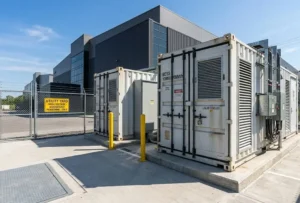
Stationary battery storage refers to fixed energy storage systems installed at a specific location to store and manage electricity for residential, commercial, or grid applications. These systems are typically housed in climate-controlled enclosures or containers and are designed to interface seamlessly with either the local utility grid or on-site renewable generation.
Difference Between Stationary and Mobile Energy Storage
The primary distinction lies in application and design priority. Mobile storage (found in EVs or portable power stations) prioritizes energy density and weight reduction. Conversely, fixed battery storage systems prioritize cycle life, safety, and cost-per-kilowatt-hour. While an EV battery might last 1,000–2,000 cycles, a stationary unit is often rated for 6,000 to 10,000 cycles.
Basic Working Principle (Charge / Store / Discharge)
The system operates in a continuous loop:
- Charge: During periods of low demand or high renewable production, the system draws AC power, which is converted to DC for storage.
- Store: The energy is held within chemical cells (usually Lithium Iron Phosphate).
- Discharge: When the grid is stressed or electricity prices peak, the stored DC energy is converted back to AC to power local loads or support the utility network.
Featured Snippet:
Stationary battery storage refers to fixed energy storage systems installed at a specific location to store and manage electricity for residential, commercial, or grid applications.
How Stationary Battery Storage Systems Work in Real-World Applications
In a practical setting, stationary battery storage acts as an intelligent buffer. Its performance is dictated by real-time data and market signals rather than just manual operation.
Energy Input (Grid or Renewable Sources)
In a grid-connected battery storage configuration, the system can “buy” energy when it is cheapest (often at 2:00 AM). In “behind-the-meter” solar applications, it captures the “clipping” or excess energy that would otherwise be wasted during peak sunlight hours.
Storage Process in Batteries
Energy is stored in racks of battery modules. In 2026, the transition toward lithium-ion battery storage (specifically LFP) is nearly complete due to its non-combustible nature and superior thermal management.
Energy Output and Load Management
The system discharges energy based on “triggers.” These could be a specific time of day (to avoid peak tariffs) or a sudden spike in industrial machinery usage that would otherwise trigger expensive demand charges.
Role of EMS in Optimization
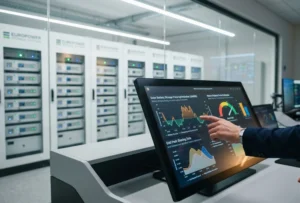
The Energy Management System (EMS) is the conductor of the orchestra. It uses AI algorithms to predict weather patterns and grid congestion, ensuring the battery is always at the optimal State of Charge (SoC) to maximize revenue or savings.
Stationary Battery Storage System Design and Key Components
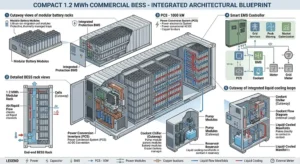
A professional stationary battery storage system design and installation involves five critical hardware and software layers:
1. Battery System (Lithium-ion / LFP)
Most commercial energy storage systems now utilize Lithium Iron Phosphate (LiFePO4) because it offers the best balance of safety and longevity. Unlike NCM batteries, LFP does not release oxygen during high-heat events, significantly reducing the risk of thermal runaway.
2. PCS (Power Conversion System)
The PCS is the bidirectional inverter. It is responsible for the transition between DC (battery) and AC (grid). High-quality PCS units in 2026 feature “grid-forming” capabilities, allowing them to restart a localized grid (Black Start) after a total blackout.
3. BMS (Battery Management System)
The BMS monitors every single cell. It tracks voltage, current, and temperature, ensuring that no individual cell is overcharged or overworked. It is the first line of defense against system degradation.
4. EMS (Energy Management System)
As discussed, the EMS handles the high-level logic, communication with the utility, and data logging for stationary battery energy storage system cost and benefits reporting.
5. Cooling and Safety Systems
Large-scale units require either HVAC air cooling or advanced liquid cooling. Liquid cooling has become the 2026 standard for large scale battery storage because it maintains a tighter temperature delta (typically within 3°C), which can extend battery life by up to 20%.
Stationary Battery Storage vs Mobile and Portable Energy Storage Systems
| Feature | Stationary Storage | Mobile Storage (EV/Portable) |
| Installation | Permanent / Fixed | Mobile / Movable |
| Capacity Scale | 100kWh to 500MWh+ | 2kWh to 150kWh |
| Cycle Life | 6,000 – 10,000 Cycles | 1,000 – 2,500 Cycles |
| Primary Goal | Grid Stability / Cost Optimization | Mobility / Range |
| Safety Standard | NFPA 855 / UL 9540 | UL 2580 |
While stationary battery storage vs mobile energy storage systems is a common comparison, the two often work together in “Vehicle-to-Grid” (V2G) scenarios. However, for a facility, the stationary system remains the more reliable asset because it is always available and not dependent on a vehicle being plugged in.
Featured Snippet:
Stationary battery storage systems are fixed installations designed for large-scale or long-term use, while mobile systems offer portability and flexibility but lower capacity.
Applications of Stationary Battery Storage in Commercial, Industrial, and Grid Sectors
The versatility of stationary energy storage applications is what makes them so attractive to various stakeholders.
Commercial Buildings
Hotels and shopping malls use these systems to reduce their “Peak Demand.” By using battery power during the afternoon peak, they can lower their monthly utility bills by 20% or more.
Industrial Facilities
Factories with heavy motor-start loads utilize industrial battery storage to provide “Voltage Support.” This prevents sensitive machinery from tripping during grid voltage sags.
Utility-Scale Grid Storage
Utilities deploy utility scale stationary battery storage solutions to replace aging gas peaker plants. These systems can respond to frequency imbalances in milliseconds, whereas a gas turbine takes minutes to ramp up.
Benefits of Stationary Battery Storage Systems for Businesses
The primary driver for stationary battery storage system for commercial and industrial use is the bottom line.
- Peak Shaving: Reducing the maximum power drawn from the grid during peak hours.
- Demand Charge Reduction: Eliminating the high fees utilities charge for the “highest 15-minute peak” of the month.
- Energy Arbitrage: Charging when power is $0.05/kWh and discharging when it would cost $0.25/kWh.
- Power Reliability: Acting as a massive UPS (Uninterruptible Power Supply) for critical data centers or production lines.
Featured Snippet:
Stationary battery storage helps businesses reduce electricity costs by storing energy during off-peak hours and using it during peak demand periods.
Economic Value of Stationary Battery Storage: Cost, Savings, and ROI
Investing in energy storage requires a clear financial roadmap. According to recent reports from SIA Partners and IDTechEx, the cost of BESS hardware has stabilized in 2026, while electricity volatility has increased, shortening the payback period.
Calculation of ROI
To calculate the simple Return on Investment (ROI) for an industrial system, use the following formula:
Annual Net Savings = (Peak Shaving Savings + Arbitrage Profits) - Annual Maintenance Costs
ROI (%) = (Annual Net Savings / Total Installed CAPEX) * 100
Typical ROI Breakdown (2026 Data)
| Sector | Avg. CAPEX ($/kWh) | Est. Payback Period |
| Commercial (C&I) | $350 – $450 | 4 – 6 Years |
| Utility-Scale | $250 – $350 | 6 – 8 Years |
| Distributed (DER) | $450 – $600 | 7 – 9 Years |
Source: 2026 Stationary Battery Storage Market Intelligence Report.
Stationary Battery Storage for Solar and Renewable Energy Systems
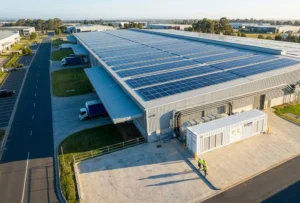
For businesses with on-site generation, solar battery storage systems are essential. Without storage, a solar array often produces the most power when the building needs it the least (e.g., weekends or midday).
- Self-Consumption: Storing midday sun to power the facility during the evening shift.
- Curtailment Prevention: Avoiding “export limits” set by utilities by storing excess solar rather than sending it back to an overcrowded grid.
The Role of EMS in Stationary Battery Storage Systems
The Energy Management System is the software layer that ensures the stationary battery energy storage system cost and benefits ratio remains positive.
- Load Forecasting: Using machine learning to predict tomorrow’s energy consumption based on the production schedule.
- Intelligent Dispatch: Automatically deciding whether to sell power to the grid or save it for an expected on-site peak.
- Health Diagnostics: Tracking SOH (State of Health) to ensure the system reaches its 15-year lifespan.
How to Install and Deploy a Stationary Battery Storage System
Deploying energy storage solutions for businesses follows a rigorous engineering path:
- Site Assessment: Reviewing 12 months of utility “Interval Data” to identify peak patterns.
- System Sizing: Choosing the right MW (Power) and MWh (Energy) ratio. (e.g., a 1MW/2MWh system is a “2-hour” battery).
- Permitting: Ensuring compliance with local fire codes and grid interconnection requirements.
- Commissioning: Testing the PCS/BMS integration and the safety shutdown protocols.
Challenges of Stationary Battery Storage Systems
While the technology is mature, it is not without hurdles:
- High Upfront Cost: Even with a high ROI, the initial CAPEX can be a barrier for smaller firms.
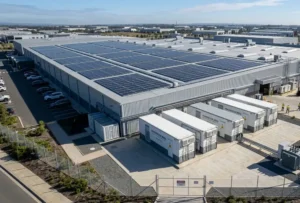
- Space Requirements: Large systems require significant outdoor space and concrete pads.
- Battery Degradation: All batteries lose capacity over time. A system designed for 100kWh today may only provide 80kWh in year 10.
- Regulatory Complexity: Grid interconnection queues can sometimes take 6–12 months in certain regions.
The Future of Stationary Battery Storage in the Energy Transition
By the end of 2026, utility scale stationary battery storage solutions will likely be the largest source of “new” capacity on the grid. We are seeing a massive shift toward distributed energy storage, where individual factories and buildings act as a “Virtual Power Plant” (VPP) to support the entire city during heatwaves or storms.
As referenced in the Knowledge Sourcing market report, the “Stationary Battery Storage Market” is expected to exceed $60 billion globally by 2027, driven by the plummeting costs of Sodium-ion alternatives for long-duration storage.
Recommended Industrial Product: AnengJi Power-Station 500
For industrial clients, we recommend the AnengJi Power-Station 500. This is a 500kWh stationary battery storage unit pre-integrated with a high-efficiency liquid cooling system and a cloud-based EMS. It is designed for “Plug-and-Play” installation, making it the ideal choice for factories looking to implement peak shaving with minimal site disruption.
FAQs About Stationary Battery Storage
What is stationary battery storage?
It is a permanent energy storage installation used to manage electricity for buildings or the grid.
How is it different from mobile storage?
Stationary systems are fixed and built for high cycle life, while mobile systems (like those in EVs) are built for weight and density.
Is stationary battery storage cost-effective?
Yes, particularly for facilities with high demand charges or those using on-site solar.
Stationary Battery Storage: Key Takeaways and Summary
- What is it? A fixed, large-scale electrochemical energy reservoir.
- Key Benefit: Direct reduction in utility bills and carbon footprint.
- Main Applications: Industrial battery storage, renewable firming, and grid services.
- Biggest Challenge: Initial capital requirements and space.
- Best Use Case: 24/7 industrial operations and utility-scale grid stabilization.
How to Choose the Right Stationary Battery Storage Solution
Choosing the right system requires a balance of technical specs and financial goals.
- Define Energy Needs: Do you need backup power (high energy) or peak shaving (high power)?
- Evaluate System Size: Don’t overbuy capacity; size the system based on your most expensive 15-minute peaks.
- Select Components: Prioritize Tier-1 LFP cells and liquid-cooled PCS units for maximum lifespan.
- Work with Professionals: Ensure your EPC provider has a track record in grid-connected battery storage to avoid interconnection delays.
Ready to optimize your energy future? Contact our engineering team for a detailed site analysis and discover how stationary battery storage can transform your operational efficiency.