Introduction
Volatile energy prices and sudden grid instability force manufacturing facilities to reconsider how they manage operational power. Relying entirely on old grid infrastructure exposes your plant to expensive peak demand surcharges and unexpected production downtime. Forward-thinking operations managers are solving these problems by deploying an industrial bess (industrial battery energy storage system). According to recent grid utilization reports, integrating onsite storage protects corporate margins by stopping energy cost inflation right at the factory meter. Implementing this infrastructure immediately boosts your power reliability while cutting monthly utility expenses.
What Is an Industrial Battery Energy Storage System?
An Industrial Battery Energy Storage System (Industrial BESS) is a large-scale energy storage solution designed for factories, industrial facilities, and commercial operations. It stores electricity in batteries and releases it when needed to reduce energy costs, provide backup power, improve power quality, and support renewable energy integration.
What Is an Industrial Battery Energy Storage System (BESS)?
This specialized equipment functions as a large-scale electrical safety reservoir for high-load industrial plants. Unlike small residential setups that only back up basic appliances, an industrial energy storage project handles massive electrical current spikes. These systems typically range from several hundred kilowatt-hours (kWh) to multiple megawatt-hours (MWh) of capacity, matching the heavy energy demands of automated production lines.
How an Industrial BESS Works
The system operates through three highly automated phases that optimize factory power management:
- Charging Phase: The system draws cheap electricity from the grid during off-peak hours or takes excess power directly from onsite industrial solar storage arrays.
- Energy Storage Phase: Large battery cells hold the captured power inside thermal-controlled enclosures with minimal self-discharge loss.
- Discharging Phase: The smart energy management system (EMS) releases power instantly when factory loads spike or when grid utility rates peak.
Key Components of an Industrial Energy Storage System
Modern battery storage EPC projects rely on four core hardware technologies working together smoothly:
- Battery Cells and Packs: High-density raw storage blocks, usually built with safe lithium chemistry.
- Battery Management System (BMS): High-speed circuitry that monitors individual cell voltages and temperatures to prevent overheating.
- Power Conversion System (PCS): Heavy-duty bi-directional inverters that convert grid AC power to battery DC power and back again.
- Energy Management System (EMS): The software brain that predicts factory load patterns and controls power dispatch for maximum financial return.
Main System Classifications and Specifications (C-Rate and Power Ratings)
Sizing an industrial bess requires balancing total battery capacity (measured in kWh or MWh) against maximum power output (measured in kW or MW). The system C-Rate indicates how fast the battery charges or discharges. For example, a 1C-rated system can deliver its full energy capacity in exactly one hour, while a 0.5C system discharges its energy over two hours, making it ideal for longer load shifting applications.
Why Invest in Industrial BESS for Energy Cost Reduction and Energy Security?
Operational Benefits and Power Quality Improvement
Heavy machinery starting up can cause micro-voltage sags that disrupt sensitive automated control systems. A grid-connected battery storage layout acts as a high-speed voltage stabilizer, filtering out line noise and maintaining steady frequency limits. This electrical protection keeps your production lines running smoothly and avoids the high costs of sudden equipment downtime.
Financial Cost Savings and Revenue Generation Opportunities
Deploying a factory energy storage system opens up multiple ways to save money and generate new revenue. By drawing stored energy during high-tariff periods, you achieve substantial peak demand management savings. Reducing demand charges on your utility bill provides immediate financial relief, while participating in local grid frequency response markets allows you to turn your energy asset into a steady revenue stream.
ESG Progress and Sustainability Advancements
Installing an industrial solar plus storage system helps your business meet strict corporate sustainability goals. Storing clean solar energy instead of letting it go to waste reduces your reliance on carbon-heavy peak grid power. This tangible carbon reduction strengthens your official ESG reporting and helps secure your position in modern, green supply chains.
Industrial BESS Applications: Peak Shaving, Backup Power and Renewable Energy Integration
Peak Shaving and Load Shifting
Many utilities charge commercial customers heavy fees based on their highest single 15-minute consumption peak each month. An industrial bess acts as an automated buffer against these demand charges. By discharging power precisely when factory consumption spikes, the system lowers peak demand profiles, flattening your utility bill and optimizing long-term power costs.
Emergency Backup Power and Grid Resilience
For high-output manufacturing plants, a sudden 10-minute power outage can ruin entire product batches and cost thousands in lost productivity. A reliable industrial backup power system switches over in milliseconds to maintain factory power management during blackouts. This continuous microgrid capability ensures your automated systems stay online, protecting expensive machinery and keeping delivery schedules on track.
Co-location with Renewable Energy Assets (Solar and Wind)
Onsite wind or solar panels can see their power generation drop sharply when clouds pass or the wind dies down. Pairing these clean assets with industrial solar battery storage smooths out those production dips. This renewable energy integration allows your business to use more of its own clean power, cutting grid reliance and avoiding utility penalties for feeding unbalanced power back into the local network.
Industrial BESS Product Types and Energy Storage Configurations
Containerized Battery Energy Storage Systems
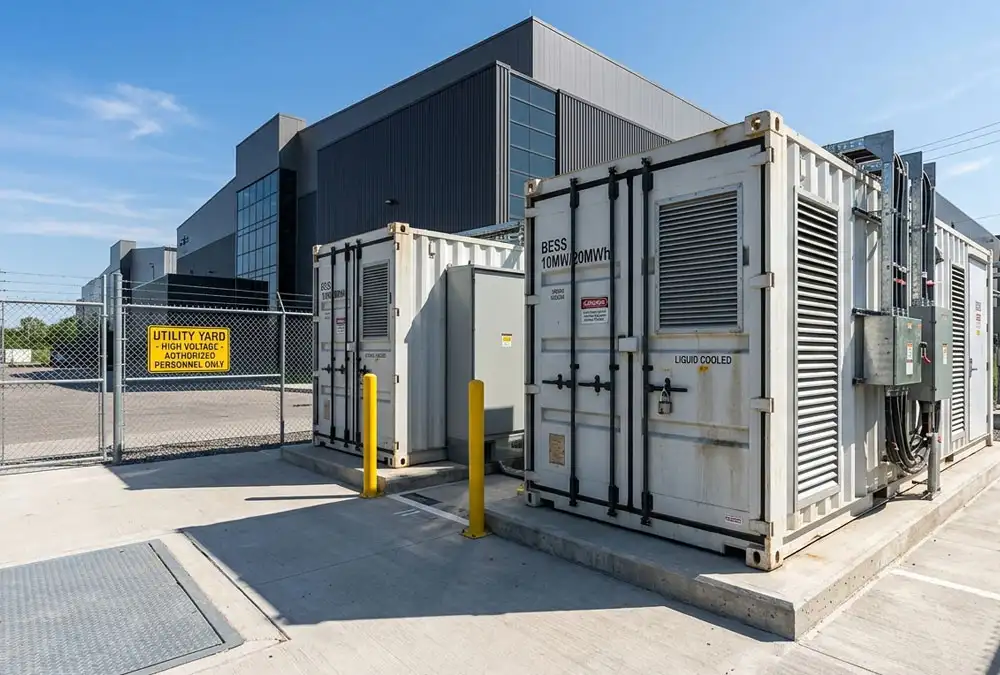
For large manufacturing plants and industrial parks, standard industrial bess container solutions offer a clean, modular deployment path. These weather-proof 20ft and 40ft steel cargo enclosures arrive at your site pre-assembled and fully wired. They place massive megawatt-level capacities on outdoor concrete pads, minimizing onsite assembly work and simplifying complex grid-connection logistics.
All-in-One Battery Cabinets
Facilities with limited yard space or smaller load profiles benefit from compact commercial and industrial正面 ESS cabinet designs. These space-saving units house the batteries, BMS, bi-directional inverter, and automated fire protection within a single footprint. They offer quick installation and can scale up easily by adding extra cabinets as your power needs grow.
Battery Chemistries: Lithium-Ion, Flow Batteries and Alternative Technologies
Choosing the right cell chemistry impacts your long-term operating costs, system safety, and lifecycle returns:
- Lithium Iron Phosphate (LiFePO4 / LFP): The clear standard for modern C&I energy storage. LFP chemistry offers excellent thermal stability and long operational lifecycles, safely handling heavy daily cycling for over a decade.
- Nickel Manganese Cobalt (NMC): Provides high energy density in a smaller physical footprint, but requires complex active cooling systems to manage thermal risks safely.
- Flow Batteries (Alternative Technology): Uses external liquid electrolyte tanks to store energy. They experience zero cell degradation over decades, making them great for multi-hour utility grid stabilization, though they require a large installation footprint.
- Sodium-Ion Batteries (Alternative Technology): An emerging low-cost option that uses abundant raw materials and performs well in cold weather, though its energy density is currently lower than standard lithium options.
Industrial BESS Safety Technologies and Thermal Management Systems
Thermal Management: Liquid Cooling vs Air Cooling
Keeping cell temperatures uniform is critical to extending battery lifecycles and preventing thermal breakdown. While basic air cooling works for smaller setups, modern high-density systems require advanced liquid cooling technology. Running coolant channels directly between the battery packs removes heat much more efficiently, maintaining optimal temperatures across all cells to prolong system life.
| Cooling Method | Temperature Uniformity | Parasitic Energy Loss | Physical Footprint Efficiency |
|---|---|---|---|
| Air Cooling Systems | Moderate (Can leave internal hot spots) | Higher (Fans run continuously at high speed) | Lower (Requires wider internal air spacing) |
| Liquid Cooling Systems | Excellent (Keeps cell variance under 2°C) | Lower (Efficient fluid heat transfer) | Highest (Allows tight, compact cell packing) |
Fire Prevention and Safety Certifications
Industrial storage systems must meet strict safety standards like NFPA 855 and hold valid UL 9540 system-level certifications. Top-tier systems combine early gas detection with automated fire suppression. If a cell malfunctions, the sensors catch off-gassing early and release clean fire suppressants to isolate the issue before it spreads.
Industrial BESS Cost Analysis: Investment, Sizing and Space Requirements
Estimating Industrial BESS Costs
The total cost of an industrial bess project includes the core hardware, site preparation, engineering designs, and final grid connection work. While upfront equipment costs can look high, working with an experienced industrial bess supplier ensures you optimize the design to eliminate unnecessary components and lower total installation costs.
Sizing an Industrial Battery Energy Storage System
Engineering teams analyze your factory’s 15-minute interval load profiles for an entire year to design the optimal system size. Sizing the capacity too small limits your peak shaving savings, while over-sizing adds unnecessary capital costs. The ideal design balances your daily load curves against your local utility tariff structures to maximize economic value.
Industrial BESS ROI: How to Calculate Payback Period and Long-Term Value
Calculating ROI and Payback Period
The financial return of an industrial energy storage project is determined using a straightforward formula based on your annual utility savings and operational earnings:
ROI Formula:
$$\text{Payback Period (Years)} = \frac{\text{Total Capital Investment} – \text{Government Incentives}}{\text{Annual Demand Savings} + \text{Arbitrage Gains} + \text{Grid Service Revenue}}$$
Typical Industrial BESS Payback Periods
According to 2025 and 2026 industrial energy transition market reports, typical project payback timelines vary by facility type and local utility rates:
- Manufacturing Facilities: 3.5 to 5 years (Driven by heavy, repeatable daily peak shaving cycles).
- Data Centers: 4 to 6 years (Based on pairing high-speed backup power with continuous load shifting).
- Logistics Centers: 5 to 7 years (Optimized by charging from large rooftop solar arrays).
Standard vs Custom Industrial BESS Engineering Solutions
Standardized, pre-engineered battery systems offer faster delivery times and lower initial equipment costs. However, unique manufacturing facilities with specialized electrical configurations often require custom engineering. Tailoring the layout ensures the new storage system integrates smoothly with your existing factory power management controls without requiring expensive plant rewiring.
Industrial BESS vs Traditional Energy Management Solutions
Traditional diesel generators provide reliable backup power during blackouts, but they require ongoing fuel deliveries, produce emissions, and cannot help you lower your daily electricity bills. Standard UPS systems protect sensitive electronics but lack the capacity needed to run heavy machinery. An industrial bess delivers clean backup power while operating 24/7 to cut demand charges, offering much higher financial value than single-purpose alternatives.
Industrial BESS Industry Trends and Future Growth Opportunities
The industrial power optimization market is evolving quickly. The latest 2026 industry updates show a clear trend toward integrating AI software directly into energy management systems. These smart platforms analyze real-time weather forecasts and grid pricing data to automatically adjust battery charging schedules, maximizing your energy arbitrage returns without requiring daily management from your staff.
Why Choose AnengJi Power for Industrial BESS Solutions
AnengJi Power delivers reliable, field-tested energy storage solutions built to handle heavy industrial demands. Our integrated technology combines long-life LFP battery packs, heavy-duty power conversion systems, and intelligent EMS software into high-performance storage assets.
Whether you need compact battery cabinets to manage peak demand charges or standard outdoor container solutions for an entire manufacturing park, our engineering teams customize each design to fit your layout. From initial site analysis through final grid connection and ongoing O&M support, AnengJi Power provides the technical expertise needed to optimize your power costs and secure your long-term energy supply.
Frequently Asked Questions About Industrial BESS
What is the typical lifespan of an industrial battery system?
Top-tier LFP systems typically last between 10 to 15 years, or around 6,000 to 8,000 full charge cycles, before their capacity drops to 80% of its original rating.
How does a BESS integrate with existing factory electrical infrastructure?
The system connects directly to your main facility switchboard through a dedicated circuit breaker, using smart meters to monitor total plant load in real time.
What are the differences between Front-of-the-Meter and Behind-the-Meter systems?
Behind-the-Meter systems connect directly to your facility’s electrical system to lower your business’s utility bill. Front-of-the-Meter systems connect directly to the utility grid to provide large-scale network stabilization services.
How much does an industrial BESS cost?
Total project costs depend on your required power and capacity ratings, along with local site connection fees. Working with an experienced supplier ensures you receive an accurate, optimized quote for your layout.
Can Industrial BESS work with solar energy systems?
Yes, pairing storage with solar allows you to store excess daytime generation and use it during expensive peak hours, maximizing your clean energy investment.
Is Industrial BESS safe for factory environments?
Yes, premium industrial systems utilize stable LFP chemistry, advanced liquid cooling, and integrated fire suppression to ensure safe operation near factory production lines.
Conclusion: Why Industrial BESS Is Becoming a Strategic Asset for Modern Industry
Deploying an industrial bess shifts your energy strategy from a fixed monthly operational cost into a smart, manageable corporate asset. Implementing onsite storage helps your business control its long-term power expenses, protects your production lines from unexpected grid blackouts, and speeds up your progress toward corporate sustainability goals.
For more information on optimizing your facility’s power costs with a reliable storage system, visit anengjipower.com. Let our engineering team design a high-performance energy solution tailored to your operational needs.