Commercial Bidirectional EV Charging: How V2G Works, Benefits, Costs and System Selection
Commercial Bidirectional EV Charging at a Glance
| Item | Commercial Bidirectional Charging Specifications |
|---|---|
| Power Flow | Grid ↔ EV / External Load (Two-way direct current or alternating current flow) |
| Key Commercial Application | Vehicle-to-Grid (V2G), Vehicle-to-Building (V2B) |
| Primary Users | Commercial Fleets, Logistics Hubs, Corporate Campuses, Bus Depots |
| Core Equipment | Bidirectional EV Charger (DC / AC), Power Conversion System (PCS) |
| Control Architecture | Energy Management System (EMS) / Charge Point Management System (CSMS) |
| Protocols | ISO 15118-20 (EV-to-EVSE), OCPP 2.0.1 (EVSE-to-Backend) |
| Main Commercial Value | Grid service revenue, peak demand reduction, TOU arbitrage, emergency resilience |
| Primary Engineering Challenges | Fleet OEM software locks, grid interconnection approvals, battery degradation control |
Electrifying a commercial vehicle fleet is no longer just about swapping diesel tanks for heavy lithium packs; it fundamentally changes your site’s relationship with the local utility grid. When you park fifty medium-duty electric trucks overnight, you aren’t just sitting on idle transport assets, you are hosting a massive decentralized power plant on your concrete lot. Implementing Commercial Bidirectional EV Charging transforms those parked assets into active revenue generators, allowing electricity to flow back into your facilities or the regional power grid dynamically. However, navigating the transition from simple uni-directional charging to complex power export requires cut-throat engineering clarity—from choosing the right power conversion topology down to clearing regulatory interconnection hurdles.
In grid-connected commercial projects, Vehicle-to-Grid (V2G) stands as the absolute core operational model driving site investment returns. While marketing brochures hype up seamless energy trading, procurement managers often struggle with real-world issues: Will sending power back degrade my battery warranties? Why won’t standard OCPP chargers handle bidirectional dispatch? This comprehensive engineering guide breaks down system mechanics, practical financial returns, communication standards, and exact deployment criteria for commercial operators.
What Is Commercial Bidirectional EV Charging?
Standard commercial EV chargers act as one-way valves, consuming AC grid power, converting it to DC (or using the vehicle’s onboard rectifier), and pushing electron streams straight into the battery pack. Commercial Bidirectional EV Charging breaks this single-direction pipeline by incorporating power electronics capable of taking high-voltage DC current directly from the vehicle’s battery chemistry and converting it back into grid-compliant AC power.
What Does Bidirectional EV Charging Mean?
At its core physical level, bidirectionality means two-way power flow capability. Power can move from Grid → EV during standard charging cycles, or reverse direction from EV → External Electrical System whenever facility energy management demands extra power output.
What Is Vehicle-to-Grid (V2G)?
Vehicle-to-Grid (V2G) represents a specific, utility-interconnected operational state within the broader bidirectional landscape. It specifically denotes energy exporting from the vehicle’s battery across an electric vehicle supply equipment (EVSE) architecture directly back into the public utility transmission or distribution grid. V2G is the primary vehicle-to-everything (V2X) application that unlocks utility monetizations, capacity market trading, and frequency regulation contracts for commercial entities.
Bidirectional Charging vs. Conventional EV Charging
| Operating Vector | Conventional EV Charging | Commercial Bidirectional Charging | Operational Advantage for Buyers |
|---|---|---|---|
| Power Direction | Unidirectional (Grid → EV) | Bidirectional (Grid ↔ EV / Facility) | Transforms chargers from static loads into dynamic dispatchable assets. |
| Grid Role | Passive Power Sink / Demand Load | Controllable Distributed Energy Resource (DER) | Provides grid services, unlocking revenue opportunities for fleet operators. |
| Financial Profile | Pure Operational Expense (OpEx) | OpEx Offset + Active Revenue Generator | Lowers overall Levelized Cost of Energy (LCOE) across fleet operations. |
| Hardware Topology | Standard Diode/IGBT Rectifiers | Active Front-End (AFE) Inverters / SiC Mosfets | Enables rapid, sub-second power reversal without grid harmonic distortion. |
V2G vs V2B vs V2H vs V2L: What’s the Difference?
One of the most frequent misunderstandings I encounter during technical client discovery sessions is the confusion surrounding V2X acronyms. Let’s establish rigid boundary definitions for these technologies:
| Technology | Energy Flow Path | Primary Application | Grid Interconnection Complexity |
|---|---|---|---|
| V2G (Vehicle-to-Grid) | EV ↔ Public Electric Grid | Frequency response, wholesale energy market trading | High (Utility interconnection approval mandatory) |
| V2B (Vehicle-to-Building) | EV ↔ Commercial Facility Meter | Facility peak demand charge reduction, load shaving | Medium (Behind-the-meter protection needed) |
| V2H (Vehicle-to-Home) | EV ↔ Residential Main Panel | Residential islanding, residential emergency power | Low/Medium (Requires automatic transfer switch) |
| V2L (Vehicle-to-Load) | EV → Plugged AC Appliances | Worksite power tools, off-grid field support | None (Standalone AC outlet from vehicle) |
| V2X (Vehicle-to-Everything) | EV ↔ External Power Destination | Umbrella term covering V2G, V2B, V2H, and V2L | Varies according to architecture |
For commercial grid-connected engineering projects, V2G is generally the most relevant bidirectional charging application to achieve economic scale.
How Does Commercial V2G Charging Work?
Operating a commercial V2G installation requires deterministic hardware execution combined with automated software handshakes across multiple protocol layers.
Step 1: The EV Stores Energy
During cheap off-peak hours (e.g., midnight to 5 AM or during peak mid-day solar generation), connected fleet vehicles draw AC power from the grid, converting and storing it inside the battery chemistry as Direct Current (DC).
Step 2: The Bidirectional EV Charger Controls Power Flow
When a discharge command is issued, a bidirectional EV charger equipped with bidirectional silicon carbide (SiC) power modules extracts DC current from the vehicle battery. The charger’s internal inverter modulates this DC current into phase-locked, low-THD (Total Harmonic Distortion) AC grid power.
Step 3: EMS and CSMS Manage V2G Operations
The site’s local Energy Management System (EMS) aggregates real-time building meters, while the Charge Point Management System (CSMS) tracks individual charger nodes. Together, they evaluate whether the facility needs power shunted internally (V2B) or pushed out onto utility distribution feeder lines (V2G).
Step 4: Grid or Aggregator Signals Trigger Charging or Discharging
External signals arriving via OpenADR 2.0b protocols from grid aggregators or utility operators inform the CSMS of grid stress events, high peak pricing, or frequency deviations, triggering an immediate discharge sequence across designated fleet chargers.
Step 5: The EV Returns to Its Required State of Charge
Crucially, control logic enforces operational buffer limits. Once the battery reaches the driver-specified Minimum State of Charge (e.g., 40% SOC reserved for morning delivery routes), discharging halts automatically, ensuring vehicle utility is never compromised for energy trading.
System Signal & Power Architecture Blueprint
│ (OpenADR 2.0b Signal / Grid Demand Request)
▼
[ Main Facility Service Entrance Meter ] ── (Modbus TCP) ──► [ Site EMS Controller ]
│ (OCPP 2.0.1 Protocol)
▼
[ CSMS Management Platform ]
│ (OCPP Smart Charging Profile)
▼
[ Commercial Bidirectional EVSE ]
│ (ISO 15118-20 PLC Communication)
▼
[ EV Onboard BMS & Battery ]Reverse Power Path: EV Battery DC Output ──► Bidirectional EVSE Inverter ──► AC Facility Board ──► Grid Metering Point
EMS, CSMS, OCPP, ISO 15118 and BMS: What Does Each System Do?
I regularly encounter project managers who assume buying an “OCPP-compliant” charger automatically gives them out-of-the-box V2G capabilities. That is a costly misconception. Commercial bidirectional EV charging requires strict synchronization across five distinct technical layers:
| System / Protocol | Primary Role in Bidirectional Charging | Key Engineering Requirement |
|---|---|---|
| BMS (Battery Management System) | Monitors vehicle pack voltage, cell temperatures, and SOC limits. Authorizes discharge rates. | Must broadcast real-time discharge parameters over CAN bus / ISO protocol. |
| Bidirectional EVSE | Executes physical AC/DC bidirectional power conversion and safety isolation. | Requires active bi-directional switching components (SiC/IGBT) and anti-islanding hardware. |
| EMS (Energy Management System) | Orchestrates site-level power balance, matching building loads, solar PV, and battery export. | Fast-response telemetry reading (Modbus/Ethernet) under 500ms sampling rates. |
| CSMS (Backend Software) | Manages fleet charging sessions, authorization, billing, and fleet schedule scheduling. | Must support bidirectional extensions and vehicle operational constraints. |
| ISO 15118-20 | Standardizes high-level vehicle-to-charger communication protocol for bidirectional transfer. | Replaces older ISO 15118-2 standards; requires PKI certificate security. |
| OCPP 2.0.1 | Standardizes charger-to-cloud backend communication profiles for bidirectional controls. | OCPP 1.6J lacks native bidirectional dispatch controls without proprietary data extensions. |
Why OCPP Support Does Not Automatically Mean Full V2G Capability
Many legacy chargers claim “OCPP 1.6 compliance.” However, OCPP 1.6 was designed primarily for unidirectional energy metering. To natively signal power injection back into the grid, your software architecture must implement OCPP 2.0.1 (specifically Device Model and Smart Charging profiles) or utilize complex custom DataTransfer keys. Without ISO 15118-20 on the vehicle side and OCPP 2.0.1 on the cloud side, true grid-integrated automated V2G is mathematically impossible.
What Can Commercial V2G Do for Businesses?
For commercial site operators, deploying commercial bidirectional EV charging solutions alters facility operational economics across several core vectors:
- Generate Revenue From Grid Services: Participate directly in wholesale capacity reserves, day-ahead energy arbitrage, and Ancillary Services (such as Spinning Reserve and Frequency Regulation).
- Reduce Electricity Costs: Arbitrage Time-of-Use (TOU) rates by charging battery packs at midnight when power prices are bottom-tier, and discharging into site loads during high afternoon peak price brackets.
- Reduce Peak Demand Charges: Shave extreme power spikes caused by industrial machinery startup. Discharging connected EV fleets behind-the-meter caps facility peak demand (kW), significantly lowering monthly utility ratchet charges.
- Improve Fleet Energy Management: Gain granular software visibilities into fleet energy consumption, SOC profiles, and site power capacities.
- Turn EV Fleets Into Flexible Energy Assets: Capitalize on millions of dollars of purchased mobile lithium assets that otherwise sit idle up to 80-90% of the working day.
- Support Grid Flexibility and Renewable Integration: Buffer local rooftop solar array over-generation, preventing curtailment by dumping clean power into EV packs for later grid export.
How Can Commercial V2G Create Economic Value?
To build a bulletproof C-suite business case, we must categorize monetary returns into direct grid revenue streams versus internal operational cost savings.
Grid-Service Revenue
Aggregated commercial fleets enter utility-scale Demand Response (DR) programs. According to actionable real-world grid data, frequency regulation programs pay premium standby capability payments just for keeping bidirectionally connected fleets available to respond to automatic generation control (AGC) sub-second grid signals.
Electricity Cost Savings & Demand Charge Reduction
In commercial utility rate structures, Peak Demand Charges (billed per kW of maximum 15-minute average power draw) often account for up to 30%–50% of a commercial facility’s total monthly electric bill. By triggering localized commercial V2B EV charging when industrial machinery starts, stored vehicle power caps site demand spikes cleanly.
A common operational fear among procurement managers is that pushing power back into the grid violates standard utility service terms. The answer is: Only if you export without interconnection authorization. V2B (behind-the-meter discharge) rarely requires utility net-metering export agreements because power never crosses the utility transformer. V2G (front-of-the-meter export), however, requires formal IEEE 1547 / UL 1741 SB interconnection filings with your distribution network operator.
Commercial V2G Applications
Commercial V2G cannot be evaluated in a vacuum. Economics depend heavily on fleet operational Duty Cycles:
1. Electric School Buses & Transit Depots
- Operational Problem: Extremely high capital acquisition costs for large battery capacities (200 kWh – 400 kWh per bus) with long midday and summer idle windows.
- V2G Solution: School buses park during peak summer demand months (June–August), offering peak capacity services precisely when utility grid stress spikes due to air conditioning loads.
- Economic Logic: Highest return application in the industry; large battery packs generate substantial capacity revenue during summer idling.
2. Last-Mile Logistics & Delivery Fleets
- Operational Problem: Fleet vans return to hubs simultaneously at 5:00 PM, causing extreme site peak demand spikes when local electricity rates peak.
- V2G Solution: Vehicles returning with 30-40% residual SOC discharge power into the distribution hub to offset peak facility operational loads, recharging fully later between 1:00 AM and 5:00 AM.
- Economic Logic: Reduces commercial building peak demand charges while guaranteeing morning departure SOC requirements.
3. Corporate & Industrial Hubs
- Operational Problem: Employee commute EVs sit idle for 8-9 hours during workplace shifts, adding unmanaged charging loads during daytime peak hours.
- V2G Solution: Workplace EMS orchestrates bidirectional EV charging, utilizing parked employee vehicles as dynamic solar buffers and facility demand-shaving units.
- Economic Logic: Transforms employee charging perks into active site resilience assets.
V2G vs. Smart Charging: Which Should Businesses Choose?
Unidirectional Smart Charging (V1G) dynamically throttles or shifts charging start times based on energy pricing signals. Commercial bidirectional EV charging (V2G) introduces physical reverse power flow.
| Evaluation Factor | Smart Charging (V1G) | Commercial V2G | Selection Guidance |
|---|---|---|---|
| Power Direction | Grid → EV (Modulated) | Grid ↔ EV (Bidirectional) | Select V2G if you need total power export capabilities. |
| Peak Management | Avoids adding new load spikes | Actively reduces existing building loads | V2G shaves existing baseline building demand. |
| Hardware Cost | Standard / Low baseline | 30%–60% Hardware Premium | V1G is cheaper initial Capex; V2G offers higher long-term OpEx yield. |
| Utility Monetization | Limited to load shedding discounts | Full capacity & ancillary revenue | Choose V2G if local ISO/RTO offers active frequency regulation markets. |
Core Decision Conclusion: If your operational goal is simple EV charging optimization, smart charging may be enough. If the project requires controlled energy export, V2B demand management, or wholesale grid service monetization, V2G provides vastly superior long-term ROI.
V2G vs. Stationary BESS: Which Is Better for Commercial Energy Management?
A major strategic question EPC developers ask is: “Should I invest in commercial EV charging with BESS (stationary storage) or just deploy a commercial V2G charging system using fleet vehicle batteries?”
When EV Batteries Are the Better Energy Asset
Utilizing fleet EVs via V2G eliminates double-capital expenditure. You are utilizing mobile battery capacities already purchased for transport needs. If fleet vehicles park predictably overnight or during peak tariff hours, V2G delivers massive energy storage assets without purchasing standalone stationary lithium cabinets.
When Stationary BESS Is the Better Option
If your commercial vehicles operate around-the-clock shift cycles (e.g., 24/7 emergency services or continuous long-haul logistics), vehicle battery availability drops to zero during peak grid hours. In these operational scenarios, stationary Battery Energy Storage Systems (BESS) are mandatory to guarantee continuous site availability and predictable peak shaving.
When EV + BESS Hybrid Integration Makes More Sense
The ideal architectural compromise for high-power depot sites is combining a modest stationary BESS cabinet with bidirectional EV chargers under a unified EMS. The stationary BESS buffers sudden high-power DC fast-charging spikes, while the connected V2G fleet provides deep, multi-hour capacity reserves for site backup and grid export.
Commercial Industrial BESS Integration Recommendations
Selecting matching stationary battery hardware to complement your V2G site infrastructure:
- 100 kWh All-in-One Outdoor Liquid-Cooled BESS: Tailored for small commercial sites; provides fast peak shaving buffers to prevent transformer overload during initial EV plugin.
- 261 kWh Commercial Industrial BESS Enclosure: Features high power density LFP chemistry; optimal balance for mid-sized logistics fleet depots executing V2B demand control.
- 418 kWh / 1 MWh Utility-Grade Modular BESS Containers: Built for large-scale microgrids, solar EV charging hubs, and high-voltage grid support.
Is Your EV Fleet Ready for Commercial V2G? (The Fleet V2G Readiness Model)
Before issuing an RFQ for bidirectional hardware, run your site through our five-point V2G Readiness Model:
- EV Compatibility Vector: Do your fleet vehicle OEMs explicitly support bidirectional power transfer via CCS2, CHAdeMO, or NACS protocols, and do they maintain battery warranties under V2G usage?
- Fleet Dwell-Time Availability: Are vehicles parked and plugged into charging points for a minimum continuous window of 4 to 6 hours during peak electricity price windows?
- Grid Interconnection Infrastructure: Does your local distribution transformer have adequate bidirectional power headroom, or will reverse power flow trigger anti-islanding relay upgrades?
- Control & Communication Stack: Does your site software support ISO 15118-20 and OCPP 2.0.1 integrations for automated real-time power dispatch?
- Economic Tariff Alignment: Does your local utility offer significant Time-of-Use (TOU) price differentials, high peak demand charges, or active Demand Response market incentives?
What Equipment Does a Commercial V2G System Need?
A complete, turnkey commercial V2G installation demands engineered hardware integration across six essential components:
- V2G-Compatible Electric Vehicles: EVs equipped with bidirectional onboard chargers (AC V2G) or direct battery DC bypass contactors (DC V2G).
- Bidirectional EV Chargers (EVSE): Specialized high-efficiency power conversion hardware equipped with active bidirectional inverters.
- Site Energy Management System (EMS): Real-time local controller monitoring transformer loads, solar PV arrays, and facility power draw.
- Charge Point Management System (CSMS): Cloud-based management platform handling fleet authorization, SOC limits, and aggregator API calls.
- Bi-Directional Smart Metering & Grid Interface: Revenue-grade dual-metering arrays verifying gross imported and exported kWh.
- Electrical Protection Switchgear: Rapid disconnect breakers, islanding detection protection relays, and surge suppression gear meeting utility interconnect codes.
AC vs. DC Bidirectional Charging for Commercial V2G
System architecture hinges on whether AC power conversion occurs onboard the vehicle or inside an external DC charging station.
| Architecture Factor | AC Bidirectional V2G | DC Bidirectional V2G | Impact on Project Selection |
|---|---|---|---|
| Power Conversion Location | Onboard Vehicle Rectifier/Inverter | External DC Fast Charger Cabinet | DC removes thermal weight from vehicles; AC relies on vehicle internal hardware. |
| Power Delivery Range | Lower Power (Typically 7 kW – 22 kW) | High Power (30 kW to 300 kW+) | DC is essential for heavy-duty commercial fleets needing fast turnarounds. |
| Charger Unit Capex | Lower initial hardware cost | Higher charger capital expenditure | AC lowers charger unit costs; DC optimizes centralized high-power site nodes. |
| Vehicle Standardization | Requires vehicle onboard AC inverter | Standard DC battery bypass contactors | DC V2G bypasses vehicle inverter limits, allowing universal fleet scalability. |
The right architectural selection depends directly on vehicle platform specs, required export response speeds, grid capacity limitations, and long-term fleet expansion schedules.
What Standards and Approvals Are Required for Commercial V2G?
Operating high-power export infrastructure without proper engineering compliance leads to instant project shutdown by utility inspectors. Ensure your bill of materials includes these mandatory approvals:
- ISO 15118-20: The standard governing bidirectional power control parameters over high-level Power Line Communication (PLC) between vehicle and charger.
- UL 1741 SB / IEEE 1547-2018: Mandatory North American grid interconnection standards certifying inverter anti-islanding safety, voltage ridethrough, and reactive power control.
- IEC 61851-23 / IEC 62477-1: International electrical safety and thermal control standards for DC bidirectional power conversion equipment.
- OCPP 2.0.1: Backend communications protocol ensuring secure, encrypted message routing for dynamic smart charging profiles.
How Much Does Commercial V2G Charging Cost?
A frequent procurement mistake is confusing the price of a commercial bidirectional EV charger hardware unit with the total installed cost of a V2G project. System budgeting breaks down across five main categories:
- Bidirectional Charger Hardware: 30 kW DC bidirectional chargers typically range from $12,000 to $25,000 per unit, while ultra-fast 100 kW+ bidirectional stations range higher depending on SiC module configurations.
- Electrical Infrastructure Upgrades: Step-up transformers, dual-metering panels, trenching, heavy copper conduit runs, and switchgear isolation relays.
- EMS & CSMS Software Licensing: SaaS platform connection fees, cloud APIs, and demand-response aggregation software enablement.
- Grid Interconnection & Utility Studies: Engineering impact studies, protective relay testing, and municipal inspection certification fees.
- Civil Works & Installation Commissioning: Site trenching, concrete pads, mounting bollards, labor, and commissioning verification.
How to Calculate the ROI of Commercial V2G
To evaluate commercial viability deterministically, use our standard financial baseline model:
Commercial V2G Value Model:
Annual Net V2G Value = (Grid Service Revenue + Peak Demand Savings + TOU Arbitrage Savings) – (Annual Software/SaaS Costs + Battery Cycling Cost Differential + Maintenance OpEx)
When factoring in utility demand response capacity markets, well-managed commercial V2G installations typically achieve simple financial payback within 2.8 to 4.5 years depending heavily on regional energy tariffs and local grid incentive structures.
How Much V2G Energy Can an EV Fleet Actually Provide?
Rookie developers often make the grave mistake of multiplying total fleet battery nameplate capacity by the number of vehicles (e.g., 50 EVs × 80 kWh = 4,000 kWh) and presenting that as available daily V2G capacity. That is flawed engineering logic.
Real-world available energy is governed by operational constraints, defined by our Usable V2G Energy Model:
Core Principle: Theoretical battery capacity is not the same as commercially available V2G capacity. Operational routes and minimum state-of-charge buffers dictate true usable energy export.
Commercial V2G Business Case: Example for a 50-EV Fleet
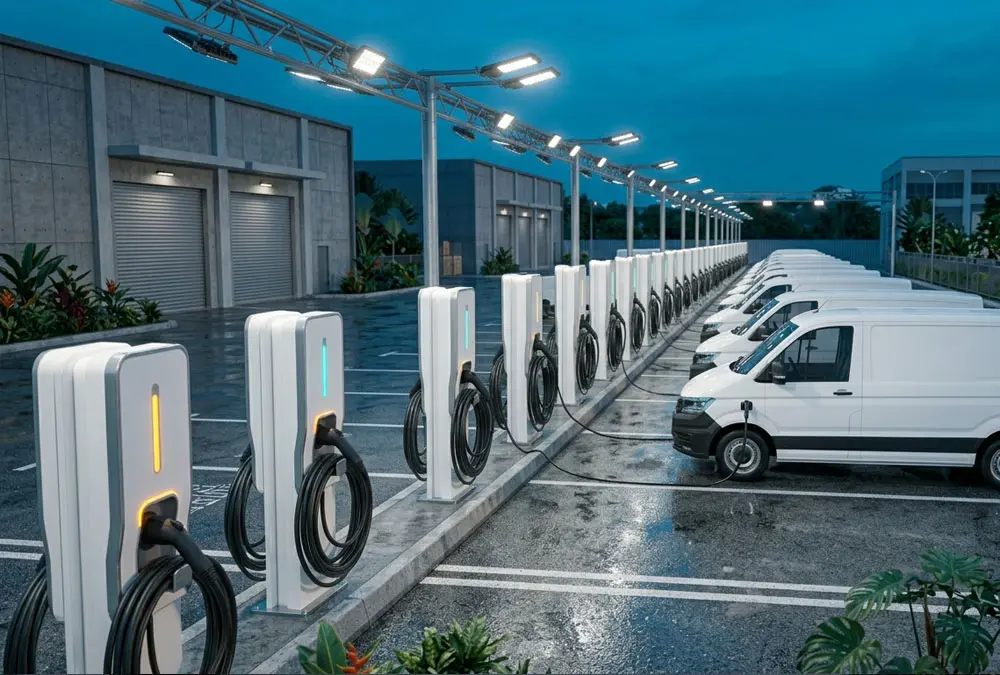
Let’s analyze a real-world hypothetical engineering model for a last-mile delivery depot operating 50 medium-duty electric delivery vans:
| Fleet Modeling Parameter | Engineering Baseline Value |
|---|---|
| Total Connected Fleet Size | 50 Electric Delivery Vans |
| Nameplate Battery Capacity per Vehicle | 80 kWh (Total theoretical fleet capacity = 4,000 kWh) |
| Fleet Availability during Peak Utility Window | 60% parked and plugged in (30 vans active) |
| Usable Depth-of-Discharge (SOC Window) | 25% allowable export buffer (reserving 50% for morning routes) |
| Power Conversion RTE (Inverter + Battery round trip) | 88% Efficiency |
| Actual Commercially Available Daily V2G Export | 528 kWh net usable energy export |
*Note: Illustrative project model — actual site performance depends on local thermal conditions, tariff profiles, and specific utility interconnect limits.
Does V2G Affect EV Battery Life?
The short answer is: It depends entirely on cycling strategy, Depth of Discharge (DoD), C-rate, and cell chemistry.
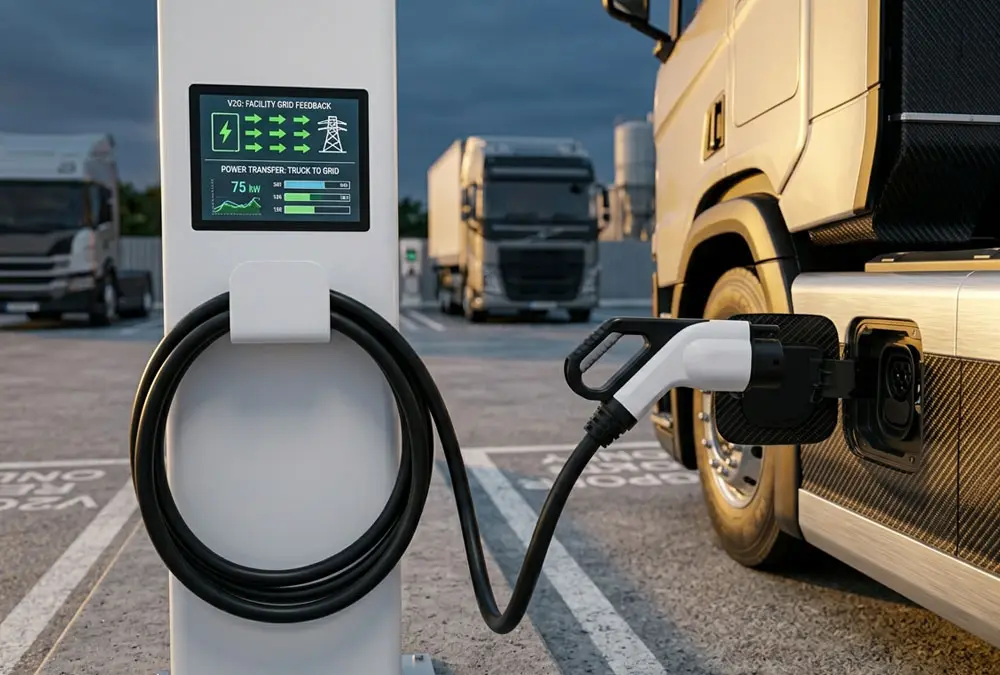
Lifting battery health concerns from a Reddit procurement thread: many commercial buyers fear V2G will instantly destroy lithium cell health. Field evidence from rigorous research shows otherwise. Real-world testing by the U.S. Department of Energy (DOE) Federal Energy Management Program (FEMP) demonstrates that shallow micro-cycling within mid-range state-of-charge windows (e.g., 40% to 70% SOC) at low C-rates (<0.5C) causes negligible additional battery degradation compared to standard driving loads. Modern Lithium Iron Phosphate (LFP) chemistries naturally handle 4,000 to 6,000 full cycles, making them ideal for high-frequency bidirectional energy management.
How to Choose a Commercial V2G Charging System
Follow this strict 10-step engineering procurement sequence:
- Confirm Vehicle OEM Compatibility: Verify written V2G warranty clearance from your EV fleet vehicle manufacturers.
- Define Operational Duty Cycles: Map precise parking dwell times and vehicle departure SOC constraints.
- Select Power Architecture (AC vs DC): Choose DC bidirectional chargers for high-power fleet turnarounds or AC systems for lower power, extended parking scenarios.
- Determine Required Unit kW Rating: Size charger power capacity (30 kW, 60 kW, 120 kW) to match local transformer limits.
- Verify ISO 15118-20 Implementation: Ensure physical charger hardware supports upcoming ISO bidirectional communication stacks.
- Validate OCPP 2.0.1 Compliance: Confirm CSMS backend software natively handles bidirectional smart charging profiles.
- Audit EMS Protocol Integration: Ensure local EMS controllers communicate cleanly via Modbus TCP or Ethernet IP.
- Evaluate Grid Interconnection Requirements: File early interconnection inquiries with your local electric utility.
- Review Safety Certifications: Audit UL 1741 SB, IEEE 1547, and local grid compliance documentation.
- Calculate Total Cost of Ownership (TCO): Compare long-term grid service revenue streams against total installed project Capex.
Commercial V2G System Buyer Checklist
Engineering & Procurement Verification Checklist
Phase 1: Pre-RFQ Assessment
- ✔ Fleet vehicle models and battery chemistry confirmed (LFP vs. NMC)
- ✔ Daily parking dwell time logs mapped (minimum 4+ hour parked windows)
- ✔ Local utility tariff sheets audited for TOU price spreads and demand charge rates
Phase 2: Hardware & Protocol Evaluation
- ✔ Charger supplier confirms active SiC bidirectional power module topology
- ✔ ISO 15118-20 and OCPP 2.0.1 compliance certificates verified in writing
- ✔ UL 1741 SB / IEEE 1547 grid safety anti-islanding test reports available
Phase 3: Final Purchase Order Clearance
- ✔ Utility formal grid export interconnection permit granted
- ✔ Multi-year software SaaS maintenance terms clear
- ✔ On-site commissioning support and factory warranty agreements signed
Common Commercial V2G Deployment Mistakes
- Procuring Chargers Before Confirming EV Firmware Support: Buying V2G hardware without verifying if vehicle OEM software locks permit reverse discharge.
- Assuming Total Battery Capacity Equals Available Export: Ignoring required driver state-of-charge buffers and thermal battery limits.
- Treating OCPP 1.6 as V2G Ready: Relying on legacy charge point protocols that lack dynamic bidirectional control parameters.
- Ignoring Utility Interconnection Lead Times: Waiting until hardware arrives on-site before submitting IEEE 1547 export interconnection paperwork to the utility.
- Skipping Small-Scale Pilot Validation: Scaling to 100+ ports without executing a 2-to-5 unit pilot test to validate software-to-vehicle power handshakes.
How to Deploy a Commercial V2G Charging Project
Step 1: Fleet Operational Audit ── Analyze vehicle arrival/departure patterns and residual SOC logs.
Step 2: Electrical Grid Capacity Study ── Evaluate distribution transformer capacity and local subpanel service margins.
Step 3: Vehicle Compatibility Audit ── Confirm bidirectional protocol handshakes with vehicle OEMs.
Step 4: System Architectural Design ── Specify bidirectional DC/AC EVSE, switchgear protection, and EMS controllers.
Step 5: Execute Utility Interconnection Filings ── Submit UL 1741 SB / IEEE 1547 export permit documentation.
Step 6: Deploy Controlled V2G Pilot ── Install 2 to 5 bidirectional stations to validate EMS-to-vehicle response latency.
Step 7: Analyze ROI & Scale ── Validate actual demand-shaving savings and scale across full fleet depots.
When Does Commercial V2G Make Business Sense?
Commercial V2G delivers peak ROI when these strategic site conditions align:
- Your fleet features long, predictable parking windows during high peak pricing hours.
- Your local electric utility imposes severe peak demand charges ($15–$30+ per kW) or offers active demand response capacity markets.
- Your fleet consists of medium- or heavy-duty vehicles with large battery capacities (e.g., school buses, logistics delivery vans).
- Your facility integrates rooftop solar PV arrays needing dynamic high-capacity battery buffers.
Frequently Asked Questions About Commercial V2G
What is commercial bidirectional EV charging?
It is an advanced charging architecture that allows commercial electric vehicles to draw energy from the electrical grid and discharge stored battery power back into facilities (V2B) or the public power grid (V2G) via specialized power conversion equipment.
Is commercial bidirectional charging the same as V2G?
No. Bidirectional charging describes the general underlying hardware technology capable of two-way power flow. V2G (Vehicle-to-Grid) is a specific grid-export operational application of that technology.
Which commercial EVs currently support V2G?
V2G support is rapidly expanding across commercial electric school buses (e.g., Blue Bird, Thomas Built), light/medium delivery vans, and heavy trucks equipped with CCS2, CHAdeMO, or emerging NACS ISO 15118-20 protocol stacks.
Does V2G require a special bidirectional EV charger?
Yes. Standard unidirectional chargers lack the internal bidirectional active front-end inverters, anti-islanding safety relays, and advanced ISO 15118-20 / OCPP 2.0.1 control protocols required to safely convert and export DC battery power back into AC grid power.
Does V2G void my EV battery warranty?
Not if executed within OEM-approved parameters. Leading commercial vehicle OEMs explicitly maintain battery warranties when V2G operation is managed via certified EMS software that respects approved SOC windows and C-rate parameters.
Does V2G require utility approval?
Exporting power back onto the utility grid (V2G) requires formal utility interconnection filing (such as IEEE 1547 / UL 1741 SB compliance). Discharging power strictly behind-the-meter to offset building loads (V2B) involves simplified interconnection requirements.
Ready to Deploy Commercial Bidirectional EV Charging Infrastructure?
Transitioning your commercial fleet into dynamic distributed energy assets requires rigorous engineering, protocol expertise, and seamless hardware integration. Work directly with senior power systems engineers to audit your fleet schedules, evaluate site transformer capacity, and design a scalable, grid-compliant bidirectional charging solution.