A practical engineering guide to evaluating Liquid Cooling vs Air Cooling for commercial EV charging sites, fleets, and highway charging hubs.
Choosing between Liquid Cooling vs Air Cooling is not simply a matter of picking the most advanced tech on the datasheet—it’s about balancing heat dissipation, continuous current output, cable weight, and long-term operating costs. As electric vehicle battery capacities scale up and commercial fleets demand sub-20-minute turnaround times, thermal management has become the single biggest bottleneck in high-power DC fast charger reliability. If your charging station overheats, it throttles power, frustrates drivers, and destroys project economics.
Whether you are planning a 180kW depot or a 600kW mega-hub, this guide breaks down the real-world performance, physical trade-offs, and Total Cost of Ownership (TCO) between air-cooled and liquid-cooled systems.
What We Will Cover in This Evaluation
- Air-Cooled vs Liquid-Cooled Architecture
- Physics of Thermal Throttling & I²R Heat Losses
- Cable Ergonomics & Continuous Current Limits
- Hot Climate Performance & Environmental Protection
- Electric Truck & Commercial Fleet Charging Demands
- Maintenance Requirements & Failure Modes
- Thermal TCO Model & CAPEX vs OPEX Analysis
- 7-Point Site Selection Decision Matrix
What Is the Difference Between Liquid-Cooled and Air-Cooled DC EV Chargers?
At a basic level, the difference comes down to the medium used to transfer heat away from high-current conductors and power electronics. In a liquid cooled vs air cooled EV charger comparison, air cooling relies on forced convective airflow generated by high-CFM fans blowing over aluminum or copper heatsinks. Liquid cooling uses a closed-loop system where a thermal fluid (typically a glycol-water mixture or synthetic dielectric fluid) circulates through cold plates and hollow-core cables to draw heat directly away from hotspot sources.
Air-Cooled and Liquid-Cooled Chargers in Simple Terms
Think of an air cooled DC fast charger like a high-performance gaming PC filled with heavy heatsinks and fast-spinning fans. It works well up to a certain power threshold, but once heat output spikes beyond the surface area’s ability to shed it into ambient air, temperature rises rapidly. A liquid cooled DC fast charger operates like an engine radiator system: it captures intense heat at the exact point of origin and pumps it to a dedicated heat exchanger located safely away from sensitive components.
Where Is the Cooling System Actually Used?
A common misconception among site hosts is thinking a charger is either 100% air-cooled or 100% liquid-cooled. In reality, thermal management spans distinct subsystems within the charging architecture:
- Power Modules (AC/DC Conversion Blocks): Convert grid AC power into controlled DC voltage. These components generate massive internal heat during active switching.
- Power Cabinet Enclosure: Houses internal busbars, contactors, and control electronics that require ambient climate control.
- Charging Cable & Connector (Gun): The physical link carrying high DC current into the vehicle inlet. Cable copper conductors generate heat proportional to current density.
Why “Liquid-Cooled” Does Not Always Mean the Whole System Is Liquid-Cooled
Many commercial installations utilize a hybrid thermal approach. For instance, high-power systems like Siemens SICHARGE D can utilize an air-cooled power cabinet paired with either a non-cooled cable assembly or a dedicated liquid-cooled cable system depending on current demands. This modular approach allows operators to deploy a liquid cooled EV charger for high power charging without necessarily paying for complex fluid cooling inside the main cabinet if air ducting suffices.
Buyer’s Perspective: “I often get asked if a liquid-cooled cable requires a massive fluid tank inside the dispenser. The answer is no. Modern liquid-cooled cable assemblies utilize compact, sealed chillers integrated directly into the base of the satellite dispenser, requiring only minimal fluid reservoirs (typically under 5 liters) that are easy to inspect during annual maintenance.”
What Is an Air-Cooled DC EV Charger?
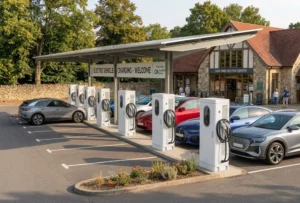
An air cooled DC charging station uses mechanical fans to draw outside air through intake louvers, direct it over power module heatsinks, and exhaust the heated air out of the enclosure. It remains the workhorse architecture for chargers operating up to 150kW–200kW.
How Air Cooling Works & Core Components
Air cooling operates through basic thermal conduction and forced convection. Internal sensors continuously monitor power module temperatures, speeding up or slowing down fan RPMs. Key components include:
- Variable-speed industrial axial or centrifugal fans.
- High-density extruded aluminum heatsinks attached directly to IGBT or SiC MOSFET switching assemblies.
- Replaceable particulate air filters (G3/G4 ratings) and rain louvers.
- Internal baffle plates to prevent hot air recirculation.
Advantages and Operational Limits of Air Cooling
The primary appeal of an air cooled EV charger lies in structural simplicity. Without pumps, coolant lines, or fluid pressure sensors, there are fewer moving parts to fail. Capital expenditure (CAPEX) is significantly lower, and routine maintenance usually involves nothing more than vacuuming air filters and checking fan bearings once or twice a year.
However, air cooling hits physical limits when ambient temperatures rise or continuous current output increases. Air has a relatively low volumetric heat capacity (approx. 1.2 kJ/m³K) compared to liquids. When ambient air exceeds 40°C, the temperature differential ($\Delta T$) drops, forcing the charger to either spin fans at deafening noise levels (>70 dBA) or actively throttle power output to protect internal electronics.
What Is a Liquid-Cooled DC EV Charger?
A liquid cooled EV charging station relies on liquid coolant circulating through a closed loop to absorb thermal energy directly from heat-generating sources and dissipate it via a radiator. This technology is essential for ultra-fast charging (350kW to 600kW+) and high-current continuous output (>300A to 500A+).
How Liquid Cooling Works & Core Components
Because liquids have a heat capacity over 3,000 times greater than air per unit volume, a liquid cooled DC charger can absorb immense amounts of thermal energy within a small physical footprint. The architecture includes:
- Magnetic-drive coolant pump: Delivers precise fluid flow without mechanical shaft seals that could leak.
- Copper or aluminum cold plates: Clamped directly against silicon carbide (SiC) power electronics.
- Specialized cable jacket: Features internal fluid channels running parallel to heavy DC copper conductors directly up to the connector contacts.
- Liquid-to-air heat exchanger: Equipped with low-noise radiator fans.
- Coolant reservoir & pressure sensors: Maintains system pressure and detects micro-leaks.
Key Advantages & Trade-offs
Comparing a liquid cooled vs air cooled DC fast charger reveals clear benefits for demanding sites: liquid systems eliminate thermal derating under harsh conditions, reduce operating noise, and enable slim, lightweight 500A charging cables that any driver can handle. The trade-off is higher upfront hardware cost, increased system complexity, and the need for periodic coolant checks and pressure testing.
Why Cooling Design Matters for Commercial DC Fast Charging
Understanding why thermal management dictates charger selection requires looking at basic electrical engineering principles. In a high-power charging hub, heat is the ultimate enemy of efficiency and hardware lifespan.
The Physics of Thermal Losses: Current Creates Heat ($I^2R$)
Electrical power transmitted to a vehicle is defined by:
However, resistive heat generated inside charging cables, internal busbars, and power modules follows the Joule heating law:
Notice that current is squared. If you double the continuous current from 200A to 400A to achieve faster charging at 400V, heat generation increases by four times! Without liquid cooling running directly alongside the cable conductors, an uncooled copper cable carrying 500A would quickly become too hot to safely touch, leading to insulation failure.
Peak Power vs Continuous Power Output
Datasheets can be deceptive. A charger rated for 360kW peak power might only maintain that output for 10 minutes before internal temperatures hit safety limits, triggering automatic power throttling. According to technical documentation for the Siemens SICHARGE D, continuous high-current delivery depends heavily on ambient temperature, solar radiation exposure, and cable thermal dissipation limits. Choosing the wrong EV charger cooling technology can reduce a 300kW station down to 120kW during afternoon rush-hour traffic.
What Is Thermal Derating?
Thermal derating is an automated protective feature built into EV charger control software. When internal temperature sensors detect that power module junction temperatures or cable connector contacts exceed safe limits (typically around 80°C–85°C), the controller actively scales down output amperage. For site operators, derating directly damages revenue by extending dwell times and creating longer queues at busy charging hubs.
Liquid Cooling vs Air Cooling: Key Differences at a Glance
| Performance Factor | Air-Cooled DC Fast Charger | Liquid-Cooled DC Fast Charger | Buyer & Site Advantage |
|---|---|---|---|
| Continuous Current Rating | Typically 150A – 250A (Boost up to 300A short term) | Continuous 500A – 600A+ without derating | Delivers maximum charging speeds for 400V/800V vehicles without power drops. |
| Cable Ergonomics & Weight | Thick, heavy copper cables (Hard to bend below 0°C) | Slim, flexible, lightweight active liquid-cooled cable | Significantly better user experience; easy for elderly drivers or commercial operators. |
| Hot Climate Resilience (40°C+) | Prone to thermal derating; fans run at maximum dBA | Maintains rated output power even in extreme heat | Protects revenue throughput in hot regions and sunny summer months. |
| Ingress Protection (Dust/Salt) | Requires high airflow; filters must be serviced regularly | Sealed cabinet designs available (IP65 / NEMA 4X) | Ideal for coastal, dusty, or harsh industrial environments. Reduces maintenance visits. |
| Upfront Hardware Cost (CAPEX) | Lower initial investment (Baseline standard) | 20% – 35% higher equipment purchase cost | Air cooling keeps entry costs low for low-utilization or lower-power sites. |
| Acoustic Noise Impact | High fan noise under full load (65–75 dBA) | Quieter operation; controlled fluid pump + low RPM radiator | Easier to meet strict municipal noise regulations in residential or hotel zones. |
Note: Neither technology is universally better. The right decision depends entirely on site power requirements, utilization rates, and environmental conditions.
When Is an Air-Cooled DC EV Charger the Better Choice?
Despite the market hype around liquid cooling, an air cooled DC fast charger remains the most logical and cost-effective choice for many commercial projects. Overspecifying a liquid-cooled system when air cooling suffices drains capital without providing meaningful return on investment.
Ideal Use-Cases for Air-Cooled Fast Chargers
- Moderate Power Demands (60kW to 180kW): At power levels under 200kW, standard uncooled 250A cables can deliver full power to 800V vehicles without excessive heat build-up.
- Low to Moderate Site Utilization: Retail parking plazas, hotel destinations, and workplace charging where vehicles remain plugged in for 1 to 3 hours do not require continuous back-to-back 500A charging cycles.
- Moderate Climate Regions: Sites where summer ambient temperatures rarely exceed 35°C do not experience severe thermal throttling issues under standard duty cycles.
- Strict Upfront CAPEX Budget Constraints: Air-cooled units cost significantly less to purchase and install, helping site hosts deploy more plugs across a limited capital budget.
When Is a Liquid-Cooled DC EV Charger Worth the Investment?
Investing in a liquid cooled EV charger for charging hubs or highway plazas pays off when high power output and maximum uptime directly drive revenue generation.
High-Power, High-Throughput Charging Hubs (300kW to 600kW+)
High-power charging stations (HPC) designed for highway corridor locations rely on 350kW EV charger cooling or 600kW EV charger cooling systems. When passenger EVs like the Porsche Taycan, Hyundai Ioniq 5, or Lucid Air pull over 300A to charge in under 18 minutes, liquid cooling is mandatory to prevent early charge termination.
Industry Benchmark Evidence: Kempower Satellite Architecture
Leading industry manufacturers have standardized liquid thermal management for high-power applications. According to technical specifications published by Kempower, their liquid-cooled Satellite terminals support continuous 500A charging outputs at up to 400kW. Kempower specifically targets these units at high-capacity passenger EV plazas and commercial heavy-duty truck depots where uncooled cables are physically incapable of meeting charging speeds.
Liquid Cooling vs Air Cooling in Hot Climate Markets
Ambient temperature plays a decisive role in real-world charging speed. In hot regions like the Middle East, Southern Europe, or the US Sunbelt, extreme heat degrades uncooled charger performance rapidly.
Solar Radiation & Enclosure Temperature Spikes
Ambient air temperature alone doesn’t tell the whole story. Direct solar radiation on an outdoor metal enclosure can push internal cabinet temperatures 15°C to 20°C above ambient air. If it is 42°C outside, internal power module air intakes might pull in air at 58°C! Under these conditions, an air-cooled power cabinet will immediately enter protective derating.
Real-World Field Observation: In EV charging community reports and field observations compiled across warm climate regions during summer operational peak periods, EV drivers routinely reported significant charging rate drops on air-cooled fast chargers when outdoor temperatures climbed above 38°C (100°F). While individual experiences vary, these incidents illustrate how environmental heat combined with cable heat accumulation degrades driver experience if thermal management is under-designed.
Liquid Cooling vs Air Cooling for Electric Truck and Fleet Charging
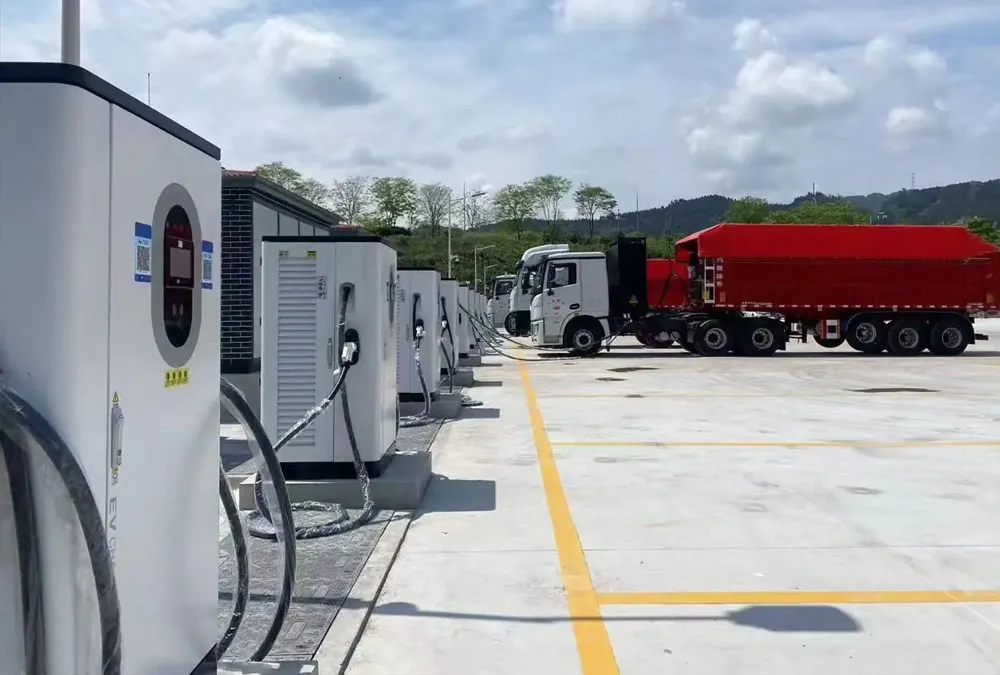
Deploying a liquid cooled EV charger for fleet charging is fast becoming standard practice for commercial logistics depots operating heavy-duty vehicles.
Why Electric Trucks Demand Liquid Thermal Management
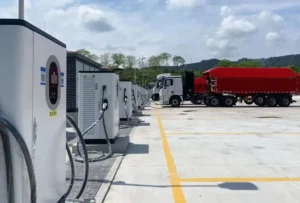
Commercial electric trucks and buses carry massive battery packs ranging from 300kWh to over 600kWh. Unlike passenger cars that draw peak current for just 10–15 minutes, a heavy-duty electric truck requires continuous 400A+ current for 45 to 90 minutes straight. This long dwell time at full load forces uncooled cables past their thermal dissipation limits within minutes.
| Commercial Application | Typical Battery Capacity | Charging Operational Demand | Cooling Architecture Recommendation |
|---|---|---|---|
| Commercial Last-Mile Vans | 60 kWh – 120 kWh | Overnight slow/medium DC charge (60kW) | Air-Cooled DC Charger |
| Regional Transit Buses | 250 kWh – 450 kWh | Rapid turnaround / Opportunity charging (150kW-300kW) | Liquid-Cooled Cable / Cabinet |
| Class 8 Heavy Electric Trucks | 400 kWh – 800 kWh+ | Megawatt / High Continuous Current (375kW – 600kW+) | Fully Liquid-Cooled Architecture |
Integrating Battery Energy Storage (BESS) with High-Power Charging Hubs
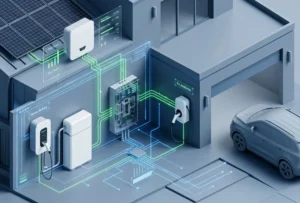
High-power liquid-cooled chargers demand immense grid capacity. When grid connection upgrades are cost-prohibitive or delayed, pairing fast chargers with an industrial Battery Energy Storage System (BESS) provides peak shaving and demand charge management.
For commercial charging hubs, we recommend integrated liquid-cooled battery storage solutions tailored to site scale:
- 261kWh Commercial All-In-One BESS Cabinet: Features high safety LFP chemistry, integrated PCS, and active liquid thermal management. Designed specifically to buffer 180kW to 360kW fast chargers against severe grid demand charges.
- 1MWh Containerized Utility-Scale BESS: Modular storage architecture ideal for highway multi-dispenser charging hubs and heavy electric truck fleets requiring sustained megawatt-level power delivery.
Cooling Design Should Be Evaluated Together With Enclosure Protection
Thermal design cannot be analyzed separately from physical enclosure protection. An air cooled EV charging station relies on continuous outdoor air intake, exposing internal power electronics to fine dust, humidity, airborne sea salt, and industrial pollutants.
IP Protection Rating Comparison
Air-cooled chargers typically achieve IP54 ratings due to necessary air louvers and intake vents. While filter screens block gross particles, fine dust can build up on heatsinks over time, insulating them and degrading thermal transfer. In contrast, liquid-cooled power cabinets can be engineered with completely sealed electronics bays (achieving IP65 or NEMA 4X ratings). The internal heat is transferred to fluid loops, keeping sensitive PCBs completely isolated from corrosive ambient air.
Maintenance and Reliability: Air Cooling vs Liquid Cooling
Maintenance routines differ fundamentally between air-cooled and liquid-cooled fast chargers. Understanding these operational expenses (OPEX) helps prevent surprise maintenance bills down the road.
Air-Cooling Preventive Maintenance Protocol
- Inspect and replace particulate air filters every 6 to 12 months.
- Clean heatsink fins using compressed air to clear accumulated dust.
- Inspect cooling fans for bearing wear, vibration, or high acoustic noise.
Liquid-Cooling Preventive Maintenance Protocol
- Check fluid levels and expansion tank pressure sensors annually.
- Sample coolant pH and glycol concentration levels every 24 to 36 months (Replace fluid as recommended by OEM).
- Inspect quick-disconnect hydraulic couplings and cable jacket seals for micro-sweating or seepage.
- Verify coolant pump flow rate and pressure differential metrics via remote telemetry.
Liquid Cooling vs Air Cooling: Initial Cost vs Total Cost of Ownership
Evaluating an air cooled vs liquid cooled DC fast charger purely on initial purchase price leads to poor investment decisions. Site hosts should evaluate projects using a full Total Cost of Ownership (TCO) model.
Thermal TCO Model Equation:
TCO = Initial Equipment CAPEX + Installation Cost + Preventive Maintenance OPEX + Energy Loss Cost (I²R) + Downtime Revenue Loss
While a liquid-cooled charger carries a 25% higher initial hardware CAPEX, its ability to maintain continuous 500A charging without derating generates significantly higher daily kWh sales at busy highway plazas. In high-utilization scenarios, the extra revenue earned by processing more EVs per hour offsets the higher upfront equipment cost within 14 to 18 months of operation.
A Site-Based Decision Matrix: Which Cooling Architecture Should You Choose?
Use this practical decision matrix to match your site parameters to the correct thermal management architecture:
| Site Condition & Goal | Air-Cooled DC Fast Charger | Liquid-Cooled DC Fast Charger |
|---|---|---|
| Power Requirement < 180kW | Optimal Choice (Lowest TCO) | Unnecessary Complexity |
| Power Requirement > 300kW | High Risk of Throttling | Recommended Architecture |
| Highway Ultra-Fast Charging Hub | Not Recommended for 500A | Essential for Short Dwell Times |
| Commercial Fleet Overnight Depot | Cost-Effective Fit | Evaluate for Megawatt Truck Hubs |
| Extreme Climate (>40°C Ambient) | Severe Derating Likely | Maintains Full Power Output |
7 Questions to Ask Before Choosing an EV Charger Cooling System
- What continuous current is required? If your target vehicles need 500A continuous power, choose liquid-cooled cables.
- What are the local ambient summer temperatures? If peak temperatures exceed 38°C routinely, factor in thermal derating curves.
- What is the target charging dwell time? Sub-20-minute turnaround demands high continuous current that only liquid cooling reliably sustains.
- What is the physical cable handling capability needed? Elderly or retail consumers struggle with heavy 250A uncooled cables; liquid-cooled cables offer vastly superior ergonomics.
- Are there strict municipal noise limits? Liquid cooling allows lower fan RPMs, helping pass tight noise ordinances.
- Is the location exposed to dust, salt, or high humidity? Sealed liquid-cooled cabinets offer superior IP rating protection against airborne contaminants.
- What is your project’s primary financial metric? If minimizing upfront CAPEX is critical, air cooling wins. If maximizing daily throughput revenue matters most, liquid cooling is the better choice.
The Future of EV Charger Cooling Technology
Thermal management technology continues to evolve alongside vehicle architecture. Key developments shaping the industry include:
- Megawatt Charging Systems (MCS): Designed for heavy commercial trucks delivering up to 1.2MW (1,200A at 1,000V), relying on advanced liquid cooling with dielectric synthetic fluids.
- Silicon Carbide (SiC) Power Electronics: High-efficiency SiC switching modules generate less heat per kW converted, allowing compact thermal designs.
- Predictive Thermal AI Controls: Cloud-connected chargers that monitor weather forecasts and upcoming vehicle arrival queues to pre-cool fluid loops before high-current charging sessions begin.
AnengJi Commercial DC Fast Charging Solutions
AnengJi manufactures high-reliability commercial DC fast chargers and integrated BESS energy solutions engineered for demanding global operating environments.
AnengJi Commercial Air-Cooled Fast Chargers (60kW – 180kW)
Engineered for retail plazas, commercial fleets, and workplace destination charging sites seeking low CAPEX and simple maintenance.
- Modular power switching architecture with auto-matrix power sharing.
- Dual-gun CCS1 / CCS2 / NACS configurations.
- IP54 industrial enclosure protection with low-noise intelligent fan control.
AnengJi Ultra-Fast Liquid-Cooled Charging Hubs (240kW – 600kW)
Designed for highway corridors, high-throughput passenger EV plazas, and heavy-duty electric vehicle transit hubs.
- Continuous 500A charging output with ultralight liquid-cooled cable assemblies.
- Sealed IP65 power electronics bay for harsh coastal or desert environments.
- Seamless integration with AnengJi Liquid-Cooled BESS storage cabinets for peak shaving.
Liquid-Cooled vs Air-Cooled EV Charger FAQ
Which is better, liquid-cooled or air-cooled EV chargers?
Neither is universally better. Air-cooled chargers offer lower upfront CAPEX and simpler maintenance for sites under 200kW. Liquid-cooled chargers are necessary for continuous high-current (300A–500A+) charging above 240kW, highway hubs, heavy electric truck fleets, and extreme hot climate installations.
Are liquid-cooled EV chargers prone to leaks?
Modern liquid-cooled EV chargers utilize industrial magnetic-drive pumps, sealed quick-disconnect fittings, and non-corrosive glycol dielectric mixtures. Built-in pressure sensors trigger automated shutdown if fluid pressure changes occur, preventing damage to electronics.
Can an air-cooled EV charger operate in hot climates?
Yes, but it will likely experience automated thermal derating during high summer temperatures, reducing charging speed to protect components. In regions exceeding 40°C ambient temperatures, liquid-cooled units perform far more reliably.
What is a liquid-cooled charging cable?
A liquid-cooled cable runs coolant fluid directly through channels inside the cable jacket alongside copper conductors. This removes heat, allowing thin, flexible cables to safely carry 500A continuous current without becoming heavy or unmanageable for drivers.
Optimize Thermal Architecture for Your Fast Charging Site
Need help choosing between air-cooled and liquid-cooled fast chargers for your upcoming commercial site or fleet project? Our engineering team provides detailed thermal modeling, site load evaluations, and customized DC fast charging configurations tailored to your local grid constraints and utilization requirements.