Introduction
The global energy transition in 2026 has reached a fever pitch, driven by the aggressive electrification of the transport sector and the integration of massive renewable assets into a volatile grid. For stakeholders in the industrial and commercial sectors, the debate often centers on a critical technical choice: ESS vs BESS. Understanding the nuance between a broad energy storage system (ESS) and a specific battery energy storage system (BESS) is no longer a luxury for engineers—it is a financial necessity for facility managers and investors looking to optimize their energy architecture. As we navigate through high-power EV charging demands and grid stability requirements, choosing the right system determines your project’s long-term viability and ROI.
ESS vs BESS Definition – What Is an Energy Storage System (ESS) vs Battery Energy Storage System (BESS)?
What Is an Energy Storage System (ESS)?
An Energy Storage System (ESS) is the broad, “umbrella” category encompassing all technologies designed to capture energy at one time for use at a later time. ESS serves as the general framework for energy management, providing the capability to balance supply and demand on the grid. This category is not limited to chemical storage; it includes mechanical systems (pumped hydro, compressed air), thermal storage (molten salt, ice storage), and chemical/electrochemical systems.
What Is a Battery Energy Storage System (BESS)?
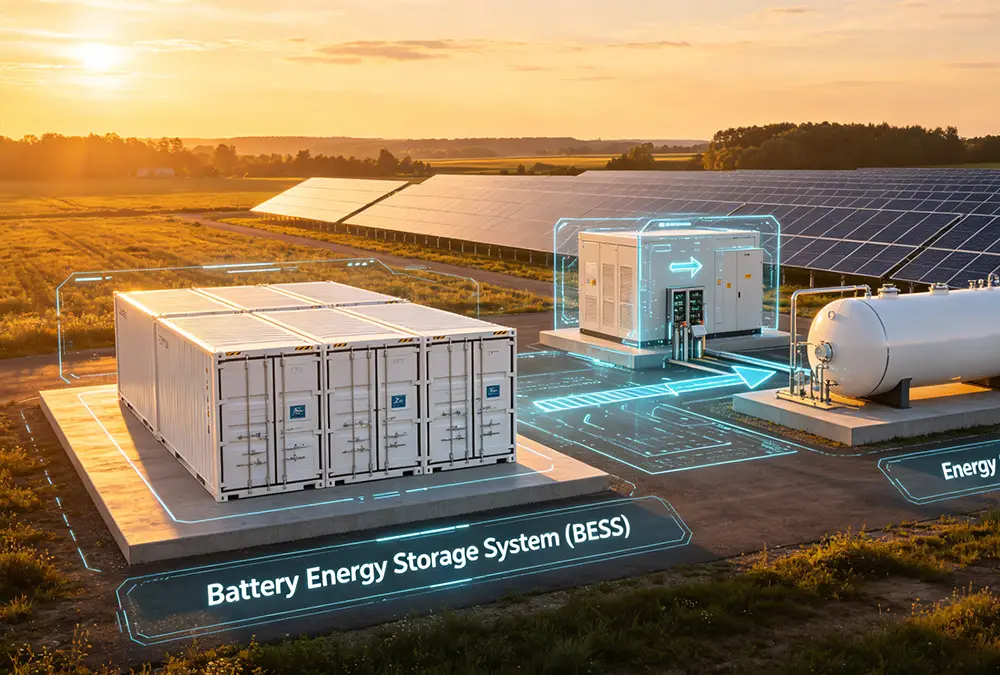
A Battery Energy Storage System (BESS) is a specific subset of ESS that utilizes electrochemical batteries to store and release electricity. In the current 2026 landscape, BESS is the most versatile and widely deployed form of storage due to its modularity and high energy density. A typical BESS is more than just a battery bank; it is an integrated solution consisting of:
- Battery Modules: Generally Lithium Iron Phosphate (LFP) for commercial use.
- PCS (Power Conversion System): The bidirectional inverter managing AC/DC flow.
- BMS (Battery Management System): The safety and health monitor.
- EMS (Energy Management System): The intelligent brain for scheduling and optimization.
ESS vs BESS Key Difference (Quick Comparison)
The primary difference lies in the scope and technology. While all BESS are ESS, not all ESS are BESS. ESS meaning in energy storage refers to the total available toolkit for grid support, whereas BESS meaning and components focus specifically on electrochemical solutions.
| Feature | Energy Storage System (ESS) | Battery Energy Storage System (BESS) |
| Scope | Broad (General category) | Specific (Subset of ESS) |
| Technologies | Mechanical, Thermal, Chemical, Hydrogen | Electrochemical (LFP, NMC, Sodium-ion) |
| Response Time | Varies (Seconds to Minutes) | Ultra-fast (Milliseconds) |
| Scalability | Often site-specific (e.g., dams) | Highly modular (Containerized) |
| Commercial Use | Grid-scale / Long-duration | C&I / EV Charging / Peak Shaving |
How ESS and BESS Work Together in Modern Energy Storage Systems
BESS as a Core Component of ESS Architecture
In modern grid-scale battery storage deployments, the BESS is often the “first responder.” Because chemical batteries can discharge almost instantly, they handle high-frequency fluctuations that mechanical ESS technologies (like pumped hydro) are too slow to manage. This makes BESS a vital component within a larger hybrid energy storage system definition (ESS).
Integration with PCS, BMS, and EMS
The technical synergy of PCS BMS EMS energy storage system components is what allows a BESS to function reliably.
- PCS (Power Conversion System): Converts DC from the battery to AC for the factory or grid. In large-scale projects, such as the 3.5MW/7.3MWh commercial storage project in Romania, advanced inverters like the ECO-E261LP are used to manage complex power flows.
- BMS (Battery Management System): Protects the cells from overcharge and thermal runaway.
- EMS (Energy Management System): Uses AI to predict load patterns and market prices, ensuring the system charges when electricity is cheap and discharges when it is expensive.
Hybrid ESS Systems (Battery + Other Technologies)
We are increasingly seeing “Multi-ESS” sites. For example, combining a lithium battery storage system (BESS) for fast response with a green hydrogen storage system for long-duration seasonal storage. This hybrid approach allows for a “Total Energy Storage” solution that covers both millisecond stability and week-long backup requirements.
ESS vs BESS Advantages and Challenges in Energy Storage Applications
Advantages of BESS (Battery Energy Storage System)
- Response Speed: Millisecond response makes it ideal for frequency regulation.
- Modularity: Units like the ECO-E233LS can be deployed in containerized formats, making them easy to install in diverse environments from New Zealand to Ukraine.
- Efficiency: Round-trip efficiency (RTE) for LFP-based BESS typically ranges from 88% to 92%.
Challenges of BESS
- Degradation: Chemical batteries lose capacity over time (typically 15-20% over 10 years).
- Safety: Requires robust thermal management to prevent fire risks.
- Cost: While falling, the ESS vs BESS cost comparison for energy storage projects shows that for 10+ hour storage, mechanical ESS can sometimes be more cost-effective.
Advantages of ESS (Non-Battery Systems Included)
- Duration: Pumped hydro and compressed air can provide power for days, not just hours.
- Lifespan: Mechanical ESS components often last 30 to 50 years, significantly longer than battery cells.
- Scale: Ideal for stabilizing national transmission networks.
Role of ESS and BESS in Grid Stability and Renewable Integration
Grid Frequency Regulation and Load Balancing
Grid operators utilize BESS for “synthetic inertia.” When a large power plant goes offline, the grid energy storage vs distributed storage assets must react instantly to prevent a blackout. Grid-scale battery storage excels here, maintaining the 50Hz/60Hz frequency.
Renewable Energy Integration (Solar + Wind)
Solar and wind are intermittent. A solar energy storage system vs battery storage analysis shows that without BESS, up to 30% of renewable generation can be wasted (curtailed) because it is produced when the grid doesn’t need it.
Peak Shaving and Demand Charge Reduction
For industrial users, the BESS system vs ESS for industrial applications choice is often driven by “Demand Charges.” Utilities charge a premium for the highest peak of power used in a month. By using a BESS to discharge during those peak moments, factories can save thousands in monthly costs.
Where You Commonly Hear BESS in the Energy Industry
Commercial & Industrial (C&I) Energy Storage
Industrial parks are now deploying systems like the 1MW/2MWh ECO-E261LP for backup and peak-shaving. These industrial battery storage solutions provide a safety net against grid instability while lowering operational costs.
EV Charging + BESS Integration
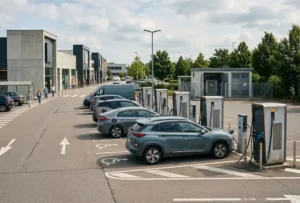
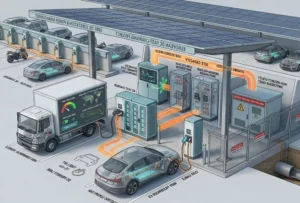
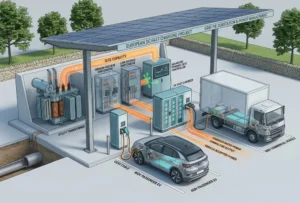
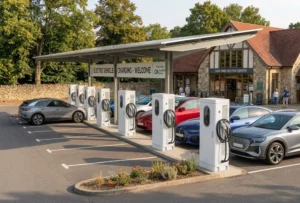
This is a critical growth area. High-power DC chargers (180kW-240kW) put immense strain on the local transformer. Integrating a BESS allows the station to “buffer” energy, charging the battery slowly and discharging it rapidly when a vehicle plugs in. This avoids expensive grid upgrades.
Real-World Applications of ESS vs BESS in Different Scenarios
The deployment of these systems varies significantly based on regional needs and local grid infrastructure.
Behind-the-Meter (C&I) Applications
In places like Malaysia, 120kW DC fast charging projects are being integrated with BESS to comply with local standards (Suruhanjaya Tenaga) while managing local demand.
Front-of-the-Meter (Grid-Scale Storage)
Large projects, such as the 500kW/1165kWh system in New Zealand, participate directly in national frequency regulation markets, proving the commercial viability of grid-scale battery storage.
Why BESS Dominates Modern Energy Storage Systems Today
Fast Deployment and Scalability
Unlike pumped hydro, which requires specific geography and a decade of construction, a commercial energy storage solutions project using BESS can be commissioned in 6–12 months.
Compatibility with Solar PV and EV Charging
BESS specifically refers to systems that use batteries, which are natively DC-based. This makes them perfectly compatible with Solar PV and EV charging, reducing conversion losses.
Choosing Between ESS vs BESS – Which Energy Storage System Is Right for You?
When to Choose BESS
- Commercial & Industrial Use: If you need to lower demand charges or have backup power.
- EV Charging Stations: To support high-power DC chargers (e.g., 180kW-240kW units) on a standard grid connection.
- High-Frequency Trading: When milli-second response is required for grid services.
Key Decision Factors for Energy Storage Projects
To determine the feasibility, engineers often use the Payback Period and LCOS (Levelized Cost of Storage) formulas:
Simple Payback Period Calculation:
Payback Period (Years) = Total System Cost / (Annual Energy Savings + Annual Revenue from Grid Services)
ROI Calculation for 2026 Projects:
ROI (%) = [(Lifetime Savings - Total Cost) / Total Cost] * 100
Recommended Industrial Storage Products (Anengji Power)
For those looking for high-reliability commercial energy storage solutions, Anengji Power offers specialized equipment designed for global deployment:
- ECO-E261LP Inverter: High-efficiency PCS used in MW-scale projects for PV self-consumption and peak-shaving.
- ECO-E241LS Inverter: Optimized for frequency regulation and grid stability in large-scale C&I applications.
- DC Fast Chargers: Supporting 120kW to 240kW standards (CCS2/GB/T) for modern EV infrastructure.
Featured Snippet – ESS vs BESS Explained in Simple Terms
What Is the Difference Between ESS and BESS?
ESS is a broad category of energy storage technologies (including mechanical, thermal, and chemical), while BESS specifically refers to systems that use batteries to store and release energy.
Is BESS Part of ESS?
Yes, BESS is a type of ESS. It is currently the most popular choice for commercial and industrial energy storage due to its fast response time and modular design.
Which Is Better: ESS or BESS?
It depends on the duration of storage needed. For fast-response and 2–4 hour storage, BESS is better for commercial use. For storage lasting 12+ hours or seasonal storage, mechanical ESS technologies may be more cost-effective.