Introduction
In the high-stakes electrical infrastructure landscape of 2026, the transition to electric mobility has reached a critical bottleneck: the power grid’s physical limits. As a power electronics engineer with over 20 years of experience in charging infrastructure and grid-scale systems, I have seen projects stalled for years due to a lack of available kilovolt-amps (kVA). Today, energy storage for EV charging is the definitive technology that allows operators to bypass grid upgrades, eliminate predatory demand charges, and deliver the ultra-fast charging speeds that modern EV drivers demand. According to the IEA Global EV Outlook 2026, the integration of a battery energy storage system (BESS) for EV charging is no longer a luxury—it is the foundational architecture for any profitable charging hub.
What Is Energy Storage for EV Charging?
Definition of Energy Storage for EV Charging Systems
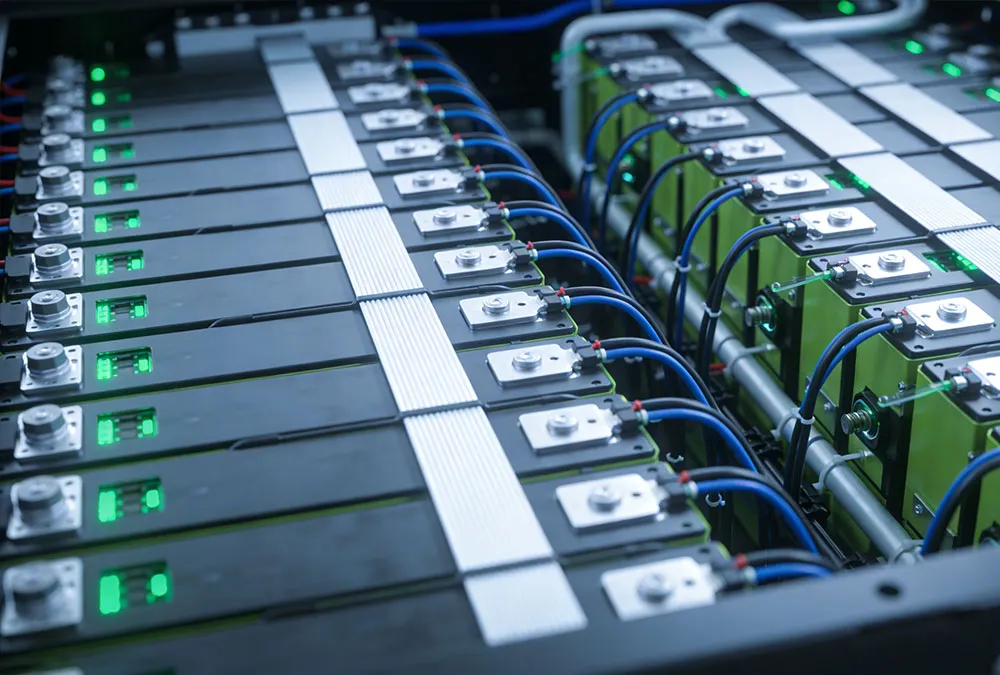
Energy storage for EV charging refers to a dedicated battery system integrated behind-the-meter at a charging site. Its role is to capture electricity from the grid (or on-site renewables) during periods of low demand and discharge it to vehicles during peak periods. This “power buffering” allows a site with a 100kW grid connection to provide 350kW of instantaneous power to a vehicle.
Why EV Charging Stations Need Battery Energy Storage Systems (BESS)
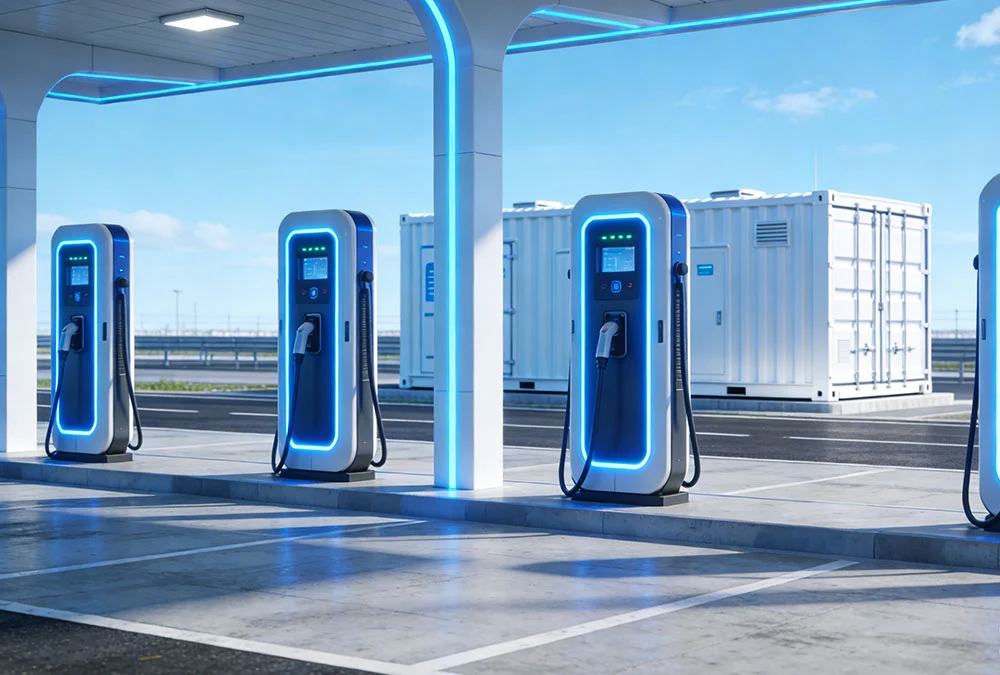
The core problem is “Peak Load.” A typical DC fast charger can draw as much power as an entire apartment building. If a site has four 150kW chargers, the potential simultaneous draw is 600kW. Most commercial feeders cannot support this without a multi-million dollar transformer upgrade. An EV charging infrastructure energy storage unit bridges this gap by providing the “burst” power required for high-speed sessions.
Key Components in EV Charging Energy Storage Systems
To ensure long-term reliability and EV charging station power management, a professional system must include:
- Battery System: Utilizing high-cycle LFP (Lithium Iron Phosphate) cells.
- Power Conversion System (PCS): A bi-directional inverter that handles the $AC \leftrightarrow DC$ conversion.
- Energy Management System (EMS): The “intelligence” or EV charging load management system that orchestrates the charging/discharging logic.
- EV Chargers: High-power dispensers (AC or DC) that interface with the BESS.
Decision Framework: Do You Actually Need BESS for Your Project?
As a consultant, I see many developers rush into buying hardware without a clear “Yes/No” framework. Before looking at EV charging battery storage system cost, use the following criteria to determine if BESS is mandatory for your site.
The “Should You Install BESS?” Checklist
| If your situation is… | BESS Recommendation | Reasoning |
| Grid Capacity < 150kW | Mandatory | You cannot support DC fast charging without a buffer. |
| Demand Charges > $20/kW | Highly Recommended | The ROI from “Peak Shaving” will pay for the BESS in < 5 years. |
| Targeting Ultra-Fast (350kW+) | Mandatory | Grid spikes at this level often trigger local blackouts or heavy fines. |
| Frequent Power Outages | Recommended | Provides “Island Mode” for business continuity. |
| On-site Solar Available | Recommended | Maximizes “Self-consumption” of free solar electrons. |
Scenario-Based Configuration Recommendations
Choosing between a containerized energy storage for charging unit and a compact cabinet depends on your specific use case:
- Shopping Malls (4-8 Chargers): 100kW/200kWh Cabinet-based BESS.
- Highway Rest Stops (8-20 Chargers): 500kW/1MWh containerized energy storage for EV charging stations.
- Fleet Depots (Buses/Trucks): 1MW+ BESS integrated with a microgrid EV charging system.
How Energy Storage Systems Work in EV Charging Stations
Energy Flow in EV Charging with Battery Energy Storage
The system operates on a “Buffer-and-Boost” principle. The BESS trickle-charges from the grid at a constant, low rate (e.g., 50kW). When an EV connects, the EV fast charging power solution draws 50kW from the grid and 300kW from the battery simultaneously.
Charging and Discharging Strategy for EV Charging Stations
We implement “Load Following” through the EV charging load management system. The EMS monitors the “State of Charge” (SoC). If the battery drops below 20%, the system automatically throttles the chargers to prevent a grid-trip, ensuring that the station remains online 24/7.
Grid-Tied vs Off-Grid EV Charging Energy Storage Systems
Most urban sites are “Grid-Tied” to utilize peak shaving for EV charging stations. However, for remote “Dead Zones” on highways, a solar plus energy storage for EV charging stations setup in “Off-Grid” mode is often the only way to provide service without laying 20 miles of new cable.
Battery Energy Storage System (BESS) for EV Charging Infrastructure
Role of BESS in EV Charging Infrastructure
In 2026, the BESS is the “Heart” of the station. It performs “Voltage Regulation,” ensuring that when a Tesla or a heavy-duty truck starts charging, the voltage doesn’t sag and cause nearby electrical equipment to fail.
Integration of PCS and EMS in EV Charging Energy Storage
The PCS must be “Fast-Acting.” In an energy storage system for fast EV charging, the inverter must be able to ramp from 0 to 100% output in less than 100 milliseconds to meet the vehicle’s initial handshake demand.
Containerized Energy Storage for EV Charging Stations
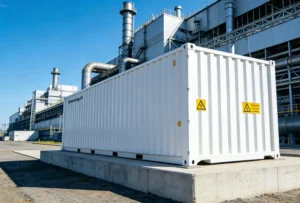
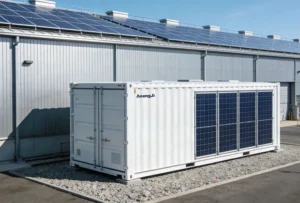
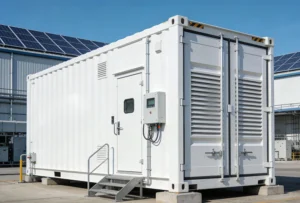
For multi-megawatt sites, containerized energy storage for charging is the gold standard. These units are pre-assembled with fire suppression, liquid cooling, and inverters, reducing on-site installation time by 75%.
Key Benefits of Energy Storage for EV Charging Stations
Peak Shaving and Demand Charge Reduction for EV Charging
This is the single biggest “Profit Center.” By capping your grid draw at a low level, you avoid the “Demand Spike” penalty. For a 400kW station, this can save over $60,000 per year in utility fees alone.
Enabling Fast EV Charging with Limited Grid Capacity
Energy storage for EV charging allows you to open stations in prime locations (like historic city centers) where the grid is old and capacity is non-existent.
Improving EV Charging Station Profitability
By utilizing commercial EV charging energy solution arbitrage—storing energy at $0.06/kWh (night) and selling it at $0.45/kWh (peak)—your “spread” increases, significantly shortening your payback period.
Energy Storage for Fast EV Charging Applications
Energy Storage for DC Fast Charging Stations (120kW–350kW)
Modern 800V vehicle architectures demand sustained high power. A fast charging energy storage solution ensures that even the 4th car in a row gets the same “Top Speed” as the first one.
Ultra-Fast Charging with Battery Energy Storage Support
Ultra-fast charging is a “high-transient” load. An energy storage for DC chargers setup protects the grid from the “thermal shock” of rapid 350kW cycles.
Solar Plus Energy Storage for EV Charging Stations
Solar + Battery Energy Storage + EV Charging Integration
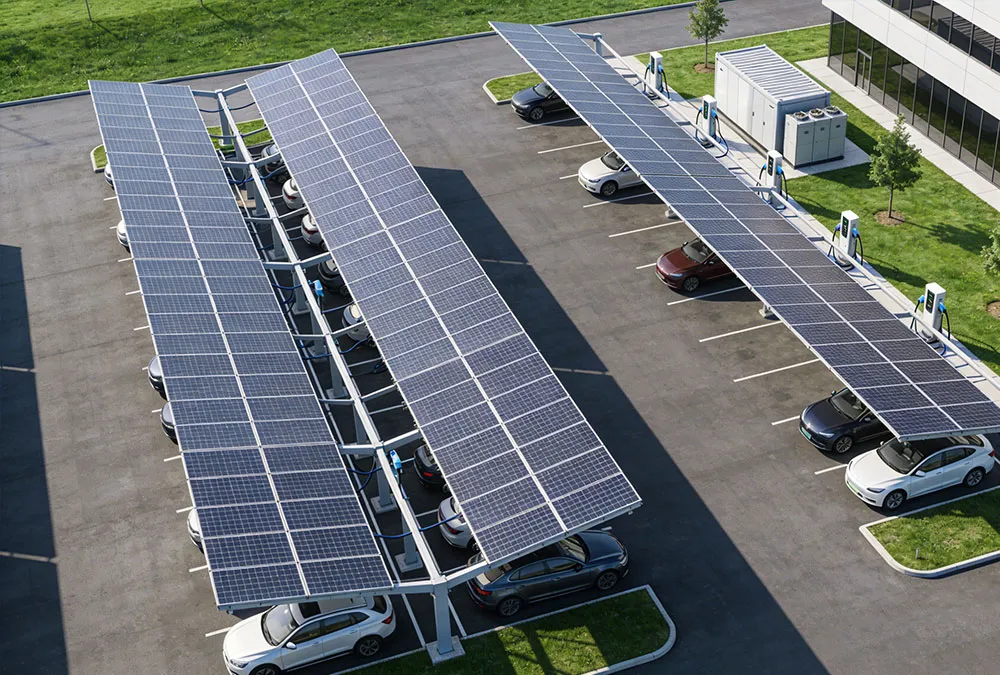
The solar plus energy storage for EV charging stations model is the ultimate green-energy solution. It allows you to “Fuel” cars with 100% renewable energy generated directly above the parking spot.
Benefits of Solar Energy Storage for EV Charging
Beyond sustainability, solar provides a “Price Floor.” You are no longer 100% dependent on utility rate hikes; you own your generation and your storage.
Energy Storage for EV Charging System Cost and ROI Calculation
To make a bankable decision, you need more than just a quote; you need a financial model.
H3: CAPEX Breakdown of EV Charging Energy Storage Systems (2026)
| Component | Estimated Cost (per kWh) | Notes |
| LFP Battery Modules | $160 – $210 | 10-year warranty standard |
| PCS & Inverter | $70 – $110 | Bi-directional capability |
| EMS & Software | $20 – $40 | AI-driven optimization |
| Installation/Civil | $50 – $90 | Site prep and grid connection |
| Total Turnkey | **$300 – $450** | Ready-to-operate |
ROI Case Study: The “Profitability Gap”
Let’s look at a real-world EV charging station with energy storage system example:
- Site: 4x 150kW DC Chargers.
- Grid Limit: 150kW.
- BESS Investment: $200,000 (500kWh system).
- Monthly Savings (Demand Charges): $3,200.
- Monthly Savings (Arbitrage/Solar): $800.
- Monthly Total: $4,000 Savings.
- Payback Period: ~4.2 Years.
- 10-Year Net Profit: +$280,000 (after O&M and CAPEX).
How to Size Energy Storage for EV Charging Stations
Calculating Battery Capacity (kWh) for EV Charging
We use a “Peak Overlap” formula. If your grid can provide 100kW, but your cars need 300kW for 2 hours during the evening rush, you need a “Delta” of 200kW x 2h = 400kWh of usable capacity.
Load Management Strategies Using EMS
The EV charging station power management software is the “Brain.” It must be able to communicate via OCPP 2.0.1 to dynamically lower charger output if the battery SoC is too low, ensuring the station never goes dark.
Challenges and Solutions for EV Charging BESS
High Initial Investment in Battery Energy Storage
The upfront EV charging battery storage system cost is high. Solution: Look for “Energy-as-a-Service” (EaaS) or “Lease-to-Own” models that allow you to pay for the system using the monthly savings it generates.
Battery Degradation and Lifecycle Management
Energy storage for EV charging involves heavy cycling. Solution: Always insist on LFP (Lithium Iron Phosphate) chemistry. It offers 6,000 to 10,000 cycles, lasting 10+ years even with daily deep discharges.
How to Choose an Energy Storage System for EV Charging Projects
Selecting the Right Battery Technology (LFP vs NMC)
In my 20 years of engineering, I’ve seen NMC (Nickel Manganese Cobalt) used for high density, but for EV charging station battery system applications, LFP is the clear winner. It is safer, significantly cheaper per cycle, and lacks the thermal runaway risks of NMC.
Certifications and Safety Standards
Your BESS must be UL 9540 and NFPA 855 certified. Without these, you will struggle to get insurance or municipal permits for your charging station.
FAQ: Energy Storage for EV Charging
What is energy storage for EV charging?
Energy storage for EV charging is a battery-based system (BESS) that stores grid or solar power and discharges it to EV chargers to support high-speed charging and reduce utility costs.
Why do EV charging stations need energy storage?
They need it to avoid expensive grid upgrades, reduce monthly “Peak Demand” charges, and enable fast charging (150kW+) in locations where the grid is weak or limited.
How much does energy storage for EV charging cost?
In 2026, the cost typically ranges from $300 to $450 per kWh for a turnkey commercial system, including batteries, inverters, and basic installation.
Can energy storage support fast EV charging?
Absolutely. A fast charging energy storage solution provides the “burst” power needed for 150kW-350kW chargers, allowing fast charging even on a standard commercial 100kW grid connection.
Conclusion: Summary of BESS Strategic Value
To summarize, energy storage for EV charging has moved from a technical “nice-to-have” to a financial “must-have.” By implementing a battery energy storage for EV charging stations, you effectively decouple your business from the limitations and costs of the local utility grid. You gain the ability to offer ultra-fast speeds, slash operational expenses via peak shaving, and create a resilient, future-proof microgrid.
As an engineer who has designed these systems globally, I can tell you: the most expensive BESS is the one that is undersized or poorly integrated. Success depends on a precise match between your grid limit, your charger throughput, and your battery’s C-rate.
Ready to move from “Theory” to “ROI”?
As your expert partner, I can provide a Full Site Load Simulation to tell you exactly how much you can save.
[Click here to Get a Custom BESS Sizing Report]
[Download our 2026 ROI Calculator for Charging Stations]
[Talk to a Senior Power Engineer about your Site]