Introduction
The global industrial sector is navigating a defining era of energy transition, where the shift from passive consumption to active energy management has become a baseline for survival. At the forefront of this movement is the Commercial and Industrial Battery Storage System, a sophisticated technological stack that empowers enterprises to hedge against grid volatility and carbon taxes. As we analyze the commercial and industrial battery storage system cost and ROI in the current 2026 market, it is clear that these assets have transitioned from elective “green” projects to mandatory financial shields. For modern facilities, a C&I battery storage system for factories and manufacturing is no longer just about sustainability; it is about securing a predictable, high-quality power supply in an increasingly unstable global grid environment. This guide explores the engineering depth, economic benefits, and technical selection criteria required to deploy a world-class energy storage solution.
What Are Commercial and Industrial Battery Storage Systems (C&I BESS)?
Definition of C&I Battery Energy Storage Systems
A commercial battery energy storage system (BESS) is an integrated electrochemical infrastructure designed to capture electrical energy and release it during high-value periods. Unlike small-scale residential units, C&I systems are built for high power density and continuous heavy-duty cycling. These systems act as a bridge between energy generation (grid or renewable) and industrial loads, ensuring that power is available exactly when the economic or operational benefit is highest.
How C&I Battery Storage Systems Work
The operational logic of an industrial energy storage solution is governed by high-speed power electronics and AI-driven software. The cycle follows three distinct phases:
- Charging Phase: The system absorbs energy during off-peak hours when grid prices are low, or directly from an on-site solar array during peak generation.
- Equilibrium/Storage Phase: Energy is held within Lithium Iron Phosphate (LFP) cells. In premium systems, a Thermal Management System (TMS) actively regulates the internal environment to prevent degradation.
- Discharging Phase: When the facility’s load spikes or grid tariffs enter the “Peak” window, the peak shaving battery storage system discharges, instantly covering the load and reducing the draw from the utility.
Key Applications of Industrial Battery Storage Systems
The versatility of a distributed energy storage system allows it to serve various high-stakes scenarios:
- Manufacturing Plants: Stabilizing voltage for precision robotics and heavy motor startups.
- Commercial Business Parks: Aggregating load management to reduce shared infrastructure costs.
- Data Centers: Serving as a high-capacity industrial power backup system that replaces or supplements traditional UPS and diesel generators.
Core Components of Commercial and Industrial Battery Storage Systems (Battery PCS BMS EMS)
To evaluate the commercial and industrial battery storage system cost and ROI, one must understand that a BESS is not just a “box of batteries.” It is a complex integration of four critical subsystems, often referred to as “4S” integration.
1. Battery System (Energy Storage Core)
As of 2026, the lithium battery storage for commercial use has standardized on LFP (Lithium Iron Phosphate) chemistry. LFP is preferred for C&I applications because it avoids the thermal runaway risks associated with cobalt-based batteries. Modern engineering now focuses on “cell-to-pack” (CTP) designs that eliminate heavy internal modules, significantly increasing the energy density per square meter.
2. PCS – Power Conversion System
The PCS inverter for battery storage is the bi-directional gateway. It converts the DC energy stored in the battery into the AC power used by the factory. Advanced PCS units in 2026 utilize Silicon Carbide (SiC) technology to achieve conversion efficiencies exceeding 98.5%, directly impacting the overall system ROI by reducing energy waste.
3. BMS – Battery Management System
A high-level battery storage system for factories requires a sophisticated BMS that monitors parameters at the millisecond level. It ensures “SOC” (State of Charge) and “SOH” (State of Health) balancing across thousands of cells, which is vital for maintaining the system’s 15-year operational life.
4. EMS – Energy Management System
The energy storage system with EMS is the intelligence layer. It connects the hardware to external data—weather forecasts, electricity market spot prices, and factory production schedules—to determine the optimal time to charge or discharge.
How C&I Battery Storage Systems Reduce Costs
The primary driver for the adoption of a commercial energy storage cabinet is the immediate and measurable reduction in operational expenditure (OPEX).
Peak Shaving and Demand Charge Reduction
Utility providers charge industrial customers based on their “Peak Demand”—the highest power usage recorded in a 15-minute interval. For many factories, these demand charges can account for up to 50% of the total monthly bill. A demand charge reduction system uses stored energy to “shave” these spikes, ensuring the facility never crosses its contracted power limit.
Energy Arbitrage Strategy
This strategy exploits the “Price Spread” of electricity. The EMS automatically charges the BESS at 2:00 AM when electricity is at its cheapest and discharges it at 2:00 PM during the peak rate window. Over a 10-year period, this simple arbitrage can pay for the entire system CAPEX.
Backup Power and Loss Prevention
In modern manufacturing, a voltage dip lasting even 100 milliseconds can trip a CNC machine, resulting in hours of recalibration and lost materials. An integrated battery storage cabinet for industrial applications provides an Uninterruptible Power Supply (UPS) function, switching to battery power so fast (<20ms) that the production line never feels the grid failure.
Types of C&I Battery Storage Systems (Containerized vs. Cabinet ESS)
Selecting the right form factor is essential for optimizing the commercial and industrial battery storage system cost and ROI.
| Feature | Integrated Storage Cabinet | Containerized BESS |
| Typical Capacity | 50 kWh – 300 kWh | 1 MWh – 5 MWh+ |
| Cooling Method | Fully Liquid Cooled (Advanced) | Air or Liquid Cooled |
| Installation | Plug-and-Play (Zero-leakage) | Site-assembled / Large footprint |
| Ideal For | EV Stations, Small Factories | Utility-scale, Large Zero-carbon Parks |
| Space Saving | Up to 35% reduction | Standard container footprint |
Containerized Battery Energy Storage Systems
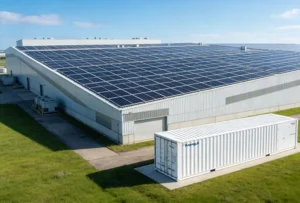
A containerized battery energy storage system for commercial use is designed for massive scale. These units are typically deployed in 20ft or 40ft ISO containers and are the preferred choice for commercial battery storage system suppliers and solutions targeting utility-side or large-scale renewable integration.
Integrated Battery Storage Cabinets
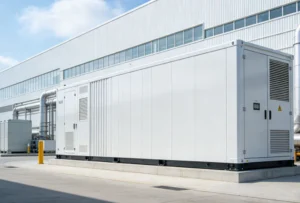
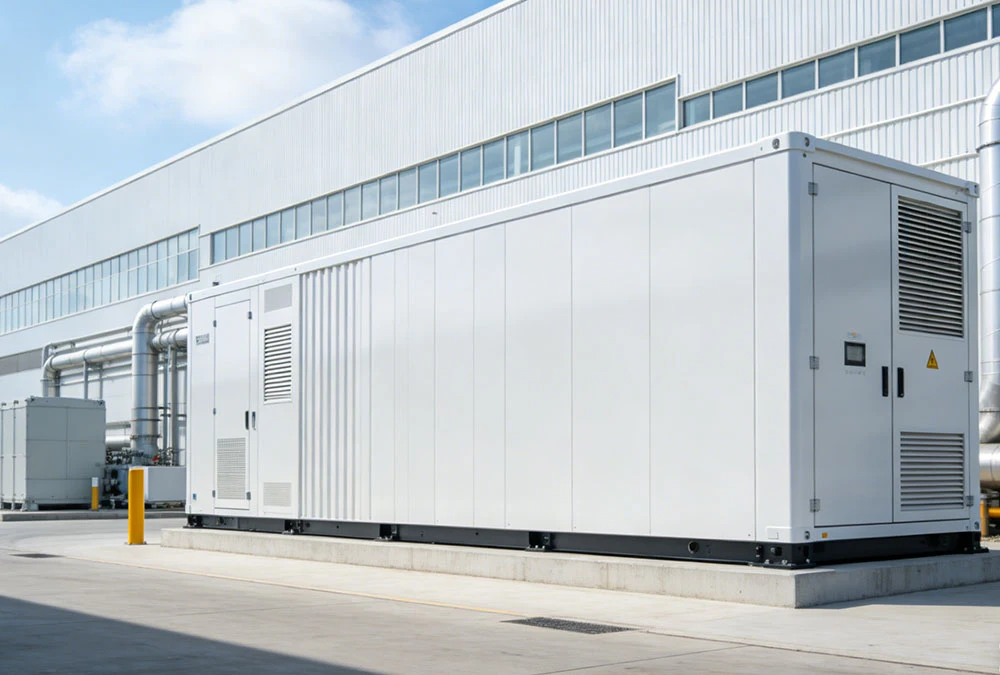
The commercial energy storage cabinet is the modern standard for urban or space-constrained industrial sites. These all-in-one units integrate the PCS, Battery, BMS, and Thermal Management into a single footprint, offering a much higher energy density than older air-cooled systems.
Comparison of Commercial Battery Storage Systems (BESS Comparison Guide)
In the 2026 market, engineering superiority is defined by thermal management and intelligence.
Liquid Cooling vs. Air Cooling
Traditional air-cooled systems suffer from uneven temperature distribution, which shortens battery life. Modern integrated battery storage cabinets utilize liquid cooling. This ensures a temperature differential of less than 2°C across all cells, which, as noted in McKinsey’s “Battery 2035” report, is the single most important factor in extending a BESS’s cycle life to 15+ years.
On-grid vs. Off-grid vs. Microgrid
- On-grid: Primarily for cost saving and peak shaving.
- Off-grid: For remote base stations or emergency medical facilities.
- Microgrid: For industrial parks that want to operate independently from the main grid during emergencies, often combining solar, wind, and storage.
Anengji 261kWh Liquid-Cooled BESS: The New Industry Standard
For enterprises looking for the best C&I battery storage system suppliers, the Anengji 261kWh All in one system represents the pinnacle of current energy storage engineering. This unit is a next-generation, fully integrated solution designed specifically for the rigorous demands of the energy transition.
Smart Fully Liquid-Cooling for High Power Density
The Anengji 261kWh system utilizes an advanced liquid cooling technology that delivers over 20% higher power density and up to 30% lower energy consumption compared to traditional air-cooling solutions. By maintaining a less than 2°C temperature differential between cells and IGBT modules, the system ensures uniform thermal management. This engineering precision extends component lifespan while maintaining optimal stability even in harsh environments up to 50°C or at altitudes of 4,000 meters. With a peak round-trip efficiency reaching 90.3%, it enables reliable performance with minimal conversion losses.
Cloud-Edge Collaboration and Smart Management
Our intelligent control system features edge-based EMS decision-making, allowing for a rapid fault response of less than 100ms. This ensures a site availability of over 99%. Simultaneously, the system integrates with the cloud for centralized monitoring, batch strategy deployment, and real-time fault detection. This “Cloud-Edge” synergy allows for predictive maintenance, significantly reducing O&M (Operation & Maintenance) costs over the system’s life.
Comprehensive Safety and Ultimate Protection
Safety is the non-negotiable pillar of Anengji’s engineering. The 261kWh system adopts a robust 3-level, 6-type safety functionality. This includes early warning sensors, PACK-level and cabin-level fire suppression, interlocked ventilation, and explosion relief. Every unit is supported by cloud-edge intelligence that can preemptively isolate a single pack before a thermal event can escalate, minimizing risk to the surrounding industrial facility.
Integrated Design for Simplified O&M
The system is fully integrated, featuring modular components and quick-disconnect terminals. This design supports rapid, zero-leakage maintenance, reducing O&M time by 60%. For businesses with growing needs, the system supports parallel scaling of up to 16 units for on-grid operation and 8 units for off-grid applications. This allows capacity expansion from 125kW to a maximum of 2MW, while saving 35% of the installation footprint.
ROI of Commercial and Industrial Battery Storage Systems (Cost & Payback Analysis)
When calculating the commercial and industrial battery storage system cost and ROI, businesses must consider the “Revenue Stacking” capability of the asset.
Key Factors Affecting ROI in 2026
- Demand Charge Savings: Often the largest contributor, especially in high-tariff regions.
- Grid Service Revenue: In many jurisdictions, businesses can now get paid by the grid to provide “Frequency Regulation” services.
- Solar Self-Consumption: Storing excess midday solar to avoid purchasing expensive evening grid power.
Typical Payback Period
According to McKinsey’s insights on “Powering the Future,” the reduction in LFP cell costs combined with rising grid tariffs has brought the typical payback period for a C&I BESS down to 3–6 years. When you consider that the Anengji system is certified for IP55 and C5 anti-corrosion with a 15+ year durability, the “Profit Window” (years of free energy after the system is paid off) is nearly a decade long.
Data Comparison: Air-Cooled vs. Liquid-Cooled ROI
| Metric | Traditional Air-Cooled BESS | Anengji Liquid-Cooled BESS |
| System Lifespan | 8 – 10 Years | 15+ Years |
| Round-Trip Efficiency | 85% – 87% | 90.3% |
| Maintenance Cost | High (Filter changes, fans) | Low (Modular, 60% faster) |
| Energy Density | Standard | 20% Higher |
| Typical ROI Window | 6 – 8 Years | 3 – 5 Years |
How to Choose the Right Commercial Battery Storage System
- Assess Your Load Profile: Use a power analyzer to map your 15-minute interval usage for at least 12 months. This determines the required kWh capacity.
- Evaluate Environmental Conditions: If your factory is in a high-temperature zone or a coastal area with high salinity, you must prioritize C5 anti-corrosion and liquid-cooled systems.
- Verify Safety Certifications: Never accept a system that does not meet UL9540A or IEC 62933 standards. The safety of your facility and employees depends on the quality of the BMS and fire suppression systems.
- Look for Scalability: Your energy needs in 2026 may be different in 2030. Choose modular units like the Anengji 261kWh cabinet that can be added in parallel as your business expands.
Future Trends of Commercial and Industrial Battery Storage Systems
AI-Driven Energy Arbitrage
By late 2026, EMS software will use machine learning to predict utility price spikes before they happen, charging the battery proactively during low-cost lulls in production.
Integration with Virtual Power Plants (VPP)
Distributed energy storage is moving toward a “Community Energy” model. Factories will be able to trade excess stored energy with neighboring facilities through local VPP platforms, creating a secondary revenue stream.
Long-Duration Energy Storage (LDES)
While 2-hour and 4-hour systems are the current standard, we are seeing a trend toward 8-hour storage solutions for manufacturing plants looking for 100% renewable energy autonomy.
Conclusion: Why C&I Battery Storage Systems Are Essential for Businesses
The conclusion drawn from the latest McKinsey reports and 2026 industry data is clear: the energy market is no longer a stable utility; it is a variable that must be managed. A commercial and industrial battery storage system provides the physical and digital tools necessary to master that variable. By investing in high-efficiency, liquid-cooled technology like the Anengji 261kWh system, businesses can realize a compelling commercial and industrial battery storage system cost and ROI, securing their operational future while contributing to a decarbonized global economy. The transition is not just about environmental responsibility—it is about building a more profitable, resilient, and independent enterprise.
FAQ – Commercial and Industrial Battery Storage Systems
What is a commercial and industrial battery storage system?
A C&I BESS is a large-scale energy storage solution that allows businesses to store electricity for use during peak times, outages, or to integrate with renewable energy sources like solar.
How do battery storage systems reduce electricity costs?
They reduce costs by peak shaving (lowering demand charges), energy arbitrage (using low-cost energy during high-price periods), and providing backup power to prevent production losses.
What are the main components of a C&I BESS system?
The system consists of the Battery Packs (typically LFP), the Power Conversion System (PCS), the Battery Management System (BMS), and the Energy Management System (EMS).
What is the difference between containerized and cabinet energy storage systems?
Containerized systems are for MW-level utility use, while integrated battery storage cabinets are compact, modular solutions ideal for factories and commercial buildings with limited space.
What is the typical ROI of a C&I battery storage system?
With current technology and electricity prices in 2026, most systems see a full return on investment within 3 to 6 years, depending on local utility tariffs and government incentives.