Introduction
The global transition toward electric mobility has transformed the “refueling” landscape from traditional gas stations to sophisticated Charging Pile vs Charging Station infrastructures. For business owners, fleet managers, and developers, understanding the technical and operational distinctions between these two is critical for a successful investment. A charging pile generally refers to a single-unit piece of equipment, while a charging station represents a holistic system integrating power distribution, management software, and often, energy storage. In this comprehensive guide, we will analyze the technical architecture, cost structures, and ROI models to help you determine the best solution for your specific EV charging needs.
What Is a Charging Pile? (EV Charging Pile Explained)
Definition of Charging Pile in EV Infrastructure
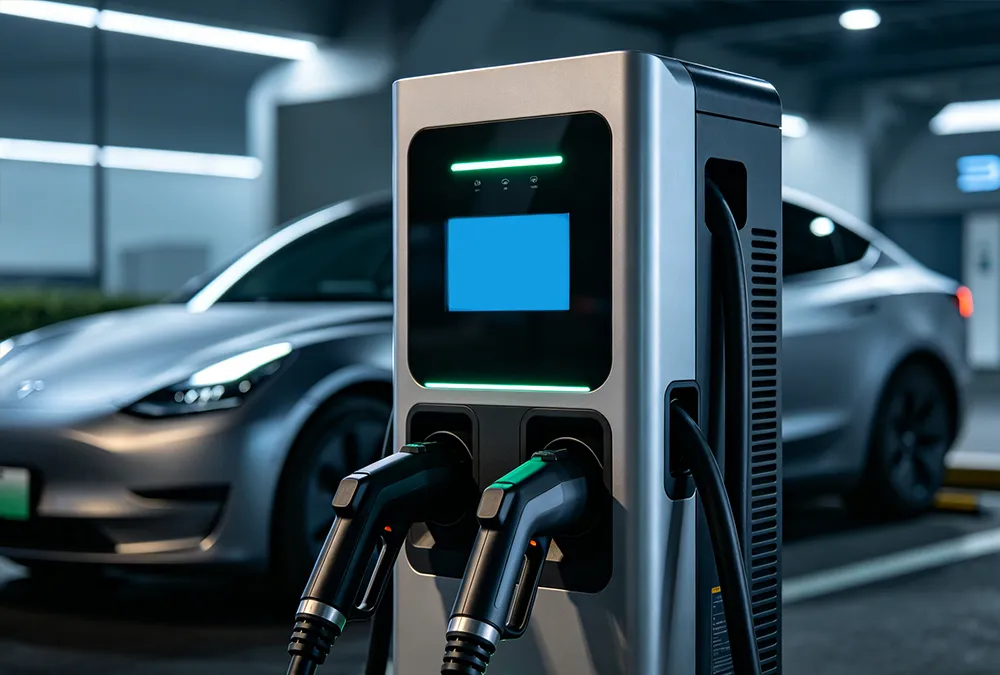
In the technical lexicon of EV charger infrastructure, a charging pile is a standalone piece of hardware that delivers electrical energy to an electric vehicle.
- Single Unit Definition: It is an endpoint device, similar in concept to a traditional fuel pump, but designed for electrical transfer.
- English Synonyms: You will often see it referred to as an EV Charger, Charging Point, or EVSE (Electric Vehicle Supply Equipment).
Main Components of a Charging Pile
As an OCPP charging pile supplier, we categorize the internal architecture into three primary systems:
- Charging Module (AC/DC): The heart of the unit. In AC piles, this is primarily a control and safety relay. In DC piles, this is a sophisticated power converter that transforms Grid AC into high-voltage DC.
- Communication System (OCPP): Most modern commercial units utilize OCPP (Open Charge Point Protocol) version 1.6J or 2.0.1. This allows the hardware to communicate with cloud-based management platforms.
- Control System: This manages the HMI (Human Machine Interface), RFID card reading, billing logic, and safety sensors (temperature, leakage, and overcurrent).
Types of Charging Piles (AC vs DC Charging Pile)
The power output defines the utility of the pile:
- AC Charging Pile (Slow Charging): Typically ranges from 3.7kW to 22kW. These are best suited for long-stay parking where the vehicle’s onboard charger handles the AC-to-DC conversion.
- DC Fast Charging Pile (Level 3): Ranging from 30kW to 600kW. A DC fast charger bypasses the onboard charger, delivering power directly to the battery, which is essential for highway and commercial fleet applications.
What Is a Charging Station? (EV Charging Station System)
Charging Station Definition and System Architecture
Unlike a standalone pile, an EV charging station is a comprehensive system-level concept. It is a dedicated facility or “hub” that houses multiple charging units and the necessary electrical infrastructure to support them simultaneously.
Key Components of a Charging Station
To ensure stability and profitability, a professional charging station includes:
- Power Distribution System: Transformers and switchgears that step down medium voltage from the grid to usable levels.
- EMS (Energy Management System): A digital brain that monitors real-time load and prevents the station from exceeding its power capacity.
- BESS (Battery Energy Storage System): Increasingly, a commercial EV charging station solution with storage is used to mitigate high peak-demand charges.
Commercial vs Public Charging Station Use Cases
- Commercial Operations: These are private or semi-private stations (e.g., workplace charging, logistics hubs) focused on smart charging system efficiency.
- Public Infrastructure: Located at malls or rest areas, these focus on high turnover and user convenience via diverse payment gateways.
Charging Pile vs Charging Station: What’s the Difference?
Quick Answer (Featured Snippet Ready)
The primary difference between a charging pile vs charging station lies in scale and complexity. A charging pile is a single EV charger device used for individual vehicle charging. In contrast, a charging station is a complete system that includes multiple charging piles, advanced power distribution infrastructure, and integrated energy management systems (EMS).
Detailed Comparison Table
To provide a clear technical overview, the following table compares the two based on 2025 industry standards:
| Feature | Charging Pile | Charging Station |
| Type | Individual Equipment | Integrated System |
| Scale | Single unit (AC or DC) | Multi-unit (Clustered) |
| Includes EMS | No (Simple control only) | Yes (Active load balancing) |
| Includes Storage | No | Optional (BESS integration) |
| Grid Impact | Low to Moderate | High (Requires substation) |
| Primary Use Case | Home / Small Business | Commercial / Utility / Fleet |
Which One Should You Choose?
- Home vs. Small Office: If you are looking for a home charging pile, a single AC unit is sufficient.
- Investment vs. Public Utility: If you are an investor looking for high DC fast charging pile price 120kW returns, building a full charging station is the professional path to scalability.
Charging Pile Types and Power Levels (AC vs DC Fast Charging)
AC Charging Pile (Level 1 & Level 2)
In the electric vehicle charging network, AC piles are the “marathon runners.”
- Level 1: Uses standard residential outlets (1.4kW). Rare in commercial settings.
- Level 2: The standard for AC charging station setups in offices and apartments (7kW–22kW).
DC Fast Charging Pile (Level 3)
DC technology is the “sprinter.” High-power modules allow a vehicle to reach 80% charge in under 30 minutes. As a leading EV charging pile manufacturer China, we are seeing a massive shift toward 120kW and 180kW dual-gun units for highway rest stops.
How to Choose the Right Charging Power
Choosing power depends on “Dwell Time”:
- 7kW: For 8+ hours (Residential).
- 60kW – 120kW: For 1–2 hours (Malls, Supermarkets).
- 350kW – 600kW: For 10–20 minutes (Expressway “Gas Station” style).
Smart Charging Station with Energy Storage (BESS + EMS)
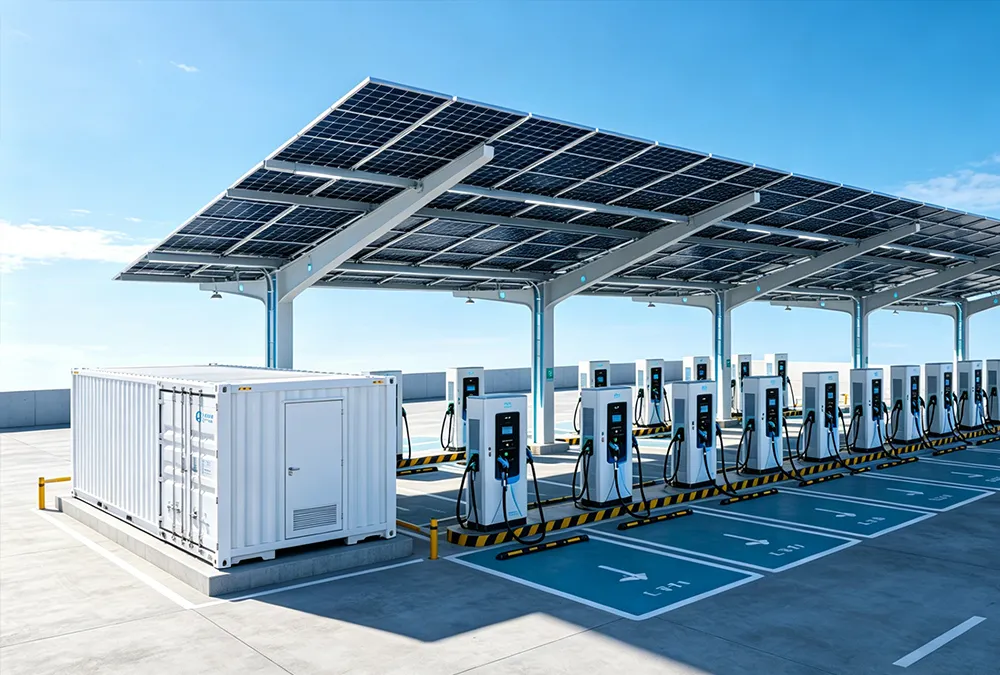
Modern grid constraints have made the integrated solar storage charging station system the “Gold Standard” for 2025-2030.
Why Add Battery Energy Storage System (BESS)?
Integrating a battery energy storage system (BESS) solves the “Demand Charge” problem.
- Peak Shaving: Discharge the battery during peak hours when electricity prices are highest.
- Load Leveling: Charging the battery during off-peak hours (nighttime).
Role of PCS, BMS, and EMS in Charging Stations
To understand a commercial EV charging station solution with storage, we must define the tech:
- PCS (Power Conversion System): A bi-directional inverter that converts AC from the grid to DC for the battery, and vice versa.
- BMS (Battery Management System): Monitors cell voltage, temperature, and SOC (State of Charge) to ensure safety.
- EMS (Energy Management System): The high-level software that decides when to charge the battery and how much power to give each charging pile.
Solar + Storage + Charging Integration
This “Triple Play” allows stations to run partially off-grid. By using solar PV canopies, operators can significantly reduce their Carbon Footprint and Operational Expenditure (OPEX).
Charging Pile Cost vs Charging Station Investment
Charging Pile Price Breakdown
The EV charging pile price varies significantly:
- Residential AC (7kW): $300 – $800.
- Commercial AC (22kW): $1,000 – $2,500.
- DC Fast Charger (120kW): $12,000 – $25,000 (depending on module quality and certifications).
Charging Station Setup Cost
A full station investment involves:
- Civil Works: Trenching, cabling, and parking lot modification (30% of cost).
- Electrical Upgrades: Transformers and grid connection fees (25% of cost).
- Hardware: The actual DC and AC piles (40% of cost).
- Software: SaaS platform fees (5% of cost).
ROI of Commercial EV Charging Stations
To calculate the return on investment, use this simplified formula:
Annual Profit = (Total kWh Sold * (Selling Price per kWh - Purchase Price per kWh)) - Annual OPEX
ROI (Years) = Total Investment / Annual Profit
Example: A 120kW station in a high-traffic area can often achieve ROI within 2.5 to 4 years.
Common Problems with Charging Piles (And Solutions)
Grid Capacity Limitations
Problem: The local grid cannot support five 120kW chargers running at once.
Solution: Implement a smart energy management system (EMS) for dynamic load balancing or install a BESS to buffer the load.
Slow Charging Speed
Problem: Users complain that a “fast charger” is slow.
Solution: This is often due to “Power Sharing.” Upgrade to liquid-cooled cables or higher-power modules (300kW+) to maintain high speeds even when multiple cars are plugged in.
Poor Utilization Rate
Problem: The station is empty most of the day.
Solution: Use data-driven site selection and integrate your station with roaming platforms (Hubject, GIREVE) to increase visibility.
How to Choose a Reliable Charging Pile Supplier
Key Certifications (CE, UL, OCPP)
When vetting an EV charging pile manufacturer China, ensure they hold:
- CE (LVD/EMC): For the European market.
- UL/ETL: Mandatory for North America.
- OCPP 1.6J/2.0.1 Certification: Ensures the hardware isn’t “locked” to one software provider.
Customization Capability
A top-tier EV charging solution provider should offer white-labeling (branding), custom cable lengths, and hardware modifications for local grid codes.
After-Sales and Platform Support
Hardware is only half the battle. Ensure your supplier provides a 24/7 cloud management platform and a clear warranty for power modules.
FAQs About Charging Pile and Charging Station
What is the difference between charging pile and charging station?
A charging pile is the physical unit (the “pump”), whereas a charging station is the entire location or facility (the “gas station”) encompassing multiple units and energy management tech.
How much does a charging pile cost?
Prices range from $300 for basic home AC units to over $50,000 for ultra-fast 350kW DC chargers. The DC fast charging pile price 120kW usually settles between $12,000 and $18,000 for high-quality industrial grade.
Can a charging station work without energy storage?
Yes, most do. However, as EV adoption grows, stations without storage face higher utility “peak demand” fees, making the ROI slower compared to stations with BESS.
Is DC charging better than AC charging?
“Better” depends on the use case. DC is better for commercial profitability and “on-the-go” charging. AC is better for battery longevity and cost-effective home/overnight charging.
Conclusion: Charging Pile vs Charging Station — Which Is Right for You?
Choosing between a charging pile vs charging station depends on your business scale.
- For Home or Small Offices: A single home charging pile (AC) is the most cost-effective entry point.
- For Commercial Operators: Building a multi-unit charging station with an integrated smart charging system is the only way to achieve professional-grade service.
- For High-Profit Models: We strongly recommend an integrated solar storage charging station system. By decoupling from the grid during peak hours, you maximize your margins.
Final Insight: If you’re planning to enter the EV charging business, don’t just sell charging piles—build smart charging stations with energy storage for maximum ROI. The future of energy is distributed, and those who own the infrastructure will lead the market in 2026 and beyond.
Technical Deep Dive: Battery Tech in BESS
For those choosing a commercial EV charging station solution with storage, understanding the battery chemistry is vital:
- LFP (Lithium Iron Phosphate): The industry standard for stationary storage due to its 6,000+ cycle life and high thermal stability.
- NMC (Nickel Manganese Cobalt): Higher energy density but lower cycle life and higher cost; generally less preferred for stationary charging hubs unless space is extremely limited.
- Alternative: Flow Batteries (Vanadium): An emerging technology for ultra-large scale stations, offering near-infinite cycle life but requiring a larger physical footprint.
Recommendation for Industrial Use
For industrial-grade applications, we recommend Liquid-Cooled Energy Storage Systems. Liquid cooling maintains a temperature delta of <3°C between cells, extending the life of your investment by up to 20% compared to traditional air-cooled systems.