Introduction
In the rapidly evolving energy landscape of 2026, the transition toward decentralized power and grid independence has turned energy storage from a luxury into a strategic necessity. For commercial and industrial (C&I) enterprises, the accuracy of a BESS sizing calculation is the most critical factor in determining the financial viability and operational success of an energy project. Whether you are integrating renewables to meet ESG goals or deploying high-power EV charging infrastructure, the engineering precision behind sizing determines your long-term ROI. A poorly sized system—whether oversized, leading to wasted CAPEX, or undersized, failing to meet peak demand—can turn a promising energy asset into a liability. This comprehensive guide provides the technical framework, formulas, and industry insights required to master battery energy storage system design for modern industrial applications.
What is BESS Sizing Calculation (Battery Energy Storage System Sizing Basics)
Definition of BESS Sizing
BESS sizing is the engineering process of determining the optimal power rating (measured in kilowatts, kW) and energy capacity (measured in kilowatt-hours, kWh) for a battery storage system. It is not a “one-size-fits-all” calculation; rather, it is a bespoke design process that aligns the electrochemical capabilities of the battery with the specific electrical demand of a facility.
Why Accurate BESS Sizing is Critical
- Avoid Oversizing: Excess capacity leads to unnecessary upfront costs, longer payback periods, and increased space requirements.
- Avoid Undersizing: A system that cannot handle peak loads or provide sufficient backup time will fail to deliver the expected demand charge savings or operational resilience.
- System Longevity: Correct sizing ensures the battery operates within its optimal State of Charge (SoC) window, preventing accelerated degradation.
Key Parameters in Energy Storage System Sizing
When performing a BESS sizing calculation, engineers focus on three pillars:
- Load Demand: The instantaneous power required by the facility.
- Peak Power: The maximum spike in demand that the BESS must “shave.”
- Energy Consumption: The total amount of energy needed to be shifted or stored over a specific duration.
Key Factors in BESS Sizing Calculation (Energy Storage Capacity & Power Design)
Load Profile Analysis (Daily and Peak Load)
The foundation of any energy storage capacity calculation is the Load Profile. This involves analyzing 15-minute interval meter data over a 12-month period. In 2026, advanced EMS tools allow us to identify seasonal variations and “spiky” loads that are invisible in monthly utility bills.
Power Requirement (kW) vs. Energy Capacity (kWh)
Understanding the “C-rate” is essential. A 100kW/200kWh system is a 0.5C system (2-hour duration), whereas a 100kW/100kWh system is a 1C system (1-hour duration). The power (kW) determines if you can meet the peak, while capacity (kWh) determines how long you can sustain that power.
Depth of Discharge (DoD) and Battery Efficiency
You can never use 100% of a battery’s nameplate capacity without damaging it. Most Lithium Iron Phosphate (LFP) systems are sized based on an 80% to 90% DoD. Furthermore, Round-Trip Efficiency (RTE)—the energy lost during the AC-DC-AC conversion—must be factored in (typically 85-90%).
Backup Time and Application Requirements
If the primary goal is an industrial power backup system, sizing is dictated by the “Critical Load” and the required “Autonomy Time” (e.g., 4 hours of operation during a grid outage).
BESS Sizing Calculation Formula (kWh and kW Calculation Method)
To perform a professional battery storage sizing calculation for peak shaving or backup, we use the following engineering steps:
Basic Battery Capacity Calculation Formula
The raw energy requirement is calculated as:
Adjusted Formula with DoD and Efficiency
To find the actual “Nameplate Capacity” () required, we must account for the Depth of Discharge (DoD) and System Efficiency ( ):
Example: If you need to support a 100kW load for 2 hours with 90% DoD and 90% efficiency:
Power (kW) Sizing for PCS Selection
The PCS inverter for battery storage must be sized to handle the maximum peak load plus a safety margin (typically 10-20%). If your peak shaving target is to reduce demand from 500kW to 300kW, your PCS must have a continuous output of at least 200kW.
Step-by-Step BESS Sizing Example: Industrial Factory
- Objective: Reduce demand charges by 150kW.
- Duration of Peak: The peak lasts for 3 hours every afternoon.
- Calculation: (Usable).
- Final Sizing: Adjusting for DoD (90%) and Efficiency (90%), the required nameplate capacity is roughly 555kWh.
BESS Sizing Calculation for Different Applications
BESS Sizing for Peak Shaving Applications
In peak shaving battery storage system design, the goal is to cut the “top” off the load curve. Sizing is highly sensitive to the width of the peak. A narrow, high peak requires high power (kW) but low energy (kWh), whereas a broad peak (common in manufacturing) requires high energy capacity.
BESS Sizing for Solar + Storage Systems (PV + BESS)
When performing BESS sizing for solar plus storage systems, the battery is sized based on the “Over-generation.”
- Formula: .
- The goal is to store excess solar energy to avoid selling it back to the grid at low feed-in tariffs.
BESS Sizing for EV Charging Stations
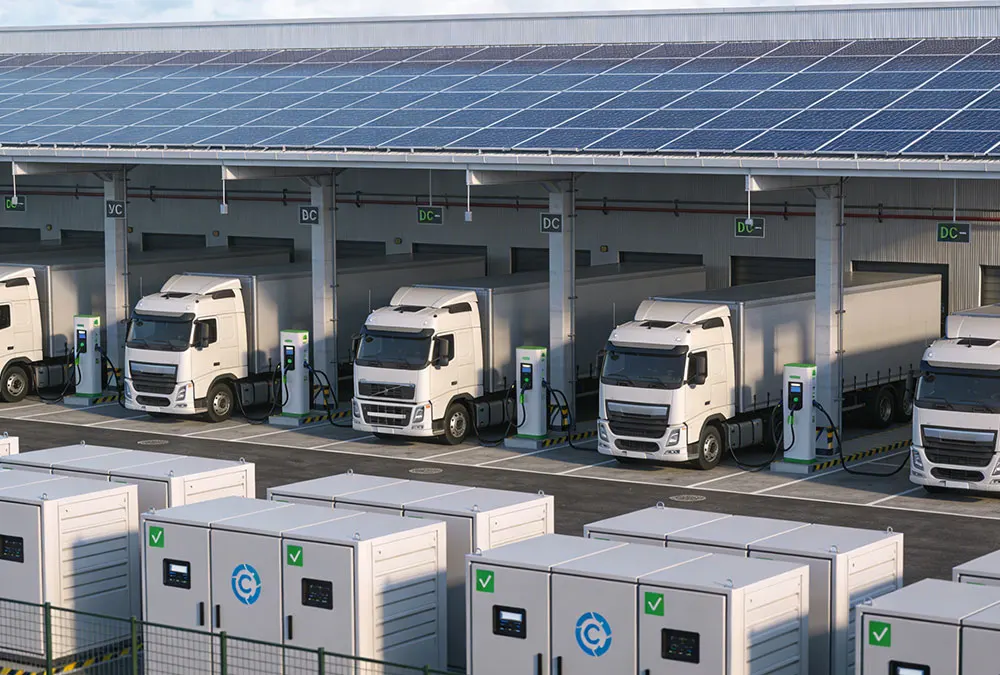
A BESS sizing calculator for EV charging stations must account for the “Coincidence Factor.” If four 120kW chargers are used simultaneously, the grid impact is 480kW. Sizing a BESS to provide 200kW of that load significantly reduces demand charges and infrastructure upgrade costs.
Common Mistakes in BESS Sizing Calculation
Oversizing the Battery System
Many developers include excessive “safety buffers,” leading to a BESS sizing for commercial applications that is 30% larger than necessary. This kills the ROI, as the extra capacity is never utilized but still incurs maintenance costs.
Ignoring Load Variability
Sizing based on “Average Load” is a fatal error. Industrial loads are dynamic. A factory’s demand might be 200kW on average but spike to 800kW when a large compressor starts. Your BESS must be sized for the spikes, not the averages.
Incorrect PCS Power Matching
If the battery capacity (kWh) is high but the PCS (kW) is too small, you cannot release the energy fast enough to shave the peak. This is known as being “power-limited.”
How to Optimize BESS Sizing for ROI
Balancing Cost vs. Performance
The energy storage system cost analysis in 2026 shows that the last 10% of peak shaving is often the most expensive. It is often more profitable to size a system to shave 80% of the peaks rather than 100%.
Using EMS for Smart Energy Dispatch
Sizing is not static. A smart energy management system can use AI to predict peaks. If the system knows a peak is coming, it can manage the SoC more aggressively, allowing for a smaller physical battery size to achieve the same financial result.
Payback Period and ROI Analysis
According to recent McKinsey reports on “Powering the Future,” the average payback for a correctly sized C&I BESS is now 3 to 5 years. Accuracy in how to calculate battery energy storage system capacity directly correlates to the speed of this payback.
Tools and Methods for BESS Sizing Calculation
Manual Calculation vs. Software Tools
While the battery storage sizing formula provided above works for basic estimates, professional engineers use simulation software (like HOMER Pro or PVSyst) to run “Monte Carlo” simulations, testing the BESS against thousands of weather and load scenarios.
Digital Twins and AI-Based EMS Optimization
In 2026, we utilize “Digital Twins.” Before a single battery is installed, we create a virtual model of the facility and run the proposed BESS design calculation method against real-time grid prices and load data to guarantee performance.

How to Choose the Right BESS Size for Your Business
- Define Your Application Scenario: Is it for peak shaving, solar storage, or backup?
- Analyze Energy Consumption Patterns: Obtain at least one year of 15-minute interval data.
- Select Battery and PCS Configuration: Choose modular systems that allow for future expansion.
- Work with Experienced Providers: Sizing is a mix of chemistry, electrical engineering, and financial modeling.
Anengji BESS Solutions with Optimized Sizing
As a global leader in energy infrastructure, Anengji provides a commercial energy storage sizing guide backed by decades of engineering expertise. Our solutions are designed to eliminate the guesswork in BESS deployment.
Customized BESS Sizing and Design Services
We don’t just sell hardware; we provide BESS sizing for solar plus storage systems tailored to your specific facility. Using our proprietary sizing tools, we analyze your load profile to recommend the exact kW/kWh configuration that maximizes your NPV (Net Present Value).
Advanced EMS for Intelligent Sizing Optimization
The Anengji 261kWh liquid-cooled system features an integrated energy storage system with EMS that uses cloud-edge collaboration. By optimizing the discharge depth and timing in real-time, our system often allows users to achieve their energy goals with a smaller, more efficient footprint.
Typical Project Example: Logistics Center
- Problem: High demand charges from EV delivery van charging.
- Analysis: 400kW peaks during evening charging windows.
- Anengji Solution: Optimized 200kW/400kWh BESS sizing.
- Result: 45% reduction in monthly utility bills and a 3.8-year ROI.
Future Trends in BESS Sizing Calculation
AI-Based Load Forecasting
By late 2026, BESS sizing calculation will be largely automated. AI will analyze a facility’s “digital footprint” to predict future growth and automatically suggest modular battery expansions before the load exceeds capacity.
Integration with Smart Grids
Future sizing will account for “Grid Services” (Frequency Regulation). Systems will be sized slightly larger to allow businesses to sell excess capacity back to the grid, creating a secondary revenue stream.
Conclusion: How to Accurately Perform BESS Sizing Calculation
Accurate BESS sizing calculation is the cornerstone of the modern industrial energy strategy. In an era of high demand charges and grid instability, the ability to precisely match storage capacity with load requirements is a competitive advantage. By following a rigorous engineering approach—analyzing load profiles, accounting for DoD and efficiency, and selecting high-performance components like those from Anengji—businesses can ensure maximum efficiency and the fastest possible ROI. Remember, the goal is not to buy the biggest battery, but the right battery for your specific energy signature.
FAQ – BESS Sizing Calculation
How do you calculate BESS size?
BESS size is calculated by identifying the required power (kW) to cover your peak load and the energy capacity (kWh) required for the duration of that load. Use the formula: .
What is the difference between kW and kWh in BESS sizing?
kW (Power) is the rate at which electricity is used or delivered (instantaneous). kWh (Energy) is the total amount of electricity used or stored over a period of time.
What factors affect battery storage sizing?
The primary factors include the facility’s load profile, peak demand spikes, desired backup duration, battery chemistry (e.g., LFP), and the Depth of Discharge (DoD).
How do you size a battery for solar energy storage?
Calculate the total excess solar energy (kWh) generated during the day that is not consumed by the load. The battery should be sized to capture this excess for use during the night or peak hours.
What happens if a BESS system is oversized or undersized?
Oversizing leads to a poor ROI due to high CAPEX for unused capacity. Undersizing results in “peak leakage,” where the system fails to reduce demand charges effectively, and can lead to battery over-stressing.