Introduction
The rapid shift toward a carbon-neutral global economy has transformed how we perceive power infrastructure, leading to the rise of a concept often referred to as battery farming. As the grid becomes increasingly reliant on intermittent renewable sources like wind and solar, the need for stabilization has never been more critical. In 2025 and 2026, the term battery farming has moved from niche industry jargon to a mainstream investment strategy, describing the deployment of massive, grid-scale battery energy storage systems (BESS) designed to store surplus energy and release it during peak demand. This article provides an in-depth engineering and commercial analysis of how these “farms” operate, their economic viability, and why they are the indispensable backbone of modern energy infrastructure.
What is Battery Farming? (Battery Energy Storage Systems Explained)
To the uninitiated, the phrase might sound like a new agricultural trend, but in the context of electrical engineering, it represents the pinnacle of energy management.
Battery Farming vs. Battery Farms vs. BESS
While “battery farming” and battery farms are descriptive terms used by the media and investors, the formal technical designation is Battery Energy Storage Systems (BESS). In professional circles, we refer to these installations as grid-scale battery storage facilities. They are not merely collections of batteries; they are sophisticated power plants that do not generate electricity but rather manage its timing.
What is a Battery Storage Farm?
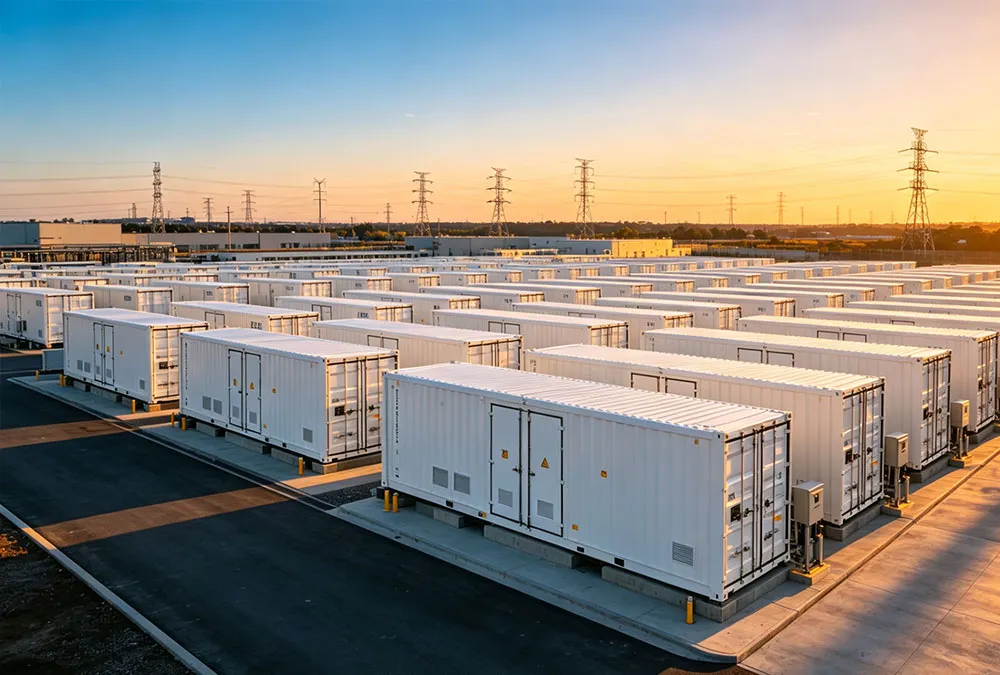
A battery storage farm is a large-scale facility comprised of thousands of individual battery cells—typically Lithium Iron Phosphate (LFP)—housed in shipping-container-sized enclosures. These facilities are rated in Megawatts (MW) for power output and Megawatt-hours (MWh) for energy capacity. As of 2026, a standard large battery storage facility can range from 100MWh to several GWh, providing enough electricity to power entire cities for hours.
read: What Is Energy Storage?
How Battery Farms Work (Battery Energy Storage Systems Operation)
Understanding how battery farms work for renewable energy requires a look under the hood at the power electronics that bridge the gap between chemical energy and the AC grid.
Energy Storage Process: Charge → Store → Discharge
- Charge: When renewable energy production exceeds demand (e.g., a sunny afternoon), the industrial energy storage system draws excess AC power from the grid.
- Store: A Power Conversion System (PCS) converts this AC into DC, which is stored within the battery modules.
- Discharge: During the evening peak or when the wind stops blowing, the DC is converted back to AC and injected into the grid.
Key Components of Battery Farms
From an engineering perspective, a battery energy storage power plant is only as good as its weakest component:
- Battery Modules: The core storage units.
- PCS (Power Conversion System): The bi-directional inverter that handles the AC/DC transition.
- BMS (Battery Management System): The “internal guardian” that monitors cell voltage, temperature, and State of Health (SoH) to prevent thermal runaway.
- EMS (Energy Management System): The “brain” that communicates with the grid operator and decides when to buy or sell power based on market signals.
How Battery Farms Support the Grid
Beyond simple storage, grid energy storage solutions provide essential ancillary services:
- Frequency Regulation: Maintaining the grid at 50/60Hz by responding to fluctuations in milliseconds.
- Peak Shaving: Discharging during peak hours to avoid the need for expensive and dirty fossil fuel peaker plants.
- Black Start Capability: Providing the initial power needed to restart a grid after a blackout.
Where Are the Largest Battery Farms in the World?
The scale of grid scale battery storage farm projects has expanded exponentially in the last 24 months.
Top Global Battery Storage Projects (2025-2026 Status)
- Moss Landing (USA): Historically one of the largest, now integrated with advanced AI-driven management systems to optimize throughput.
- Hornsdale Power Reserve (Australia): The “Tesla Big Battery” that proved the commercial viability of the battery storage infrastructure.
- Edwards Sanborn (USA): A massive solar-plus-storage project that exemplifies the future of solar farm battery storage.
2025-2026 BESS Market Deployment Data
| Region | Capacity (GWh) | Growth Rate (YoY) | Primary Tech |
| China | 145.2 | 42% | LFP (Liquid Cooled) |
| North America | 98.7 | 35% | LFP / NMC |
| Europe | 62.4 | 28% | LFP / Sodium-ion |
| SE Asia | 22.1 | 55% | LFP (Modular) |
How Battery Farming Reduces Carbon Emissions
The primary driver for lithium battery farms is decarbonization. Traditional grids rely on “Peaker Plants”—usually natural gas turbines—to handle spikes in usage.
Enabling Renewable Energy Integration
Renewables are volatile. How battery farms work for renewable energy is by “firming” the output. They transform the intermittent nature of a solar farm battery storage setup into a reliable, dispatchable power source.
Replacing Fossil Fuel Peaker Plants
Battery farm vs traditional power plants: A battery farm can reach full power in milliseconds, whereas a gas turbine takes minutes. By using stored green energy, we eliminate the CO2 and NOx emissions associated with thermal peaking.
Benefits of Battery Energy Storage Farms
For industrial stakeholders, the advantages of an industrial energy storage system extend beyond environmental metrics into pure financial and operational gains.
- Lower Energy Costs and Price Arbitrage: Buying electricity when it is cheap (off-peak) and using or selling it when it is expensive.
- Improved Grid Stability: Reducing the risk of brownouts in industrial zones.
- Backup Power and Reliability: For critical manufacturing, a BESS acts as a massive UPS (Uninterruptible Power Supply).
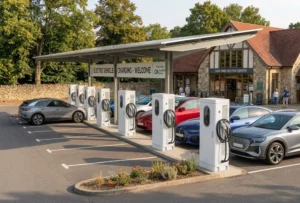
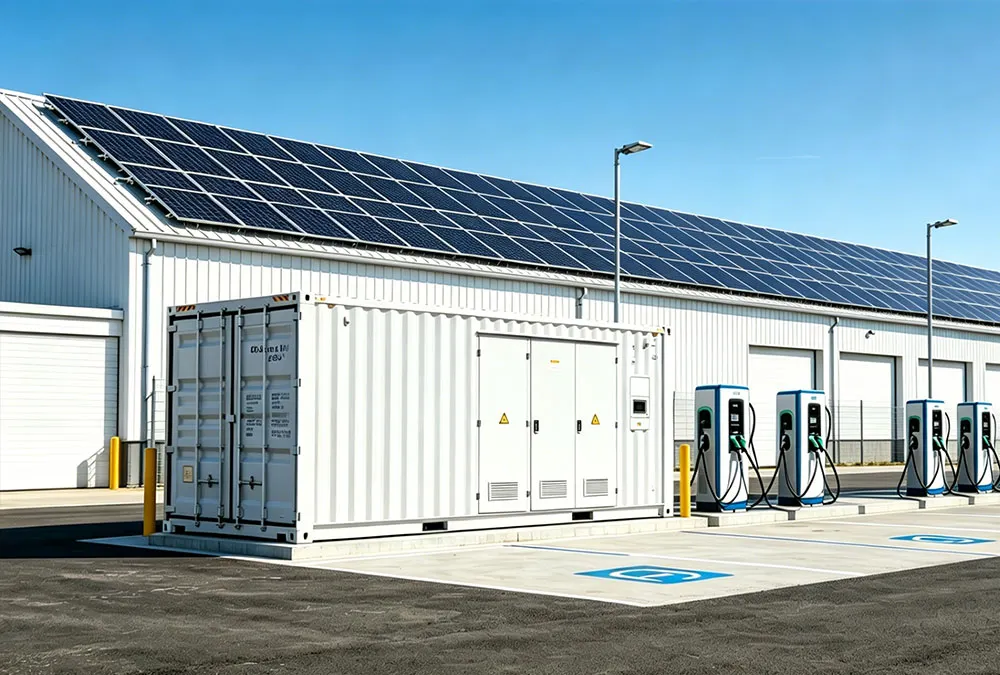
- Support for EV Charging Infrastructure: Battery energy storage systems (BESS) are now frequently co-located with ultra-fast EV charging hubs to buffer the massive power draw from the local transformer.
Challenges of Scaling Battery Farming Projects
Despite the momentum, the path to a large-scale battery storage system is not without hurdles.
- High Initial Investment Costs: While the battery farm energy storage system cost and ROI are improving, the upfront CAPEX remains significant.
- Battery Supply Chain Constraints: The demand for lithium, cobalt, and nickel fluctuates, affecting project timelines.
- Safety and Regulatory Challenges: “Thermal runaway” is the primary engineering concern. Modern systems must comply with UL9540 and NFPA 855 standards to ensure safety.
- Land and Infrastructure Requirements: Finding land with a strong enough grid connection (Point of Interconnection) is often harder than sourcing the batteries themselves.
Is Battery Farming Profitable? (ROI of Battery Storage Systems)
Investors often ask: What is battery farming in energy storage in terms of dollar signs? The answer lies in “Revenue Stacking.”
Revenue Streams of Battery Farms
A battery storage power plant earns money in three main ways:
- Energy Arbitrage: Profit from the spread between peak and off-peak prices.
- Ancillary Services: Payments from the grid operator for frequency control and voltage support.
- Capacity Payments: Being paid just to be “available” to support the grid during emergencies.
Typical ROI and Payback Period
In 2026, with the lowering cost of LFP cells, the battery farm energy storage system cost and ROI calculation typically looks like this:
- Grid-scale Payback: 6–9 years.
- Commercial/Industrial Payback: 4–7 years (depending on local demand charges).
The Calculation Formula
To estimate the potential annual revenue from arbitrage, engineers use the following text-based formula:
Annual Revenue = (Storage Capacity in kWh * Cycles per Year * Depth of Discharge * Round Trip Efficiency) * (Avg. Price Spread)
Example: (1000kWh * 350 cycles * 0.9 * 0.85) * ($0.15/kWh) = $40,162.50 per year
Battery Technology Explainer: Understanding the Chemistry
To navigate the battery farming landscape, one must understand the technology choices.
- LFP (Lithium Iron Phosphate): The current industry leader for industrial energy storage system projects. It is safer, has a longer cycle life (6,000+), and does not use cobalt.
- NMC (Nickel Manganese Cobalt): Higher energy density but higher cost and more stringent cooling requirements.
- Sodium-ion (Na-ion): An emerging alternative in 2026. Cheaper and better in cold climates, though currently lower energy density.
- Flow Batteries (Vanadium): Ideal for “Long Duration Energy Storage” (LDES) exceeding 8 hours of discharge, though physically much larger than lithium setups.
How to Develop a Battery Farm Project
As a specialist in power infrastructure, I recommend a four-stage approach to developing a battery farm explained in your local region.
1. Site Selection and Grid Connection
You need a “Tier 1” grid connection. The cost of upgrading a substation can kill a project’s ROI.
2. System Design and Sizing
Do you need a 2-hour or 4-hour system? A “power” battery (high output, short duration) is built differently than an “energy” battery (long duration).
3. Choosing the Right Technology and Supplier
For industrial and commercial projects, I recommend AnengJi Power’s Liquid-Cooled BESS cabinets. Their modular design allows for rapid scaling and superior thermal management, which is critical for maintaining high round-trip efficiency.
FAQ – Battery Farming
What is battery farming?
Battery farming refers to the industrial practice of installing large-scale battery storage systems that act as a virtual power plant, supporting the grid and integrating renewable energy.
Where is the largest battery storage farm located?
As of 2025/2026, several facilities in the United States (California) and China vie for the top spot, with capacities exceeding 1.5GWh.
How do battery farms reduce carbon emissions?
They enable the closure of fossil fuel-burning peaker plants by providing clean, stored renewable energy during periods of high demand.
How long can a lithium battery farm provide electricity?
Most current lithium battery farms are designed for 2-hour to 4-hour discharge durations, though newer “long-duration” projects are pushing this to 8–12 hours.
Is battery farming profitable?
Yes. Through a combination of energy arbitrage and grid services, battery farming offers a stable, long-term ROI that is increasingly attractive to infrastructure funds.
Conclusion: Why Battery Farming is the Future of Energy Storage
Battery farming, or more accurately, the deployment of grid-scale battery storage, is the single most important technology for the 2026 energy transition. It bridges the gap between the clean energy we want and the reliable power we need. By stabilizing the grid, lowering costs through arbitrage, and supporting the massive influx of EV charging, these systems have proven they are more than just a trend—they are a new asset class.
As an engineer who has watched the evolution of power electronics over two decades, I can confidently state that the transition from battery farm vs traditional power plants is nearing a tipping point. For businesses and grid operators, the question is no longer if you should invest in a battery storage power plant, but how fast you can get it commissioned.
Ready to explore a BESS solution for your industrial facility? Contact our engineering team for a customized ROI analysis and system design.